


Safe regular expression use is essential for preventing catastrophic backtracking vulnerabilities and severe denial-of-service attacks across modern enterprise web architectures today. At Secure Coding Practices, expert security engineers emphasize that unconstrained pattern matching leaves production servers completely vulnerable to malicious input manipulation attempts.
Modern developers must construct robust expressions featuring strict length anchors and deterministic evaluation limits. By implementing these rigorous operational controls, engineering teams eliminate regex-based performance bottlenecks, secure backend microservices against unexpected runtime execution failures, and maintain optimal application reliability across all distributed deployment environments.
Core Principles of Secure Expression Handling
Implementing structured validation mechanisms provides critical defensive advantages for application performance and safety.
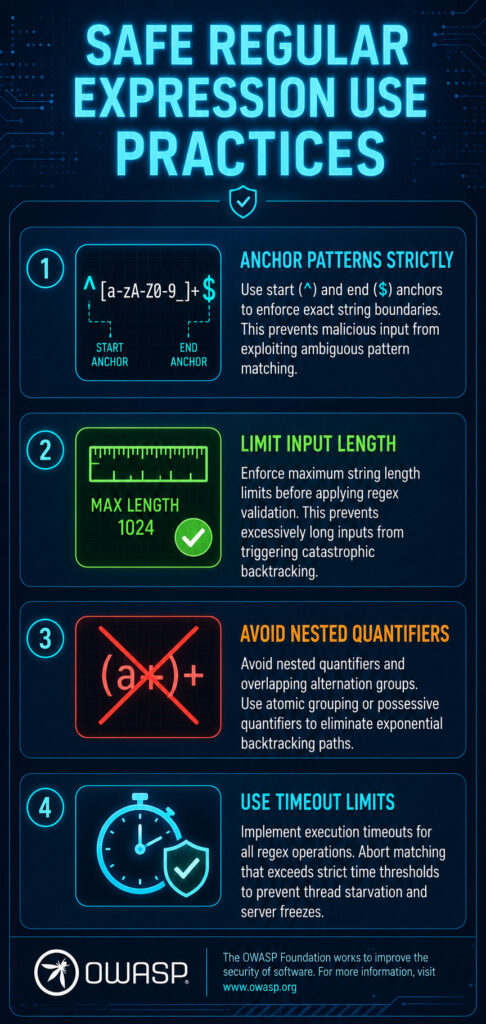
- Enforcing strict anchor boundaries immediately stops recursive backtracking loops during pattern matching execution.
- Restricting maximum input string lengths eliminates memory exhaustion risks caused by oversized payloads.
- Utilizing pre-compiled patterns prevents redundant parsing overhead across high-throughput enterprise API gateways.
How Does Safe Regular Expression Use Aid Input Validation Sanitization?
Integrating robust pattern matching controls requires comprehensive data hygiene frameworks, especially when handling unpredictable user input streams. Ensuring Safe Regular Expression Use across enterprise applications prevents attackers from exploiting poorly constructed parsing rules that trigger catastrophic resource exhaustion. By replacing unoptimized wildcard matching with deterministic boundaries, developers safeguard system uptime against malicious Regular Expression Denial of Service (ReDoS) vectors.
Exploring our detailed guide on input validation sanitization highlights how backend microservices maintain absolute boundary control. When systems enforce rigid data formatting rules alongside proactive sanitization protocols, they prevent malicious payloads from altering internal application workflows or corrupting shared runtime memory structures.
Furthermore, when developers apply rigorous checking routines alongside proper using-regex-securely-input-validation principles, they effectively neutralize complex injection vectors before data ever reaches core database layers. This unified engineering approach ensures that all incoming string parameters match strict syntactic expectations, eliminating ambiguity and securing enterprise infrastructure from advanced security breaches.
Why Is Safe Regular Expression Use Critical Against ReDoS Attacks?
Implementing strict Safe Regular Expression Use practices is essential for stopping algorithmic complexity attacks before they trigger server-wide downtime. Reviewing our technical guide on preventing regex denial of service redos provides engineering teams with tactical patterns to avoid exponential matching loops and thread starvation.
Industry security organizations emphasize the severe risks associated with unoptimized pattern matching:
“Vulnerabilities related to regular expression denial of service occur when code parses untrusted inputs against insecure regex patterns featuring ambiguous alternation or overlapping quantifiers.” – OWASP ReDoS Guide
Enforcing these architectural standards ensures that backend parsers maintain predictable execution times even under high-volume production traffic.
Which Common Patterns Undermine Safe Regular Expression Use?
Credits: r4vik
Ensuring Safe Regular Expression Use requires developers to recognize architectural pitfalls during pattern design and code deployment. Reviewing insights on common regex security mistakes to avoid helps engineering teams eliminate dangerous backtracking paths before they reach production servers.
Additionally, exploring our guide on testing regular expressions security performance ensures that runtime engines maintain optimal execution speeds without risking thread starvation.
- Avoiding overlapping quantifiers and nested alternation groups prevents catastrophic evaluation cycles during parsing.
- Implementing automated benchmark testing catches inefficient regex patterns prior to deployment.
- Enforcing strict input length boundaries stops memory exhaustion from overly complex payloads.
Why Is Safe Regular Expression Use Essential for Input Validation?

Maintaining Safe Regular Expression Use across complex applications requires precise string evaluation rules, particularly when handling specific input formats. Developers can consult our comprehensive guide on validating email address regex secure to implement non-vulnerable pattern matching techniques for user identifiers without risking performance degradation.
Software engineering authorities emphasize that unconstrained input parsing in regex engines introduces critical architectural flaws:
“Developers should restrict regular expression inputs and avoid unbounded repetition to prevent catastrophic backtracking and denial-of-service conditions.” – CERT Secure Coding Standard
Enforcing these strict parsing controls ensures that production applications remain resilient against malicious input injection and systemic resource exhaustion.
How Does Safe Regular Expression Use Prevent System Failures?
Practicing Safe Regular Expression Use guarantees that production systems remain responsive under heavy user workloads by eliminating exponential time complexity and preventing unexpected runtime crashes. When engineers focus on optimizing regex performance secure coding, they ensure that complex string evaluations execute within deterministic timeframes, stopping runaway CPU utilization during high-throughput microservice operations.
Furthermore, avoiding vulnerable matching structures requires careful evaluation of underlying parser tools. Reviewing our technical recommendations on regex libraries security features considerations helps development teams select robust modules that enforce explicit evaluation timeouts, pre-compile expression patterns, and protect infrastructure from malicious payload injections.
How Does Safe Regular Expression Use Protect Authentication Systems?
Implementing Safe Regular Expression Use is especially critical when evaluating user credentials and enforcing stringent security policies. For practical implementation patterns, our guide on secure regex password complexity example demonstrates how to structure match rules safely without introducing recursive evaluation traps that compromise server resources.
Beyond authentication, data sanitization pipelines require meticulous pattern controls to stop malicious string injection attempts before data processing begins. Reviewing our technical recommendations on sanitizing input using regex carefully helps development teams construct resilient validation layers that filter harmful parameters while maintaining high throughput.
- Designing strict character classes prevents unauthorized symbols from bypassing authentication validation checks.
- Limiting alternative match branches reduces CPU spikes during high-frequency credential submissions.
- Isolating regex parsing logic into dedicated validation modules simplifies code maintenance and security auditing.
FAQ
What causes catastrophic backtracking in regular expressions?
Catastrophic backtracking occurs when ambiguous patterns with overlapping quantifiers force the regex engine to test an exponential number of paths. Implementing strict input length validation regex rules helps prevent excessive string lengths from triggering these costly evaluation loops.
Why are pre-compiled regex patterns faster?
Pre-compilation parses the expression structure once into an internal bytecode format, avoiding redundant compilation overhead across high-frequency application requests.
Can regular expressions be used for HTML sanitization?
No, regular expressions struggle with nested structures and arbitrary nesting levels, making them unreliable for parsing HTML or XML securely.
How do timeout limits protect regex parsers?
Execution timeouts force matching engines to abort immediately if evaluation exceeds strict time thresholds, stopping thread starvation and server freezes.
Are character classes safer than wildcards?
Yes, explicit character classes restrict allowed inputs to precise predefined sets, preventing arbitrary characters from bypassing system validation boundaries.
Securing Applications Through Proactive Code Defense
Mastering Safe Regular Expression Use is essential for safeguarding modern software architectures against devastating service attacks and catastrophic backtracking vulnerabilities. Relying on unconstrained pattern matching leaves production application programming interfaces completely exposed to malicious exploitation and resource exhaustion.
Development teams must systematically transition toward strict matching boundaries, deterministic evaluation limits, and rigorous validation frameworks across every system layer.
Ready to elevate your software security standards and master advanced enterprise defense techniques now? Join the Secure Coding Practices Bootcamp to build completely secure enterprise architectures and protect critical production systems permanently against emerging cyber threats and sophisticated payload injection vectors today.
References
- https://owasp.org/www-community/attacks/Regular_expression_Denial_of_Service_-_ReDoS
- https://cmu-sei.github.io/secure-coding-standards/
Related Articles
- https://securecodingpractices.com/input-validation-sanitization/
- https://securecodingpractices.com/using-regex-securely-input-validation/
- https://securecodingpractices.com/preventing-regex-denial-service-redos/
- https://securecodingpractices.com/common-regex-security-mistakes-avoid/
- https://securecodingpractices.com/testing-regular-expressions-security-performance/
- https://securecodingpractices.com/validating-email-address-regex-secure/
- https://securecodingpractices.com/optimizing-regex-performance-secure-coding/
- https://securecodingpractices.com/regex-libraries-security-features-considerations/
- https://securecodingpractices.com/secure-regex-password-complexity-example/
- https://securecodingpractices.com/sanitizing-input-using-regex-carefully/
- https://securecodingpractices.com/input-length-validation-regex/