


preventing regex denial service ReDoS is essential for maintaining high availability across modern enterprise software architectures and cloud applications. At Secure Coding Practices, security experts emphasize that unconstrained pattern matching leaves backend servers completely vulnerable to malicious payload injections and exponential backtracking loops.
Modern developers must implement strict evaluation limits, pre-compiled patterns, and precise character constraints. By deploying these robust defensive mechanisms, engineering teams eliminate performance bottlenecks, safeguard server infrastructure against sudden runtime failures, and ensure reliable execution across all distributed web services to protect critical production application environments from emerging cyber threat actors daily.
Essential Safeguards Against Expression Vulnerabilities
Implementing robust architectural controls ensures that backend systems remain resilient against sophisticated evaluation exploits.
- Enforcing strict anchor boundaries immediately stops recursive backtracking loops during pattern matching execution.
- Restricting maximum input string lengths eliminates memory exhaustion risks caused by oversized payloads.
- Utilizing pre-compiled patterns prevents redundant parsing overhead across high-throughput enterprise API gateways.
How Do Regex Engines Fail?
Regular expression matching engines operate by exploring potential character combinations to find valid strings. When patterns contain overlapping quantifiers or ambiguous structures, the internal engine evaluates multiple paths, which can rapidly expand into exponential computational complexity.
As these execution paths multiply, CPU utilization spikes dramatically, starving other critical backend threads and causing severe system degradation. Attackers exploit this predictable mechanical behavior by crafting malicious inputs specifically designed to maximize backtracking iterations. Eliminating these architectural weaknesses requires strict adherence to deterministic parsing rules.
Which Parsing Strategies Differ?

Evaluating backend defenses against algorithmic complexity requires comparing traditional pattern matching against safe regular expression use methodologies to ensure sustained high performance across production environments.
| Approach Type | Processing Behavior | Vulnerability Exposure |
| Unbounded Quantifiers | Recursive backtracking paths | High (ReDoS prone) |
| Deterministic Limits | Controlled step evaluation | Low & Predictable |
| Pre-Compiled Bytecode | Optimized token matching | Minimal |
What Causes Expression Complexity Flaws?
Developing secure software requires a deep understanding of how pattern matching flaws emerge in production codebases. Industry standards highlight the structural risks associated with unchecked regular expressions:
“Inefficient regular expression complexity can lead to denial of service conditions by causing the parser to consume excessive CPU and memory resources.” – MITRE CWE-1333 Specification
This architectural weakness demonstrates why strict token validation and deterministic execution paths are mandatory for enterprise applications.
How Do Input Controls Help?
Credits: Coder Mha
Integrating robust data validation mechanisms ensures that only expected character sets reach core matching engines. Reviewing our guide on using regex securely input validation provides comprehensive frameworks to isolate untrusted payloads and neutralize execution risks before pattern evaluation begins.
- Restricting accepted character classes prevents unexpected token expansion during parsing.
- Implementing strict length limits stops oversized payloads from triggering deep loops.
- Validating syntax upfront ensures that malicious injection attempts fail instantly.
Where Do Attacks Target?
Exploring how complex expressions process untrusted strings reveals why backend systems remain vulnerable to targeted resource exhaustion attacks. Attackers frequently probe API endpoints and server gateways with hyper-crafted payloads designed to exploit underlying evaluation weaknesses.
Furthermore, failing to secure these processing entry points allows malicious inputs to bypass standard authorization layers completely. Technical authorities emphasize the necessity of monitoring engine performance closely during high-throughput operations:
“Applications should avoid using regular expressions that are vulnerable to catastrophic backtracking when processing untrusted input.” – OWASP ReDoS Community Guide
How Do Strict Boundaries Protect Systems?
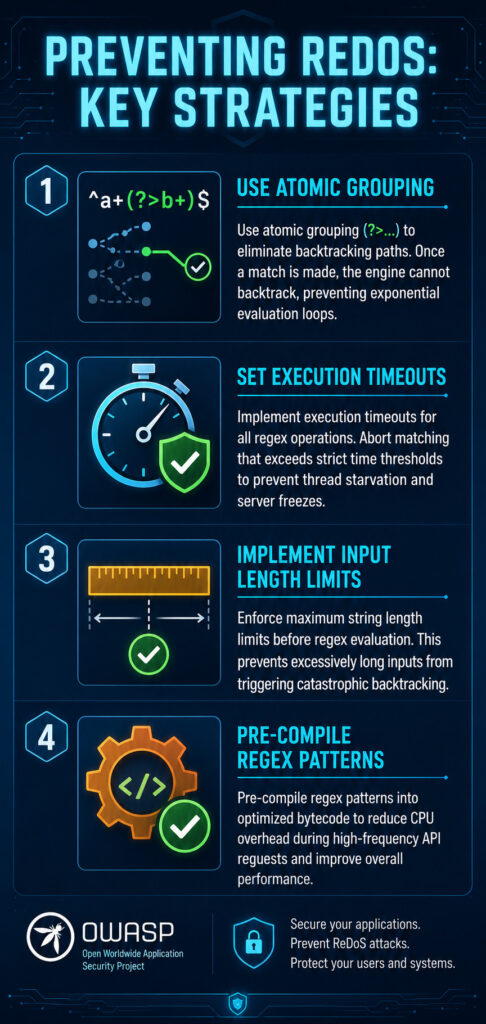
Implementing strict formatting boundaries prevents malicious data streams from destabilizing core application infrastructure. When developers enforce rigid validation rules, they ensure that incoming parameters cannot execute unexpected code paths or trigger expensive evaluation loops.
Furthermore, maintaining clear operational boundaries reduces system complexity and improves overall maintainability. This structural discipline ensures long-term software resilience across distributed server environments.
- Limiting alternative match branches reduces CPU spikes during high-frequency requests.
- Isolating regex parsing logic into dedicated modules simplifies security audits.
- Enforcing maximum string length constraints blocks buffer overflow attempts.
How Can Developers Optimize Regex Performance?
Ensuring that pattern matching operations execute swiftly requires continuous monitoring and deep profiling of expression execution times. When applications scale under heavy user traffic, unoptimized patterns create major bottlenecks that slow down overall system throughput.
Implementing efficient caching mechanisms and refining token structures significantly reduces computational overhead. Exploring our comprehensive resource on optimizing regex performance secure coding provides actionable techniques to streamline engine throughput and eliminate unnecessary evaluation cycles. These foundational improvements protect core infrastructure from latency degradation.
- Caching compiled regex objects prevents redundant compilation overhead across repeated transaction cycles.
- Avoiding atomic group bypasses ensures that search engines terminate failed matches instantly.
- Profiling production memory usage helps identify bottleneck expressions before deployment.
FAQ
What triggers catastrophic backtracking in regular expressions?
Catastrophic backtracking occurs when ambiguous patterns with overlapping quantifiers force the regex engine to test an exponential number of possible evaluation paths.
How do execution timeouts stop server freezes?
Execution timeouts force matching engines to abort immediately if evaluation exceeds strict time thresholds, stopping thread starvation and server freezes.
Why should developers avoid nested quantifiers?
Unbounded repetitions like plus or asterisk signs without length constraints allow inputs to expand infinitely, causing severe memory exhaustion and thread locks.
Are pre-compiled regex patterns safer for production?
Pre-compilation parses the expression structure once into an optimized bytecode format, reducing CPU overhead during high-frequency API requests.
Can input length limits prevent ReDoS attacks?
Implementing strict input length rules helps prevent excessive string lengths from triggering costly evaluation loops and resource exhaustion scenarios.
Securing Applications Through Advanced Input Defense
Mastering preventing regex denial service ReDoS strategies is vital for protecting modern enterprise software applications against catastrophic backtracking, severe service failures, and sophisticated injection attacks. Unconstrained pattern matching leaves critical system endpoints completely exposed to resource exhaustion and malicious exploitation.
Development teams must systematically transition toward strict matching boundaries, deterministic evaluation limits, and rigorous validation frameworks across every single architectural layer.
Ready to elevate your comprehensive software security standards and master advanced enterprise defense techniques today? Join the Secure Coding Practices Bootcamp to build completely secure enterprise systems and protect critical infrastructure permanently against all emerging global cyber threat vectors.
References
- https://cwe.mitre.org/data/definitions/1333.html
- https://owasp.org/www-community/attacks/Regular_expression_Denial_of_Service_-_ReDoS