


An input length validation regex helps enforce character and length limits, reducing the risk of oversized or malformed data reaching your application. By using range-based quantifiers, developers can check both input format and length in a single pattern.
However, regex validation alone cannot prevent memory exhaustion or buffer overflow attacks, so it should be combined with request size limits and other server-side safeguards. Keep reading to learn how to apply these checks effectively and strengthen your API security.
Regular Expression Boundaries Prevent Memory Exhaustion Exploits
Integrating range-based quantifiers inside regular expressions establishes immediate, dual-layer validation across incoming payload strings.
- Quantifier parameters explicitly enforce lower and upper character limits on every incoming string parameter.
- Combining character sets with explicit length boundaries neutralizes denial-of-service vectors before processing occurs.
- Pre-filtering payload dimensions reduces computational overhead across backend application microservices.
Why Exact String Boundaries Matter in API Security?
Accepting unrestricted input lengths can put backend systems at risk of resource exhaustion and performance issues. Oversized strings may consume excessive memory, while poorly designed regular expressions can trigger Regular Expression Denial of Service (ReDoS) under certain inputs.
An input length validation regex can enforce character rules and length limits in a single pattern. However, regex checks should complement explicit request size limits and server-side validation rather than replace them. Applying these safeguards helps prevent oversized or malformed payloads from consuming unnecessary resources and disrupting API performance.
Relying solely on programmatically checked string length properties can sometimes introduce logical race conditions or lead to inconsistent validation across multi-tier architectures. By embedding explicit quantifiers directly within regular expressions, developers guarantee that input parameters conform strictly to defined structural constraints before deeper business logic executes.
This centralized approach reduces boilerplate conditional statements while maintaining high-density code readability across API routes. Ultimately, defining clear character limits at the regex level forms an essential perimeter control, keeping API endpoints fast, predictable, and resilient against unexpected memory spikes.
Can Input Length Validation Regex Performance Outperform Manual String Checks?
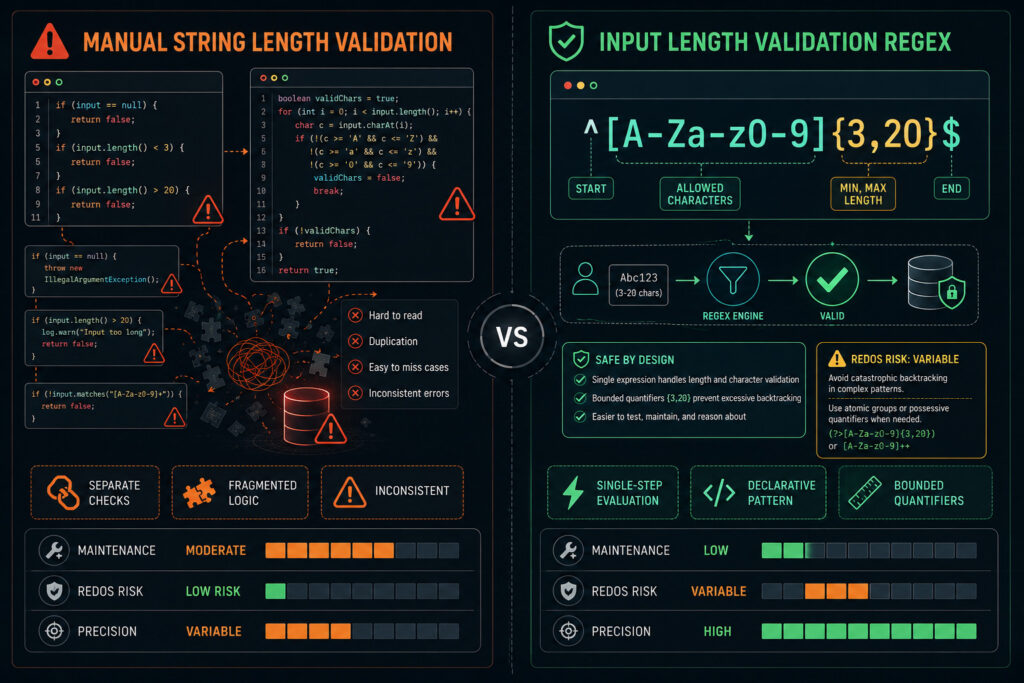
Checking string length directly in code is often straightforward, but validation logic can become harder to maintain when rules are scattered across multiple application layers. Regular expressions can combine length limits with character and format requirements in a single pattern. For guidance on building secure patterns, see our overview of safe regular expression use.
However, regex validation isn’t necessarily faster than manual string checks. Performance depends on the pattern, input, and runtime. For simple length limits, a direct length check is often easier to read and more efficient. Choose the approach that best fits the validation requirements, and avoid complex patterns that could introduce ReDoS risks.
| Evaluation Metric | Manual String Length Validation | Input Length Validation Regex |
| Enforcement Model | Separate checks for string length and character type | Single-step combined evaluation of size and content |
| ReDoS Vulnerability Risk | Low risk; does not evaluate regex quantifiers directly | Variable; requires atomic groups or bounded quantifiers |
| Code Maintainability | Moderate; requires multiple if-else blocks per field | High; declarative regex patterns apply across DTO schemas |
| Boundary Precision | Dependent on consistent framework execution | Explicitly bounded using {min,max} quantifier syntax |
How Does Framework Automation Enforce Input Constraints Seamlessly?
Modern server-side frameworks can enforce input limits through declarative validation attributes and annotations on data models. Developers can define minimum and maximum lengths alongside format requirements, using regular expressions when needed to validate specific input patterns.
These constraints allow frameworks to reject invalid payloads during model binding or request validation, before they reach core application logic. This reduces repetitive validation code and helps teams apply consistent rules across endpoints. Explicit request size limits and server-side checks remain important for protecting against oversized payloads.
Official framework documentation outlines the primary security and stability benefits of automated validation pipelines:
“Having validation rules automatically enforced by ASP.NET Core helps: Make the app more robust; Reduce chances of saving invalid data to the database.” – Microsoft ASP.NET Core Validation Tutorial
What Common Security Flaws Threaten Regex Boundary Controls?
Regex patterns without clear length limits or carefully designed matching rules can expose backend applications to performance and security risks. Developers should define acceptable input lengths and avoid patterns with excessive backtracking, which can make processing unexpectedly expensive.
Reviewing common regex security mistakes to avoid can help teams identify risky patterns during implementation. A well-designed input length validation regex should enforce the intended character and length requirements without unnecessary complexity. Combining these checks with request size limits and server-side validation adds another layer of protection.
When regular expressions omit explicit length constraints or rely on unbounded quantifiers like + or *, malicious actors can submit exceptionally long inputs to trigger ReDoS attacks. This processing stall freezes backend execution threads, causing widespread denial of service.
Enforcing strict character length boundaries directly inside regex definitions stops catastrophic backtracking before it can impact server infrastructure.
Systematic pattern design protects application endpoints while preserving high parsing throughput across modern enterprise systems.
- Using explicit range quantifiers like
{1,30}prevents unbounded string execution across API routes. - Anchoring regular expressions with
^and$guarantees full string matching rather than unsafe partial checks. - Testing regular expressions against edge-case long strings identifies potential ReDoS bottlenecks prior to production deployment.
Why Must Server-Side Engines Enforce Input Boundaries Independently?
Credits: kudvenkat
Relying on client-side regex checks to enforce payload constraints creates a false sense of security. While client checks improve user experience, executing an Input Length Validation Regex on the backend ensures malicious input cannot bypass security controls.
Standard security guidance emphasizes the absolute necessity of server-side validation:
“You must not rely on front-end validation to catch security issues, because an attacker may subvert or completely bypass the front-end code. So you must also validate input on the server, before processing it.” – MDN Input Validation Security Guidance
Can Unbounded Regex Patterns Trigger Server Downtime?
Unbounded regular expressions without explicit length limits pose severe risks to backend stability. When input processing algorithms encounter arbitrarily long strings, catastrophic backtracking can consume 100% of CPU capacity, causing thread starvation across application servers. Implementing an Input Length Validation Regex with strict range quantifiers prevents catastrophic ReDoS (Regular Expression Denial of Service) conditions by stopping evaluation early when inputs exceed allowed boundaries.
- Setting explicit quantifier upper bounds limits total execution steps for string evaluations.
- Validating input size before pattern matching prevents server CPU thread exhaustion.
Why Is Range-Bounded Parsing Essential for Payload Filtering?
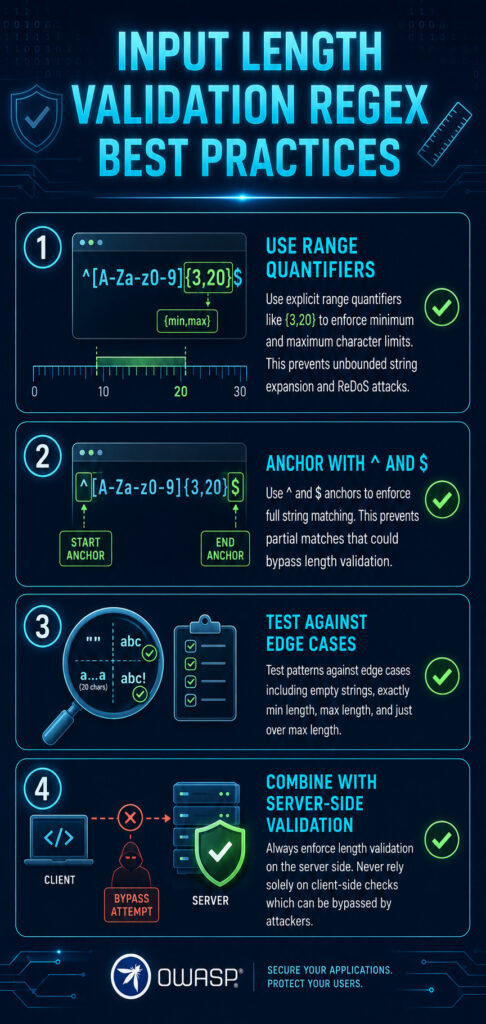
Enforcing precise string length boundaries forms the first line of defense against malicious payload injection. Modern web applications process thousands of concurrent API requests, making it vital to inspect parameter dimensions before passing data into underlying data stores.
To handle raw request data safely, see our guide to sanitizing input using regex carefully across server environments. A well-designed input length validation regex can help reject strings that exceed defined limits before they reach core application logic. Pairing regex checks with request size limits and server-side validation helps protect backend resources without relying on a single security measure.
When applications accept unconstrained input lengths, malicious actors can easily inject bloated payloads designed to exploit memory buffers or bypass weak validation checks. Bounding quantifiers ensure that strings conform strictly to allowed structural dimensions, preventing arbitrary data expansion.
Centralizing validation parameters at the perimeter layer ensures that malformed requests are cleanly rejected with clear status responses rather than causing application-level crashes.
Maintaining disciplined regex construction prevents common security flaws while maintaining optimal application performance.
- Incorporating bounded quantifiers like
{2,50}ensures strings strictly respect minimum and maximum size requirements. - Validating overall payload length prior to pattern execution mitigates potential Regular Expression Denial of Service vulnerabilities.
- Structuring clear validation error responses prevents unnecessary exposure of internal server stack details to untrusted clients.
FAQ
What is input length validation regex and why is it important?
Input length validation regex is a pattern matching technique that uses range-based quantifiers to enforce minimum and maximum string lengths, preventing buffer overflows and resource exhaustion.
How do range quantifiers in regex enforce length boundaries?
Range quantifiers like {min,max} explicitly specify the exact number of characters a string must contain, ensuring incoming payloads stay within safe operational limits.
Can input length validation regex prevent Regular Expression Denial of Service attacks?
Yes, capping the maximum length of an input string directly inside the regular expression drastically reduces execution steps and stops catastrophic backtracking before it consumes server CPU.
Is client-side length validation using regex sufficient for API security?
No, client-side checks can easily be bypassed or stripped by attackers, making server-side length validation mandatory for all API endpoints.
What is the difference between string length methods and regex length validation?
String length methods only check character counts, whereas regex length validation verifies both character type restrictions and length boundaries in a single, unified execution step.
Build Unshakeable API Defenses Today
Validating input length helps protect web applications from oversized payloads and unnecessary resource consumption. Without clear boundaries, applications may face performance issues, while poorly designed regular expressions can introduce ReDoS vulnerabilities.
Defining permitted character sets and explicit length limits helps reject malformed input before it reaches core application logic. Combine these checks with request size limits and server-side validation to strengthen API defenses and keep backend services more resilient.
Elevate your software engineering skills and master advanced secure coding principles from industry professionals. To build bulletproof API architectures, join our secure coding bootcamp today and eliminate backend vulnerabilities completely.
References
- https://learn.microsoft.com/en-us/aspnet/core/tutorials/razor-pages/validation?view=aspnetcore-10.0
- https://developer.mozilla.org/en-US/docs/Web/Security/Defenses/Input_validation