


Common Regex Security Mistakes Avoid is critical for maintaining robust backend performance and preventing catastrophic denial-of-service vulnerabilities in modern software applications. At Secure Coding Practices, security architects emphasize that unconstrained pattern matching leaves enterprise servers completely vulnerable to malicious payload injections and exponential backtracking loops.
Modern developers must implement strict evaluation limits, pre-compiled patterns, and precise character constraints across every service layer. By deploying these robust defensive mechanisms, engineering teams eliminate performance bottlenecks, safeguard server infrastructure against sudden runtime failures, and ensure reliable execution across all distributed web services.
Strict Defensive Measures Prevent Catastrophic Parsing Failures
Adopting systematic coding standards protects production environments from severe performance degradation and resource exhaustion.
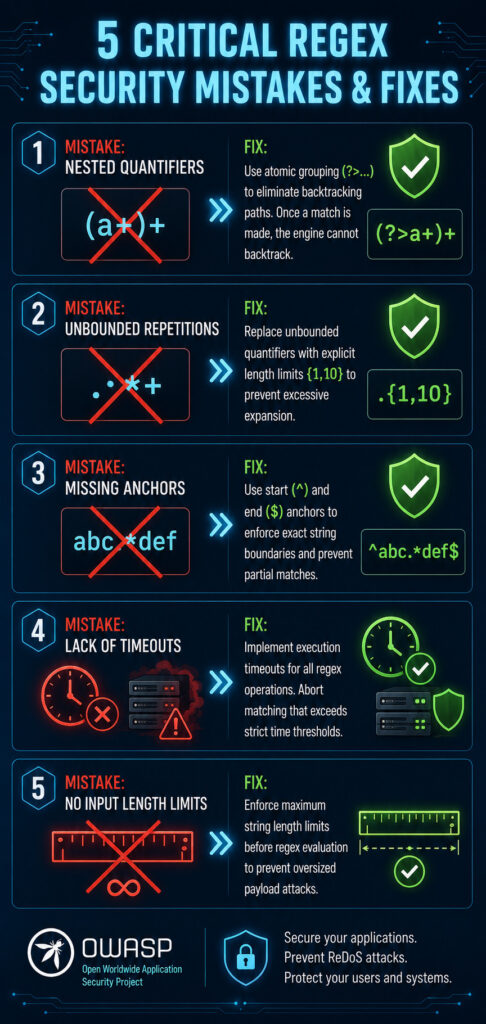
- Enforcing strict anchor boundaries immediately stops recursive backtracking loops during pattern matching execution.
- Restricting maximum input string lengths eliminates memory exhaustion risks caused by oversized payloads.
- Utilizing pre-compiled patterns prevents redundant parsing overhead across high-throughput enterprise API gateways.
Why Unchecked Patterns Compromise Backend Logic?
Regular expression matching engines operate by exploring potential character combinations to find valid strings. When patterns contain overlapping quantifiers or ambiguous structures, the internal engine evaluates multiple paths, which can rapidly expand into exponential computational complexity, making safe regular expression use essential for backend stability.
As these execution paths multiply, CPU utilization spikes dramatically, starving other critical backend threads and causing severe system degradation. Attackers exploit this predictable mechanical behavior by crafting malicious inputs specifically designed to maximize backtracking iterations. Eliminating these architectural weaknesses requires strict adherence to deterministic parsing rules.
Why Do Common Regex Security Mistakes Avoid Detection During Code Reviews?

Evaluating backend defenses against algorithmic complexity requires comparing traditional pattern matching against safe regular expression use methodologies to ensure sustained high performance across production environments.
| Approach Type | Processing Behavior | Vulnerability Exposure | Performance Impact |
| Unbounded Quantifiers | Recursive backtracking paths | High (ReDoS prone) | Variable / High CPU |
| Deterministic Limits | Controlled step evaluation | Low & Predictable | Minimal & Predictable |
| Pre-Compiled Bytecode | Optimized token matching | Minimal | Highly Optimized |
How Do Complex Expressions Trigger Server Outages?
Analyzing how untrusted inputs interact with poorly optimized patterns reveals the hidden mechanics behind sudden production outages. When developers fail to constrain search structures, malicious actors can easily weaponize backtracking behavior to paralyze backend services.
Security platforms and educational resources consistently emphasize the importance of identifying vulnerable regex constructs before deployment. Industry documentation details how these algorithmic flaws materialize in real-world applications:
“Regular Expression Denial of Service is a type of algorithmic complexity attack that exploits the worst-case behavior of regex engines.” – GetPageSpeed ReDoctor Guide
How Can Engineers Stop Regex Denial of Service Vulnerabilities?
Credits: Coder Mha
Deploying structured defenses across development lifecycles ensures that pattern matching engines do not become targets for computational exploitation. Reviewing our comprehensive guide on preventing regex denial service redos provides essential strategies to isolate untrusted data and eliminate catastrophic backtracking risks before code reaches production servers.
- Setting strict execution time limits stops rogue evaluation threads from consuming server memory.
- Replacing ambiguous nested quantifiers with atomic groups prevents exponential backtracking loops.
- Auditing regex pattern logic regularly catches hidden complexity flaws during code reviews.
What Are the Hidden Dangers of Ambiguous Quantifiers?
When development teams write pattern matching logic without properly understanding engine evaluation behavior, subtle flaws like nested quantifiers often slip into production codebases. These structural weaknesses allow untrusted inputs to trigger massive computational loops that quickly exhaust available server threads.
Industry cybersecurity references consistently warn against deploying unverified pattern structures into high-throughput environments:
“A regular expression denial of service is an algorithmic complexity attack that produces a denial-of-service by providing a regular expression that takes a long time to evaluate.” – Wikipedia ReDoS Article
How Can Automated Testing Catch Regex Vulnerabilities?
Integrating automated testing tools into the continuous integration pipeline helps engineering teams detect flawed patterns before deployment. Automated linters and static analysis tools scan codebase regular expressions for catastrophic backtracking risks and excessive complexity.
- Running static analysis checks in CI/CD pipelines flags ambiguous quantifiers instantly.
- Fuzz testing patterns with malicious payloads reveals performance bottlenecks under load.
- Maintaining a secure regex repository prevents developers from reusing vulnerable snippets.
What Security Features Should Regex Libraries Provide?
Selecting the right matching library is critical for mitigating performance vulnerabilities in backend architectures. Modern development frameworks often bundle basic parsing engines that lack built-in safeguards against catastrophic backtracking and recursive loop exhaustion.
Engineers must evaluate third-party dependencies carefully to ensure they support native timeout controls, safe compilation flags, and deterministic evaluation limits. Exploring our detailed guide on regex libraries security features considerations helps development teams select robust parsing tools designed to withstand aggressive injection attempts.
- Choosing engines with built-in execution timeouts prevents runaway processes from locking server threads.
- Verifying native support for atomic groups and possessive quantifiers eliminates unwanted backtracking paths.
- Reviewing dependency security advisories ensures outdated parsing libraries are patched promptly.
FAQ
What makes regular expressions vulnerable to denial of service?
Ambiguous patterns with overlapping quantifiers and nested repetitions force the regex engine to test exponential evaluation paths when given crafted inputs.
How do atomic groups prevent exponential backtracking?
Atomic groups lock in matches and prevent the engine from backtracking to re-evaluate previous tokens, stopping runaway computation loops instantly.
Why are unvalidated user inputs dangerous in pattern matching?
Allowing untrusted strings to define or interact directly with complex patterns exposes backend applications to malicious payload injections and resource exhaustion.
Can execution timeouts completely eliminate ReDoS risks?
Timeouts act as a critical safety net by aborting runaway evaluation threads, though developers should still prioritize writing deterministic, non-vulnerable patterns.
What is the best way to test regex performance before deployment?
Integrating static analysis linters, fuzz testing with malicious payloads, and profiling execution times under load help identify bottlenecks early.
Securing Applications Through Advanced Input Defense
Mastering preventing regex denial service ReDoS strategies is vital for protecting modern enterprise software applications against catastrophic backtracking, severe service failures, and sophisticated injection attacks. Unconstrained pattern matching leaves critical system endpoints completely exposed to resource exhaustion and malicious exploitation.
Development teams must systematically transition toward strict matching boundaries, deterministic evaluation limits, and rigorous validation frameworks across every single architectural layer.
Ready to elevate your comprehensive software security standards and master advanced enterprise defense techniques today? Join the Secure Coding Practices Bootcamp to build completely secure enterprise systems and protect critical infrastructure permanently against all emerging global cyber threat vectors.
References
- https://redoctor.getpagespeed.com/redos-explained/
- https://en.wikipedia.org/wiki/ReDoS