


Using regex securely input validation is critical for preventing catastrophic backtracking and advanced parameter injection exploits across modern enterprise software systems and cloud APIs. At Secure Coding Practices, expert security engineers emphasize that unconstrained pattern matching leaves production servers completely vulnerable to malicious input manipulation attempts.
Modern developers must construct robust expressions featuring strict length anchors and deterministic evaluation limits. By implementing these rigorous operational controls, engineering teams eliminate regex-based performance bottlenecks, secure backend microservices against unexpected runtime execution failures, and maintain optimal application reliability across all distributed deployment environments.
Core Principles of Secure Expression Handling
Implementing structured validation mechanisms provides critical defensive advantages for application performance and safety.
- Enforcing strict anchor boundaries immediately stops recursive backtracking loops during pattern matching execution.
- Restricting maximum input string lengths eliminates memory exhaustion risks caused by oversized payloads.
- Utilizing pre-compiled patterns prevents redundant parsing overhead across high-throughput enterprise API gateways.
How Using Regex Securely Input Validation Protects Enterprise Applications?
Implementing proper pattern matching requires a thorough understanding of how regex engines process untrusted data strings. When developers prioritize using regex securely input validation, they establish foundational defenses that prevent malicious actors from exploiting subtle flaws in backend logic.
Unchecked input strings often lead to severe architectural vulnerabilities, making structured filtering an absolute necessity for modern web applications. Furthermore, maintaining strict oversight over regular expression execution ensures that application servers remain stable under high-traffic conditions.
Without robust defensive boundaries, complex expressions can consume excessive CPU cycles and memory resources, leading to potential denial-of-service scenarios. Developers must therefore enforce deterministic limits and precise character constraints across all service endpoints.
These proactive measures collectively eliminate recurring security blind spots and fortify overall infrastructure resilience.
How Do Pattern Matching Strategies How Do Validation Methods Compare?

When engineering teams evaluate backend defenses, comparing traditional wildcard parsing with safe regular expression use highlights major differences in operational reliability. Implementing using regex securely input validation requires structured comparisons to ensure optimal performance without sacrificing security boundaries across distributed API gateways.
| Validation Method | Operational Principle | Security Risk Profile | Performance Impact |
| Unconstrained Wildcards | Relies on broad pattern matches | Extremely High (ReDoS prone) | Variable / High CPU |
| Strict Anchor Boundaries | Enforces exact start/end limits | Low and Controlled | Minimal & Predictable |
| Pre-compiled Patterns | Evaluates pre-parsed bytecode | Very Low | Highly Optimized |
Why Is Input Validation Essential for Security?
Ensuring proper data hygiene requires robust architectural controls across all system entry points. When developers implement strict validation layers, they prevent malicious injection attacks from corrupting core backend services and ensure that data flows conform strictly to predefined syntactic expectations.
Security standards emphasize the importance of comprehensive input controls to protect application integrity:
“Inputs should be validated using positive validation (whitelist) whenever possible, ensuring that only expected characters and formats are accepted by the system.” – OWASP Input Validation Cheat Sheet
Adopting these structured patterns drastically minimizes the risk of unexpected runtime anomalies and structural bypass attempts.
How Can Developers Prevent Regex Denial Of Service?
Credits: CyberSecurityTV
Mitigating catastrophic algorithmic complexity requires developers to adopt advanced defensive controls. Exploring our guide on preventing regex denial of service redos outlines critical steps to stop exponential backtracking loops and maintain high server availability under heavy workloads.
- Eliminating nested quantifiers stops catastrophic evaluation paths during string matching operations.
- Setting hard execution timeout limits protects backend threads from entering infinite loops.
- Enforcing strict input character boundaries prevents unexpected payload parsing resource exhaustion.
Where Do Regex Vulnerabilities Begin?
Unsecured pattern matching implementations often introduce critical security gaps by trusting external payloads without proper syntactic verification. When applications parse complex data strings using unverified rules, they risk exposing internal processing layers to unexpected manipulation and execution failures.
Government and cyber security authorities highlight the foundational role of rigorous validation frameworks in mitigating software vulnerabilities:
“Input validation is a design practice intended to prevent malformed data from entering an information system’s data store or processing components.” – NIST Computer Security Resource Center
Adopting these standardized definitions helps developers structure reliable boundary controls, ensuring that all incoming parameters conform strictly to safe execution patterns before any processing occurs.
How Do Strict Boundaries Protect Systems?
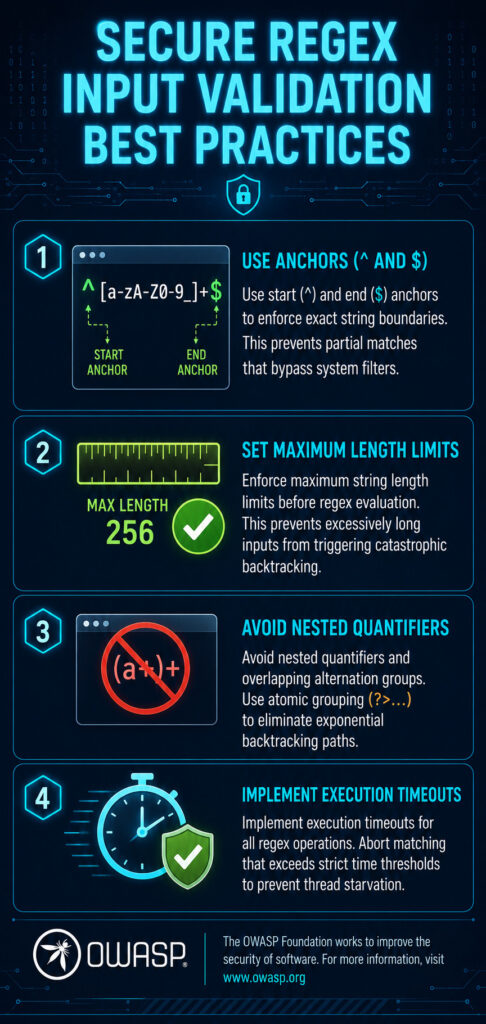
Implementing strict formatting boundaries prevents malicious data streams from destabilizing core application infrastructure. When developers enforce rigid validation rules, they ensure that incoming parameters cannot execute unexpected code paths or trigger expensive evaluation loops.
Furthermore, maintaining clear operational boundaries reduces system complexity and improves overall maintainability. This structural discipline ensures long-term software resilience across distributed server environments.
- Limiting alternative match branches reduces CPU spikes during high-frequency requests.
- Isolating regex parsing logic into dedicated modules simplifies security audits.
- Enforcing maximum string length constraints blocks buffer overflow attempts.
How Do Specific Formats Require Secure Regex Parsing?
Handling common data types like email identifiers introduces unique parsing challenges. Developers must avoid fragile pattern matching rules that fail under complex inputs. Reviewing our guide on validating email address regex secure provides precise patterns that prevent structural bypasses.
Implementing these specialized rules ensures user data complies with strict standards. Maintaining robust checks across all format types secures the application entry point completely. This vigilance stops malicious parameter injections effectively.
- Using non-capturing groups reduces memory consumption during string verification.
- Avoiding overlapping domains stops catastrophic backtracking loops in user flows.
- Enforcing exact local-part length limits prevents resource exhaustion attacks.
FAQ
What makes standard regular expressions vulnerable to attacks?
Standard expressions often use ambiguous quantifiers and overlapping alternatives, allowing malicious payloads to trigger exponential evaluation times and server bottlenecks.
How do regex anchors improve input security?
Anchors like caret and dollar signs force matching engines to evaluate the entire string from start to finish, preventing partial matches that bypass system filters.
Why should developers avoid unbounded quantifiers?
Unbounded repetitions like plus or asterisk signs without length constraints allow inputs to expand infinitely, causing severe memory exhaustion and thread locks.
Is input validation alone enough to stop all injection threats?
While input validation forms the crucial first line of defense, it must be paired with output encoding and parameterized queries for complete security.
What is the role of pre-compiled expression patterns?
Pre-compilation parses the expression structure once into an optimized bytecode format, reducing CPU overhead during high-frequency API requests.
Securing Applications Through Advanced Input Defense
Mastering using regex securely input validation is vital for protecting modern enterprise software applications against catastrophic backtracking, severe service failures, and sophisticated injection attacks. Unconstrained pattern matching leaves critical system endpoints completely exposed to resource exhaustion and malicious exploitation.
Development teams must systematically transition toward strict matching boundaries, deterministic evaluation limits, and rigorous validation frameworks across every single architectural layer.
Ready to elevate your comprehensive software security standards and master advanced enterprise defense techniques today? Join the Secure Coding Practices Bootcamp to build completely secure enterprise systems and protect critical infrastructure permanently against all emerging global cyber security threat vectors.
References
- https://cheatsheetseries.owasp.org/cheatsheets/Input_Validation_Cheat_Sheet.html
- https://csrc.nist.gov/glossary/term/validation