


Testing regular expressions security performance is an essential engineering practice for modern software development teams striving to prevent catastrophic system downtime. As complex backend applications increasingly process untrusted user inputs, unoptimized pattern matching logic can expose server infrastructure to severe denial of service vulnerabilities and massive resource exhaustion.
At Secure Coding Practices, security architects emphasize that implementing robust evaluation methodologies and automated validation checks protects critical enterprise assets against sophisticated algorithmic complexity attacks.
By systematically evaluating your matching logic before production deployment, your organization ensures resilient operations and eliminates hidden performance bottlenecks across all distributed web services.
Comprehensive Testing Ensures Long-Term Backend Resilience
Implementing structured evaluation practices safeguards production environments from hidden vulnerabilities and unexpected operational failures.
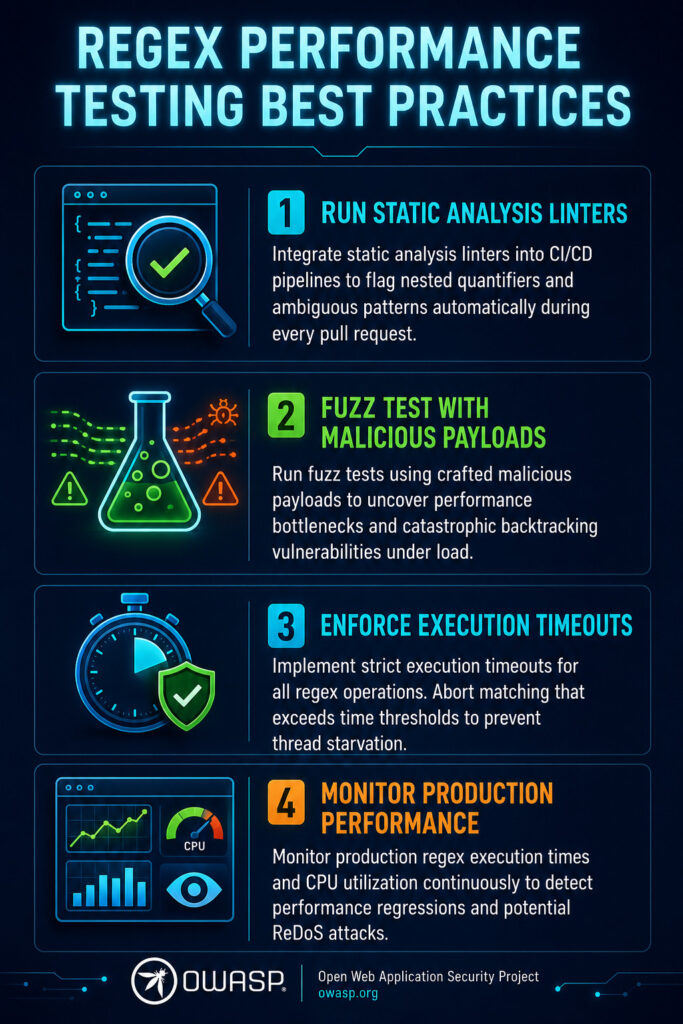
- Integrating static analysis pipelines into continuous integration workflows catches flawed pattern logic early.
- Simulating heavy traffic loads through specialized fuzz testing reveals underlying performance bottlenecks.
- Enforcing strict deterministic time limits prevents malicious payloads from locking server execution threads.
Why Is Testing Regular Expressions Security Performance Essential For Modern Systems?
Executing comprehensive evaluation routines for Testing Regular Expressions Security Performance allows development teams to detect algorithmic flaws before malicious actors can exploit system weaknesses. Unoptimized pattern structures often harbor hidden vulnerabilities that escape standard code reviews, making rigorous pre-deployment checks an absolute necessity for enterprise stability.
When engineers neglect systematic validation, recursive backtracking loops can cause sudden CPU spikes and application thread exhaustion. Establishing proactive assessment protocols ensures that production servers maintain high availability even when processing large volumes of complex data. This disciplined approach prevents costly outages.
How Do Evaluation Approaches Compare in Testing Regular Expressions Security Performance?
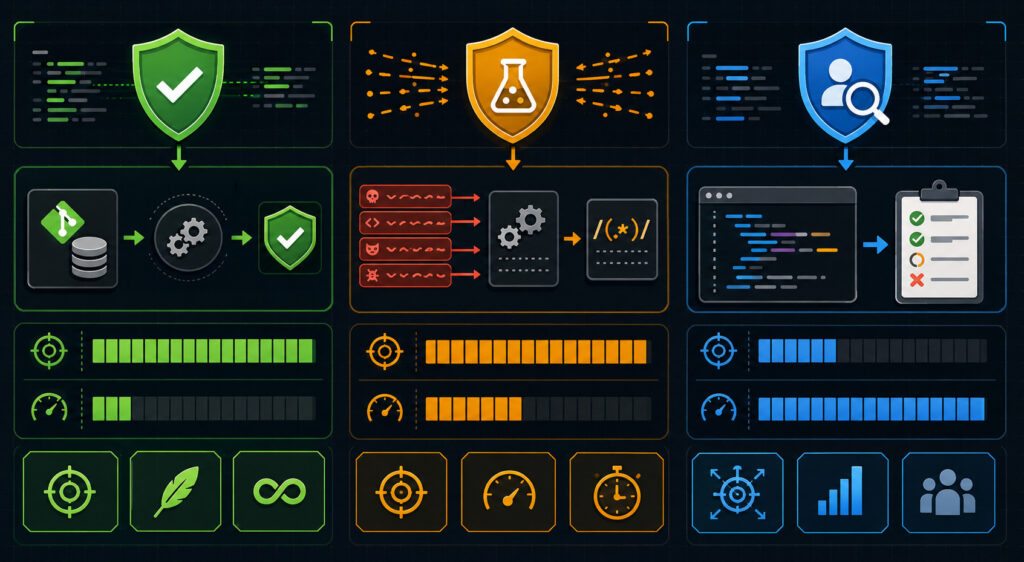
When conducting rigorous testing regular expressions security performance assessments, teams must evaluate various inspection strategies against safe regular expression use standards to ensure complete production readiness.
| Testing Method | Execution Target | Error Detection Rate | Operational Overhead |
| Static Analysis Linters | Source Code Patterns | High (Syntax Flaws) | Minimal (CI/CD Integrated) |
| Fuzz Testing Payloads | Runtime Engine Behavior | High (ReDoS Bottlenecks) | Moderate (Load Testing) |
| Manual Code Review | Developer Logic Flow | Variable (Human Error) | High (Time Intensive) |
What Are The Hidden Failure Risks In Poorly Tested Patterns?
Failing to execute thorough evaluations during development leaves backend applications exposed to unexpected computational spikes. When untrusted inputs bypass validation filters, complex patterns can easily overwhelm system resources and paralyze critical enterprise services.
Industry security standards emphasize the critical need for proactive pattern inspection:
“Inefficient regular expression complexity can lead to denial of service conditions by causing the parser to consume excessive CPU and memory resources.” – MITRE CWE-1333 Specification
How Can Engineering Teams Optimize Testing Regular Expressions Security Performance?
Implementing structured defensive protocols during testing regular expressions security performance ensures that parsing engines remain resilient against malicious injection attempts. Developers can leverage strategies outlined in our guide on preventing regex denial service redos to systematically eliminate performance bottlenecks and secure production infrastructure.
- Establishing strict execution time thresholds prevents rogue evaluation threads from consuming server memory.
- Replacing ambiguous nested quantifiers with atomic groups stops exponential backtracking loops instantly.
- Auditing regex pattern logic regularly catches hidden complexity flaws during automated code reviews.
Why Do Unvalidated Patterns Threaten System Scalability?
Credits: Farah Hawa
Production applications processing high volumes of concurrent requests require robust input validation layers to prevent computational stalls. When development teams deploy unverified matching structures, malicious payloads can exploit engine weaknesses to degrade overall service responsiveness.
Software engineering standards emphasize the absolute necessity of utilizing predictable parsing implementations:
“The regular expression implementation in Go guarantees linear-time execution with respect to the size of the input and the size of the expression.” – Go Regexp Package Documentation
How Can Automation Streamline Testing Regular Expressions Security Performance?
Integrating automated verification tools into development workflows significantly reduces the risk of human oversight during pattern creation. Continuous pipeline integration ensures that every code change undergoes rigorous validation before hitting production environments.
- Integrating linters into code repositories flags nested quantifiers automatically during pull requests.
- Running scheduled fuzz tests uncovers hidden performance regressions under high concurrency loads.
- Maintaining centralized pattern registries prevents the reuse of vulnerable legacy expressions.
What Role Do Modern Libraries Play In Testing Regular Expressions Security Performance?
Selecting advanced parsing libraries with native safeguards forms a critical barrier against malicious injection attempts. Standard framework engines often lack built-in execution limits, leaving backend architectures vulnerable to runaway processes and thread starvation during peak loads.
Evaluating third-party dependencies carefully ensures your application supports deterministic evaluation rules and safe compilation flags.
Reviewing our analysis on regex libraries security features considerations provides actionable criteria for selecting robust parsing tools.
- Enforcing native timeout controls stops malicious payloads from locking core execution threads.
- Verifying support for atomic groups eliminates unwanted recursive backtracking paths.
- Tracking vendor security patches ensures outdated parsing dependencies are upgraded promptly.
FAQ
What is testing regular expressions security performance?
Testing regular expressions security performance involves systematically evaluating pattern-matching logic to identify algorithmic complexity flaws, catastrophic backtracking vulnerabilities, and resource exhaustion risks before code reaches production environments.
Why do unoptimized regular expressions cause server outages?
When matching patterns contain ambiguous nested quantifiers, malicious or unexpected inputs can cause the regex engine to enter exponential evaluation loops, driving CPU utilization to maximum capacity and locking essential backend threads.
How can developers automate regex vulnerability detection?
Engineering teams can integrate static analysis tools and automated linters directly into continuous integration pipelines to catch flawed syntax and risky pattern structures during every pull request.
What are atomic groups and how do they prevent ReDoS?
Atomic groups instruct the regex engine to discard its backtracking checkpoints once a sub-expression matches, effectively stopping recursive evaluation paths and neutralizing the risk of denial-of-service attacks.
Do modern programming languages protect against regex denial of service?
While certain modern runtimes implement deterministic linear-time algorithms, many standard language libraries still rely on traditional backtracking engines, making explicit input validation and timeout controls necessary.
Ensure Long-Term System Security
Implementing rigorous validation protocols and systematic testing regular expressions security performance guarantees long-term enterprise application stability across distributed web environments. Development teams must prioritize proactive pattern reviews, strict execution timeouts, and comprehensive static analysis within continuous integration pipelines to completely eliminate catastrophic backtracking risks.
Safeguarding backend infrastructure against sophisticated algorithmic complexity attacks requires continuous technical education and disciplined engineering standards.
To accelerate your organization’s expertise in building robust, uncompromised backend architectures, explore our advanced security documentation and join our secure coding bootcamp today to significantly elevate your team’s defensive capabilities and protect critical production systems from emerging security threats seamlessly.
References
- https://cwe.mitre.org/data/definitions/1333.html
- https://pkg.go.dev/regexp