


Mastering Allowlist vs Denylist Validation is essential for engineering secure web applications that handle untrusted user inputs safely today. When development teams build robust input filters, they prevent malicious injection attempts and unauthorized resource access across all cloud infrastructure environments.
At Secure Coding Practices, security experts stress that implementing precise verification rules eliminates common architectural security blind spots.
Choosing strict permit lists over traditional restriction lists ensures that applications maintain absolute boundary controls, protecting underlying infrastructure against evolving cyber threats and sophisticated bypass vectors efficiently every single day to ensure complete system stability and resilience.
Comprehensive Allowlist vs Denylist Validation Controls Block Advanced Web Threats
Proper implementation of Allowlist vs Denylist Validation establishes absolute boundary security against unauthorized parameter injection.
- Prioritize explicit permit lists to ensure that only verified structural schemas pass through backend request handlers.
- Eliminate reliance on restriction lists that fail to account for alternative URI encodings and bypass vectors.
- Enforce strict runtime parsing to prevent attackers from manipulating network routing layers and internal endpoints.
Why Do Traditional Denylists Fail to Stop Modern Attack Vectors?
Relying on restriction-based filtering often creates a false sense of security because attackers continuously discover novel ways to bypass character blacklists. When evaluating Allowlist vs Denylist Validation mechanisms, security professionals consistently find that blocking known bad inputs leaves systems exposed to thousands of unknown or obfuscated variations.
Because software environments are complex and dynamic, attempting to anticipate every potential malicious payload is practically impossible. Instead of trying to blacklist every dangerous pattern, engineering teams must pivot toward permit-based models that explicitly define what is safe to process.
How Do Allowlist Strategies Compare to Traditional Sanitization?
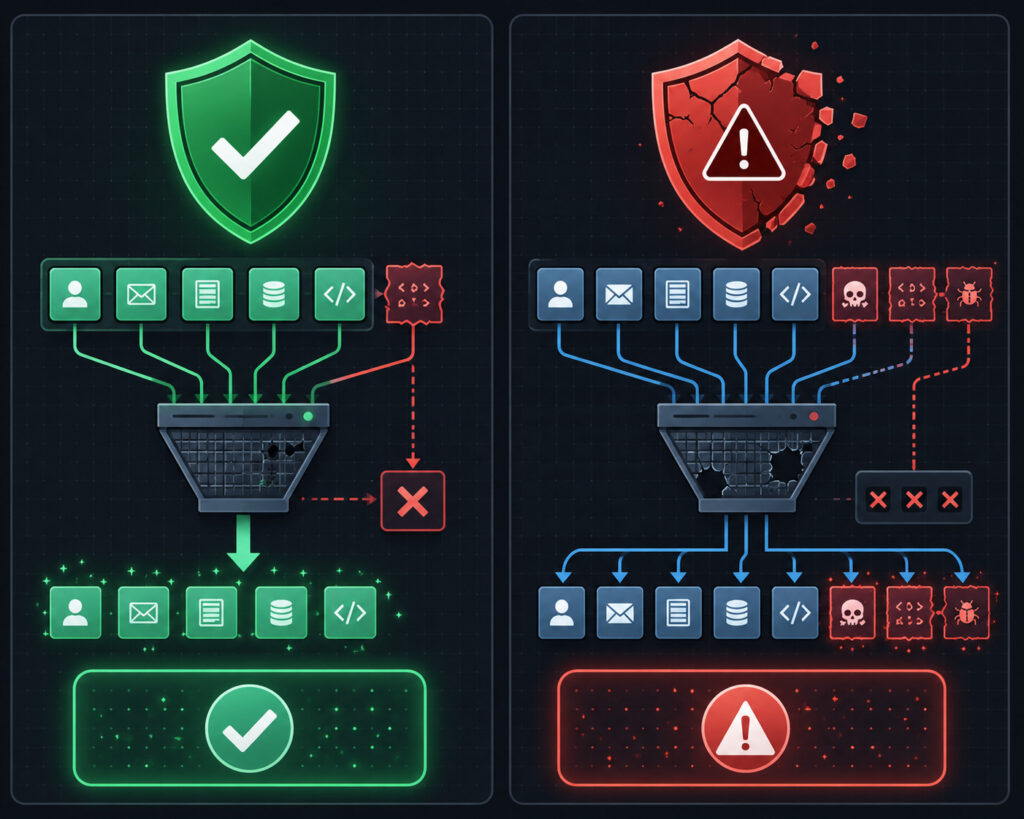
When designing enterprise web defenses, implementing comprehensive input validation and sanitization processes ensures that all untrusted parameters are rigorously cleaned before backend processing. Similarly, adopting an effective input validation allowlist approach guarantees that systems only execute pre-approved operations while maintaining rigorous Allowlist vs Denylist Validation standards across all microservices.
| Strategy Layer | Core Mechanism | Security Outcome |
| Allowlist Approach | Permits only explicitly recognized safe inputs | Neutralizes unknown bypass techniques |
| Denylist Filtering | Blocks known malicious strings and signatures | Vulnerable to obfuscation and new variants |
| Sanitization Routine | Modifies or strips unsafe character sequences | Prevents injection if implemented correctly |
Why Do Allowlist Strategies Outperform Traditional Restriction Models?
When developers evaluate application security frameworks, understanding core security gaps helps emphasize why analyzing input validation denylist approach risks matters for modern architectures. Proper execution of Allowlist vs Denylist Validation ensures that systems reject unauthorized patterns before input data reaches core business logic.
When engineering teams explore why allowlisting is more secure than denylisting, they quickly discover that explicitly defining valid data parameters completely eliminates the guesswork associated with blocking malicious string variants. This architectural shift ensures that enterprise systems remain resilient against unexpected input manipulation and zero-day injection attacks.
“Input validation should be implemented as close to the data source as possible. Allowing only known good data positive or whitelist validation is typically the best approach.” – OWASP Input Validation Cheat Sheet
How Do You Implement Secure Allowlist Controls in Practice?
Credits: What is cybersecurity?
When implementing allowlist validation effectively in code, developers must ensure that data type checks and regular expressions are strict, unambiguous, and executed before any core business logic processes the request.
Furthermore, studying practical examples of allowlist based validation checks helps engineering teams understand how to maintain robust Allowlist vs Denylist Validation boundaries across different application modules.
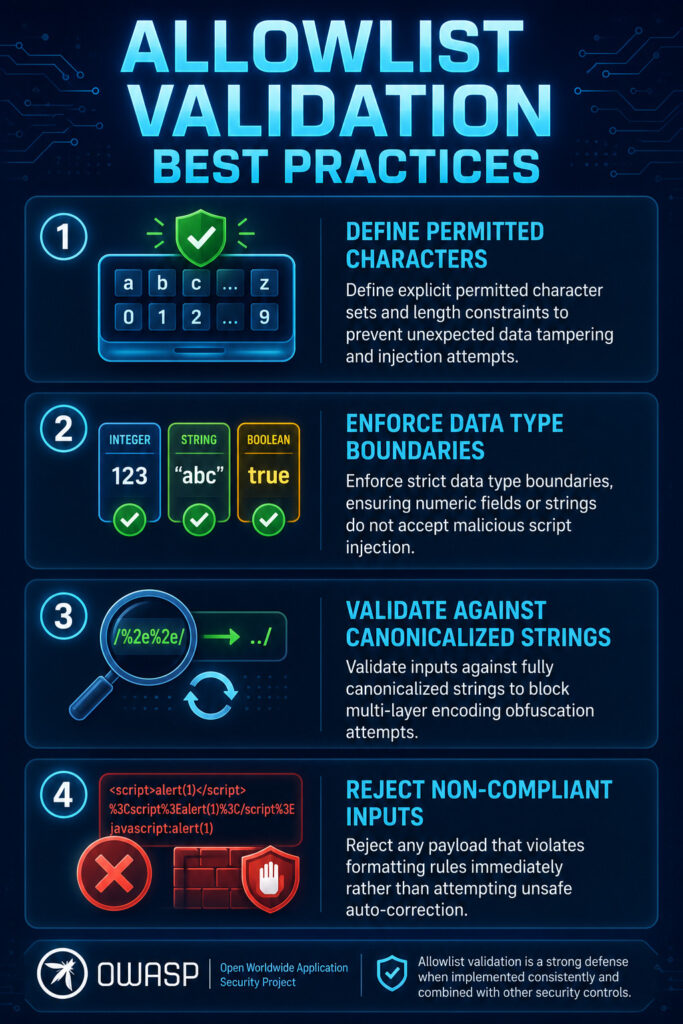
- Define explicit length constraints and permitted character sets to prevent unexpected data tampering.
- Validate inputs against fully canonicalized strings to block multi-layer encoding obfuscation attempts.
- Reject any payload that violates formatting rules immediately rather than attempting unsafe auto-correction.
What Common Pitfalls Plague Denylist Validation Implementations?

When software engineering teams overlook denylist validation common pitfalls and issues, they frequently introduce subtle security blind spots into their validation pipelines. Relying solely on character restriction lists without proper input canonicalization completely undermines the effectiveness of Allowlist vs Denylist Validation across distributed architectures.
“The product uses a blacklist to protect against an input-based vulnerability, but the blacklist is incomplete, or it does not account for all potential encoding variations or bypass techniques.” – MITRE CWE-184
How Do Character Encoding and Data Types Shape Allowlist Verification?
When building resilient defense systems under Allowlist vs Denylist Validation standards, engineering teams must ensure that proper character encoding validation allowlist checks are applied to block hidden payloads. Furthermore, integrating a reliable data type validation allowlist strategy guarantees that incoming parameters conform strictly to expected structural formats before execution.
- Verify all incoming byte streams against explicit character sets to prevent multi-byte bypass flaws.
- Enforce strict data type boundaries, ensuring numeric fields or strings do not accept malicious script injections.
- Reject non-compliant parameters immediately to maintain secure application state transitions.
How Can Organizations Choose and Benefit From Optimal Validation Models?
When designing comprehensive defensive layers under Allowlist vs Denylist Validation, security architects must carefully evaluate choosing the right validation strategy for every scenario to ensure maximum defense coverage. Furthermore, fully understanding the security benefits of allowlisting input helps teams justify the shift from fragile blocklists to robust permit-based systems.
- Analyze application data flows to determine where strict allowlist rules provide the highest risk mitigation.
- Document performance and maintenance overheads associated with maintaining complex restriction lists versus allowlists.
- Establish continuous auditing protocols to review active validation schemas against evolving threat landscapes.
FAQ
What is the main difference between allowlist and denylist validation?
Allowlist validation permits only explicitly recognized safe data patterns, whereas denylist validation attempts to block known malicious strings or signatures while permitting everything else by default.
Why are denylists considered less secure for modern web applications?
Denylists fail because attackers can easily bypass character restrictions using alternative encodings, obfuscation techniques, or novel payloads that security teams did not anticipate in the blocklist.
How does allowlist validation protect against zero-day injection attacks?
By strictly enforcing predefined structural schemas and permitted character sets, allowlists reject any unexpected or unverified inputs, neutralizing zero-day vectors that rely on unexpected parameter variations.
Can development teams combine allowlists and denylists in the same application?
While mixing strategies is possible, security best practices strongly recommend prioritizing strict allowlists for critical boundary validation to minimize the structural gaps inherent in restriction-based lists.
What challenges do engineering teams face when implementing allowlist validation?
Implementing allowlists requires a comprehensive understanding of application data flows and can introduce maintenance overhead when legitimate input formats evolve or expand over time.
Mastering Allowlist vs Denylist Validation Ensures Long-Term Enterprise Resilience
Mastering Allowlist vs Denylist Validation is critical for shielding enterprise software architectures against sophisticated injection attacks and unexpected parameter tampering. While traditional restriction lists leave backend systems vulnerable to clever bypass techniques and multi-layer encoding obfuscations, strict permit-based validation models establish unyielding boundary controls across all application layers.
Engineering teams must systematically eliminate fragile blocklists in favor of robust, proactive verification frameworks. Ready to elevate your software security standards and master enterprise defense techniques? Join the Secure Coding Practices Bootcamp to build bulletproof architectures and protect critical enterprise deployments from evolving cyber threats completely right now every single day.
References
- https://cheatsheetseries.owasp.org/cheatsheets/Input_Validation_Cheat_Sheet.html
- https://cwe.mitre.org/data/definitions/184.html
Related Articles
- https://securecodingpractices.com/input-validation-sanitization/
- https://securecodingpractices.com/input-validation-allowlist-approach-explained/
- https://securecodingpractices.com/input-validation-denylist-approach-risks/
- https://securecodingpractices.com/why-allowlisting-more-secure-denylisting/
- https://securecodingpractices.com/implementing-allowlist-validation-effectively-code/
- https://securecodingpractices.com/examples-allowlist-based-validation-checks/
- https://securecodingpractices.com/denylist-validation-common-pitfalls-issues/
- https://securecodingpractices.com/character-encoding-validation-allowlist/
- https://securecodingpractices.com/data-type-validation-allowlist-strategy/
- https://securecodingpractices.com/choosing-right-validation-strategy-scenario/
- https://securecodingpractices.com/security-benefits-allowlisting-input/