


Denylist validation is often treated as a quick way to block malicious input, but relying on it alone creates dangerous security gaps. Many of the most denylist validation common pitfalls issues come from incomplete rules, unexpected input formats, and constantly evolving attack techniques.
While Secure Coding Practice recognizes that denylists can provide an extra layer of filtering, they should never replace stronger validation and secure development methods. Understanding these weaknesses is the first step toward building more resilient applications. Keep reading.
What You’ll Learn
This article covers the biggest weaknesses of denylist validation and explains how to reduce the risks with stronger security practices.
- Denylists are inherently reactive and impossible to make complete.
- Bypasses often come from encoding, case variations, or whitespace tricks.
- Secure Coding Practices, like parameterized queries, are your primary defense, with denylists as a secondary scrubber.
What Is Denylist Validation Actually Meant to Do?

At its core, denylist validation is a filter. It scans input, a username, a search term, a form field, for known-bad patterns and rejects or sanitizes them. The goal is to stop specific, predictable attacks like SQL injection, cross-site scripting (XSS), or path traversal. It’s a simple concept: “If the input contains ‘OR 1=1–‘, block it.”
“Denylisting or denylist validation attempts to check that given data does not contain ‘known bad’ content. For example, a web application may block input that contains the exact text <SCRIPT> in order to help prevent XSS. However, this defense could be evaded with a lower case script tag or a script tag of mixed case. When building secure software, allowlisting is the recommended minimal approach. Denylisting is prone to error and can be bypassed with various evasion techniques and can be dangerous when depended on by itself.” – GitHub
We used to rely on it heavily. It felt proactive. We’d grab lists of SQL keywords and common XSS payloads from OWASP, paste them into our code, and call it a day. The problem is, this approach mistakes a known symptom for a cure.
It’s like trying to stop burglars by making a list of all the tools they’ve used in the past (crowbars, lock picks) and banning anyone carrying them. A determined burglar will just use a new tool, or disguise the old one. Denylist validation works on the same flawed premise. It’s a reactive, after-the-fact blockade that smart attackers are exceptionally good at evading.
Why Is It So Hard to Make a Complete Denylist?
The list can never be finished. Attackers have infinite creativity, and you have finite time. Think about SQL injection. Your denylist might block ‘ OR ‘1’=’1. But what about:
- ‘ OR ‘1’=’1′– (with a different comment syntax)
- ‘ UNION SELECT null– (using UNION)
- `’||’1′ (in an Oracle database)
- The same payloads encoded in hex, Unicode, or double URL encoding?
You see the problem. For every pattern you block, there are dozens of functional equivalents. The same goes for XSS. Block <script>, and they’ll try <SCRIPT>, <scr<script>ipt>, or use event handlers like onmouseover=”alert(1)”.
Maintaining a denylist that covers all possible variations is a full-time, losing battle. It creates a false sense of security. You think you’re covered because you blocked the examples from the textbook, but the exam questions are always different.
How Do Attackers Bypass Denylists with Simple Tricks?
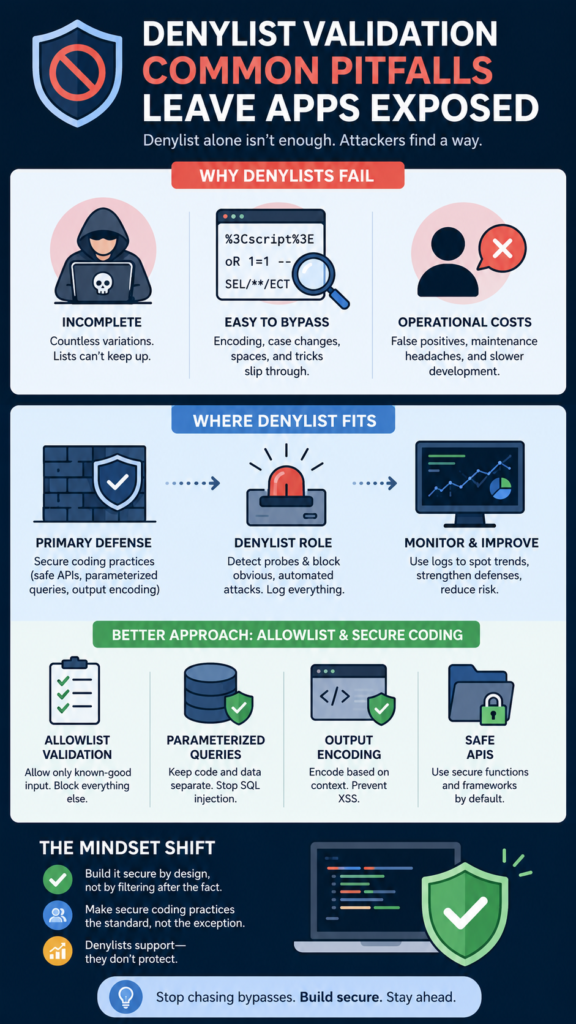
They don’t need zero-days. They use basic obfuscation that most denylists fail to anticipate. Encoding is the classic method. A denylist looking for <script> might not recognize %3Cscript%3E (URL encoded) or \u003cscript\u003e (Unicode).
Whitespace and case sensitivity are other major pitfalls. Does your filter catch or 1=1 (with two spaces)? Does it do a case-insensitive match? Or 1=1 with a capital ‘O’ can slip through a naive check. Attackers also break up strings. SEL + ECT might bypass a simple string search for SELECT. Context is another killer.
The string 1; DROP TABLE users is malicious in a SQL context, but it’s a perfectly valid (if oddly named) title for a forum post. A denylist that blocks it globally will break legitimate functionality.
We learned this through a painful XSS flaw. Our denylist blocked javascript: in links. So the attacker used jAvAsCrIpT: (mixed case). It sailed right through. The browser executed it just fine. Our validation logic was weaker than the browser’s parsing logic, which is a recipe for failure.
What Are the Operational Costs of a Bad Denylist?
The costs aren’t just security breaches. They’re baked into daily operations. First, there’s maintenance hell. The list becomes a sprawling, unmanageable mess. Every time a new bypass is discovered, you add another regex pattern. The code becomes bloated and slow.
Second, false positives become a nightmare for users and support teams. A customer named “John O’Reilly” has his name blocked because of the apostrophe (a common SQL injection character). A legitimate search for “union station” gets flagged. You end up creating complex exception rules, which themselves can become security holes.
Third, it creates a cultural problem. Developers start to see security as a checklist item, “I added the denylist, my work is done”, rather than understanding the underlying vulnerability. It discourages them from learning real Secure Coding Practices, like using parameterized queries for SQL or proper output encoding for XSS, which solve the root cause.
Where Does Denylist Validation Fit in a Secure Strategy?
Credits: QAFox
It should be a secondary, supplemental control, never the primary one. Its best use is as a final scrubber or a canary in the coal mine. Think of it like this: Your primary defense is a solid wall (parameterized queries). The denylist is a motion sensor at the base of that wall. If the sensor goes off, you know someone’s probing, even if they can’t get through the wall.
We repositioned our approach this way. Secure Coding Practices are our foundation. We mandate parameterized queries for all database access. We use templating engines that auto-escape output for XSS prevention.
For example, for a “country” field, only allow entries from a fixed list of valid country codes. For a “phone number” field, only allow digits, spaces, and a plus sign. Implementing allowlist validation in these scenarios significantly reduces unexpected input while keeping validation predictable and robust.
Then, and only then, we apply a lightweight, well-maintained denylist on certain high-risk inputs (like admin comment fields) as an additional layer. Its job isn’t to stop all attacks, but to catch lazy, automated scripts and log attempts for our review. This table clarifies the shift in mindset:
| Aspect | Old Approach (Denylist-First) | Secure Approach (Denylist as Supplement) |
| Primary Defense | Blocking known-bad strings in input. | Using safe APIs (parameterized queries, output encoding). |
| Goal of Denylist | To prevent attacks. | To detect probing attempts and catch obvious bad input. |
| Maintenance Burden | High (constant updates to catch bypasses). | Low (focused list for common, noisy attack patterns). |
| False Positives | Frequent, disruptive to users. | Rare, as it only flags egregiously malicious patterns. |
| Developer Mindset | “I added the security filter.” | “I used the safe method by design.” |
How Can You Implement a Denylist That Doesn’t Suck?
If you must use one, do it smartly. First, keep it small and focused. Don’t try to block every possible attack variant. Focus on the most common, noisy payloads from automated scanners (like sqlmap default tests). This makes it manageable.
Second, normalize input before checking. Decode URL encoding, standardize whitespace, convert to a single case (lowercase), and remove obfuscation like \n or /**/ in SQL. This reduces the attacker’s obfuscation options. A check for or 1=1– against normalized input is more reliable.
“The blacklistdenylist approach is bound to miss some cases. You’d need to study a lot more about how queries are formed, and you should write thorough unit tests for your code so anyone who reviews your code can see which cases you’ve tested. The blacklistdenylist approach is also going to get false positives. It appears that you cannot insert any data that includes the word ‘DROP’ for example. That’s going to block some legitimate data values.” – Rutgers
Third, use context-aware libraries. Don’t roll your own regex. Use well-tested, community-maintained libraries like OWASP ESAPI or the security features built into modern frameworks. They’ve thought about more edge cases than you have.
Finally, log and monitor denylist hits aggressively. Every hit is a potential attack attempt. These logs are gold for threat intelligence. They tell you what attackers are trying and where. But remember, a lack of hits doesn’t mean you’re safe. It might just mean the attacker bypassed your list.
What Are the Secure Alternatives You Should Use First?

This is the critical shift. Denylist validation is “allow by default, block what I know is bad.” The secure alternative is allowlist validation (positive validation), highlighting the practical difference in the ongoing allowlist vs denylist validation approach. This is “block by default, allow only what I know is good.”
But the true kings are safe coding techniques that make the attack irrelevant.
- For SQL Injection: Use parameterized queries (prepared statements) or a reputable ORM. This separates code from data, so ‘ OR 1=1– is treated as a harmless string literal, not executable SQL.
- For XSS: Use context-sensitive output encoding. When putting data into HTML, HTML-encode it. For JavaScript contexts, use JavaScript encoding. Modern frameworks like React and Angular do this by default.
- For Path Traversal: Don’t use user input to construct paths. Use a mapping of allowed resource IDs.
We train our developers on these practices from day one, reinforcing them with practical allowlist-based validation checks developers can apply across common input fields. The denylist is mentioned as a historical artifact, a thing you might see in legacy code that needs to be refactored away, not a tool to reach for.
FAQ
Should I just remove denylists entirely from my code?
Not necessarily from legacy systems where a major refactor isn’t possible. But for new development, you should almost never start with a denylist. Invest the time in building with safe patterns from the start. If you find a denylist in old code, treat it as a debt to be paid by replacing it with proper parameterization or encoding.
What about Web Application Firewalls (WAFs)? Aren’t they just big denylists?
Yes, and they suffer from the same pitfalls. A WAF is a network-level denylist. It’s useful for catching known, automated attacks and buying time, but it should never be relied upon as the sole application security control. A skilled attacker can often find ways to bypass WAF rules. Your application’s own security must be sound.
How do I handle rich text input where users need to use HTML (like a blog editor)?
This is one of the few places where a denylist (or more accurately, a sanitizer) is necessary, but it must be incredibly robust. Use a dedicated, battle-tested library like DOMPurify. It parses the HTML, builds a DOM tree, and removes anything not on its very strict allowlist of safe tags and attributes. Never try to regex or blacklist your way through this problem.
My security scanner says I need a denylist for compliance. What do I do?
Challenge that requirement. Show the auditor your use of parameterized queries and output encoding. Explain that these are superior, preventive controls, while denylists are detective and prone to bypass. Frame it as moving beyond checkbox compliance to actual risk reduction. Most modern compliance frameworks understand this.
The Validation Mindset Shift
Denylist validation should support your security strategy, not define it. Prioritize Secure Coding Practices by making parameterized queries, output encoding, and safe APIs your default approach, while using denylists only as a secondary filter for obvious malicious input.
The Secure Coding Practices Bootcamp gives developers practical, hands-on training in secure coding, covering OWASP Top 10 risks, input validation, authentication, encryption, and dependency security so teams can build safer software from day one.
References
- https://github.com/bluwork/postgres-scout-mcp/issues/12
- https://people.cs.rutgers.edu/pxk/classes/419/notes/command-injection-guide.html