


Modern software architects constantly face sophisticated parameter manipulation vectors that undermine fragile defensive perimeters across distributed APIs today. At Secure Coding Practices, domain specialists advocate for explicit positive filtering strategies to neutralize complex runtime exploits before system compromise occurs.
Integrating practical examples allowlist based validation checks transforms how backend microservices evaluate incoming parameters, rejecting unauthorized schemas instantly before data reaches sensitive database layers.
By replacing outdated trial-and-error blocklists with rigid structural verification standards, engineering teams build resilient, attack-resistant applications capable of withstanding advanced zero-day injection payloads across all modern production environments seamlessly and completely secure.
Proactive Filtering Secures Modern Backend Architecture
Implementing structured verification mechanisms provides critical defensive advantages for enterprise applications.
- Enforcing rigid schema boundaries immediately drops unexpected payloads at the network gateway before database processing occurs.
- Replacing reactive blocklists with explicit permit rules eliminates ongoing maintenance costs associated with constant signature updates.
- Standardizing server-side type and length checks neutralizes injection and path traversal exploits across all microservices.
Why Traditional Filtering Models Fail Against Modern Cyber Threats?

Legacy security strategies have long relied on denylists or signature-based blocking to filter out malicious web traffic. However, this reactive approach inherently chases an infinite variety of evasion techniques, leaving applications exposed to subtle encoding tricks, null-byte injections, and unexpected payload structures that slip past standard regex patterns.
In contrast, adopting concrete examples allowlist based validation checks shifts the security paradigm from reactive exclusion to proactive inclusion. By explicitly defining what valid data looks like such as strict numeric ranges, exact character sets, or pre-approved string lengths systems discard any anomalous input by default, neutralizing unknown threat vectors instantly.
This fundamental structural shift eliminates guesswork from backend validation and establishes a reliable zero-trust perimeter across microservices.
How Do Allowlists Compare to Denylists?
Reviewing comprehensive resources like allowlist vs denylist validation demonstrates why implementing examples allowlist based validation checks outperforms legacy restrictions across scalable production systems.
| Validation Architecture | Core Operational Principle | Security Effectiveness | Maintenance Burden |
| Denylist (Restriction) | Blocks known malicious patterns | Reactive and Fragile | Extremely High |
| Allowlist (Permit) | Permits pre-approved schemas | Proactive and Robust | Low and Stable |
Why Are Explicit Input Standards Mandatory?
Integrating robust examples allowlist based validation checks ensures that enterprise applications enforce strict data boundaries before execution. Security frameworks mandate that external inputs must never be trusted implicitly.
Official software vulnerability definitions emphasize the critical need for explicit boundary enforcement:
“To prevent injection and integrity errors, software must validate all input data against a rigorous specification defining expected syntax and range.” – MITRE CWE-20 Guidance
Adopting these authoritative technical standards protects production software from unexpected parameter injection and structural bypass vulnerabilities.
What Risks Do Legacy Denylists Introduce?
Credits: Arfi Tutorials
Reviewing our detailed breakdown of input validation denylist approach risks highlights why executing examples allowlist based validation checks is vital for modern web applications. Relying on reactive blocklists exposes core databases to severe exploitation vectors that simple filters fail to catch.
- Relying on reactive blocklists exposes core databases to SQL injection and remote code execution vulnerabilities.
- Failing to anticipate creative evasion tactics leaves applications completely unprotected against zero-day payloads.
- Constant maintenance overhead diverts valuable engineering hours away from building robust, proactive software defenses.
Why Use Strict Schema Validation?
Implementing robust examples allowlist based validation checks ensures that enterprise applications enforce strict data boundaries before execution. Security frameworks mandate that external inputs must never be trusted implicitly.
Official software security guidelines emphasize the critical need for explicit boundary enforcement across all software components:
“Secure software development practices require rigorous validation of all input sources against predefined specifications to prevent injection and component tampering.” – NIST Secure Software Development Framework (SSDF)
Adopting these authoritative technical standards protects production software from unexpected parameter injection and structural bypass vulnerabilities.
Why Block Malicious Payloads Early?
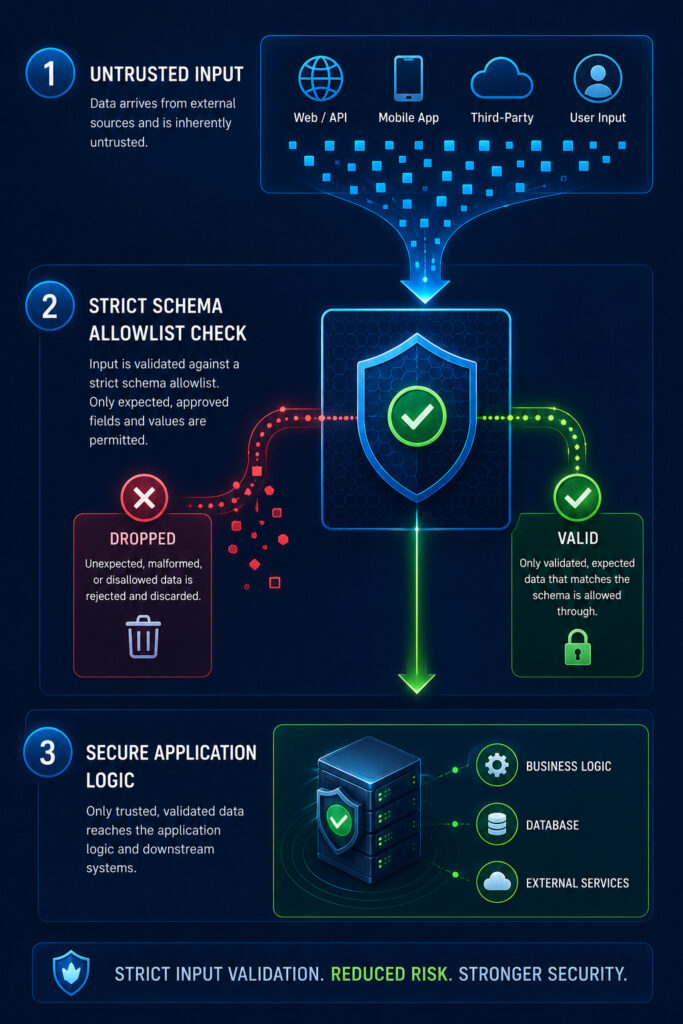
Deploying concrete examples allowlist based validation checks ensures that advanced security mechanisms stop malicious payloads before they ever reach core database logic. By enforcing strict schema rules, modern applications maintain a resilient security posture across every system entry point.
Furthermore, this proactive filtering layer stops malicious actors from exploiting parsing quirks, type juggling, or unexpected data formats during runtime execution.
- Strict data typing ensures malicious SQL or command strings are dropped immediately at the application edge.
- Pre-defined length restrictions prevent buffer overflow attempts and unexpected memory exhaustion.
- Canonical character enforcement neutralizes cross-site scripting (XSS) payload delivery attempts.
Why Is Allowlisting Inherently More Secure?
Transitioning from reactive filters to positive verification reveals fundamental architectural advantages in modern security engineering. When developers implement concrete examples allowlist based validation checks, they establish an absolute baseline of trust that ignores any parameter failing to match pre-approved structural definitions. This approach completely eliminates the blind spots inherent in traditional blocklisting models.
For a deeper architectural comparison, exploring our guide on why allowlisting is more secure than denylisting illuminates how positive validation safeguards complex backend microservices from unforeseen zero-day exploit vectors. By forcing all incoming data streams through rigid evaluation pipelines, systems maintain absolute clarity and predictability under heavy production loads.
- Pre-approved schemas ensure that only structurally verified parameters pass into internal application logic.
- Deterministic boundary checking eliminates ambiguity during string parsing and variable type conversion.
- Proactive filtering significantly reduces the attack surface across distributed cloud environments.
FAQ
Why use examples allowlist based validation checks?
They enforce positive verification by permitting only pre-approved data formats, completely blocking unexpected injection payloads.
How do allowlists prevent directory traversal?
By mapping input identifiers to fixed server paths, unauthorized directory navigation attempts are safely rejected.
Are regular expressions safe for allowlists?
Yes, provided the expressions define exact start and end anchors to enforce strict character set boundaries.
Should allowlists run client or server side?
Validation must execute on the server side to prevent attackers from bypassing browser checks via direct API requests.
Does schema validation replace sanitization?
Strict schema verification eliminates the need for unpredictable sanitization by rejecting bad data upfront.
Securing Enterprise Applications Through Proactive Verification
Embracing proactive verification architectures is essential for ensuring enduring software resilience against evolving cyber threats. Relying on outdated reactive blocklists leaves production systems vulnerable to creative encoding bypasses and severe injection attacks.
Engineering teams must systematically transition toward strict permit models that enforce absolute boundary controls across every system layer. Mastering practical examples allowlist based validation checks guarantees absolute data integrity and safeguards enterprise networks from emerging risks.
Ready to elevate your software security standards and master advanced enterprise defense techniques now? Join the Secure Coding Practices Bootcamp to build completely secure enterprise architectures and protect critical production systems permanently.
References
- https://cwe.mitre.org/data/definitions/20.html
- https://csrc.nist.gov/pubs/sp/800/218/final