


The input validation denylist approach risks expose modern enterprise software to severe security vulnerabilities and bypass vectors. When engineering teams rely solely on blocking known malicious patterns rather than defining permitted inputs, applications remain inherently fragile.
At Secure Coding Practices, security experts emphasize that failing to recognize these architectural blind spots leaves backend systems wide open to novel injection attacks, multi-layer encoding exploits, and unexpected data corruption. Transitioning to robust validation frameworks is essential for maintaining complete application integrity and defending against persistent cyber threats.
Reactive Blacklisting Creates Unacceptable Application Security Blind Spots
Understanding the core architectural vulnerabilities of reactive filters helps engineering teams eliminate critical security flaws.
- Blocklists consistently fail against novel encoding schemes and multi-layer payload obfuscation attempts.
- Maintaining reactive filter rules introduces unsustainable overhead and provides a false sense of security.
- Transitioning to proactive allowlisting guarantees robust perimeter defense across all enterprise applications.
Why Do Reactive Filters Fail Against Modern Exploits?
When application developers rely on reactive blocklists, they assume that every malicious pattern can be anticipated and neutralized beforehand. Unfortunately, attackers constantly leverage advanced encoding schemes, character manipulation, and custom payloads that easily circumvent standard signature-matching rules.
This fundamental architectural flaw leaves backend systems exposed to unauthorized execution paths and severe data corruption. Eliminating these security gaps requires moving away from endless patch cycles and adopting robust data verification protocols.
By enforcing clear structural limits and schema boundaries before execution, engineering teams ensure that only valid, expected data ever reaches core application components.
How Do Allowlist and Denylist Models Differ in Execution?

Evaluating validation strategies requires analyzing how effectively each model scales across enterprise architectures. While restriction models attempt to blacklist dangerous strings, they fundamentally misunderstand the nature of untrusted data by chasing an infinite list of potential threats.
When engineering teams review comprehensive comparisons such as allowlist vs denylist validation, the operational superiority of positive security models becomes evident. Positive schemas ensure that every input adheres strictly to pre-defined specifications before processing begins.
Adopting this structural shift eliminates chronic security vulnerabilities completely.
| Validation Strategy | Core Mechanism | Security Posture | Maintenance Overhead |
| Denylist Model | Blocks known bad patterns | Reactive / Fragile | High (Constant updates) |
| Allowlist Model | Permits pre-approved inputs | Proactive / Robust | Low (Stable schema rules) |
Why Do Flawed Validation Mechanics Expose Systems to Exploitation?
When developers implement weak inspection boundaries, they often fail to account for how improperly verified data interacts with downstream services. This architectural oversight creates major security blind spots that malicious actors can easily exploit to execute unauthorized operations or manipulate application state.
Recognizing these systemic flaws requires understanding standardized vulnerability definitions established by global security authorities. Industry frameworks explicitly categorize these structural weaknesses as fundamental validation failures that threaten software reliability and data integrity:
“The product receives input or data, but it does not validate or incorrectly validates that the input has the properties that are required to process the data safely and securely.” – MITRE CWE-20
Addressing these vulnerabilities demands an immediate transition away from reactive restrictions toward comprehensive, structured schema definitions. By enforcing strict boundaries at every application entry point, organizations eliminate the core risks associated with improper input handling and safeguard critical deployments.
How Can Engineering Teams Eliminate Denylist Vulnerabilities?
Credits: TechInFive
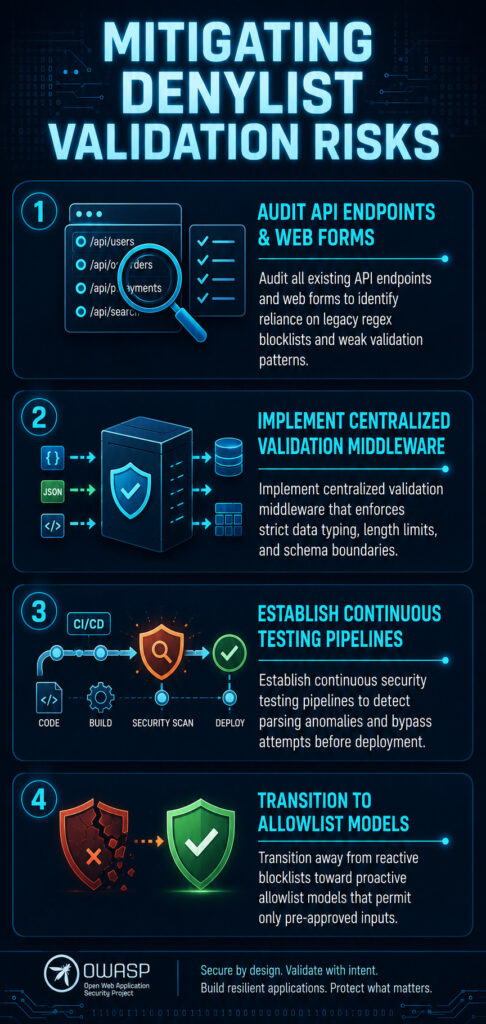
Addressing the hidden dangers of reactive filtering requires a systematic overhaul of application entry points. Development teams can explore comprehensive guidance on securing application inputs to transition effectively toward modern defensive architectures and eliminate legacy security debt.
- Audit all existing API endpoints and web forms to identify reliance on legacy regex blocklists.
- Implement centralized validation middleware that enforces strict data typing and length limits.
- Establish continuous security testing pipelines to detect parsing anomalies before deployment.
Why Do Regulatory Standards Mandate Robust Input Verification?
Modern compliance frameworks and regulatory bodies increasingly penalize organizations that rely on fragile security controls like blocklists. Because threat actors continuously discover novel ways to bypass signature-based filters, auditors look for proactive architectural defenses that enforce strict structural parameters across every system boundary.
Federal and industry guidelines stress that protecting enterprise data requires continuous adherence to established security baselines rather than reactive patching. Comprehensive documentation from government standards organizations underscores the critical importance of secure parameter handling:
“Organizations shall ensure that information system interfaces mitigate input validation vulnerabilities by employing rigorous control parameters and secure coding standards.” – NIST Special Publication 800-53
Implementing these stringent control guidelines ensures that applications maintain verifiable integrity even under aggressive probing by sophisticated adversaries. By aligning internal software development lifecycles with recognized security publications, engineering teams eliminate systemic blind spots and build resilient architectures capable of withstanding advanced cyber threats.
How Do Legacy Blocklists Compromise API Security?

APIs processing raw JSON or XML payloads become highly vulnerable to parameter tampering when they rely exclusively on reactive blocklists.
- Failure to inspect deeply nested data structures allows hidden payload injections to reach backend databases.
- Inconsistent string decoding across microservices creates multiple entry points for malicious query execution.
- Lack of strict type enforcement permits attackers to swap data types and bypass application logic.
Why Is Character Encoding Crucial for Effective Allowlisting?
Ensuring proper character normalization prevents attackers from smuggling malicious payloads past input filters. For a deeper breakdown of these mechanisms, review the guide on character encoding validation allowlist.
- Normalize all multi-byte character strings to canonical Unicode forms prior to applying validation checks.
- Reject inputs containing mixed-encoding or ambiguous byte sequences instantly at the application gateway.
- Maintain strict character set definitions to ensure filters cannot be bypassed via URL encoding or hexadecimal obfuscation.
FAQ
Why are denylists considered reactive rather than proactive?
Denylists wait for known attack patterns to emerge before adding them to a blocklist, leaving systems entirely unprotected against novel zero-day exploits and custom payloads.
What happens when an attacker uses alternative character encodings?
Alternative encodings like hexadecimal or unicode allow malicious strings to bypass superficial blocklist filters completely while still being interpreted correctly by backend databases.
How does maintaining a blocklist impact development team productivity?
Constantly updating regex patterns and block rules creates massive operational overhead and diverts valuable engineering time away from core feature development.
Can input sanitization make up for denylist vulnerabilities?
Basic sanitization often strips or replaces characters inconsistently, leaving complex parsing ambiguities that sophisticated threat actors can still manipulate.
What is the most effective alternative to denylist validation?
Implementing a strict allowlist approach explicitly permits only verified, safe data schemas and structures, rejecting all unknown inputs by default.
Comprehensive Verification Strategies Ensure Lasting Digital Defense
Eliminating input validation denylist approach risks is absolutely essential for maintaining robust enterprise application security across all production environments. Relying on reactive blocklists leaves software deployments permanently vulnerable to novel encoding bypasses, complex multi-layer obfuscation, and persistent cyber threats.
Engineering teams must systematically transition away from fragile filtering models toward structured, proactive verification architectures that enforce strict boundary controls across every system layer.
Ready to elevate your software security standards and master advanced enterprise defense techniques? Join the Secure Coding Practices Bootcamp to build bulletproof architectures and secure your critical systems against modern cyber threats right now every single day.
References
- https://cwe.mitre.org/data/definitions/20.html
- https://nvlpubs.nist.gov/nistpubs/SpecialPublications/NIST.SP.800-53r5.pdf