


Mastering the input validation allowlist approach explained thoroughly is essential for engineers aiming to build secure web applications that handle untrusted user inputs safely. When development teams construct robust input filters, they effectively prevent malicious injection attempts and unauthorized resource access across all cloud infrastructure environments.
At Secure Coding Practices, security specialists stress that implementing precise verification rules eliminates common architectural blind spots. Choosing strict permit lists over traditional restriction lists ensures applications maintain absolute boundary controls, protecting underlying systems against evolving cyber threats and sophisticated bypass vectors efficiently every single day to guarantee resilience.
Core Implementation Principles Drive Strict Allowlist Security
Proper enforcement of structural constraints ensures that backend systems reject malicious inputs reliably.
- Prioritize explicit permit lists to ensure that only pre-approved data structures cross system boundaries.
- Eliminate reliance on fragile restriction lists that leave applications exposed to complex encoding bypasses.
- Enforce canonicalization routines to neutralize multi-layer payload obfuscation attempts before data processing.
Why Do Traditional Restriction Lists Fall Short Against Advanced Threats?
Relying on blacklists or traditional restriction lists creates a false sense of security for modern development teams. Because attackers continuously discover novel ways to encode payloads or bypass character filters, trying to block every known bad pattern is fundamentally unsustainable.
When security architects evaluate system vulnerabilities, they find that permit-based mechanisms provide superior protection. By defining what is explicitly permitted rather than attempting to guess every possible malicious variation, applications achieve a much higher level of boundary defense against modern injection techniques.
How Does Permit-Based Verification Compare to Legacy Filtering Methods?
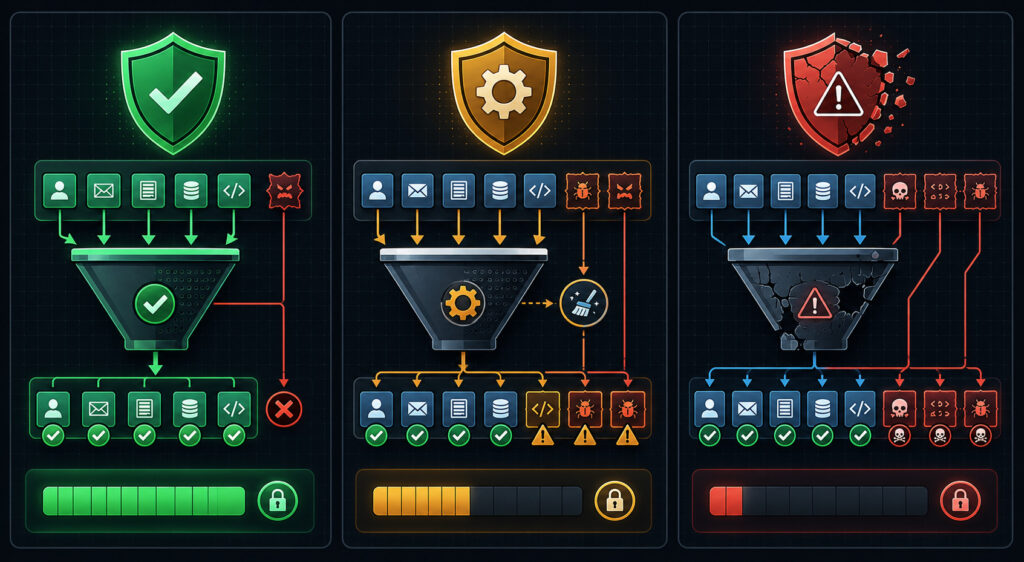
When developers thoroughly review the input validation allowlist approach explained, they discover how structural permits completely outperform fragile denylists by enforcing strict baseline schemas before any data processing occurs.
| Strategy Layer | Core Mechanism | Security Reliability |
| Allowlist Model | Permits only pre-approved inputs | High (Blocks unknown payloads) |
| Denylist Model | Blocks known malicious strings | Low (Vulnerable to bypasses) |
| Sanitization Routine | Modifies or strips unsafe characters | Medium (Prone to encoding flaws) |
What Standards Recommend Allowlisting for Secure Application Architecture?
When designing secure enterprise frameworks, architecture guidelines mandate strict verification controls to prevent unauthorized data manipulation. Adopting rigorous permit-based paradigms ensures that applications meet modern regulatory compliance benchmarks and maintain robust perimeter defense.
“Applications shall verify all input against a data dictionary or specific structural criteria (whitelisting/allowlisting) rather than a blacklist.” – OWASP Application Security Verification Standard
What Are the Core Risks Associated With Denylist Validation?
Credits: CodeLucky
When engineering teams rely solely on reactive filtering methods, they often overlook critical input validation denylist approach risks that can compromise overall system security. Because malicious actors constantly invent new obfuscation techniques and bypass strategies, attempting to block bad inputs leaves applications inherently vulnerable to unauthorized data manipulation.
- Failure to account for alternative character encodings and multi-layer payload obfuscation vectors.
- High maintenance overhead required to continuously update blocklists with newly discovered attack signatures.
- False sense of security that misleads teams into believing complete boundary protection has been achieved.
Why Is Comprehensive Input Sanitization Insufficient Without Strict Allowlist Boundaries?
When developers attempt to secure web forms and API endpoints, relying solely on basic sanitization routines often leaves subtle parsing flaws unaddressed. Establishing rigorous schema checks guarantees that only well-formed, anticipated data structures ever reach the application backend, neutralizing unexpected injection vectors.
“The product receives input or data, but it does not validate or incorrectly validates that the input has the properties that are required to process the data safely and securely.” – MITRE CWE-20
How Do Developers Enforce Strict Validation Rules?

Establishing a reliable defense framework guided by the core principles of the input validation allowlist approach explained requires clear mapping between expected data schemas and incoming application requests. When engineering teams build these structured layers, they eliminate the ambiguities that typically lead to severe injection vulnerabilities in modern web architectures.
Implementing these verification routines ensures that every parameter is thoroughly checked before execution occurs. To maintain this level of robust security across distributed systems, development teams should follow core architectural practices:
- Enforce strict length limits and explicit character type restrictions on all incoming form fields.
- Normalize and decode data payloads completely prior to executing any underlying validation logic.
- Reject non-compliant requests instantly with standardized error handling codes to prevent execution.
How Do Security Frameworks Compare Different Validation Strategies?
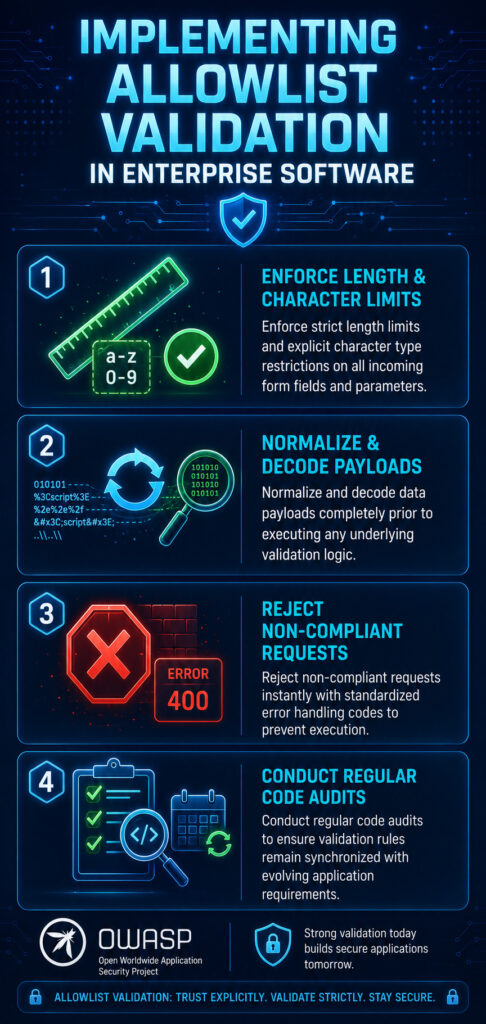
When architecture teams evaluate application security models, contrasting allowlist vs denylist validation as detailed in any complete input validation allowlist approach explained framework clarifies why permit-based models provide superior defense against modern web vulnerabilities and unexpected data tampering attempts.
- Evaluate architectural complexity and maintenance effort before deploying validation schemas across production environments.
- Prioritize positive security models that reject unapproved inputs by default across all API endpoints and database boundaries.
- Conduct regular code audits to ensure validation rules remain synchronized with evolving application requirements and threat intelligence updates.
FAQ
What is the input validation allowlist approach?
The input validation allowlist approach explained across modern security documentation is a practice that explicitly permits only recognized, safe data types, formats, and characters, rejecting everything else by default.
Why is an allowlist preferred over a denylist?
An allowlist is much more secure because it blocks unknown or novel attack vectors, whereas denylists are easily bypassed by alternative encodings and newly discovered payloads.
How does allowlist validation protect against code injection?
By enforcing strict schema and structural boundaries, allowlists prevent malicious code snippets or scripts from reaching backend execution logic.
What are the main challenges when implementing allowlists?
The primary challenge is maintaining up-to-date validation rules as application data structures evolve, which requires careful planning and regular code reviews.
Can allowlists be used for all types of user inputs?
Yes, allowlists can be applied across form fields, URL parameters, API payloads, and headers to ensure strict boundary validation throughout the entire application.
Comprehensive Verification Strategies Ensure Lasting Digital Defense
Embracing the input validation allowlist approach explained ensures that enterprise applications remain resilient against sophisticated injection attacks and unexpected parameter manipulation. While legacy denylists leave backend systems exposed to clever encoding bypasses, strict permit-based verification models establish unyielding boundary controls across all application layers.
Engineering teams must systematically replace fragile blocklists with proactive, structure-driven validation frameworks to protect critical deployments from emerging threats successfully.
Ready to elevate your software security standards and master advanced enterprise defense techniques? Join the Secure Coding Practices Bootcamp to build bulletproof architectures and secure your critical systems against modern cyber threats right now every single day.
References
- https://owasp.org/www-project-application-security-verification-standard/
- https://cwe.mitre.org/data/definitions/20.html