


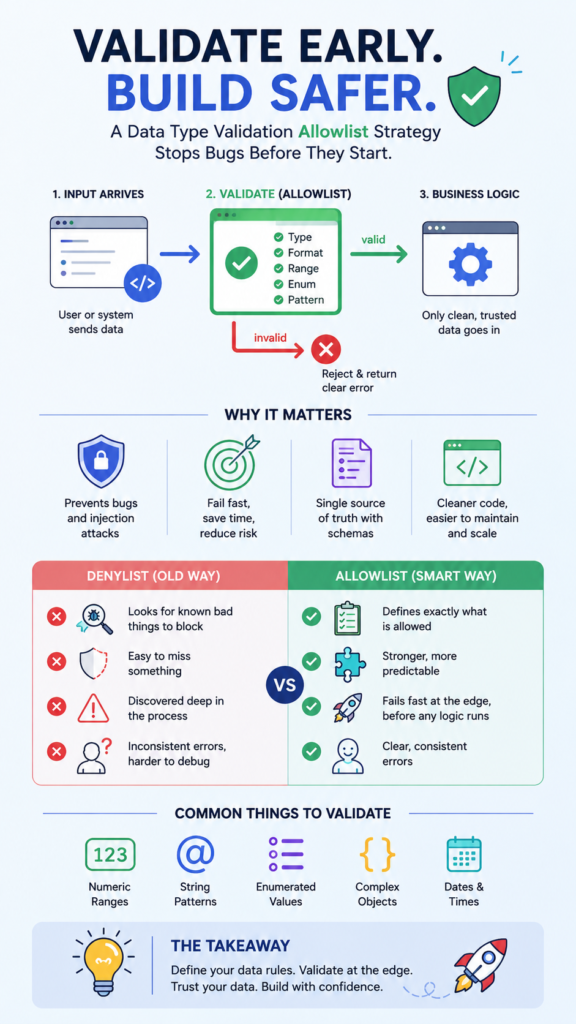
A data type validation allowlist strategy helps ensure every piece of data entering your application matches predefined rules before it reaches your business logic. Instead of relying on assumptions, developers explicitly define what is acceptable, making software more secure and predictable.
At Secure Coding Practice, we encourage this proactive approach because preventing invalid input is far easier than fixing the problems it creates later. Keep reading to learn how strict data validation builds stronger applications.
Why This Strategy Matters
Adopting a data type validation allowlist strategy creates a strong foundation for secure and reliable software. Here are the most important benefits:
- An allowlist strategy defines explicit, strict rules for data before it enters your business logic, preventing type-related bugs and injection attacks at the source.
- Implementing this with centralized schemas (like Zod or Yup) creates a single source of truth, ensuring consistency and drastically reducing human error across all application layers.
- This approach is a cornerstone of secure coding, shifting development from reactive debugging to proactive design, making systems inherently more predictable and maintainable.
What Is a Data Type Validation Allowlist?

Think of your application as a machine with specific input slots. One slot only accepts round pegs, another only square pegs. A data type validation allowlist is you defining the exact shape and size of those pegs. It’s not just checking if something is a “number.” It’s declaring: “This input must be a positive integer between 1 and 100.”
Or: “This field must be a string that is a valid email address. The “allowlist” part means you are listing the allowed types and constraints. Anything not matching is rejected immediately. This approach is fundamentally different from denylist validation, which attempts to block only known bad input instead of defining exactly what is allowed.
This is a stark contrast to the common, fragile approach of assuming data will be correct and writing logic to handle “just in case” scenarios.
That approach scatters defensive checks throughout your code. The allowlist strategy consolidates defense at the border. It’s the difference between checking every door in a building individually versus having one secure, well-guarded main entrance.
We moved to this after one too many undefined is not an object errors in production. The problem wasn’t our logic; it was that our logic received data we never anticipated.
Why Is This Strategy More Effective Than Checking Later?
Many developers add validation inside their functions. A processOrder function might start by checking if itemId is a number. This seems responsible, but it scales poorly. Every function needs its own checks. Worse, the error is discovered deep in the workflow, often after some side effects have already occurred.
The allowlist strategy validates data at the point of entry, before any business logic touches it. An API request is validated against a schema the moment it hits the route handler. If the data is invalid, the request fails fast with a clear error. The core application code can now operate under a guarantee: the data it works with already conforms to the rules.
This eliminates whole categories of bugs. It makes code simpler, because functions don’t need to be paranoid about their inputs. It also provides consistent error messaging to users or calling services right at the boundary.
The efficiency gain is massive. You’re not finding bugs during complex operations; you’re preventing invalid data from ever starting the journey.
How Do You Implement This in a Real Project?
It starts with choosing a tool for defining schemas. We use Zod now, but the concept applies to any library. You don’t write validation logic in your route handler. You define a schema object separately.
const UserRegistrationSchema = z.object({
username: z.string().min(3).max(20).regex(/^[a-z0-9_]+$/),
email: z.string().email(),
age: z.number().int().min(13).max(120),
subscriptionTier: z.enum([‘free’, ‘pro’, ‘enterprise’])
});
This schema is your allowlist. It’s a declarative, readable contract. In your API route, you call UserRegistrationSchema.parse(incomingData). This function either returns a perfectly typed, validated data object or throws a detailed validation error. All your validation logic is in one place.
The rest of your codebase consumes data that is guaranteed to match these types and rules. This pattern works for frontend forms, API inputs, and even data read from a database or file. You establish a validation layer at every system boundary.
Where Does This Fit in Secure Coding Practices?
In our secure coding practices, this is step one. It’s the “input validation” pillar, and we treat it as non-negotiable. Secure code isn’t just code that avoids SQL injection; it’s code that behaves predictably. Unvalidated data is the root cause of injection attacks, logic flaws, and system crashes.
“When building secure software, allowlisting is the recommended minimal approach. Denylisting is prone to error and can be bypassed with various evasion techniques and can be dangerous when depended on by itself. Even though denylisting can often be evaded, it can often be useful to help detect obvious attacks. So while allowlisting helps limit the attack surface by ensuring data is of the right syntactic and semantic validity, denylisting helps detect and potentially stop obvious attacks.” – SocketDev
By rigorously defining and enforcing data types, you eliminate the ambiguity that attackers exploit. A field expecting a number that receives a string can lead to strange type coercion, which can sometimes be leveraged. A field expecting an enum that receives an arbitrary value can break your state machine.
For text inputs, combining strict schemas with character encoding validation further reduces the risk of malformed or unexpectedly encoded data slipping through application boundaries.
This strategy is the foundation. Other practices, like parameterized queries or output encoding, rely on working with known-good data. You can’t safely build a SQL query if you’re not sure if the userId is actually a number or a piece of malicious script.
We frame it as a design requirement, not a security add-on. The schema is part of the feature specification.
What Are Common Data Types to Allowlist?
Credits: DataResearchLabs
You apply this strategy to every piece of external data. Common examples form the backbone of robust applications.
- Numeric Ranges: Not just number, but integer between 1 and 5. This prevents invalid state like a 5-star rating system receiving a 10.
- String Patterns: email, URL, phone number, hex color code. Use regex to define the exact allowed format.
- Enumerated Values: enum(‘pending’, ‘shipped’, ‘delivered’). This is the purest allowlist, literally listing allowed options.
- Complex Objects: Nested schemas that define the required shape of JSON payloads, ensuring all required fields exist and are of the correct type.
- Dates and Times: Validating that a string is a parseable ISO 8601 date and that it falls within a sensible range (e.g., not a birthdate in the future).
The following table illustrates the shift in approach for a user profile update API:
| Validation Aspect | Old Way (Ad-hoc Checks) | Allowlist Strategy |
| Age Field | Check in function: if (typeof age !== ‘number’) throw error; | Schema: age: z.number().int().min(13).max(120) |
| Email Field | Maybe send a confirmation email to check? | Schema: email: z.string().email() |
| Status Field | if (status !== ‘active’ && status !== ‘inactive’) {…} | Schema: status: z.enum([‘active’, ‘inactive’]) |
| Error Location | Error thrown deep inside business logic function. | Validation fails immediately at API route, before any logic runs. |
| Code Clarity | Validation logic mixed with business logic, harder to read. | Validation is declarative and separate; business logic is clean. |
This systematic approach turns vague requirements into executable contracts.
How Do You Handle Complex or Nested Data Structures?
Real-world data is rarely flat. You have arrays of items, nested objects, optional fields. The strategy scales elegantly to handle this. You build schemas compositionally. Define a ProductSchema with its own rules. Then, an OrderSchema can include a line items field defined as z.array(ProductSchema).
This validates that every item in the array matches the product rules. For optional fields, you use .optional() or .nullable() explicitly. This forces you to decide: is this field optional, or does it need a default value? That decision is part of the contract. The validation library will enforce it.
For conditional logic (e.g., if paymentType is ‘creditCard’, then cardNumber is required), advanced schema libraries allow you to define these relationships declaratively. The validation logic can become complex, but its complexity is isolated in the schema definition, not strewn across your application’s functions.
This keeps your core application logic clean and focused on what to do, not on whether the data is valid enough to do it.
What Are the Pitfalls and How to Avoid Them?
Even with a well-designed schema, a few common mistakes can reduce its effectiveness. Many of these problems also appear when teams rely too heavily on denylist validation, where overlooked edge cases and bypass techniques can leave unexpected gaps. Here are the most important ones to watch for:
- Inconsistent validation across systems
If your API and frontend use different validation rules, users may submit data successfully only to have it rejected by the server. Share the same schema across both whenever possible. - Overly restrictive schemas
Rules that are too strict can block legitimate user input. Define schemas based on real business requirements and document important decisions, such as optional fields and default values. - Unnecessary performance concerns
Schema validation is usually much faster than database queries or network requests. The small overhead is worth the reduction in bugs and security risks. Profile your application if performance is a concern.
“The rule the whole chapter rests on: every byte that enters your process from the network is hostile until a schema has touched it. Validate at the edge, parse into a typed object, and pass that typed object, not the raw req.body , into the rest of the handler. If a value never gets validated, assume an attacker put it there.” – Github
Start with simple validation rules, establish a consistent pattern, and expand to more complex scenarios as your application grows.
How Does This Strategy Scale in a Large Application?

This is where the strategy pays its highest dividends. In a large codebase with many developers, ad-hoc validation leads to subtle bugs and security gaps. With an allowlist strategy, you build a shared vocabulary. You have a schemas/ directory. There’s a UserSchema.ts, an OrderSchema.ts.
When a new feature needs user data, the developer imports UserSchema. The validation rules are consistent everywhere. Changes are managed in one place. If the business says “usernames can now have hyphens,” you update the regex in UserSchema.ts.
This change automatically applies to the registration form, profile edit API, and admin user import tool. It also becomes a form of documentation.
A new developer can look at the schemas to understand the core data models and their constraints without reading a dozen controller files. Scaling this practice requires initial discipline and good patterns, but it reduces long-term complexity and bug counts dramatically.
It transforms data validation from a repetitive chore into a structured, maintainable part of your architecture.
FAQ
Doesn’t this create duplication if I need validation on both frontend and backend?
It can, but the best practice is to avoid duplication. Use a validation library that can run in both environments (like Zod) and share the schema definition itself. If that’s not possible, some frameworks allow you to generate frontend validation code from your backend schemas. The goal is a single source of truth.
What about data coming from my database? Should I validate that too?
Yes, at the application layer. Your database has its own constraints (NOT NULL, UNIQUE), but you should still validate data as it leaves your database layer and enters your application logic, especially if it’s from a legacy system or a third-party API. Treat your own database as an external boundary.
This seems like a lot of boilerplate for simple forms. Is it worth it?
For a single, simple throwaway form, maybe not. But applications grow. That simple form often becomes complex. The few minutes spent defining a schema upfront save hours of debugging later when a new field is added incorrectly. It’s an investment in stability.
Can’t I just use TypeScript for this?
TypeScript is fantastic for developer experience and catching errors at compile time, but it’s a development tool. It doesn’t exist at runtime. A malicious API request doesn’t care about your TypeScript interfaces.
Runtime validation via an allowlist schema is essential for security and data integrity. Use both: TypeScript for development, runtime schemas for execution.
The Predictability of Defined Contracts
A data type validation allowlist strategy creates software that is predictable, maintainable, and resilient by enforcing clear data contracts from the start. Instead of reacting to unexpected input, developers can focus on building features with confidence, knowing only valid data reaches application logic.
To strengthen these skills in real-world development, join the Secure Coding Practices Bootcamp. Through hands-on labs and practical secure coding techniques, you’ll learn to build safer applications from day one.
References
- https://socket.dev/pypi/package/validate-it/overview/0.11.2/tar-gz
- https://github.com/batuhan-satilmis/api-security-checklist/commit/881b35c4c1c8c8a001dc252dedbdb5092c6d1b26