


Importance of Server-Side Validation. Don’t trust the browser. It’ll tell you a form is fine, that the input looks good, then send garbage to your server. The real check happens on your turf. Server-side validation is that final, unskippable gatekeeper. It’s not an add-on. It’s the foundation for keeping your data clean, your app secure, and staying in charge.
This is a core part of our Secure Coding Practices. If you care about what actually runs your site, this step isn’t optional. Keep reading to understand why.
Backend Validation in Brief
Together, these practices ensure your backend remains the trusted source of truth while keeping your application secure, reliable, and resilient.
- Server-side validation is the final security boundary because it enforces rules that users cannot bypass.
- It protects your application from malicious input, injection attacks, and business logic errors before processing begins.
- A strong validation strategy combines whitelist rules with framework-based validation to verify every incoming request consistently.
Why Can’t This Backend Checkpoint Be Skipped?
Client-side checks are a courtesy, easily turned off by a user or attacker. The real enforcement happens on our server, which is why server-side validation remains essential. We’ve reviewed student projects where a frontend price validation failed because the server didn’t re-check.
The rule is simple: never trust client input. For our training, this is foundational. It ensures data integrity, keeping databases accurate. It’s a critical security filter, blocking malformed data that could lead to SQL injection or other attacks. It guarantees consistency, applying the same rules to every request from any source. Our server must be the final authority.
As highlighted by DWP Security Standard
“All data inputs must be validated on a trusted system (e.g., the server, not the client).” – DWP Security Standard
| Responsibility | What It Does | Security Benefit |
| Business Rule Enforcement | Applies the same validation rules to every request | Prevents invalid or unauthorized operations |
| Malicious Input Detection | Rejects tampered or unexpected data before processing | Reduces SQL injection and other attack risks |
| Data Integrity Protection | Ensures only valid data reaches the application and database | Improves system reliability and data quality |
Why Is Browser-Side Validation Only an Illusion of Safety?
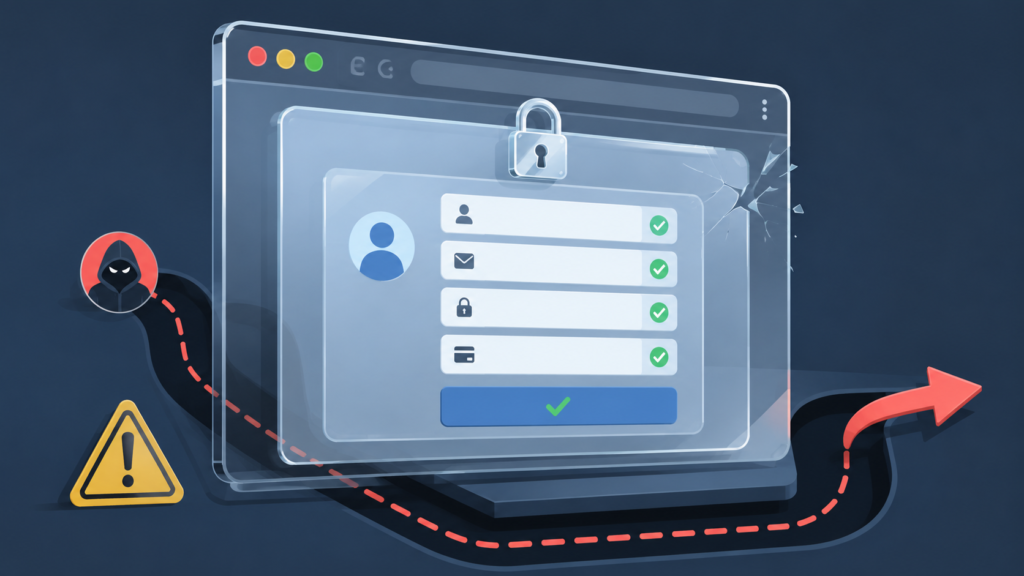
We still use it for a better user experience, although client-side and server-side validation serve very different purposes. It gives quick feedback and stops some bad requests. But we teach it’s a convenience, not a control.
Bypassing client-side validation is trivial. In our labs, students disable JavaScript in seconds. They open browser tools (F12), edit the live HTML, and delete validation. Or they skip the browser entirely, using curl or Postman to send any data directly to the server endpoint.
The core issue is control. Client-side code runs on the user’s machine, in an environment we don’t own. We provide rules, but we can’t enforce them there. The server is our ground. The checks that run on our servers are the only ones that are mandatory.
How Do You Build Strong Backend Validation Patterns?
Credit: Mustapha Botchway
Building strong validation means assuming all incoming data is guilty until proven clean.
In our Java training, we demonstrate server-side validation in Java with annotations on model objects. Here’s an example EmployeeDto:
public class EmployeeDto {
    @NotBlank(message = "First name is required")
    private String firstName;
    @Email(message = "Must be a valid email address")
    private String email;
    @Min(value = 18, message = "Must be at least 18 years old")
    @Max(value = 65, message = "Must be 65 or younger")
    private int age;
}
With @Valid in the controller, these rules are checked automatically. For complex logic, like checking database uniqueness, we write custom validators.
In PHP, the principle is the same, and server-side input validation in PHP starts by never trust $_POST.
$email = filter_var(trim($_POST['email']), FILTER_VALIDATE_EMAIL);
$age = filter_var($_POST['age'], FILTER_VALIDATE_INT, ["options" => ["min_range"=>18, "max_range"=>65]]);
if (!$email) { $errors[] = "Invalid email."; }
if ($age === false) { $errors[] = "Age must be 18-65."; }
// Proceed only if $errors is empty
The goal is to transform raw input into a safe, known format.
Why Is Whitelisting Better Than Blacklisting?
Many developers start by listing what to block like stripping SQL keywords or <script> tags. This blacklist approach is a losing game; attackers are too creative.
We push for whitelist validation. Define only what you allow. For a “status” field, only accept “active”, “inactive”, or “pending”. For a “username”, use a rule like: lowercase letters, numbers, underscores, 3-20 characters. Input that doesn’t match exactly is rejected.
Research from STIG Viewer shows
“Whitelisting is the stronger of the two policies for restricting software program execution.” – STIG Viewer
The method is simple:
- Define the exact, narrow format for acceptable input.
- Reject anything that doesn’t fit this positive pattern.
- Check for type, length, range, and format.
This moves you from blocking bad things to allowing only good things. It’s a more robust logic for preventing injection by stopping unexpected data before it reaches your queries.
| Validation Approach | How It Works | Security Impact |
| Whitelisting | Accepts only predefined valid input | Strong protection against unexpected input |
| Blacklisting | Blocks only known malicious patterns | Can miss new or modified attack techniques |
| Best Practice | Combine strict whitelisting with validation rules | Creates more reliable backend security |
Where Do Backend Validation Efforts Commonly Go Wrong?

Even with the best intentions, common server-side validation mistakes still happen. One of the biggest is doing validation too late. If you clean data after it’s already been used in a log statement or an error message, you might be too late to prevent an attack. Input validation and sanitization should be the very first thing you do with incoming data.
Another is leaking information in error messages. Telling a user “the email ‘admin@example.com’ is already registered” is useful for a legitimate user. Telling an attacker the same thing confirms that the account exists. Generic messages like “login failed” are safer.
Perhaps the most insidious mistake is forgetting that everything from the client is suspect. This includes hidden form fields, auto-incrementing IDs in URLs, JSON Web Tokens (if you’re not cryptographically verifying them), and prices pulled from “data-” attributes in the HTML. If it came from the request, it must be validated or re-fetched from your server’s authoritative source.
How Can Frameworks Simplify Backend Validation?
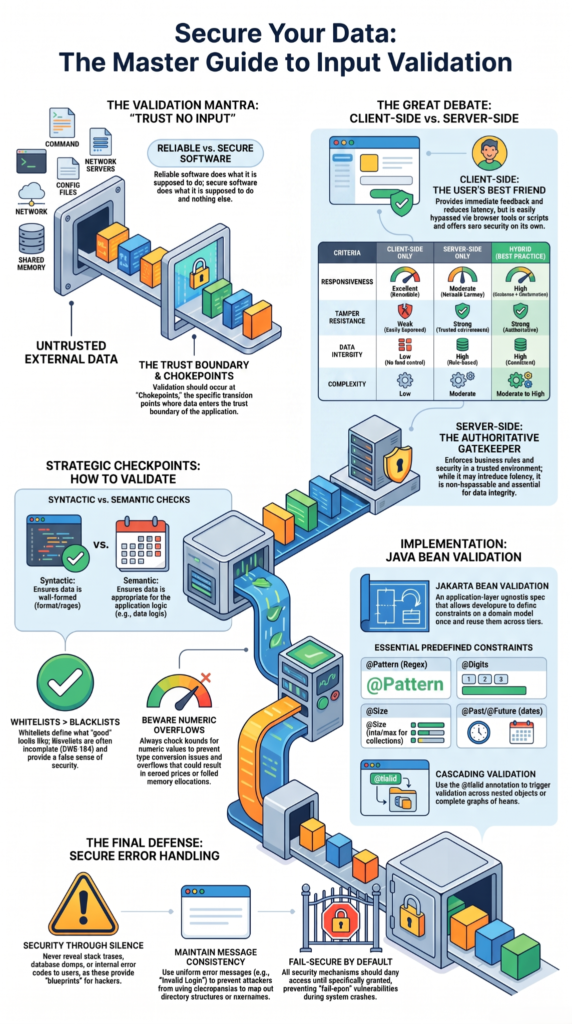
You don’t have to write every if statement from scratch. Modern frameworks are built with this need in mind. In Java Spring, the @Valid annotation and validator API handle the bulk of the workflow. In PHP, frameworks like Laravel have a rich, fluent validation system built into its Form Request objects.
// Laravel example
$validated = $request->validate([
    'title' => 'required|unique:posts|max:255',
    'body' => 'required',
    'publish_at' => 'date|after:today',
]);
These frameworks standardize the process, reduce boilerplate code, and help prevent oversights. They also deliver the benefits of robust server-side validation through consistent rule enforcement. The key is to use them consistently, on every route that accepts input.
FAQs
Why should I validate hidden fields instead of trusting them?
Hidden fields can be modified through hidden field tampering, price tampering, or ID tampering. Server-side validation, authorization checks, and business logic validation ensure that every submitted value is legitimate before processing.
How can stronger validation improve secure forms?
Strong validation combines type checking, length checks, format checks, mandatory fields, and request validation. These validation rules improve data integrity, support secure coding, and block malicious input before processing.
What should I validate besides standard form fields?
You should validate GET parameters, POST data, HTTP requests, cookies, headers, and uploaded files. Browser validation alone cannot stop browser bypass, request tampering, or other attempts to submit malicious input.
When should input sanitization happen during request processing?
Input sanitization should occur immediately after receiving user data. After sanitizing input, apply server-side checks, input filtering, and validation rules before processing or storing the data safely.
How does robust validation reduce long-term security risks?
Robust validation reduces the attack surface, strengthens application security, improves data consistency, and supports exploit prevention by enforcing security controls on every request handled by the trusted server.
Build Trust with Strong Server Side Validation
Server side validation is what keeps your application safe when it matters most. Every request deserves careful checks, because trusting input without verification can lead to costly mistakes. Make validation a standard part of every feature, not something you add later.
If you want to build secure coding habits with hands-on practice, the Secure Coding Practices Bootcamp helps developers apply server side validation and other essential security skills in real projects.
References
- https://assets.publishing.service.gov.uk/media/64c3d1597aea5b000d6a8e37/dwp-ss003-security-standard-software-development.pdf#3#2
- https://www.stigviewer.com/controls/nist-800-171/3.4.8
Related article
- https://securecodingpractices.com/input-validation-sanitization/
- https://securecodingpractices.com/why-server-side-validation-crucial/
- https://securecodingpractices.com/client-side-vs-server-side-validation/
- https://securecodingpractices.com/bypassing-client-side-validation-easily/
- https://securecodingpractices.com/implementing-server-side-validation-java/
- https://securecodingpractices.com/server-side-input-validation-php-examples/
- https://securecodingpractices.com/preventing-injection-server-side-validation/
- https://securecodingpractices.com/never-trust-client-input-rule/
- https://securecodingpractices.com/benefits-robust-server-side-validation/
- https://securecodingpractices.com/common-server-side-validation-mistakes/
- https://securecodingpractices.com/frameworks-server-side-validation-help/