
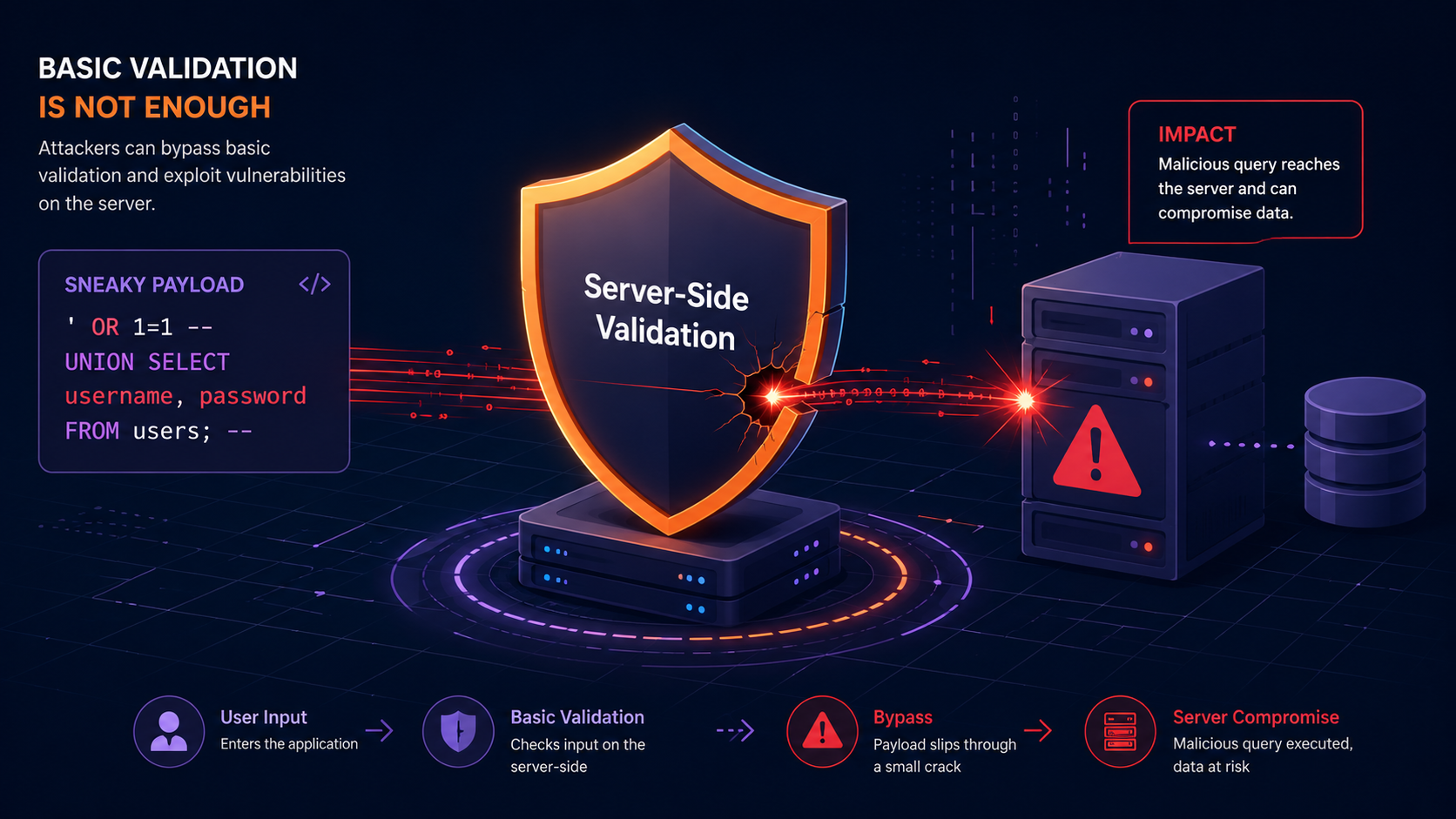

Preventing injection server side validation starts with one rule: never trust user input as code. But checking input alone won’t stop injection attacks. Server-side validation checks if data follows your application’s rules. Parameterization prevents data from being treated as code. Both matter, and one can’t replace the other. That’s a mistake people still make.
Secure Coding Practices rely on using both together. Keep reading to see why this pairing matters and how to build a defense that holds up.
Quick Reads – Injection Defense Essentials
Preventing injection server side validation requires more than checking input. These practices show why multiple security controls work together to stop injection attacks.
- Validation defines what data is, while parameterization defines what data can do.
- Custom character blacklists and regex filters are often ineffective. They fail against encoding tricks. They can also cause usability issues.
- A secure backend relies on layered defenses. This includes strict allowlist validation, parameterized queries, and least-privilege access.
What is the “O’Brien” Trap and why do custom character blacklists fail?
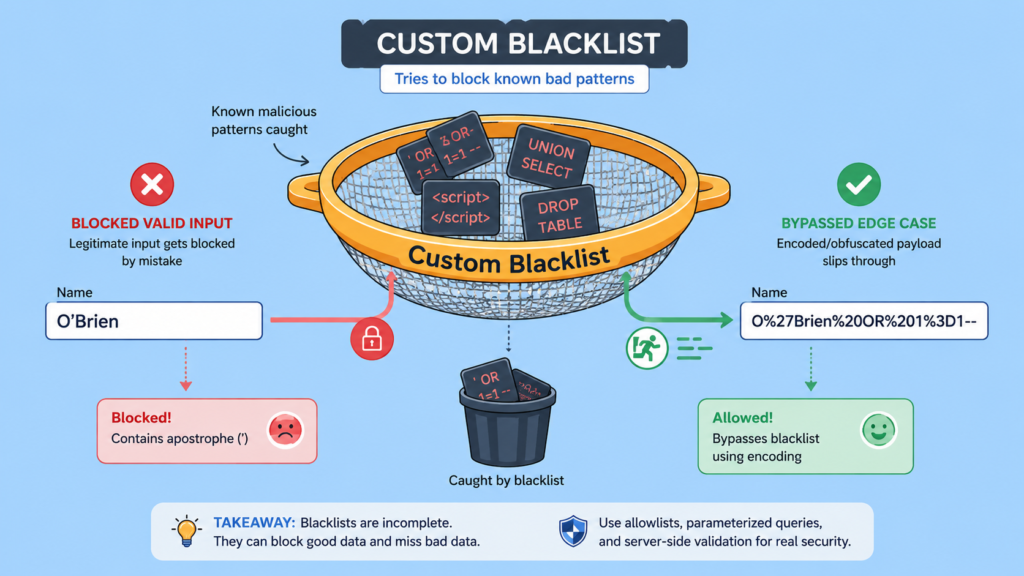
Someone removes every single quote from user input, thinking it will stop SQL injection. Then a user named O’Brien signs up, and the application turns the name into Obrien. The rule gets loosened. An attacker finds the new opening. We’ve watched this pattern repeat, and it rarely ends well.
In one of our training labs, we also tried keyword blocklists. The list kept growing, but new encoding tricks made it outdated faster than we could update it. That was enough to change how we approached input handling. Blocklists don’t age well.
As highlighted by SEI-CERT
“Denylisting is an ineffective approach to input validation because attackers are constantly developing new and unexpected methods of specifying dangerous characters. It is difficult to enumerate all possible characters and combinations that could be used in an attack.” – SEI-CERT
- Rejects valid names like O’Brien
- Bypassed with encoding tricks
- Needs constant maintenance
- Creates false confidence
The better question isn’t, “Is this dangerous?” Ask, “Is this exactly what we expect?” Cast numbers to integers, validate emails against an accepted format, and allow only valid input, including in PHP applications. That’s the habit we teach because it holds up when attackers change tactics.
What is the Defense-in-Depth Blueprint?
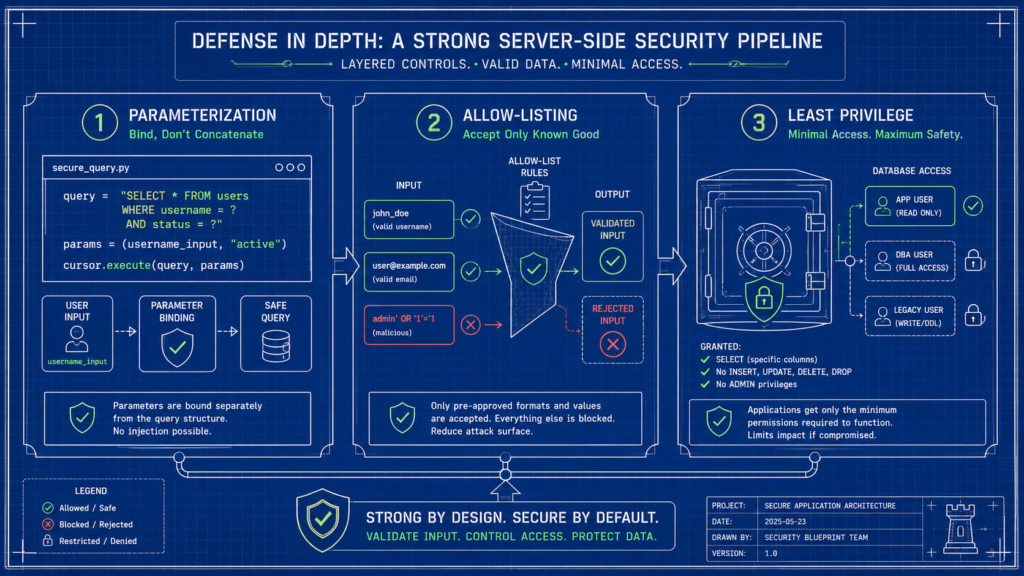
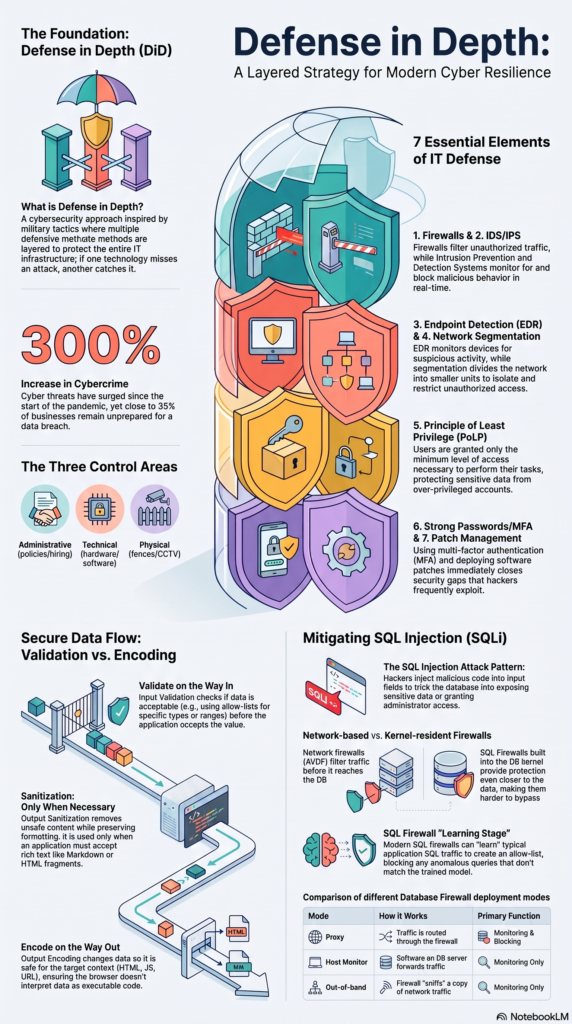
Secure applications require layers. This prevents one error from causing a complete breach. Input validation checks data. Parameterized queries separate code from data. Least privilege restricts attacker actions. This layered approach is effective in real-world projects.
Research from Department of Defense shows
“No single security capability provides complete protection. Effective security requires defense-in-depth strategies that integrate multiple, complementary controls so that the failure of any single protection mechanism does not result in a successful compromise.” – Department of Defense
We’ve also seen developers trust validation alone. It isn’t enough. Prepared statements send the SQL template and user input separately, so even payloads like ' OR '1'='1 stay as data instead of becoming executable code. The same idea applies to system commands. Pass arguments through trusted APIs, not shell strings.
Core Defensive Layers:
- Parameterized queries
- Strict allow-listing
- Least privilege
Server-side validation still matters. It catches invalid types, oversized input, or malformed emails before the application uses them. But it isn’t the vault door. Think of it as the first checkpoint while the other layers keep the application secure if that checkpoint is ever bypassed.
How can server-side JavaScript and command injections be mitigated beyond SQL?
Injection isn’t limited to SQL. Injection isn’t limited to SQL.Some developers move to MongoDB, thinking the risk is gone. However, any interpreter can be a target. Server-Side JavaScript Injection (SSJI) is an example.
If user input goes into eval() or a MongoDB $where clause, attackers can run JavaScript on the server.
Our secure development training had an exercise. A $where query accepted a user-supplied function. It returned every document. This demo was memorable.
The fix was simple. Avoid $where clauses controlled by users. Use built-in operators like $eq or $gt. These treat input as data, not code.
// Dangerous

exec(`ls ${userInput}`);

// Safer

execFile('ls', [userInput]); // Arguments stay separate
The same rule applies to system commands. Use APIs that separate commands from arguments instead of building shell strings. Keep code and data apart. That’s the habit we encourage because it works across SQL, NoSQL, and the operating system.
What is the conflict between input cleaning and context?
Data travels through many application parts. Each part handles data differently. Some teams clean data only at the start. They then assume it’s safe everywhere. This is incorrect.
Data that works for a database might still be dangerous. This is especially true when it reaches HTML or a template engine.
In a training lab, a string like “Hello ${7*7}” passed validation. It caused no problems when stored in the database. However, the same value later reached a template engine. The engine evaluated it instead of displaying it. This changed our explanation of validation to students.
The solution is context-aware protection. Validate data for integrity at the application’s edge. Then, encode or parameterize it where it is used. HTML needs HTML encoding. URLs need URL encoding. Databases need parameterized queries. The defense must match the destination.
| Destination | Recommended Protection | Why It Matters |
| SQL database | Parameterized queries | Keeps user input separate from SQL commands. |
| HTML page | HTML encoding | Prevents browsers from executing injected scripts. |
| URL | URL encoding | Ensures reserved characters are interpreted safely. |
| Operating system command | Safe APIs with separated arguments | Prevents user input from becoming executable shell commands. |
| Template engine | Context-aware escaping | Stops template expressions from being evaluated as code. |
How can internal APIs be defended against server-side parameter pollution?
Credit: Bug Bounty Base
Internal APIs receive less attention. However, attackers do not distinguish between public and private endpoints. Teams often secure public access points. They may leave connections between services unprotected.
Server-Side Parameter Pollution occurs when applications create internal requests. They combine user input with query strings.
In a security exercise, a search value like peter%26limit=1 altered an internal request. It changed limit=100 to multiple limit parameters. The outcome varied by backend framework. This could weaken access controls. It might also reveal extra data.
The fix is simple in principle: treat internal services like external ones. Use HTTP clients that safely handle parameters instead of manual string building. Validate again when the receiving service parses the data, not client-side validation alone. Every hop matters. Our training emphasizes that trust should never break between services.
FAQs
How does canonicalization improve server-side validation security?
Canonicalization standardizes input. This happens before server-side validation. It works with input normalization. It also works with allowlist and data validation. This ensures reliable rules. It improves secure input handling. It stops hidden values from bypassing security.
When should business logic validation happen after input validation?
Apply business logic validation after input validation accepts data. The application should then check authentication. It should check authorization. It should check access control. This confirms the request follows business rules. It protects the trusted boundary.
Why aren’t prepared statements enough for injection prevention?
Prepared statements reduce injection risks. Bound parameters also help. Query separation helps too. However, they cannot check if input is expected or appropriate. Combine them with server-side validation. Use strict typing. Use parameter validation. This strengthens injection prevention.
How can APIs strengthen validation against malicious payloads?
Applications strengthen API validation. They combine request validation. They use payload validation. Schema validation is important. Length and range checking are also key. These server-side checks reject untrusted input. They protect data integrity. They block malicious payloads before processing.
What makes a validation pipeline more resilient to new attacks?
A strong validation pipeline combines several elements. It uses validation middleware. Secure defaults are important. Fail-closed behavior is crucial. Error and exception handling are needed. Anomaly detection helps. Defensive coding is also necessary. These practices reduce the attack surface. They improve application security. They support consistent backend security.
Build a Stronger Backend With Layered Security
When your backend handles untrusted input, one weak point can create serious problems. Relying on one security check isn’t enough.
A layered approach helps you build safer systems with fewer gaps. The Secure Coding Practices Bootcamp helps developers learn practical methods to apply secure coding habits and protect applications from common threats.
References
- https://cmu-sei.github.io/secure-coding-standards/sei-cert-oracle-coding-standard-for-java/rules/input-validation-and-data-sanitization-ids/ids08-j/
- https://dodcio.defense.gov/Portals/0/Documents/Library/(U)ZT_RA_v2.0(U)_Sep22.pdf