
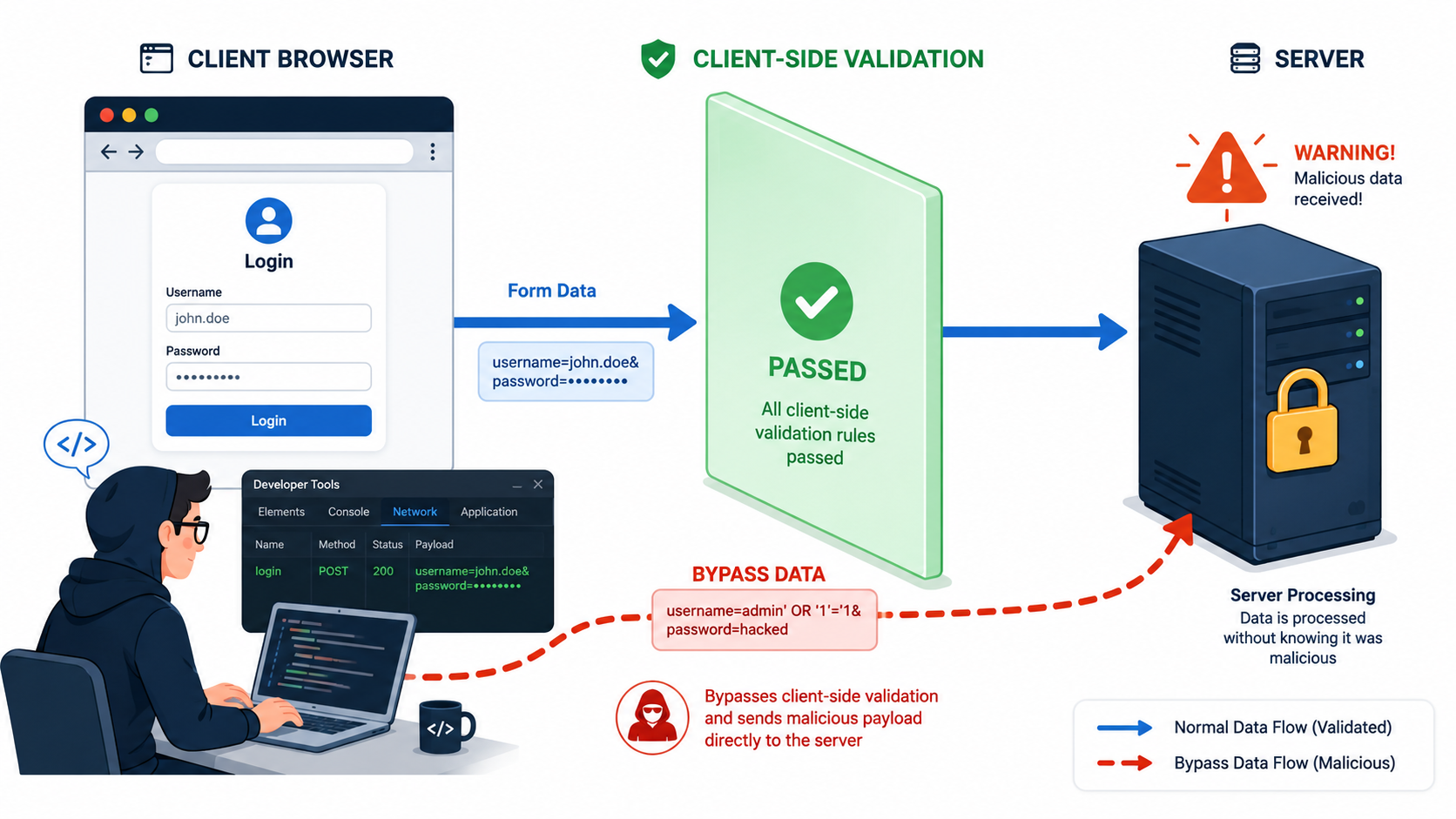

Bypassing client side validation easily? It’s a fact, not a debate. The user controls their browser. They can disable JavaScript, edit HTML, or submit crafted data directly to your server. We see it daily in testing a price change, a role elevated, all with a browser’s developer tools. This guide shows those simple bypass methods.
The goal is to understand the real trust boundary. At Secure Coding Practices, we reinforce that boundary with definitive, authoritative server-side validation. The real security must live there. See how, and why, in the rest of this guide.
Quick Recap – Trust the Server, Not the Browser
Together, these points show why secure applications always rely on server-side validation while using client-side validation only to improve usability.
- Client-side validation improves user experience, but it should never be treated as a security control.
- Any validation performed in the browser can be modified, disabled, or bypassed by an attacker.
- Server-side validation is the only reliable way to verify every request and protect your application.
What Tools Are Already Built Into Your Browser?
You don’t need special software. The tools are built into your browser. We open Developer Tools (F12) in our classes. The “Elements” panel shows the live DOM. See maxlength="100" or disabled="true"? Right-click, edit the HTML, and remove it. The field is now open.
For JavaScript validation, go to the “Console” tab. Type validateForm = function() { return true; } and every check passes. For keystroke checks, set a breakpoint in “Sources” to pause and skip. It’s a sandbox, and the user holds the keys.
As noted by NIST
“Client-side validation, including the use of JavaScript and hidden form fields, shall not be considered a security control. Such measures are easily bypassed and provide no assurance of the integrity or authenticity of the submitted data.” – NIST
| Browser Tool | What It Can Do | Security Impact |
| Elements Panel | Edit HTML attributes and hidden fields | Bypasses client-side restrictions |
| Console | Override JavaScript functions | Disables client-side validation logic |
| Network Tab | Replay or modify requests | Sends tampered data to the server |
This basic method works every time. It proves any check trusting the browser can be broken.
What if you can’t disable the validation?
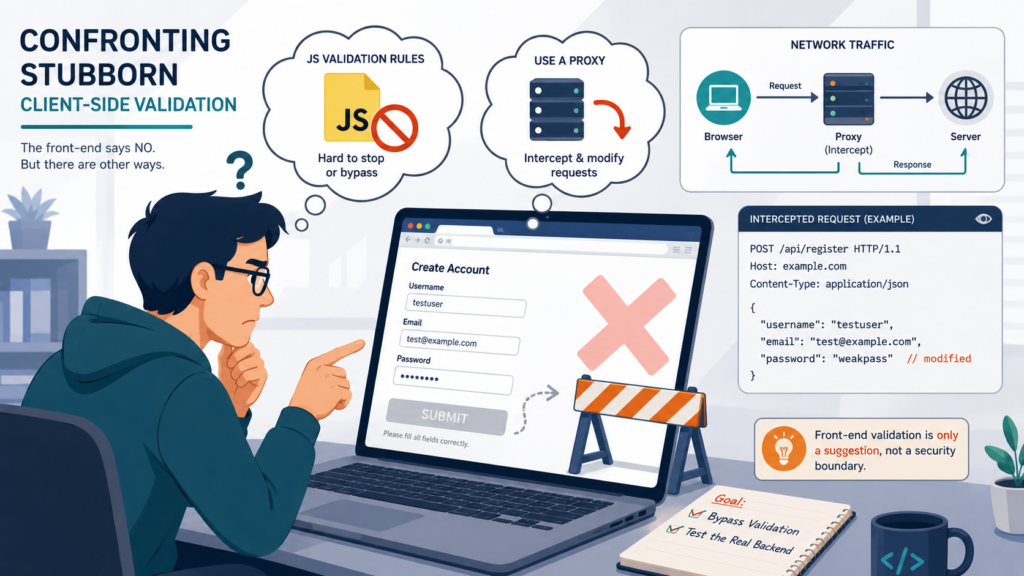
You intercept it. Proxies like Burp Suite or OWASP ZAP catch the request. We configure a browser to route traffic through them. You submit a form, but the request lands in the proxy’s “Intercept” tab.
It’s raw text. Change total_price from 100.00 to 1.00. Add user_role=admin. Strip client-side sanitization. Then forward it. This bypasses all frontend logic by editing its final output.
We use this method daily. It proves server-side validation. If a $1 order goes through, that’s a critical flaw. A 400 Bad Request means the backend is working. The proxy reveals the server’s real defenses.
How Can Someone Bypass the Browser Entirely?
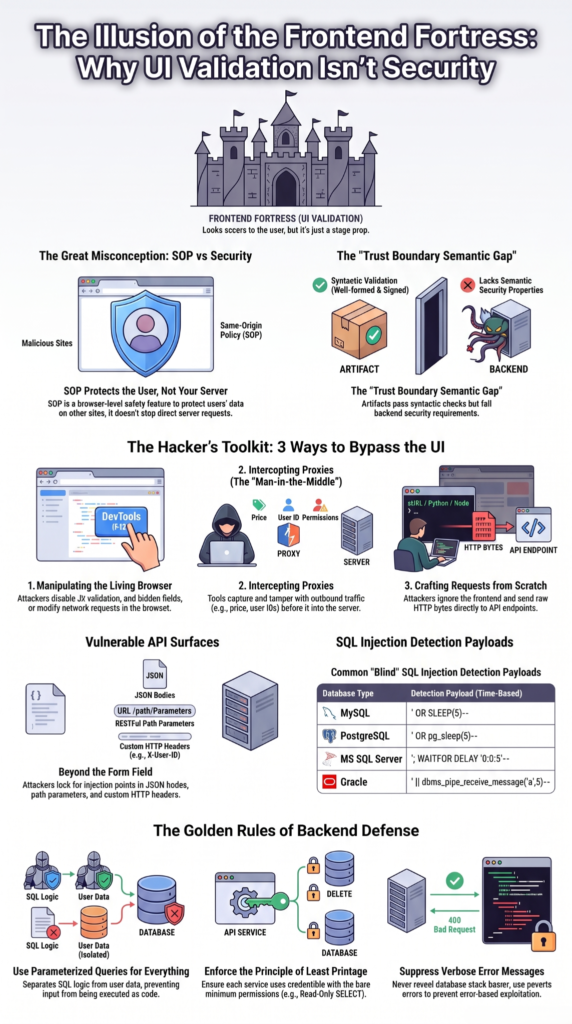
The most direct method is to ignore the browser completely. Your backend exposes endpoints just URLs. The web page is one client, but not the only one. Anyone can forge a direct API call using Postman or cURL. This request forging sidesteps the frontend entirely.
Think about a URL command posting JSON directly to your /api/createUser endpoint. Where’s the JavaScript validation? It isn’t there. The server gets the raw request. This shows the importance of server-side validation. Authentication checks must also happen on the server.
Research from MITRE CWE shows
“The product relies on client-side validation or enforcement of security-critical logic, but the server does not re-validate or re-enforce this logic. This weakness allows attackers to bypass the intended restrictions by sending crafted requests directly to the server.” – MITRE CWE
An attacker won’t use your login form; they’ll hit your authentication endpoint directly with common passwords. If your API doesn’t validate every input, a bypassed form is a minor problem.
We demonstrate this in our labs. Students send crafted requests to their own apps to see the gaps. The server is the final gatekeeper. It must act like one.
Do Modern Frameworks Really Prevent Validation Bypasses?
Credit: Learn To Troubleshoot
Modern frameworks can improve developer experience, but they do not remove the need for server-side validation. They let you define a validation schema once, promising it runs on both client and server. The trap is believing the framework handles security for you. You must explicitly ensure that schema runs on the server for every request.
A Server Action executes on the server, but if it trusts incoming data without re-validating, it’s vulnerable. The flawed logic is assuming the framework removes the need for vigilance. Backend validation must be explicit, no matter what the frontend promises.
We teach a pattern: shared validation schemas. Define rules (e.g., “valid email, 12+ character password”) in one place, like Zod. The frontend imports it for feedback.
The server imports the exact same schema to validate the request. This ensures consistency. But server-side validation is crucial; the client’s is just UX polish.
We build and break apps this way in our labs. The pattern prevents drift, but it never removes the server’s duty to run the check.
What Tricky Edge Cases Can Still Slip Through?
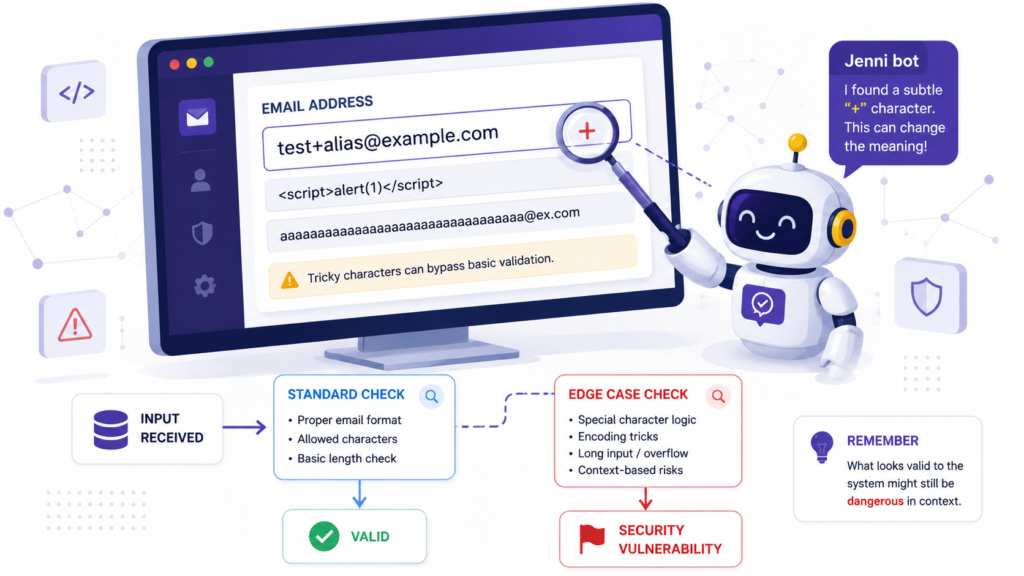
Common edge cases include:
- Client-side password hashing can complicate validation and protocol design, so the server must still validate the final submitted value and enforce authentication policy.
- UI state stored in
localStoragecan be bypassed with crafted requests. - Business rules enforced only in the front-end are easy to evade.
- Server-side validation must verify both input and business logic.
We see this in our labs. The server must validate the data and the business logic. It’s about the trust boundary between what the client shows and what the server allows.
How Do You Build a Backend That Stays Secure?
When a tampered request hits your server, your secure coding practices must respond. First, validate every input. This means request body fields, URL parameters, query strings, and headers. Use a strong validation library.
Reject anything that doesn’t match with a generic error. HTTP status codes help: use 400 Bad Requests for malformed syntax, 422 Unprocessable Entity for well-formed but invalid data. Avoid detailed error messages that reveal your rules. “Invalid request” is often enough.
| Validation Practice | Purpose | Benefit |
| Validate Every Request | Check all incoming data | Prevents malicious input from reaching business logic |
| Return Generic Errors | Avoid revealing validation rules | Reduces information disclosure |
| Log Validation Failures | Monitor rejected requests | Helps detect attacks and suspicious activity |
This is part of a broader defensive strategy. It includes input sanitization, proper authentication, and authorization. Log these validation failures. A sudden spike in validation failures may indicate probing or automation, depending on your normal traffic patterns.
We build this defense in depth in our curriculum. Even if one layer has a weakness, others provide protection. Your server-side validation is the most critical layer, the final gatekeeper before your business logic and data.
FAQs
Why should developers test for client-side validation bypass?
Developers should perform server-side validation testing because client-side validation bypass, input validation bypass, and browser validation bypass can expose insecure validation, weak validation, and client-side security flaws that attackers may exploit.
How can hidden field tampering affect application security?
Hidden field tampering, parameter tampering, and form parameter editing allow attackers to change manipulated form data. Strong server enforcement detects unauthorized input modification and prevents trust boundary violations.
Why is server-side validation important after front-end validation?
Front-end validation improves the user experience, but server-side validation verifies every request independently. It blocks malicious input, crafted payloads, request manipulation, and validation bypass before processing application data.
What makes request manipulation a common security testing technique?
Security testing uses HTTP request tampering, request replay, manual request editing, and parameter manipulation to identify insecure client logic, validation logic flaws, and insecure form handling before attackers exploit them.
How can developers strengthen validation against bypass attempts?
Developers should combine secure coding, validation hardening, defensive input validation, input sanitization, and server enforcement. This layered approach reduces validation evasion, bypass controls, and client trust issues.
Make Server Validation Your Standard
Client-side validation makes forms easier to use, but it can’t protect your application on its own. That’s the reality. Every request should be checked on the server because that’s the only place you control, no matter how someone sends data.
Want to build these skills with real coding practice? The Secure Coding Practices Bootcamp helps developers apply secure validation, authentication, encryption, and other core security skills in hands-on sessions. Join the bootcamp and start building safer applications with confidence.
References
- https://cwe.mitre.org/data/definitions/602.html
- https://pages.nist.gov/800-63-3/sp800-63b.html#sec5