
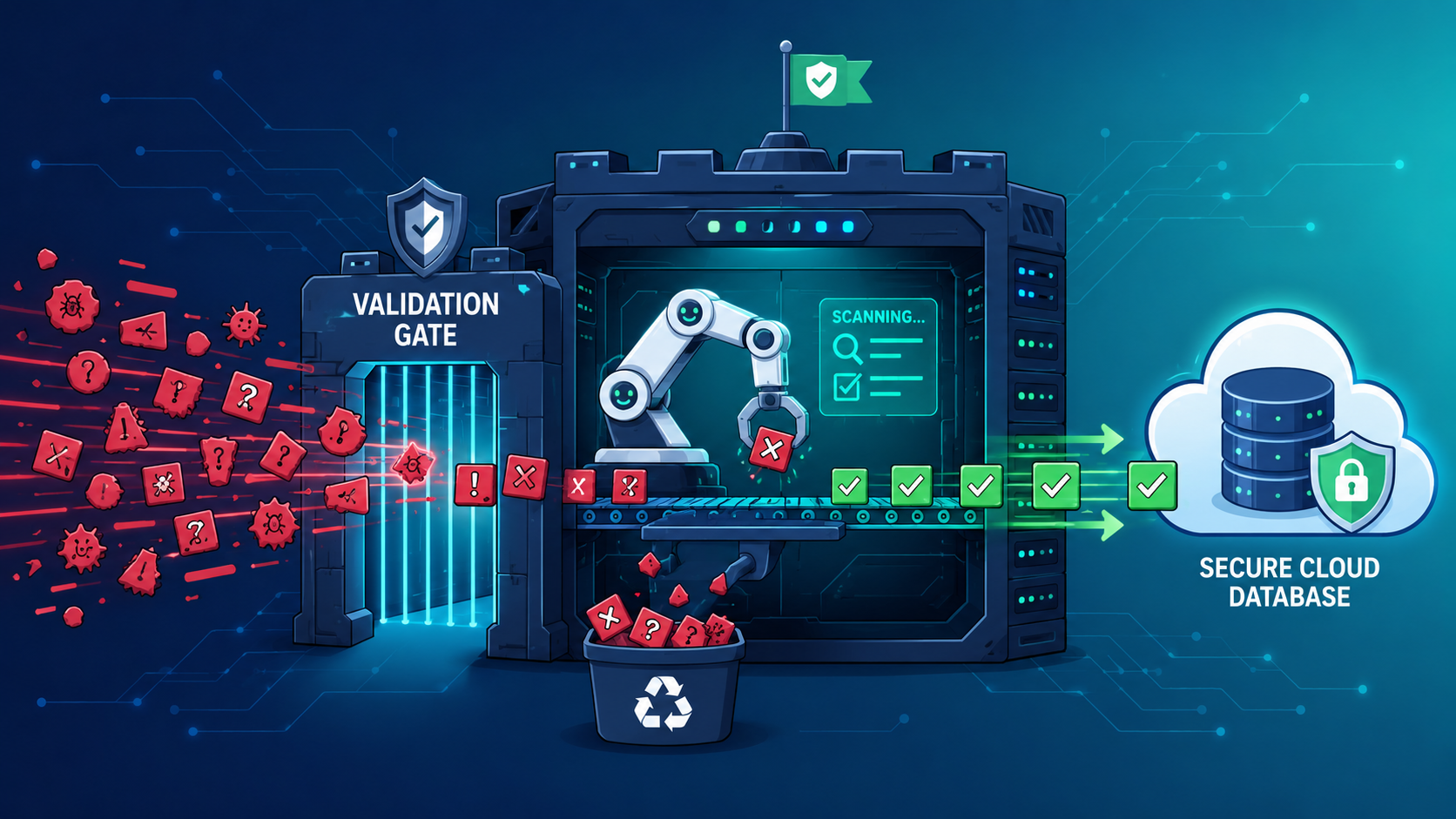

Why server side validation crucial. It’s your last defense. Think of it as the final checkpoint, the only one that truly matters. The client side is helpful, but it’s not in charge. Every bit of data coming in gets treated as a potential threat by the server.
This is a core rule for Secure Coding Practices. Skip it, and your app is vulnerable. To build anything that lasts, you have to enforce this separation. It’s not optional. Want to know why this line in the sand is absolute? Keep reading.
Server-Side Validation in a Nutshell
Together, these principles create a reliable foundation for secure applications by ensuring every request is verified before it reaches your backend.
- The client-side environment is fundamentally untrusted, so it should never be responsible for enforcing application security.
- Server-side validation is the reliable place to enforce business rules, database integrity, and authorization checks.
- A centralized validation layer keeps APIs, web applications, and other clients consistent by applying the same security checks everywhere.
Why Is Client-Side Validation Just an Illusion of Security?
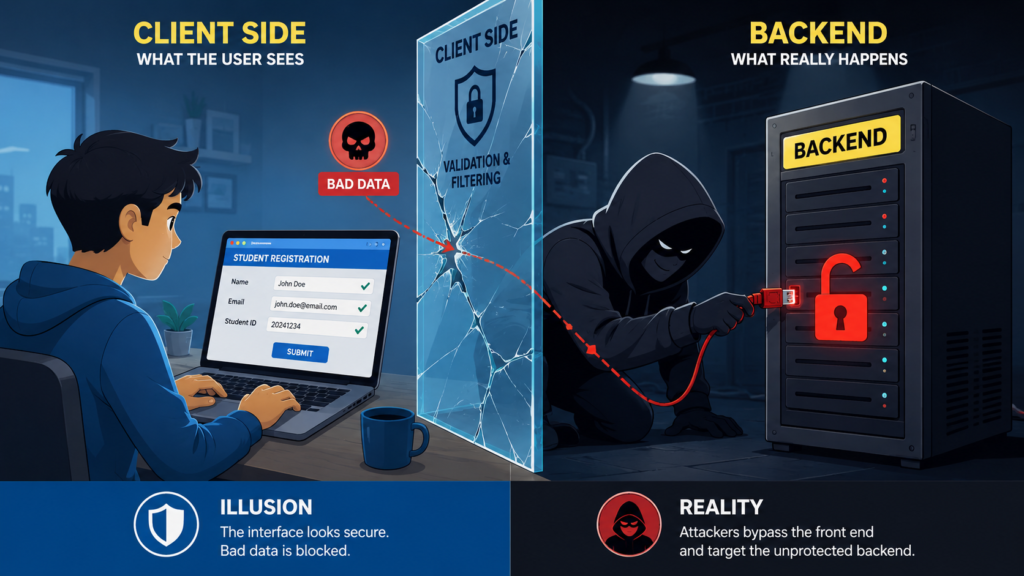
Client-side validation feels helpful. We use it for instant feedback on forms. But it’s a user experience tool, not a security one. The logic runs in the user’s browser, which they fully control.
Anyone can open DevTools, making bypassing client-side validation surprisingly easy. They can send data directly to our server API using a script, completely bypassing our form. The server can’t tell where the request came from.
That’s the trust boundary. Everything from the client is untrusted input. Server-side validation is the real enforcement that happens after that line.
Research from DWP Security Standard shows
“All data inputs must be validated on a trusted system (e.g., the server, not the client).” – DWP Security Standard
Try this quick test:
- Open Chrome DevTools.
- Right-click a form field and select “Inspect”.
- Delete the
requiredattribute in the panel. - Submit the form. The validation is gone.
This takes a few seconds. It proves front-end rules are just suggestions. They improve usability but provide zero security. Relying on them is a major flaw in our secure coding practices. We must assume the client-side checks are already broken.
How Does Server-Side Validation Enforce Business Logic and Application State?
Client-side code can check if a quantity is a positive number. But it can’t check our stock levels. That requires a live database query, which only the server can handle that race condition and prevent overselling. This is about enforcing real business rules, not just data format.
Is an email already registered? Does a user’s account have the correct status for a refund? Can this user modify that specific record? The client has an old snapshot. The server knows the current truth, reinforcing the importance of server-side validation for every request.
| Client-Side Checks | Server-Side Validation | Why It Matters |
| Validates basic input formats | Verifies live business rules and database state | Prevents invalid transactions |
| Runs in the user’s browser | Runs in the trusted backend | Cannot be bypassed by users |
| Improves user experience | Protects application security and data integrity | Ensures every request is verified |
We fixed a bug where users could apply a coupon multiple times. The front-end button was disabled, but the backend API had no-check. A script replayed the request, draining the promotion budget. The solution was a server-side database query. The front-end rule was for UX. The backend rule was for security and correctness.
How Does Server-Side Validation Stop SQL Injection and XSS?
Stopping attacks like SQL injection and XSS is the core reason for server-side validation. Injection flaws have long been a major class of web-security risk in OWASP guidance.
A front-end login form checks if a username is empty. An attacker bypasses it, sending ' OR '1'='1 directly to the server. If the server blindly uses this in a SQL string, the query always returns true. The attacker logs in, often as an admin.
Client-side checks are useless here. Server-side validation stops it. We use libraries to define strict patterns for input, rejecting dangerous payloads immediately. We also use parameterized queries as a second defense.
| Threat | Server-Side Defense | Security Outcome |
| SQL Injection | Validate input and use parameterized queries | Prevents malicious SQL execution |
| XSS | Validate, sanitize, and safely process user input | Stops malicious scripts from being displayed |
| Tampered Requests | Apply strict validation rules before processing | Blocks unexpected or modified request data |
The same principle prevents XSS. Without server-side validation to strip out <script> tags, a malicious comment gets saved. When another user loads the page, the script runs in their browser, potentially stealing their session. The server should validate input, normalize where appropriate, encode output, and use parameterized queries for database access.
Why Should Every Client Share the Same Validation Layer?
Credit: DNN Sharp
Applications aren’t just websites anymore. You have a web app, mobile apps, and maybe a public API. If validation rules live only in your React code, you must duplicate them for iOS, Android, and partners. That’s a recipe for problems.
Duplication causes drift. A team updates the email format check on the web but forgets the mobile app. Now your backend accepts different data depending on the source, fracturing data integrity.
The fix is centralized validation. Define the rules once, on the server. Every client uses the same API endpoints, which enforce the same validation. The server is the single source of truth.
This is a core principle of secure development. It ensures uniform input handling, reducing the attack surface regardless of how many clients you have. All requests pass through the same validation layer. This builds security into the architecture, not just the UI.
How to Implement a Robust Server-Side Validation Layer?
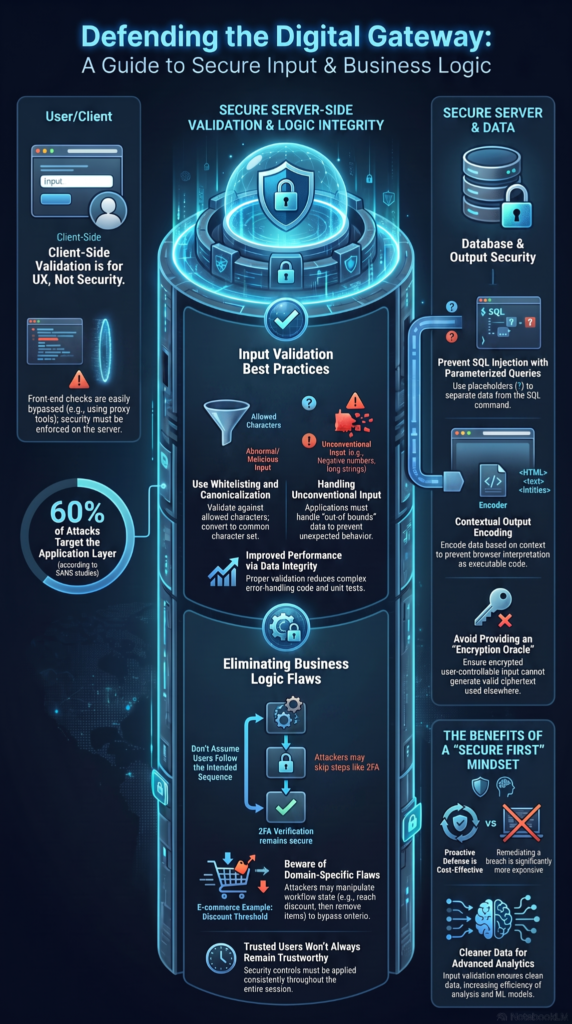
The mindset is key: treat all incoming data as untrusted until proven valid.
In practice, you intercept requests early with middleware. For a Node.js/Express app, a library like express-validator works. You define rules per route. If validation fails, the request stops before reaching your database logic.
As noted by OWASP
“Data validation must be always done on the server side.” – OWASP
For TypeScript, Zod is popular. You define a schema that acts as a single source of truth for your data’s shape. You validate request bodies against it, and the same schema can generate your TypeScript types.
const LoginSchema = z.object({
  email: z.string().email("Invalid email address"),
  password: z.string().min(8, "Password must be at least 8 characters"),
});
This server-side schema rejects invalid data. But validation isn’t just formats. After this, your code must still perform business logic checks against the database, like verifying a unique email or user permissions.
FAQs
Why is server side validation still necessary after client-side form validation?
Client-side form validation improves the user experience, but server side validation verifies every request, enforces validation rules, prevents malicious input, and protects backend security from tampered submissions.
How does server side input validation improve API security?
Server side input validation applies API request validation, request body validation, payload validation, and schema validation to ensure that only trustworthy data reaches your application and business logic.
What should I validate before processing user input?
You should validate data types, field lengths, input formats, required fields, email addresses, and business rules before processing or storing user input to maintain data integrity and application security.
How does robust validation help prevent common web attacks?
Robust validation supports SQL injection defense, XSS prevention, tampering prevention, authorization checks, and secure input handling. These practices reduce the attack surface and strengthen overall web application security.
How can I build a reliable validation layer for my application?
Build a validation layer that performs input verification, data sanitization, whitelist validation, route validation, and consistent data processing before every request reaches your backend application logic.
Server-side Validation Is Where Trust Begins
You can catch mistakes in the browser, but that’s never enough. Real protection starts when your server checks every request before it accepts it. That’s what keeps bad data out and helps your application stay reliable. Don’t assume incoming data is safe.
If you want to turn these secure coding habits into everyday practice, the Secure Coding Practices Bootcamp is a practical next step. Through hands-on labs and real development scenarios, you’ll learn how to apply input validation and other essential security skills that make a real difference.
References
- https://assets.publishing.service.gov.uk/media/64c3d1597aea5b000d6a8e37/dwp-ss003-security-standard-software-development.pdf#3#2
- https://wiki.owasp.org/index.php?title=Reviewing_Code_for_Data_Validation&diff=52246&oldid=52245