


Identifying Common Server Side Validation Mistakes is crucial for backend application security. Developers often rely heavily on frontend checks, exposing systems to critical vulnerabilities. At Secure Coding Practices, security architects analyze persistent structural flaws in data handling.
Failing to enforce strict type constraints allows malicious payloads to bypass initial defenses. Engineering teams must implement rigorous input verification directly on the server. Eliminating these errors protects enterprise databases from sophisticated injection attacks and unauthorized data access.
Critical Backend Defense Strategies
Recognizing and resolving structural data handling errors strengthens overall web application architecture.
- Relying exclusively on frontend constraints exposes backend infrastructure to direct payload manipulation.
- Missing strict type enforcement allows malicious actors to inject unexpected structural vulnerabilities.
- Implementing comprehensive server verification ensures predictable execution across all database transactions.
Why Do Common Server Side Validation Mistakes Compromise Systems?
Developers frequently misunderstand backend architecture responsibilities. Relying on client-side controls remains a critical security failure. Browsers cannot guarantee data integrity against determined adversaries.
Intercepting proxies easily bypass frontend scripts completely. Unvalidated data then enters the backend system directly. This creates severe structural vulnerabilities within core enterprise applications.
Failing to define explicit allowlists represents another widespread issue. Applications must reject unexpected input types immediately. Accepting arbitrary data formats causes unpredictable backend execution paths.
Many Common Server Side Validation Mistakes stem from incomplete type casting. Developers must validate exact length, format, and range precisely. This rigorous approach prevents dangerous memory exhaustion attacks entirely. Eliminating these specific vulnerabilities guarantees secure backend database interactions.
Why Is Addressing Common Server Side Validation Mistakes Essential?
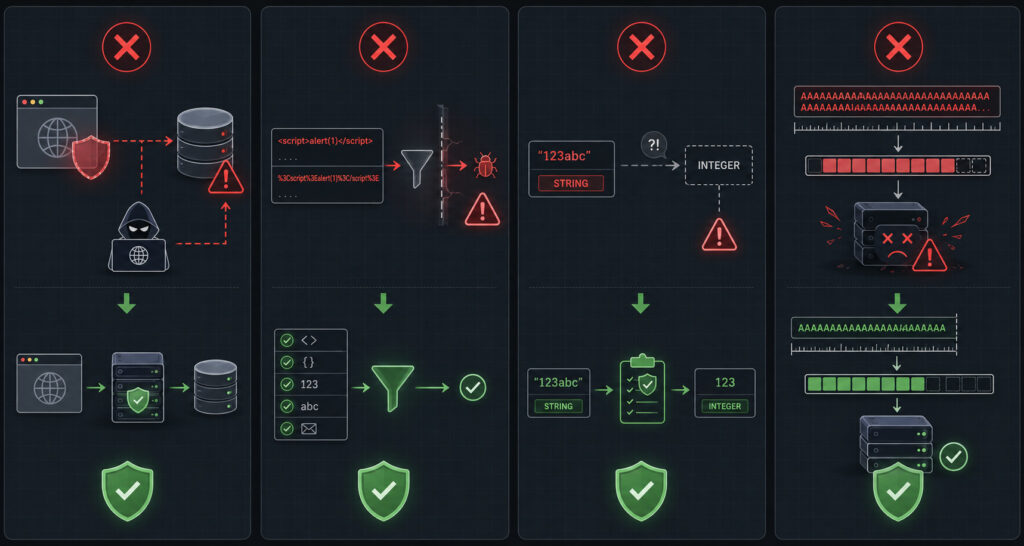
Failing to implement proper backend checks exposes core systems to severe security threats. For a comprehensive overview of fundamental protection strategies, read our guide on the importance of server side validation to strengthen your overall defense architecture.
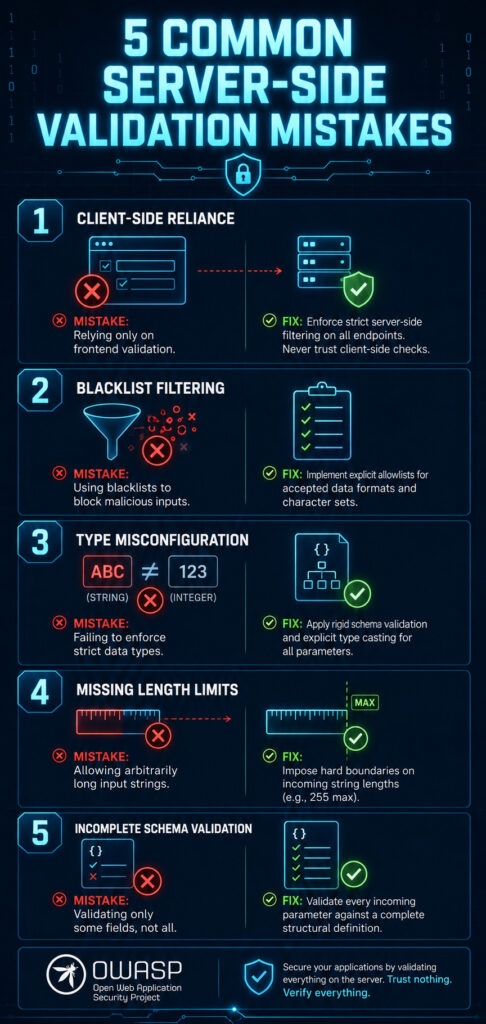
Eliminating Common Server Side Validation Mistakes requires a structured understanding of potential vulnerabilities and their corresponding mitigations.
| Validation Failure | Architectural Impact | Defensive Resolution |
| Client-Side Reliance | Complete authentication bypass | Enforce strict server-side filtering on all endpoints |
| Blacklist Filtering | Evaded via obfuscated payloads | Implement explicit allowlists for accepted data formats |
| Type Misconfiguration | Memory leaks and type confusion | Apply rigid schema validation and explicit type casting |
| Missing Length Limits | Buffer overflows and Denial of Service | Impose hard boundaries on incoming string lengths |
What Guidelines Prevent Common Server Side Validation Mistakes?
Adhering to established industry standards is essential for building resilient backend architectures. Overcoming Common Server Side Validation Mistakes requires development teams to clearly separate user experience enhancements from core security controls.
Security benchmarks explicitly highlight how to structure dual-layer validation correctly:
“Implementing both client-side JavaScript-based validation for UX and server-side validation for security is the recommended approach.” – OWASP Input Validation Cheat Sheet
How Do Attackers Exploit Common Server Side Validation Mistakes?
Cybercriminals continuously scan web endpoints for missing backend security controls. To learn how easily malicious actors override superficial browser checks, read our breakdown on by passing client side validation easily. Eliminating Common Server Side Validation Mistakes requires engineering teams to assume all client-supplied data is untrusted and hostile.
- Attackers use intercepting proxies to modify HTTP parameters before backend processing occurs.
- Disabling browser JavaScript completely renders frontend-only validation rules entirely ineffective.
- Direct API calls bypass UI constraints and deliver malicious payloads to server endpoints.
How Does Schema Enforcement Neutralize Common Server Side Validation Mistakes?
Credits: Pretty Printed
Using structured schema validation prevents structural parameter errors before backend processing occurs. Engineering teams looking to eliminate Common Server Side Validation Mistakes rely on standardized data definitions to validate complex API payloads automatically. Establishing rigid schemas guarantees that every incoming JSON object conforms strictly to predefined structural standards.
Standardized schema documentation highlights how explicit structural rules enforce data boundaries:
“You will learn everything about JSON Schema keywords through clear and examples.” – JSON Schema Reference
How Do Engineers Spot Common Server Side Validation Mistakes?
Automated security testing identifies backend input flaws early in development. Engineering teams must systematically audit API endpoints for vulnerabilities. Static analysis tools scan codebases to reveal missing sanitization steps.
Dynamic security scans simulate parameter tampering against staging environments. Catching Common Server Side Validation Mistakes during code reviews prevents high-severity exploits. Continuous monitoring ensures backend constraints remain effective as software evolves.
- Executing automated SAST scans catches unvalidated input handlers before code deployment.
- Conducting manual penetration testing uncovers logic bypasses in complex API routines.
- Writing unit tests with boundary payloads verifies backend rejection capabilities directly.
How Does Zero-Trust Architecture Prevent Validation Failures?
Modern backend development requires an absolute zero-trust model toward incoming payloads. Web applications that blindly accept data from browsers remain exceptionally vulnerable to structural exploits and business logic manipulation. To build truly resilient architectures, engineering teams must adopt the foundational never trust client input rule, ensuring that every incoming HTTP request is treated as inherently hostile.
When development teams fail to enforce complete perimeter control, they inevitably commit Common Server Side Validation Mistakes that open direct attack vectors into enterprise data stores. Enforcing comprehensive filtering on every single parameter guarantees that malformed or malicious inputs are intercepted immediately at the API boundary, long before they can execute within internal business logic.
Systematically auditing data flow patterns helps development teams eliminate weak spots and enforce strict validation rules.
- Verifying header metadata alongside payload bodies prevents parameter pollution and header spoofing attacks.
- Enforcing explicit structural allowlists blocks unexpected parameter injections across REST and GraphQL endpoints.
- Logging dropped or malformed validation requests provides real-time visibility into active intrusion attempts.
FAQ
What is the most dangerous consequence of common server side validation mistakes?
The most severe consequence is allowing unmanaged malicious input to execute on internal systems, leading to SQL injection, remote code execution, and catastrophic database breaches.
Why do developers frequently commit common server side validation mistakes?
Developers often confuse frontend user experience features with true security controls, mistakenly assuming that browser-side JavaScript checks provide sufficient protection against external threats.
How can automated tools catch common server side validation mistakes?
Static Application Security Testing (SAST) and Dynamic Application Security Testing (DAST) tools scan backend source code and simulate parameter tampering to detect missing validation routines early.
What is the difference between allowlist and denylist validation?
Allowlist validation accepts only explicitly permitted data formats and rejects everything else by default, whereas denylist validation attempts to block known bad inputs, which attackers easily evade.
How does proper schema enforcement prevent common server side validation mistakes?
Schema enforcement defines precise structural, type, and length constraints for incoming API payloads, automatically rejecting malformed requests before any backend application logic processes them.
Eliminate Backend Validation Risks
Eliminating Common Server Side Validation Mistakes is vital for safeguarding modern software applications against persistent cyber threats. Relying on frontend controls creates dangerous security gaps that attackers easily exploit. Engineering teams must implement strict data type checks, schema limits, and centralized verification logic across all backend API endpoints.
Defensive programming ensures enterprise databases remain isolated from malicious parameter manipulation and severe payload injection vectors. Elevate your software development protocols and master modern defense strategies with hands-on technical training.
To strengthen your architectural capabilities and build resilient systems, join our secure coding bootcamp today to eliminate backend flaws completely.
References
- https://cheatsheetseries.owasp.org/cheatsheets/Input_Validation_Cheat_Sheet.html#client-side-vs-server-side-validation
- https://json-schema.org/understanding-json-schema/reference