
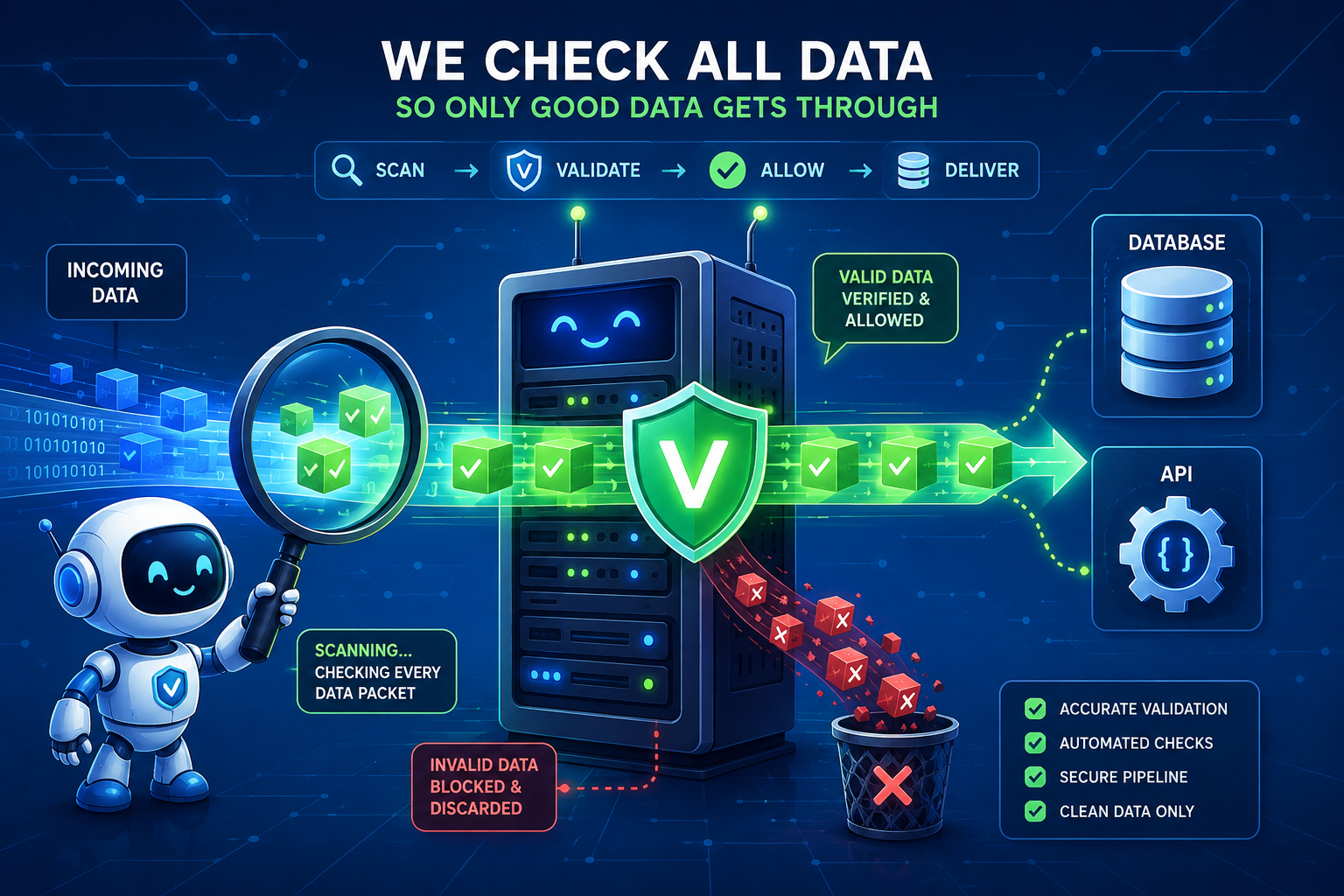

Benefits robust server side validation begin with one thing: don’t trust input from the browser. Attackers can bypass client-side checks. They can send direct HTTP requests. The server must re-validate every request. This happens before it reaches business logic or the database.
That’s still one of the smartest parts of Secure Coding Practices. And it cuts down on bad data, odd failures, and plenty of production headaches. Keep reading to see why server-side validation still matters so much in modern software.
Server-Side Validation Benefits at a Glance
Every request deserves verification before it reaches your application logic. Strong server-side validation is crucial for secure software development.
- Robust server-side validation is a critical trust-boundary control before data reaches backend systems.
- It reduces injection risk. It prevents data corruption. It stops business logic abuse. It improves overall reliability.
- Combine this with secure coding practices. This builds a scalable foundation for web application security.
Why Should You Care About Server-Side Validation?
Server-side validation is the last checkpoint before data reaches application logic or databases. Every request should be verified, whether it comes from a browser, mobile app, or API.
We’ve seen teams spend days chasing bugs that traced back to one bad request. The importance of server-side validation becomes clear when tight validation stops problems early. That’s why we teach one rule: never trust client input. Client-side checks improve usability. They don’t stop attackers.
| Client-Side Validation | Server-Side Validation |
| Improves user experience | Enforces security controls |
| Runs in the browser | Runs on trusted servers |
| Easily bypassed | Cannot be bypassed directly |
| Basic form checks | Validates business logic |
| Instant feedback | Protects applications |
Most secure teams combine type, format, length, range, and schema validation instead of relying on one filter. Makes sense.
Common protections include:
- SQL injection checks
- XSS sanitization
- Command allowlists
- File upload validation
- API payload validation
When validation happens first, developers face fewer surprises. Attackers have fewer options. Teams spend more time building. They spend less time fixing issues.
How Does Robust Server-Side Validation Improve Security?
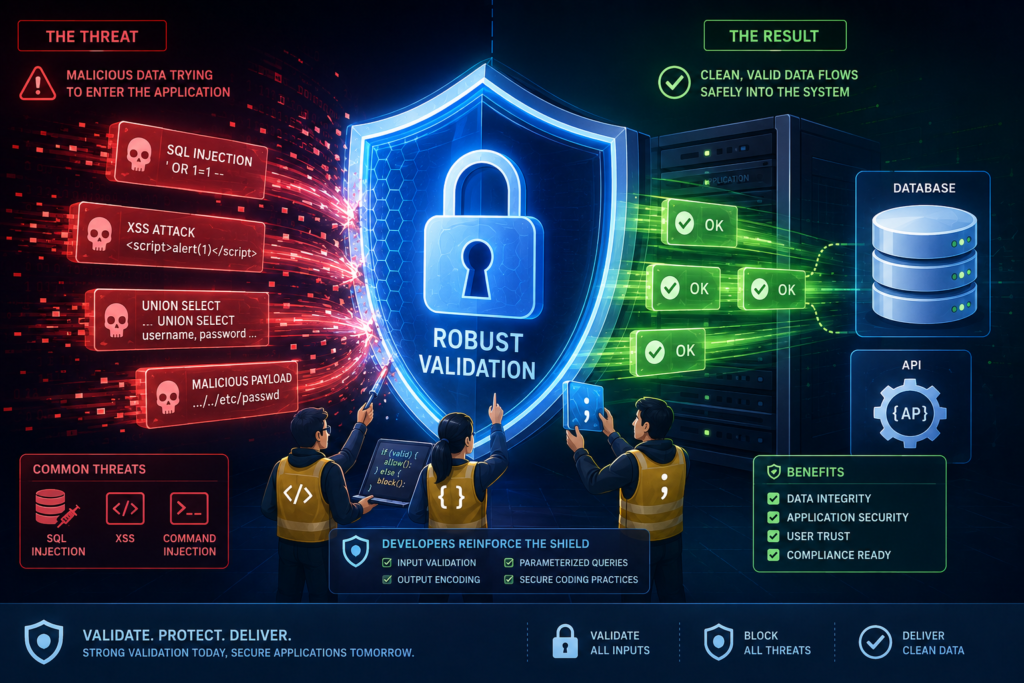
Strong server-side validation for preventing injection blocks malicious or unexpected input before it reaches sensitive code. All requests must pass validation. This happens before controllers, business logic, or databases process them.
In our training, we’ve seen how one overlooked parameter can open the door to bigger problems. Centralized validation catches mistakes early. It turns bad requests into rejected ones. This prevents security incidents. Small change. Big payoff.
As highlighted by MITRE CWE-20
“When software does not validate input properly, an attacker is able to craft the input in a form that is not expected by the rest of the application. This will lead to parts of the system receiving unintended input, which may result in altered control flow, arbitrary control of a resource, or arbitrary code execution.” – MITRE CWE-20
Proper validation reduces exposure to malformed input. This helps prevent attacks like SQL injection, XSS, command injection, path traversal, and unsafe deserialization.
However, validation should work with other defenses. These include parameterized queries, output encoding, allowlisted commands, and safe deserialization patterns.
Browser validation still has value for usability. But it isn’t security. That’s why we teach developers to treat server-side validation as the control that matters most.
Why Can’t Client-Side Validation Be Trusted?
Client-side validation is easy to bypass. It runs in the user’s browser. Developers do not control this environment. It improves the experience. It doesn’t secure the application.
We’ve demonstrated this in training many times. Disable JavaScript, edit a request, or send a crafted API call, and browser validation disappears. That’s why experienced developers never treat it as a security boundary.
As noted by OWASP
“Client-side validation can be easily bypassed, therefore it should never be relied upon for security. It serves only as a convenience to improve the user experience.” – OWASP
Common bypass methods include:
- Disable JavaScript
- Edit HTTP requests
- Use cURL or Postman
- Send requests to APIs directly
Every backend endpoint should validate input. It should also enforce authorization and authentication separately.
In practice, client-side and server-side rules can drift, which is why teams should treat server-side validation as the source of truth.
How Does Server-Side Validation Protect Business Logic?
Server-side validation does more than check data types or formats. It also verifies that every action follows the application’s rules before processing continues.
We’ve seen valid-looking requests fail business rules during security reviews. A checkout price may be a valid number but still be manipulated. The same goes for approval requests from users who don’t have the right permissions. Format alone isn’t enough.
Common business logic checks include:
- Price verification
- Date validation
- Permission checks
- Inventory validation
- Workflow order
- Account balance checks
Attackers often tamper with hidden parameters, changing prices or requesting administrative access through crafted API calls. Strong server-side validation stops those requests before they reach sensitive logic.
How Does Server-Side Validation Improve Data Quality?
Robust validation prevents invalid or inconsistent data from entering core business systems.
Even when attackers are not involved, malformed information creates operational problems. Poor data validation, data filtering, and data type enforcement allow incorrect records to spread across databases, reporting systems, and integrations.
Developers should validate more than required fields.
- Missing values
- Invalid formats
- Duplicate records
- Impossible dates
- Incorrect numeric ranges
- Unexpected JSON structures
Applications must enforce validation rules. This includes input constraints, schema validation, and contract validation. This ensures downstream systems receive predictable data. Predictable data is easier to process and audit.
How Can Robust Validation Improve User Experience?
Yes. Client-side and server-side validation work best together.
Client-side checks offer users fast feedback. Server-side validation enforces security and business rules. It does this before accepting data.. Used together, they reduce errors without weakening protection.
We have seen this approach reduce support issues. Invalid requests are rejected early. Users receive clear feedback. This prevents confusing failures later. Most teams notice the difference quickly.
Using both layers helps:
- Faster form feedback
- Consistent validation
- Fewer invalid requests
- Better reliability
- Protection from tampered data
What Makes Validation Messages Effective?
Validation messages should explain what went wrong without exposing how the application works. Keep them clear. Nothing more.
Applications should identify the affected field. They should explain why validation failed. Do not return database errors or stack traces.
Developers should return structured responses. Use 400 Bad Request or 422 Unprocessable Entity. Avoid generic 500 Internal Server Error messages. This is when validation blocks a request.
What Are the Best Practices for Server-Side Validation?
Credit: Server Logic Simplified
Validate early. Rely on allowlists. Enforce business rules consistently. Apply these rules across all application layers.
Secure validation starts with shared coding standards. It does not depend on a specific framework. Teams that follow the same approach make fewer mistakes. They spend less time fixing inconsistent validation.
A solid strategy includes:
- Allowlist validation
- Input sanitization
- Schema validation
- Business rule checks
- Shared validation middleware
- Consistent error handling
- Validation testing
Should You Prefer Allowlists Over Blocklists?
In most cases, yes. Allowlists define what is accepted instead of trying to predict every malicious payload. We’ve repeatedly seen blocklists miss unexpected input that stricter validation would reject immediately.
Where Should Validation Occur?
Every entry point handling untrusted data should apply the same validation rules. This applies to all areas. This includes APIs, authentication endpoints, file uploads, background jobs, webhooks, administrative tools, and internal services. Consistent validation strengthens security. It reduces gaps that attackers seek.
How Does Server-Side Validation Support Compliance?
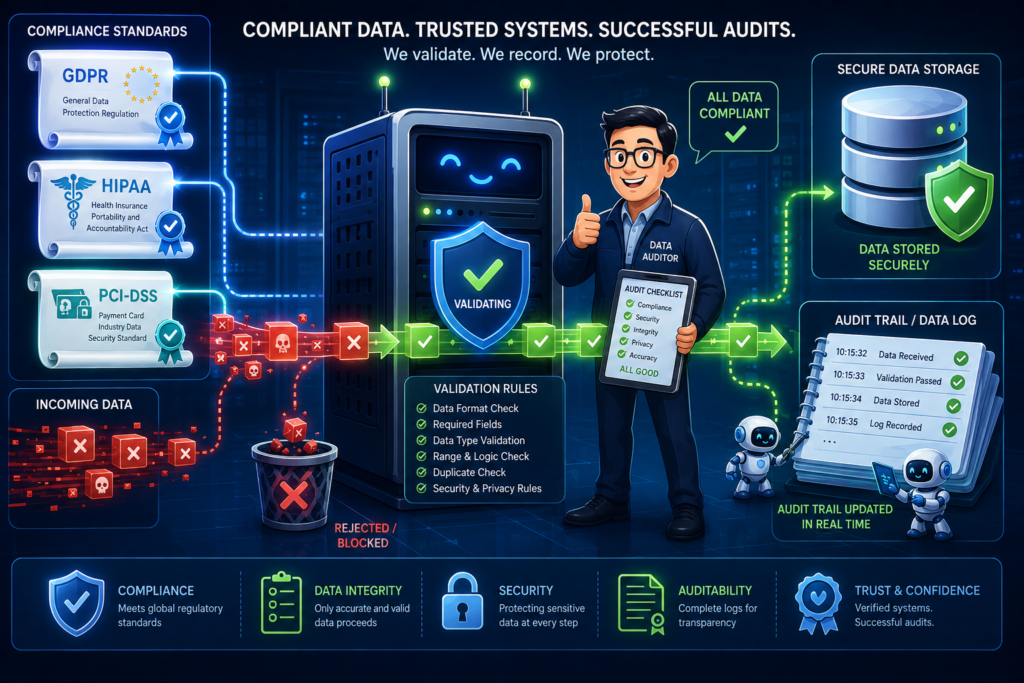
Strong validation helps organizations demonstrate secure software development and responsible data handling.
Organizations should validate input before processing sensitive data. This is a common expectation in secure coding standards.
Industries benefiting most include:
- Financial services
- Healthcare
- SaaS providers
- Government agencies
- Education
- Critical infrastructure
Validation also improves audit readiness. It makes incoming requests predictable. Logging and investigating requests becomes easier.
Developers should also remember that compliance extends beyond preventing attacks. Consistent validation improves traceability, supports governance, and reduces operational risk.
What Common Validation Mistakes Should Teams Avoid?
Many organizations still rely on browser validation instead of following the never trust client input rule.
Common mistakes include:
- Trusting hidden form fields
- Missing API validation
- Weak or inconsistent validation rules
- Accepting unexpected JSON properties
- Ignoring file upload validation
- Returning verbose server errors
- Scattering validation logic across multiple services
One useful lesson we’ve learned is to centralize validation wherever possible. Reusable schemas and shared validation middleware reduce duplication. They also minimize validation inconsistencies between frontend and backend systems.
How Can Secure Coding Practices Help You Build Robust Validation?
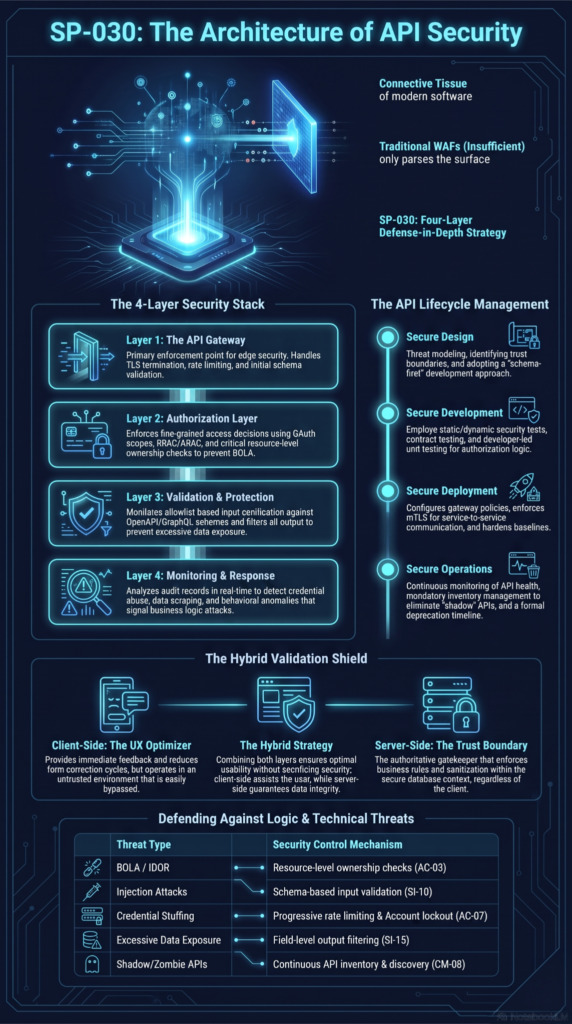
A standardized secure development approach makes validation scalable, maintainable, and consistent.
Instead of isolated code in controllers, build validation into secure coding practices from the start. This encourages developers to think about every trust boundary before writing business logic.
Practical implementation usually begins with four steps:
- Inventory every application input.
- Define centralized validation rules.
- Test invalid and malicious scenarios.
- Monitor rejected requests for emerging attack patterns.
FAQs
How Does Server-Side Validation Improve API Validation?
Server-side validation strengthens API validation. It checks every request against rules before processing. This process blocks invalid data, protects data integrity, and reduces unexpected application errors.
Why Are Validation Rules Better Than Input Filtering Alone?
Validation rules ensure input matches expected values. Input filtering only removes specific patterns. Using both methods provides stronger protection. It guards against malicious input.
Can Server-Side Checks Protect Uploaded Files?
Yes. Server-side checks protect applications during file uploads. They validate format, length, and data types. This happens before storing or processing files.
How Do Authorization Checks Strengthen Backend Security?
Authorization checks verify that users can access only permitted resources. This improves backend security. It supports access control. It helps prevent unauthorized access to sensitive information.
Why Is Trust Boundary Validation Important for Web Applications?
Trust boundary validation treats every request as untrusted until validation succeeds. This approach enhances web application security. It supports zero trust input. It ensures consistent server-side input sanitization.
Build Stronger Security With Trusted Validation
Server-side validation helps stop bad input before it can harm your application, even if client-side checks fail. That’s why it should always be part of your Secure Coding Practices. It keeps your data reliable, supports business rules, and helps you build applications that stay secure as new threats appear.
If you’re ready to put these skills into practice, the Secure Coding Practices Bootcamp gives developers hands-on training with real code, practical labs, and techniques you can use right away. Join the bootcamp and start building safer applications with confidence.
References
- https://cheatsheetseries.owasp.org/cheatsheets/Input_Validation_Cheat_Sheet.html
- https://cwe.mitre.org/data/definitions/20.html