
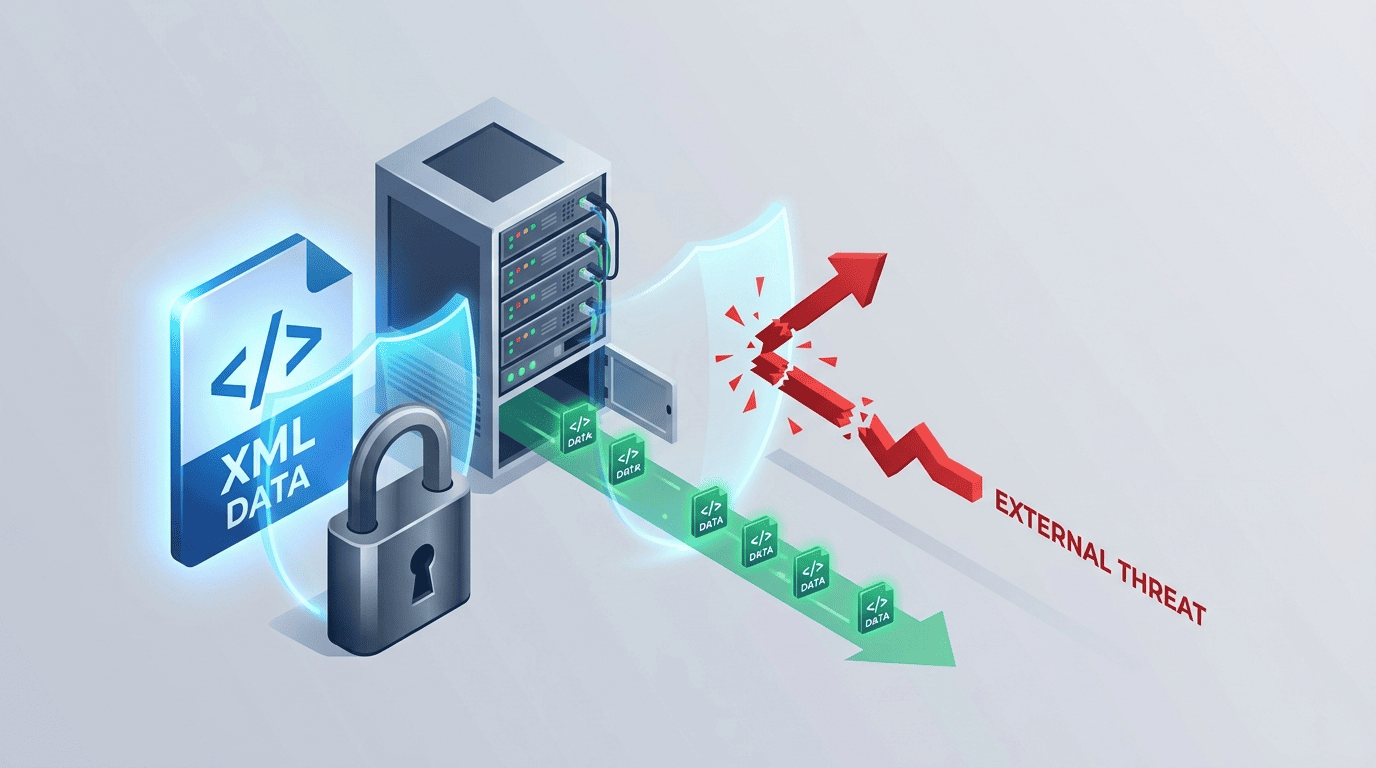

XML External Entity (XXE) Prevention is the process of securing XML parsers against attacks caused by unsafe handling of DTDs and external entities. If a parser is configured incorrectly, attackers may access sensitive files like /etc/passwd or probe internal systems.
You prevent it by disabling those features in your code. It’s a straightforward fix, but you must know the right configuration flags. The following guide details the specific Secure Coding Practices for Java, .NET, and other platforms to eliminate XML External Entity (XXE) risk.
Read on for the exact code changes.
XXE Defense in a Nutshell
The most effective way to stop XXE attacks is to secure your XML processing from the start and reinforce it with validation, maintenance, and testing.
- Disable DTD processing completely as your primary defense, preventing most XXE attack vectors at their source.
- Configure XML parsers securely by explicitly setting security features; default settings are often dangerously permissive.
- Implement layered validation using schemas and allowlists while maintaining updated dependencies and regular security testing.
What Is an XXE Vulnerability Attack?
An XXE vulnerability is a web security flaw. It happens when an application processes XML input that references external entities. If the parser resolves these without proper validation, attackers can read server files, scan internal networks, or cause a denial-of-service.
The vulnerability comes from the XML specification itself. Standard parsers support features like external entities that can load data from URIs, even if our application doesn’t use them.
Think of it like a building with a mail chute. The application is the building, XML is the mail, and the parser is the chute. An XXE payload is like a letter instructing the chute to “fetch and include the document from the safe in room 301.” A secure system would be sealed against such instructions. A vulnerable one just does it.
We’ve seen this in training when teams use default parser settings. The core issue is trust parsers often extend the application’s trust to the data, which is a dangerous mistake. This flaw is tracked as CWE-611 and has been in the OWASP Top 10.
What Are Common XXE Attack Examples, Scenarios, and Code Samples?
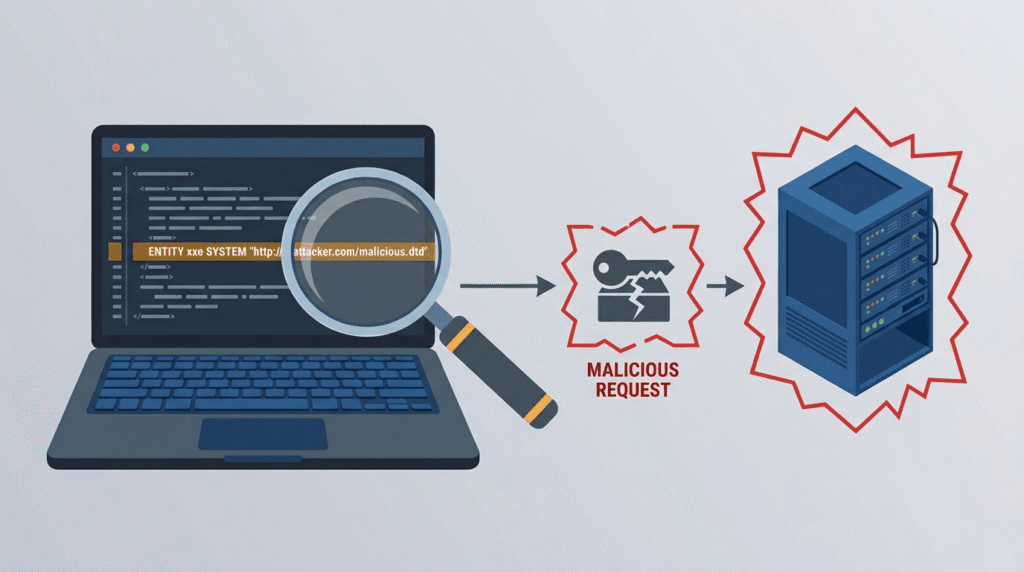
You need to see the attack in action. Let’s walk through a real scenario. A web application accepts XML to check product stock.
A normal request is simple:
<?xml version=”1.0″ encoding=”UTF-8″?>
<stockCheck><productId>381</productId></stockCheck>
Here’s the malicious payload an attacker might send:
<?xml version=”1.0″ encoding=”UTF-8″?>
<!DOCTYPE foo [ <!ENTITY xxe SYSTEM “file:///etc/passwd”> ]>
<stockCheck><productId>&xxe;</productId></stockCheck>
The DOCTYPE declares an external entity named xxe pointing to the server’s password file. The parser replaces &xxe; with that file’s contents, leaking user data in the response.
In our training labs, we see other attack examples and XXE scenarios:
- SSRF Attack: Using http://169.254.169.254/latest/meta-data/ to query internal cloud metadata.
- Denial-of-Service: The “Billion Laughs” attack uses nested entities to exhaust parser memory.
- Blind XXE: Entities pointing to http://attacker.com/collect exfiltrate data via out-of-band calls.
The pattern is consistent: declare a bad entity, reference it, and let the insecure parser execute the instruction.
How Can You Start Preventing XXE Injection in Java and .NET?
The cornerstone of prevention is secure parser configuration. You must explicitly disable dangerous features. Relying on defaults is a common and critical mistake.
For Java and .NET environments, secure parser configuration is non-negotiable:
DocumentBuilderFactory dbf = DocumentBuilderFactory.newInstance();
// PRIMARY DEFENSE: Disallow DTDs entirely.
dbf.setFeature(“http://apache.org/xml/features/disallow-doctype-decl”, true);
// If DTDs are absolutely required, disable external entities instead:
// dbf.setFeature(“http://xml.org/sax/features/external-general-entities”, false);
// dbf.setFeature(“http://xml.org/sax/features/external-parameter-entities”, false);
// dbf.setFeature(“http://apache.org/xml/features/nonvalidating/load-external-dtd”, false);
// Additional security settings
dbf.setXIncludeAware(false);
dbf.setExpandEntityReferences(false);
dbf.setFeature(“http://javax.xml.XMLConstants/feature/secure-processing”, true);
DocumentBuilder builder = dbf.newDocumentBuilder();
For .NET, modern versions (4.5.2+) are safer by default, but verification is key. For XmlDocument:
XmlDocument xmlDoc = new XmlDocument();
xmlDoc.XmlResolver = null; // This critical line disables external resource resolution
xmlDoc.LoadXml(xmlString);
For XmlReader, ensure DtdProcessing is set to Prohibit. The principle is the same: assume nothing, configure everything for security.
Why Is Disabling External Entities in XML Parsers a Critical Security Step?
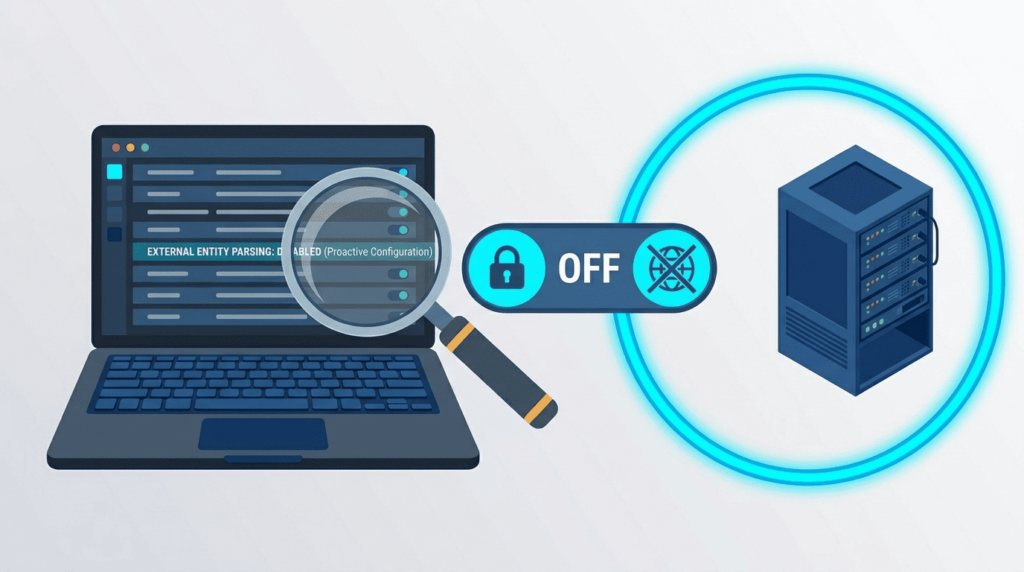
If you can’t disable DTDs entirely, the next critical step is disabling external entities through secure parser configuration. This stops the parser from fetching data from outside the document, which is how attackers read files or scan networks.
An external entity is declared with the SYSTEM keyword and can point to a file path or URL. Disabling the parser’s ability to resolve these blocks the data retrieval part of the attack. In Java, you set the features external-general-entities and external-parameter-entities to false. In .NET, you set the XmlResolver property to null.
We make it a standard practice to wrap parser creation in a factory method that applies these secure settings. This ensures no instance is ever created in an unsafe state. The configuration flag has different names across languages, but the concept is universal: find the switch for “loading outside data” and turn it off.
How Do Safer XML Processing Libraries Help Prevent XXE Attacks?
Using a library designed for security can be the safest approach. These tools have secure defaults or make it much harder to create a vulnerable parser.
For Python, we recommend defusedxml. It’s a set of patches for the standard libraries that defuses XML bombs and blocks external entities. You use it as a drop-in replacement: from defusedxml import parse. In Java, the solution isn’t a new library but a rigorously reviewed factory pattern for creating DocumentBuilderFactory instances, which we enforce across projects.
For new .NET code, XmlReader and XDocument are safe by default in modern versions. A broader architectural decision is to use JSON for new APIs, which eliminates the entire XXE threat model. The goal is to make the secure choice the easiest one, baking prevention into the development process itself.
What Is the Real Impact of a Successful XXE Attack?
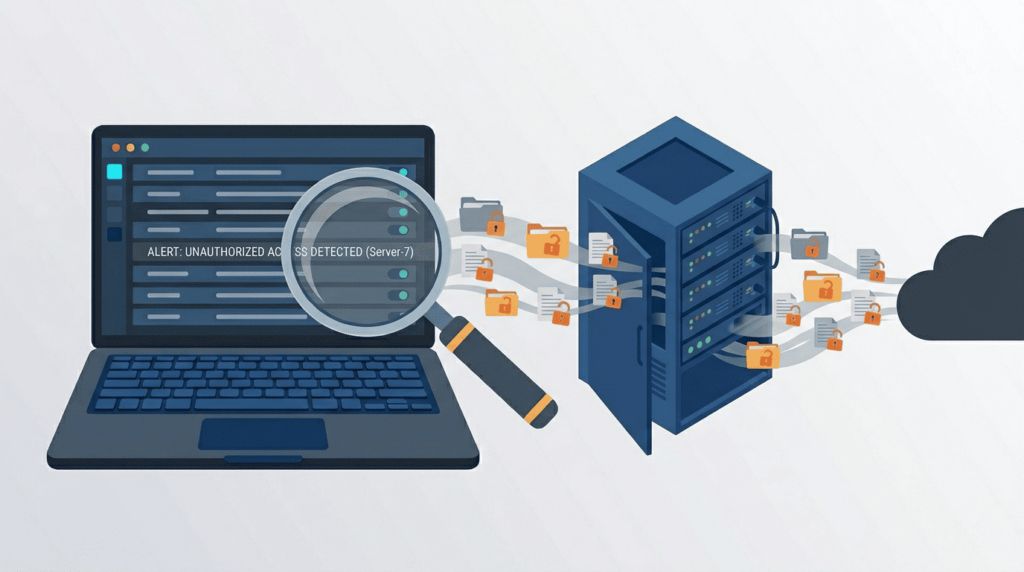
A successful XXE attack has severe consequences that go far beyond an error message. The immediate technical impacts are significant.
- Sensitive files can be read. This includes files like /etc/passwd, application configurations, and source code.
- Attackers can use the vulnerable server as a proxy. This allows them to attack internal systems. These systems can be cloud metadata endpoints, database admin panels, or other non-public services.
- Entity expansion attacks can consume all CPU and memory. This can crash the application or server.
- Attackers can trigger connection attempts to different ports. They can then analyze response times or errors. This allows them to map internal networks.
The business impact is real. A 2025 flaw in a document processing library (CVE-2025-66516) allows XXE via crafted PDFs and has been exploited in production systems. CVE-2025-58360 (GeoServer, CVSS 8.2) is actively exploited per CISA KEV listing, affecting versions 2.25.0–2.25.5 and 2.26.0–2.26.1.
These incidents cause financial loss, operational disruption, reputational damage, and regulatory trouble.
How Can You Test for XXE Vulnerabilities in Practice?
Credits: Cyber Tomb
You need to test for XXE vulnerabilities to find them. A combined approach works best:
- Intercept and Modify: Use a proxy tool to capture a legitimate XML request from your application.
- Inject Basic Payloads: Send it to a repeater tool and try a classic file retrieval payload.
- Test for Blind XXE: If there’s no direct response, try an out-of-band payload. Define an entity with a URL to a server you control (like a Burp Collaborator domain). If the parser is vulnerable, you’ll see an HTTP request from your application server to your domain.
- Expand the Surface: Don’t just test obvious XML endpoints. Test file uploads (SVG, DOCX, XML), API endpoints that accept different Content-Type headers, and any integration that might receive XML.
The key is to test each data node in the XML individually. Sometimes only certain fields trigger the vulnerability. A methodical approach and proper testing tools beat a single shotgun payload.
Research from HKCERT shows
“In OWASP Top 10-2017, XXE was ranked A4 (fourth). In OWASP Top 10-2021 and 2025, XXE is included within A05 Security Misconfiguration.” – HKCERT
How Can Content Validation Help Prevent XXE Attacks?
Parser configuration is your main defense, but content validation is a crucial safety net. The goal is to reject malicious data before it ever reaches the parser.
| Validation Method | Primary Purpose | XXE Protection Benefit | Best Practice |
| XSD Validation | Enforce XML structure | Rejects unexpected entities | Use strict schemas |
| File Upload Validation | Verify uploaded content | Blocks malicious XML files | Inspect content, not extensions |
| Input Filtering | Remove dangerous patterns | Reduces attack opportunities | Use only as a secondary control |
| Server-Side Validation | Validate trusted inputs | Prevents client-side bypasses | Apply validation before parsing |
What Does the OWASP XXE Prevention Cheat Sheet Recommend?
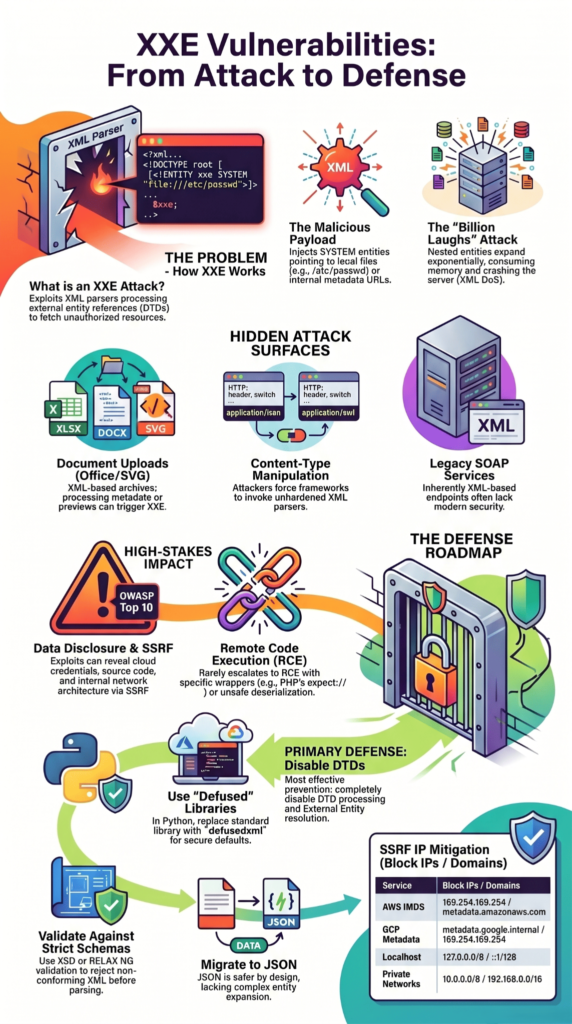
The OWASP Cheat Sheet Series provides an authoritative, language-by-language reference. It should be your first stop for detailed implementation guidance. Its core advice, which aligns perfectly with our experience, can be summarized as a hierarchy of controls:
- Prefer non-XML data formats like JSON whenever possible.
- Disable XML external entities and DTD processing in all your XML parsers.
- Implement positive (“allowlist”) input validation on the server side.
- Keep all XML processors and libraries updated to patched versions.
The cheat sheet provides the specific feature names and property strings for disabling features in Java, .NET, Python, PHP, and more. It’s a living document that reflects the current state of parsers and libraries. Bookmark it. Integrate its recommendations into your team’s Secure Coding Practices and code review checklists. When in doubt about a specific parser or edge case, the OWASP guide is the canonical source to consult.
As highlighted by OWASP
“The safest way to prevent XXE is always to disable DTDs (External Entities) completely. Depending on the parser, the method should be similar to the following: factory.setFeature(“http://apache.org/xml/features/disallow-doctype-decl“, true);” – OWASP
What Are the Most Actionable XXE Mitigation Strategies for Developers?
Prevention is a process, not a one-time fix. Here is a consolidated guide to build into your workflow:
- Configure Securely at Creation: Never use an XML parser without explicit security configuration. Wrap creation in a helper function that applies the secure settings: disable DTDs, disable external entities, enable secure processing mode.
- Validate Input with Schemas: Use XSD or similar strict validation for any XML your application must accept. Reject anything that doesn’t conform.
- Choose Safer Alternatives: Opt for JSON in new designs. Use security-focused libraries like defusedxml for Python.
- Manage Dependencies Aggressively: Use SCA tools to track XML libraries and reduce common vulnerabilities. Update them promptly when vulnerabilities are disclosed.
- Test Continuously: Integrate XXE testing into your security assessment regimen. Use automated scanners and perform manual penetration testing for critical components.
- Educate and Enforce: Train your development team on XXE risks, mitigation strategies, and secure patterns. Enforce the use of secure wrapper functions through code reviews and CI/CD gates.
FAQs
How can I reduce XXE risks without changing application features?
You can disable DTD processing. You can also disable XML external entities entirely. Configure parsers securely to block XXE attacks.
Should I validate XML before processing uploaded files?
Yes. Always validate before parsing. Validate XML uploads. Reject untrusted XML uploads. This stops malicious XML content.
What helps prevent file disclosure through XML requests?
Disable entity resolution. Disable external general entities. Block external resource access. This prevents file disclosure attacks.
How can I make XML handling more secure long term?
Patch XML processors regularly. Upgrade XML libraries. Use dependency checkers. Perform security audits to find weaknesses.
What extra safeguards help detect XXE attack attempts?
Monitor XML traffic. Log XML parsing events. Detect XXE attacks. Block XXE payloads before exploitation.
Why Should You Secure XML Parsing Before an Attack Happens?
XXE vulnerabilities occur when XML parsers have unnecessary capabilities. The solution is simple. Review your XML parsing code. Disable unsafe features. Make secure parser configuration a standard part of development.
To improve these skills, consider the Secure Coding Practices Bootcamp. It provides hands-on training. It focuses on practical secure development. Developers will learn to apply defenses confidently. Join here: Secure Coding Practices Bootcamp
References
- https://cheatsheetseries.owasp.org/cheatsheets/XML_External_Entity_Prevention_Cheat_Sheet.html
- https://www.hkcert.org/blog/owasp-top-10-2021-is-now-released
Related articles
- https://securecodingpractices.com/common-vulnerabilities-attacks/
- https://securecodingpractices.com/what-is-xxe-vulnerability-attack/
- https://securecodingpractices.com/preventing-xxe-injection-java-net/
- https://securecodingpractices.com/xxe-attack-examples-scenarios-code/
- https://securecodingpractices.com/testing-for-xxe-vulnerabilities-tools/
- https://securecodingpractices.com/xxe-mitigation-strategies-developers-guide/
- https://securecodingpractices.com/disabling-external-entities-xml-parser/
- https://securecodingpractices.com/using-safer-xml-processing-libraries/
- https://securecodingpractices.com/impact-of-successful-xxe-attack/
- https://securecodingpractices.com/OWASP-XXE-prevention-cheat-sheet/
- https://securecodingpractices.com/content-validation-against-xxe/