
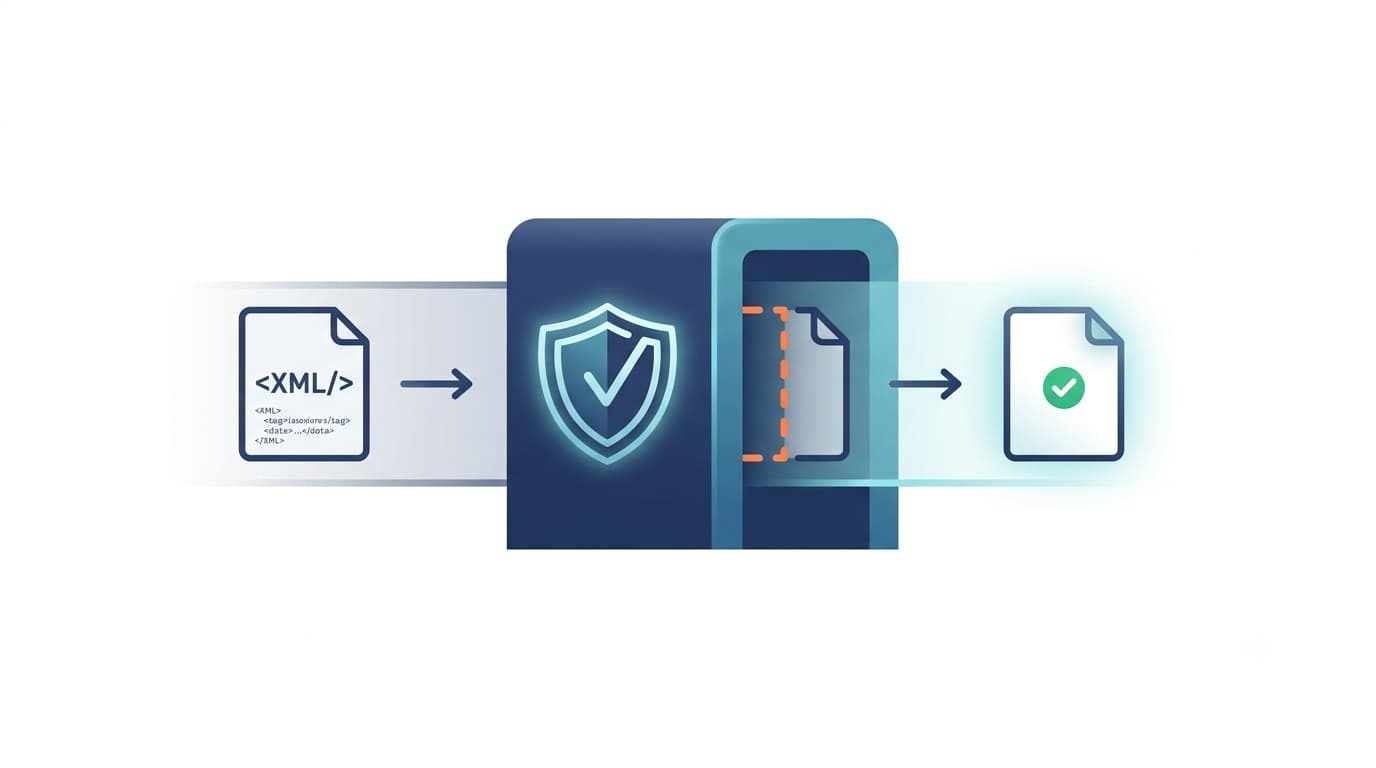

XXE risk drops when XML validation uses hardened parsing settings with external entities disabled, in line with OWASP guidance. Teams should treat XML as data, not as an executable structure, so parsing stays controlled from the start. That choice needs to be intentional. No execution path should be allowed.
But XXE is not only a parsing flaw. It is also a configuration weakness that can appear across different systems, environments, and runtimes. External entities should be stripped early in the pipeline before they reach deeper application logic.
For Secure Coding Practices, the safer approach is to keep external entities disabled across environments and review parser settings during early design reviews, not after deployment. This is where many systems fail.
We should not assume defaults are safe in every runtime, because small misconfigurations can still slip through. Audit XML parser configurations before release. Keep reading.
What Actually Matters in Content Validation Against XXE?
A quick summary of how XXE really happens and what actually prevents it in real XML processing systems.
- XXE comes from unsafe parser settings, not XML format itself, especially when DTDs and external entities are enabled.
- The main fix is disabling DOCTYPE and external entity processing at the parser level, aligned with Secure Coding Practices.
- XSD validation only checks structure and cannot stop entity-based attacks.
Why Do XXE Attacks Still Bypass XML Validation Pipelines?
XXE still slips through when validation happens too late or only in one layer. We’ve seen this in training labs where the XML looks “clean,” but the parser already expanded entities before checks ran. No surprise there.
Security teams often assume validation equals safety, but in practice, timing matters more than intention.
“Web services must treat all external input as untrusted and apply strict input validation before processing.” – NIST
And in real systems, one service disables entities while another forgets. That mismatch opens the door.
Where Validation Pipelines Fail In Practice?
Validation usually happens after parsing, which is the core issue. By then, the damage can already be done.
We’ve tested scenarios where schema validation passed cleanly, but file access still happened in the background due to earlier entity expansion. This is exactly the kind of issue discussed in preventing XXE injection approaches, where control must happen before parsing, not after.
Look at the flow. Parse first. Validate later. That order is the problem.
So validation becomes a label, not a barrier.
What Actually Makes XXE Possible Inside XML Parsers?
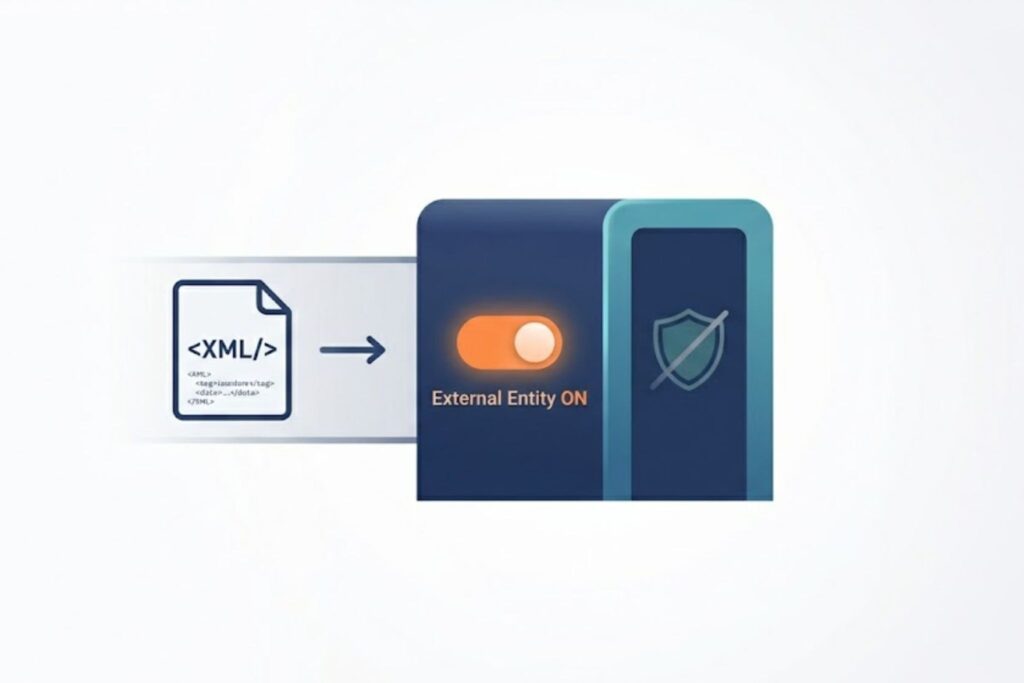
XXE shows up when parsers are allowed to resolve external references. That flexibility was never designed with hostile input in mind. This is often explained in discussions around XXE vulnerability and how it emerges at the parser level.
DOCTYPE As The Entry Point
DOCTYPE is where entity definitions live. When enabled, it lets someone define references that point outside the document.
We teach learners to treat this as a red flag zone, not normal structure.
And once DOCTYPE is active, control shifts from the application to the parser engine.
External Entities And Parser Defaults
External General Entities and Parameter Entities can pull data from local files or remote URLs.
So the parser starts behaving like a fetch tool, not a validator.
Many default configurations in SAX or StAX-based systems still allow this unless explicitly disabled.
That’s the quiet risk most teams miss.
Hidden Exposure In Default Configurations
And here’s the part that surprises most trainees: some environments differ between dev and production.
One disables entities. The other doesn’t.
Same code. Different outcome.
That inconsistency is where XXE survives.
How Does Content Validation Block Malicious XML Before Parsing?
Content validation helps, but only when it sits in the right place in the pipeline. In our bootcamp labs, we always stress this point: validation before parsing is very different from validation after parsing.
So the goal is simple. Stop unsafe XML before it reaches anything that can interpret it.
And yes, schema checks help, but they don’t control parser behavior.
We remind learners of this early because it’s where most confusion starts.
Schema Validation And Structure Control
XML Schema Definition (XSD) is useful for structure. It checks fields, types, and required elements.
But it doesn’t stop entity expansion.
That separation matters more than people expect.
We’ve seen learners assume XSD blocks attacks. It doesn’t. It only confirms format.
And format is not the same as safety.
Pre Parsing Inspection In Real Systems
Many systems add a filtering layer before XML reaches the parser. API gateways often scan raw payloads for patterns like <!ENTITY or SYSTEM.
We use similar checks in training environments to show early warning signals.
But attackers can encode or reshape payloads.
So detection becomes inconsistent under real conditions.
No surprise. Simple pattern matching breaks fast.
Where Most XXE Failures Come From?
Most XXE issues we see in exercises don’t come from ignorance. They come from mismatched configuration.
One service is hardened. Another isn’t.
Misconfigured Parser Environments
Development setups often disable external entities for safety. Then production gets deployed with slightly different defaults.
We see this mismatch a lot during secure coding reviews.
Same application. Different risk profile.
That’s usually where exposure starts.
SOAP Heavy Systems And Compatibility Pressure
SOAP-based systems still exist in enterprise environments, especially in older integrations.
They often keep DOCTYPE support for compatibility reasons.
So security gets traded for legacy support.
And that trade quietly increases risk.
Parser Settings That Actually Matter
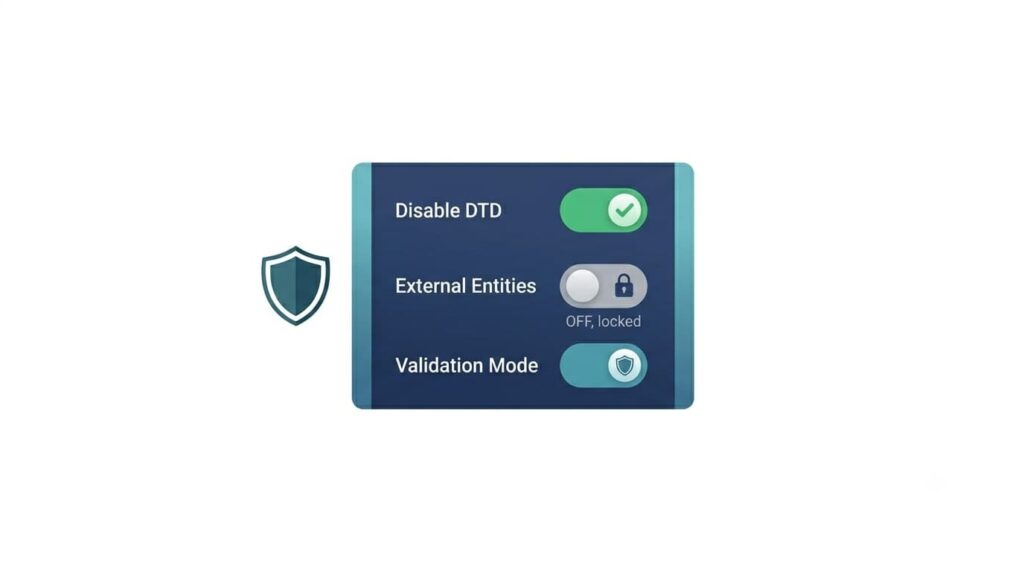
Configuration is where real control lives. Understanding XXE prevention at the parser level is what actually reduces exposure in real systems.
We focus heavily on this in training because it’s the most direct defense against XXE.
Java Based Parser Hardening
In Java systems, disabling DOCTYPE and external entity resolution is non-negotiable.
We typically enforce this at the earliest configuration step, before any business logic runs.
Get parser safety right first. Everything else later.
Safe XML Parsing In Python
Python has a clean option here: defusedxml.
It blocks unsafe entity processing by default.
We use it in exercises because it shows how safer defaults reduce mistakes.
And learners usually notice how much simpler secure parsing becomes.
How WAFs And API Gateways Handle XXE?
WAFs help, but they sit outside the core trust boundary.
Signature Based Detection
Most WAFs look for known patterns like entity declarations or external references.
That catches basic payloads.
But it’s not enough on its own.
We treat it as a filter, not protection.
“XML External Entity processing should be disabled whenever possible to prevent injection of external data sources.” – OWASP
Why XSD Alone Isn’t Enough?
Source: CodeWrite
Schema validation and security are often confused.
They are not the same layer.
Structure Versus Execution
XSD validates shape. Parser configuration controls execution behavior.
That difference is the core issue in XXE.
We repeat this often in training because it clears up a common misconception.
Valid XML can still be dangerous XML.
Secure XML Pipeline Summary
Here’s how we usually explain the full control chain in class:
| Component | Control | Result |
| XML Parser | Disable DOCTYPE + entities | Stops expansion |
| XSD Validator | Strict schema rules | Ensures structure |
| API Gateway | Payload filtering | Blocks known patterns |
| Application Layer | Secure coding rules | Prevents unsafe logic |
| HTTP Layer | Content-Type checks | Prevents format mix-ups |
We use this table a lot during reviews because it shows how each layer supports the next.
No single control wins alone.
FAQs
How does content validation against XXE reduce XML external entity injection risk?
Content validation against XXE reduces XML external entity injection risk by blocking unsafe XML content before it reaches the parser. It prevents attacker-controlled XML structures that use external entity references, DTD processing, and entity expansion.
This reduces risks such as file disclosure via XML, SSRF via XXE, and XML injection attacks that exploit insecure entity resolution in server-side XML parsing.
Why is XML parser security more important than XML schema validation?
XML parser security is more important than XML schema validation because schema validation only checks whether the XML structure follows defined rules. It does not control how the parser handles entities, external DTDs, or DOCTYPE declarations.
XXE prevention depends on secure parser configuration, including disabling external entity processing and enabling secure XML parsing settings at the parser level.
What role do DTD processing and external entity references play in XXE?
DTD processing and external entity references are the main mechanisms used in XML external entity injection attacks. Attackers use them to define general entities or parameter entities that can access local files or remote systems.
This can result in local file read attacks or SSRF via XXE. Disabling DOCTYPE declarations and blocking external DTD loading is required to prevent this behavior.
How can APIs protect against untrusted XML input and XML injection attack?
APIs protect against untrusted XML input by enforcing strict XML content-type handling, validating input at the server side, and rejecting malformed XML payloads.
REST XML endpoints and SOAP services must prevent request payload tampering by disabling external entity resolution and applying secure parser settings. Proper input filtering and parser misconfiguration prevention reduce the risk of XML injection attacks.
What are best practices for XXE prevention in secure coding practices?
Best practices for XXE prevention include disabling DOCTYPE declarations, blocking external entity resolution, and enforcing secure parser configuration for DOM, SAX, or StAX parsers.
Secure coding practices also require network access blocking to prevent remote entity loading and strict XML request validation. Regular vulnerability assessment, XXE scanning, and penetration testing help ensure consistent XML security hardening.
XXE Security Comes Down to Parser Trust
You run into XXE issues when XML input is trusted too early or parsed with unsafe defaults. It breaks quietly, then exposes data when you least expect it. The real problem is not complexity, it is misplaced trust in configuration.
Fixing it comes down to discipline in how you handle parsing and validation order. If you want structured practice, the Secure Coding Practices Bootcamp helps you apply these controls in real scenarios so you stop relying on default settings.
References
- https://csrc.nist.gov/pubs/sp/800/95/final
- https://owasp.org/www-project-web-security-testing-guide/