
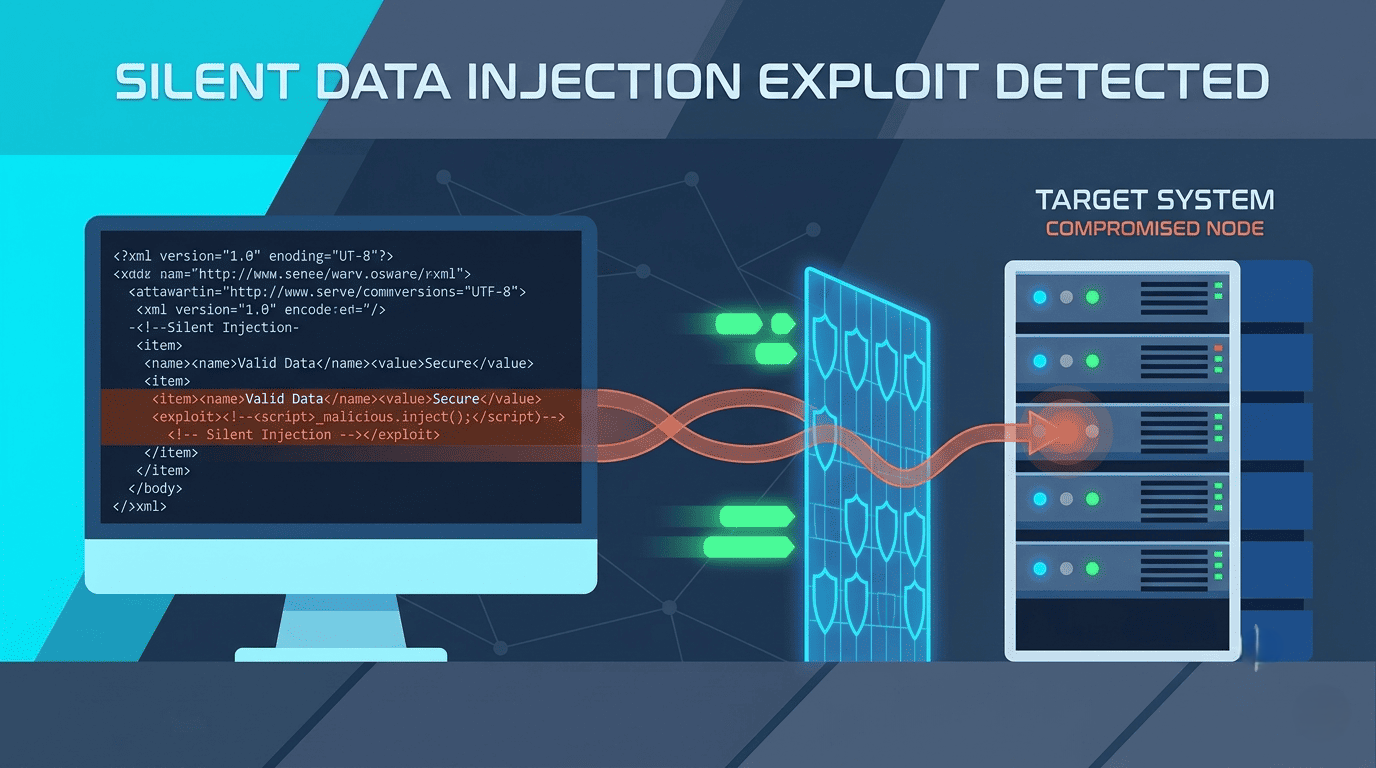

What is XXE vulnerability attack? It’s a hack where an attacker manipulates an XML parser to read files from the server or interact with internal systems. This happens when an app blindly trusts XML input. It’s a serious flaw often hidden in features like file uploads or document processing.
If XML is set in a weak way, attackers can get private data. To prevent this, you must validate and sanitize all XML input and disable dangerous parsers. Learn the specifics of Secure Coding Practices to lock this backdoor shut.
XXE Attack Essentials at a Glance
Understanding XXE is the first step to stop XML attacks and stop network risk.
- XXE exploits insecure XML parsers to read server files or trigger internal network calls.
- This flaw can be in file tools or outside code, not just your code.
- To stop it, turn off unsafe parser parts like entities and DTDs.
What Is an XML External Entity?
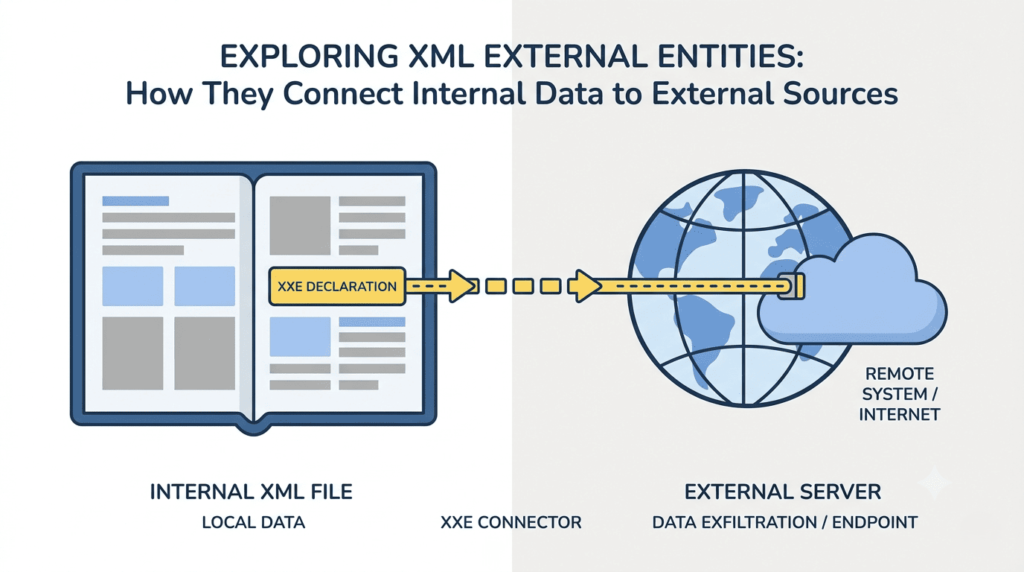
Think of an XML External Entity (XXE) as a shortcut that backfires. XML lets you define an entity as a placeholder. An external entity pulls data from outside, from a file on the server or a URL.
The risk is when the XML parser is not set in a safe way. An attacker can inject a malicious entity, and the parser will fetch whatever it points to. In our labs, we’ve turned a basic document upload into a tool that reads system files like /etc/passwd. We’ve even used it to probe internal networks.
That’s why it’s classified as CWE-611 (Improper Restriction of XML External Entity Reference). The fallout is real: stolen data, crashed systems, or server-side request forgery. This isn’t abstract. It’s a flaw we train our developers to find and fix, primarily by locking down the parser configuration.
As OWASP states
“The XML processor is configured to resolve external entities within the DTD, this default is the vulnerability” – OWASP
How Does an XXE Attack Work?
Credits: Hacksplaining
The process is methodical. An application, perhaps handling a SOAP API or a document upload, accepts some XML data. Its parser starts reading. If it’s configured insecurely which is common in XXE attack examples it will process DOCTYPE declarations and resolve any external entities defined there.
An attacker injects a line like this:
<!ENTITY xxe SYSTEM “file:///etc/passwd”>
Later in the document, they simply call &xxe;. The parser sees this reference and dutifully fetches the contents of the server’s password file, often leaking that data right back in the response.
We stress this point in our bootcamp labs: you often don’t write the parser yourself. It’s buried inside a third-party library, framework, or SDK you’re using. The default setting in many of these tools is to allow external entity resolution. OWASP pinpoints this as the core issue: “The XML processor is configured to resolve external entities within the DTD.” That default is the vulnerability.
As noted by defusedxml (Debian Sources)
“The case of parsed external entities works only for valid XML content. The XML standard also supports unparsed external entities with a NData declaration.” – defusedxml (Debian Sources)
What Real-World Damage Can XXE Cause Beyond File Reading?
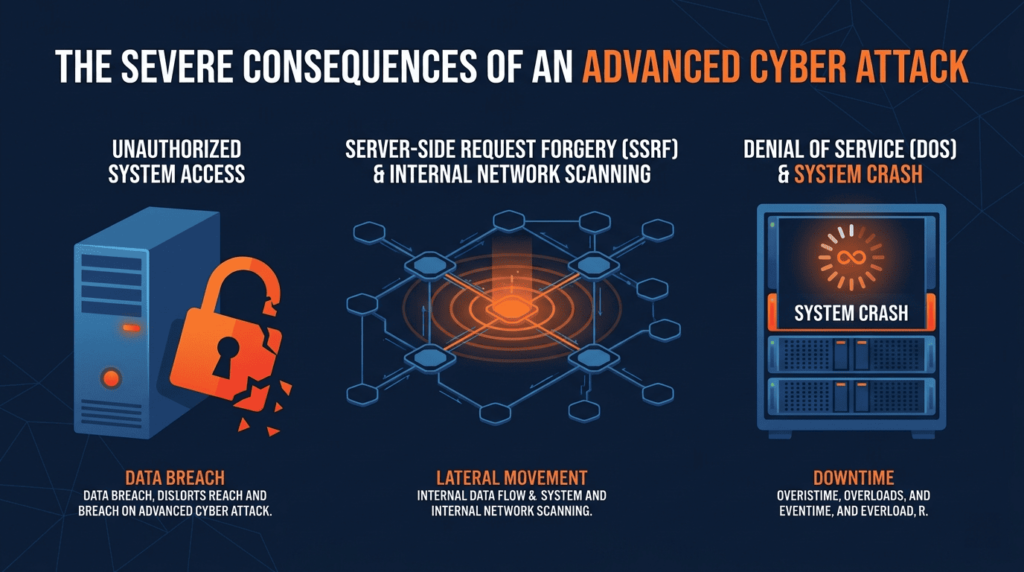
The real danger of XXE is escalation. Reading /etc/passwd is just the start. That file often points to configs with database credentials. Attackers use those to reach admin panels or sensitive data. This makes a small bug into a big attack.
XXE also enables Server-Side Request Forgery (SSRF). An entity pointing to http://169.254.169.254 tricks your server into fetching its own cloud metadata, leaking access keys. Your app does the attacker’s network probing for them.
It can also stop the system from working. The “Billion Laughs” attack defines recursive entities. The parser expands them exponentially, consuming all memory and crashing the service. It’s a blunt, effective kill switch.
These aren’t theoretical risks. They’re documented attack paths we recreate in our bootcamp labs to teach robust defenses.
Is Disabling DTDs Alone Enough to Prevent XXE Attacks?
The standard advice is to disable DTD processing entirely. In theory, it’s the perfect fix. In practice, it’s often a non-starter. Legacy systems or vendor packages sometimes depend on DTDs for document validation. Forcing this change can break core functions, creating a fight between security and stability that ops teams dread.
| Security Control | Why It Helps | Real-World Limitation |
| Disable DTD Processing | Blocks the primary XXE attack vector | Legacy applications may require DTDs for validation |
| Web Application Firewall (WAF) | Filters suspicious requests before they reach the application | Encoded or nested XML payloads can evade detection |
| File Upload Scanning | Identifies malicious content in uploaded files | Hidden XML content may remain undetected |
| Perimeter Defenses | Reduce exposure to external attacks | Cannot protect vulnerable XML parsers inside backend systems |
WAFs and other perimeter defenses also struggle here. Attackers encode their payloads or bury them within other formats, like XFA data inside a PDF. The firewall sees a safe file, not the bad XML inside. Recent vulnerabilities in tools like Apache Tika prove this; the attack surface is often a parser deep in a backend pipeline, far from any network filter.
How Can You Build an XXE Defense That Actually Works?
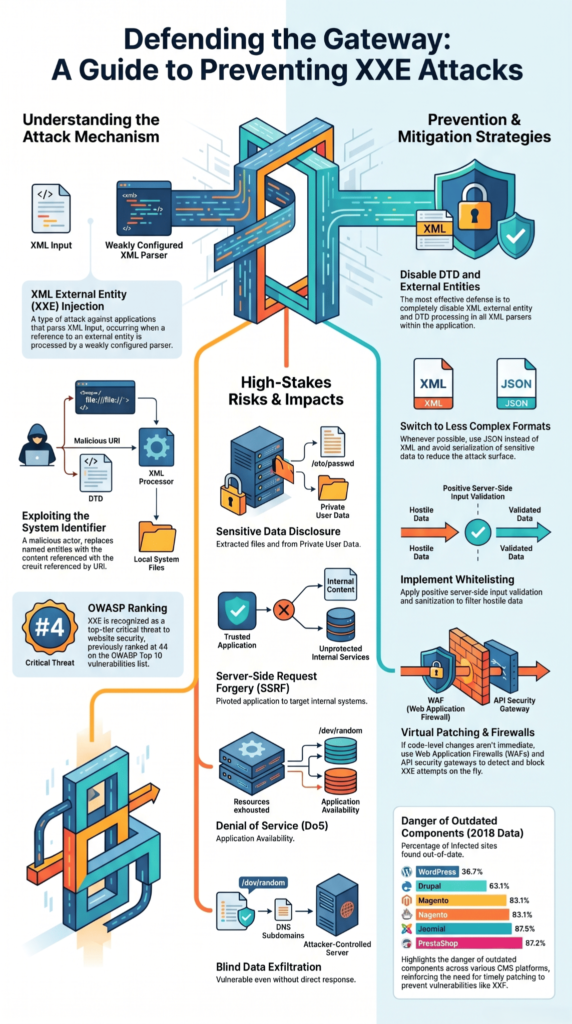
Effective defense against XXE requires a layered approach that reduces both exposure and impact, preventing XXE injection in Java or .NET is critical.
- Disable external entity resolution and DTD processing in all XML parsers.
- Use secure parser configurations that reject DOCTYPE declarations by default.
- If DTD is needed, allow only safe items and local files.
- Prefer safer data formats like JSON when XML is not necessary.
- Validate and sanitize all untrusted XML input before processing.
- Keep XML-related libraries updated and monitor for CWE-611 vulnerabilities.
- Log parsing errors and watch for unusual outbound connections that may indicate XXE or SSRF activity.
Start by locking down the parser, the most important step. Then reduce the attack surface by limiting XML usage wherever possible. You must also manage tools well. Bugs can be in other code like Apache Tika. Finally, assume that defenses may fail and implement monitoring to detect suspicious parsing behavior and unexpected network activity before an attacker can cause significant damage.
FAQs
Can XXE expose internal systems?
Yes. XXE can be used to access internal network resources via SSRF.
What is blind XXE?
Blind XXE does not return data in responses. Data exfiltration occurs via external channels.
What is an XML bomb?
An XML bomb uses recursive entity expansion to exhaust system resources and cause denial of service.
Which systems are affected?
Any system using XML parsing, including SOAP services, SAML, and document processors.
What is CWE-611?
CWE-611 refers to improper restriction of XML external entity references.
How Can You Move Beyond Simply Fixing the Vulnerability?
XXE shows that bad input should not get system access. That’s the reality. The best defense is making XML parsing a deliberate, reviewed process with safe defaults and regular testing.
If you want practical, hands-on training that helps developers build these habits into everyday work, join the Secure Coding Practices Bootcamp and learn how to write safer code from day one:
References
- https://sources.debian.org/data/main/d/defusedxml/0.6.0-2/README.html
- https://owasp.org/www-community/vulnerabilities/XML_External_Entity_(XXE)_Processing