
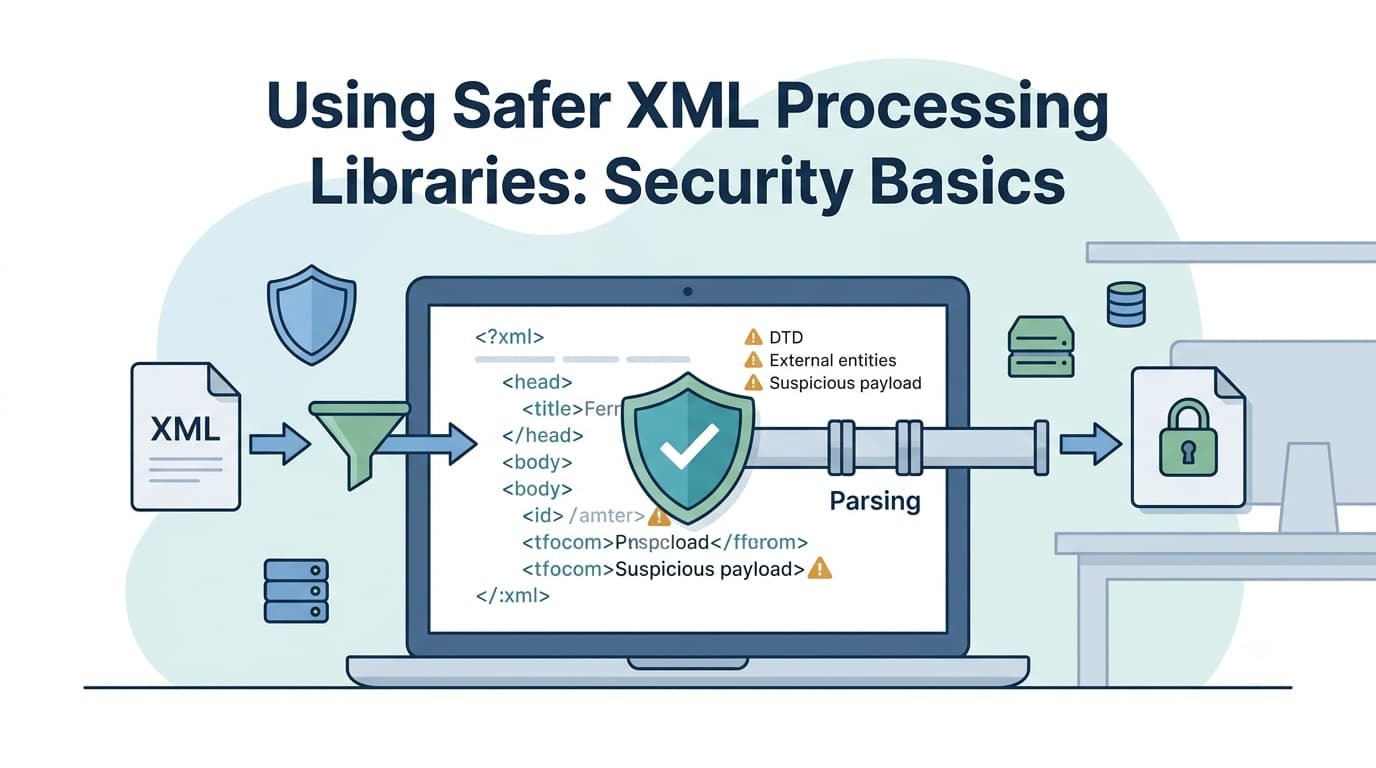

Safer XML processing libraries reduce exposure to XML External Entity (XXE) attacks and parser-based risks. We see this in enterprise data pipelines, where misconfigured parsers open quiet entry points, and legacy systems still running make it worse.
Secure Coding Practices shape how every XML input is treated as untrusted data, and that shift changes how teams think about risk. No shortcuts. Treat XML input as untrusted data; we’ve seen teams overlook this and pay for it later, and that pattern feels avoidable with basic discipline.
That surprised me. Simple checks change outcomes. No exceptions in legacy systems really Keep reading below
Security Signals You Shouldn’t Miss
These insights show that most XML vulnerabilities are not caused by XML itself, but by configuration choices and unsafe defaults that can be reduced early through Secure Coding Practices and careful parsing decisions.
- XML parsing risks stem from built-in features like DTDs and external entities.
- Most attacks exploit configuration gaps, not the format itself.
- Secure Coding Practices reduce exposure before any library-level handling.
Why Legacy Systems Keeps The Risk Alive?
Bootcamp students often ask why “old systems matter if we’re writing new code.” The answer shows up in audits we simulate.
Legacy parsers still run inside:
- ingestion pipelines
- reporting tools
- background sync services
One weak link is enough. We’ve seen environments where one service allows entities while others don’t. That inconsistency becomes the real vulnerability.
How XXE Attack Actually Work?
XXE is not magic. It’s configuration taking a wrong turn.
When external entities are allowed, an attacker can point XML toward internal files or services, which is why XXE prevention starts before the parser touches untrusted input. We’ve reproduced this in controlled labs using harmless test payloads.
From our side, we drill one habit into learners:
Disable external entity resolution before anything else runs.
Get that wrong, and everything downstream inherits the risk.
How XML Bomb Issues Overload Systems?
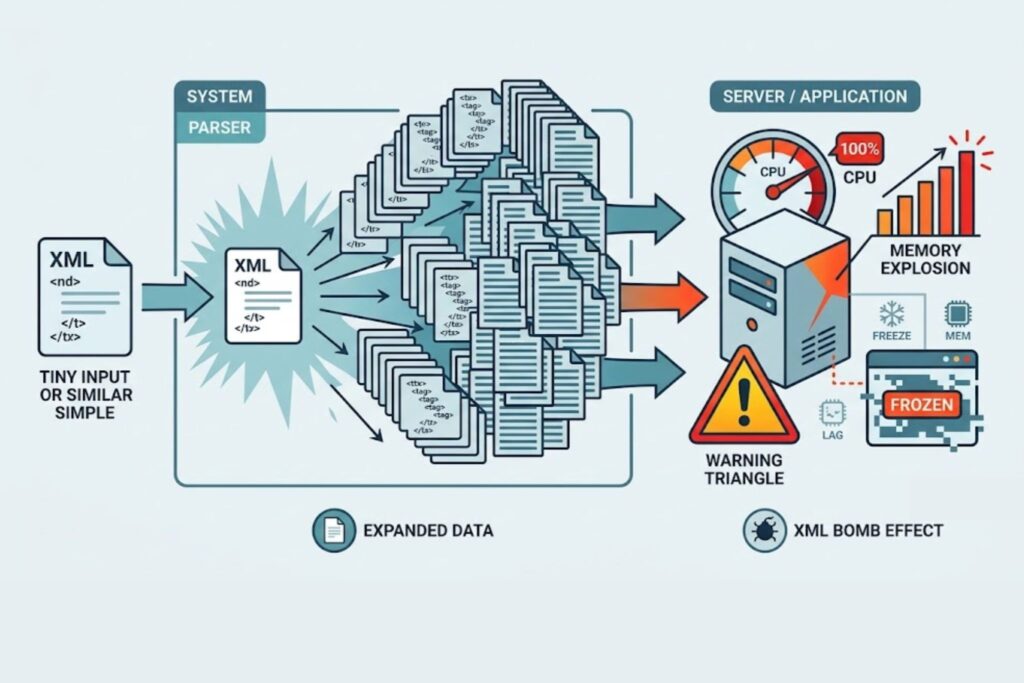
A small XML file can grow into something massive in memory. That’s the core issue.
We show this carefully in training environments. A few nested entities. Then expansion. CPU spikes. Memory pressure rises fast.
The Python Software Foundation describes the broader risk clearly in its XML security documentation:
“An attacker can abuse XML features to carry out denial of service attacks, access local files, generate network connections to other machines, or circumvent firewalls.” –Python XML Security Documentation
That is why XML bomb protection should not be treated as a secondary concern. In real pipelines, resource exhaustion can happen before schema validation, logging, or application-level checks have a chance to respond.
Concise View of Impact?
| Trigger Type | System Effect |
| Nested entities | Memory explosion |
| Repeated expansion | CPU overload |
| Large payload parsing | Service freeze |
No complex exploit chain needed. Just structure abuse.
And yes, we’ve seen pipelines go down before validation even starts.
How Java XML Parsing is Hardened?
In our Java labs at the bootcamp, we usually start with a default parser. Then we break it. Then we fix it.
That sequence sticks better than theory.
Java’s DocumentBuilderFactory is powerful, but it doesn’t assume strict security out of the box, so XXE injection in Java and .NET needs to be handled through explicit parser settings. We’ve seen students miss one setting and end up with external entities still active.
So we push a simple rule:
Lock it down before you parse anything.
Disable DOCTYPE. Turn on secure processing. Remove entity resolution paths.
It sounds small. It isn’t.
One missed flag can undo everything else.
Why Phyton Defused XML is Common in Practice?
Python is often the first language where students hit XML risks.
The standard libraries feel simple, but that simplicity hides edge cases.
We often switch learners to defusedxml early in training. Not because the default tools are “bad,” but because they don’t enforce safety strongly enough on their own.
defusedxml changes the behavior at the library level:
- blocks entity expansion
- disables DTD parsing
- removes recursive traps
Less room for human error. That matters in real systems.
We’ve seen fewer mistakes once teams stop relying on manual configuration alone.
How Net XML Settings Reduce Exposure?
In .NET environments, newer defaults are more controlled, but version differences still show up in real systems.
During enterprise-style exercises, we often find mixed configurations across services.
Some use secure readers. Others still allow legacy behavior.
That inconsistency is where issues appear.
We usually reinforce one idea:
Secure one service doesn’t secure the system.
Everything has to align.
XmlReader settings matter most when they are enforced consistently across services, not just documented.
Node JS Parsers and Hidden Behavior
Node.js introduces another layer of complexity because many XML parsers rely on native bindings.
In training, we show how this creates unpredictability.
One library might block entities. Another might pass them through. Same input, different outcome.
That inconsistency confuses newer developers.
We usually pause here and repeat:
Don’t assume behavior. Verify it.
Safer setups avoid entity expansion entirely. That removes a whole class of surprises.
Input Validation Before Parsing
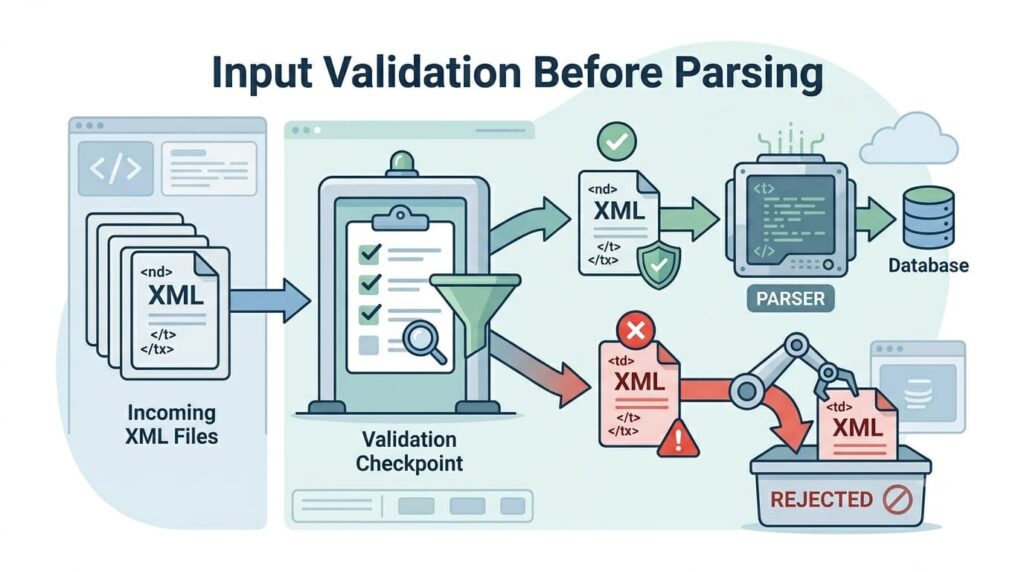
We spend a lot of time on this in the bootcamp because it’s easy to skip in real projects.
Validation before parsing reduces exposure fast.
We often show a simple flow:
Reject bad structure early. Then parse what remains.
Schema validation helps, but only when used early in the pipeline.
If XML with DTD shows up, we don’t “sanitize it later.”
We drop it before it reaches the parser.
That single decision prevents a lot of downstream risk.
Why Disabling DTD is a Core Control?
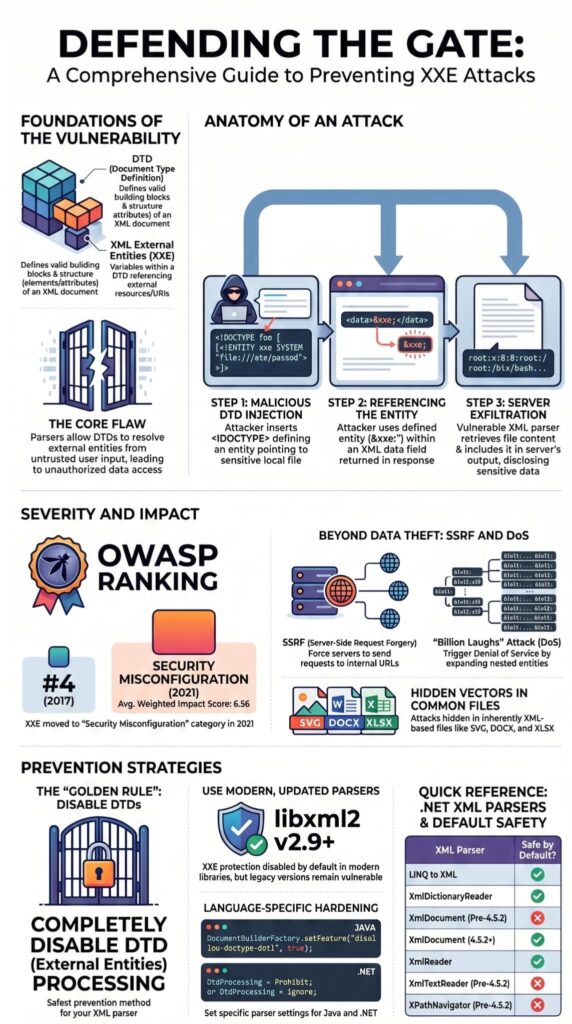
DTD support is the root of many XML parsing issues because it can turn harmless-looking input into an XXE vulnerability attack path when external entities are still enabled.
When we teach this, students usually ask what breaks if we disable it. The answer is often: less than expected. Most modern systems don’t depend on it anymore.
OWASP makes this control very clear in its XML External Entity Prevention Cheat Sheet:
“The safest way to prevent XXE is always to disable DTDs (External Entities) completely.” – OWASP XML External Entity Prevention Cheat Sheet
That guidance matches what we see in Secure Coding Practices training environments. Once DTD processing is disabled early, many XXE paths lose their entry point before validation, business logic, or downstream services ever get involved.
What gets removed:
- external entity expansion
- recursive definitions
- parameter entity tricks
We’ve only seen rare legacy cases where DTD still matters. And even then, we isolate those systems instead of relaxing global rules.
Standardising Safe XML Practices
At our bootcamp, we push standardisation early.
Not as bureaucracy, but as protection.
Different teams using different parser settings is where risk grows quietly.
We encourage teams to align on:
- defused parsing in Python
- secure factories in Java
- restricted readers in .NET
- no entity expansion in Node.js
When everyone follows the same baseline, fewer surprises show up in production.
We’ve seen this reduce incident reports in simulation projects.
Limitations of Even Safe Setups
Nothing is fully bulletproof if configuration drifts.
Legacy systems still create gaps.
We’ve seen cases where a secure service connects to an insecure internal parser. That one connection reopens risk.
So we teach students to think in boundaries, not just tools.
Security breaks at integration points more often than inside code.
That pattern shows up again and again.
Long Term XML Strategy
Source: Loi Liang Yang
Over time, we encourage teams to reduce XML dependency where possible.
Not because XML is “bad,” but because safer formats reduce entire categories of risk.
In real-world architectures, JSON or simpler structured formats often replace XML in new services.
For systems that must keep XML, we focus on containment:
- strict parsing rules
- isolated processing layers
- consistent library use
We don’t try to “fix everything.” We narrow the attack surface.
That’s usually enough.
FAQs
How does safer XML parsing reduce XML security risks?
Safer XML parsing reduces security risks by limiting or disabling features that attackers commonly exploit, such as external entities and DTD processing. When XML parsers allow these features by default, attackers can manipulate input to access internal files or overload system resources.
Applying XML parser security and XML security best practices helps prevent these issues by enforcing strict parser configuration security and reducing the XML attack surface before any data is processed.
What are the most important XML security best practices for untrusted input?
The most important XML security best practices begin with treating all incoming XML as untrusted XML handling. This requires strict XML input validation, secure XML processing, and controlled parser configuration security.
Developers should explicitly disable external entities and disable DTD processing to prevent unsafe expansion or injection. These XML security hardening steps ensure safe document parsing and protect systems from unexpected or malicious XML content.
How do XXE mitigation and XML entity expansion defense work in practice?
XXE mitigation works by blocking external entity resolution and preventing XML from accessing external resources during parsing. XML entity expansion defense focuses on stopping recursive entity expansion that can exhaust memory or CPU resources.
Techniques such as billion laughs attack prevention and XML bomb protection are used to control these risks. When combined with hardened XML parser settings, these controls reduce XML vulnerability exposure and strengthen secure XML ingestion.
Why are secure DOM and SAX parsing important for XML safety?
Secure DOM and SAX parsing are important because they determine how XML data is loaded and processed in memory. DOM parsing loads the full document into memory, which can increase risk if not properly configured, while SAX parsing processes XML as a stream, reducing memory usage and improving control.
Both approaches require secure parser settings and parser hardening to ensure XML parsing protection and reliable XML parser resilience in production systems.
How do secure XML libraries improve XML processing safety?
Secure XML libraries improve XML processing safety by enforcing safe defaults and reducing unsafe configuration options. They support XML sanitization, XML schema validation security, and XML deserialization safety to prevent malformed or malicious input from being processed incorrectly.
These libraries also improve XML file security and XML read protection by applying consistent XML security controls. This helps ensure robust XML parsing and reduces the risk of XML exploitation across applications.
Conclusion and Next Step
Safe XML processing isn’t solved by a single tool or setting. When teams aren’t consistent, small parser issues keep coming back and slow everything down.
If you’re ready to strengthen how you handle XML, the Secure Coding Practices Bootcamp gives you hands-on practice that builds better habits over time. Secure Coding Practices Bootcamp.
References
- https://cheatsheetseries.owasp.org/cheatsheets/XML_External_Entity_Prevention_Cheat_Sheet.html
- https://docs.python.org/3/library/xml.html#xml-security