


The dangers of insecure deserialization represent a significant threat to modern web applications, often allowing attackers to manipulate internal logic or execute arbitrary code. Many developers unknowingly introduce this risk by trusting serialized data objects, failing to realize that these objects can be weaponized.
At Secure Coding Practices, we focus on identifying and neutralizing these high-risk flaws before they compromise your production environment. In this article, we explore the mechanics of these attacks and outline the necessary defense strategies to keep your infrastructure resilient.
Core Security Principles
- Insecure deserialization occurs when untrusted data is processed without sufficient validation, potentially allowing for Remote Code Execution (RCE).
- Attackers often leverage “gadget chains” within application dependencies to perform unauthorized actions.
- The most effective defense is a zero-trust approach toward all incoming serialized data, favoring safer formats like JSON.
Why Are the Dangers of Insecure Deserialization Critical?
The primary danger lies in how applications handle data objects. When a system blindly restores a serialized object, it essentially invites the input to become part of the application’s executable logic.
This is one of the most prominent common vulnerabilities and attacks we monitor, as it frequently bypasses traditional firewalls. If your system assumes that “internal” data is inherently safe, it leaves a door wide open for sophisticated injection techniques that can lead to full server takeover.
What is the core technical process behind the vulnerability?
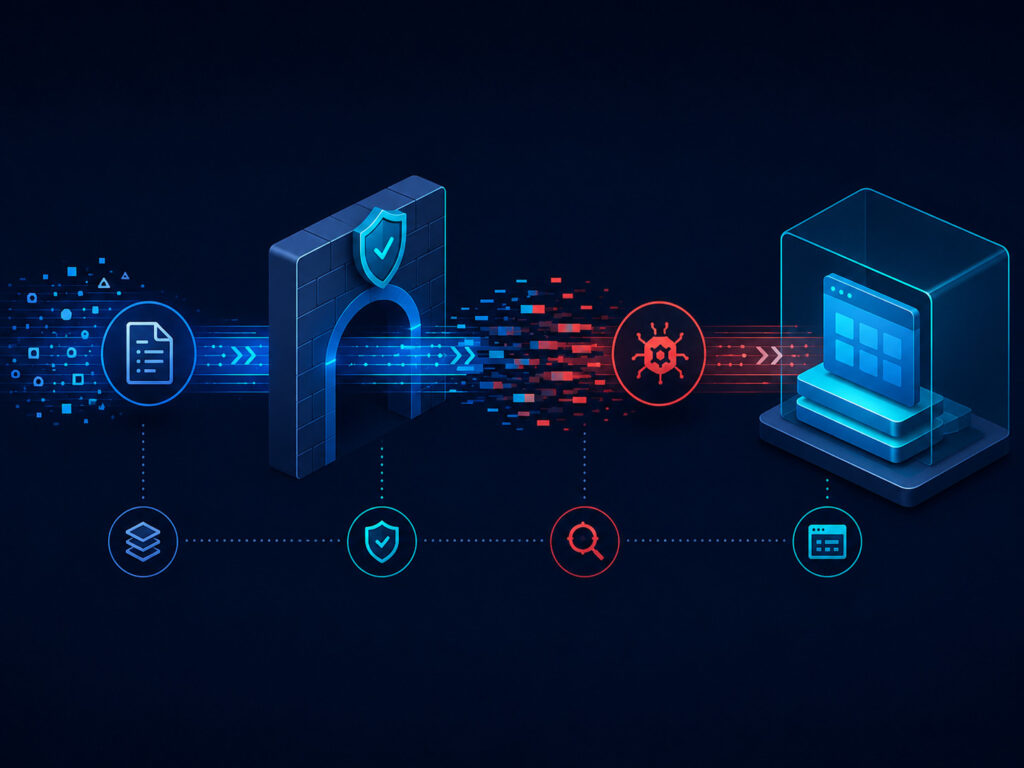
To fully grasp the risks, you must first understand the fundamental transformation of data. If you are unfamiliar with the terminology, refer to our comprehensive guide on what insecure deserialization vulnerability means.
Deserialization is the inverse process of serialization. Developers use serialization to convert complex objects into a byte stream for storage or transmission. When the application receives this byte stream, it reverses the process to reconstruct the original object in memory.
The vulnerability arises when an application trusts the incoming byte stream without validating the object type or structure. By manipulating the stream, an attacker can instruct the application to instantiate unintended classes or force the object to interact with malicious logic embedded within the stream.
This happens because the application relies on the incoming data to dictate the execution path, rather than strictly defining what classes are permitted to be reconstructed.
Why does global asset visibility impact your security posture?
Maintaining a secure infrastructure requires more than just code reviews. You need a comprehensive understanding of your entire asset landscape to ensure that security configurations are applied uniformly across all environments. Before identifying these blind spots, it is beneficial to practice testing insecure deserialization vulnerabilities to ensure that your security configurations are applied uniformly across all environments.
Effective cybersecurity depends on managing these outcomes through rigorous asset management and risk mitigation strategies. When you fail to maintain visibility over which libraries are utilizing serialization, you create an environment where vulnerabilities can persist undetected.
Automated scanning and robust asset inventory practices are vital to ensuring that no legacy system or obscure service is running insecure configuration parameters. By mapping your infrastructure, you ensure that security outcomes are predictable and that policies are applied consistently, preventing unauthorized access through unmonitored endpoints.
How do gadget chains facilitate successful exploitation?

Attackers rarely rely on a single flaw. They utilize gadget chains to leverage existing code within your application to perform unintended actions. A gadget is essentially a method or a sequence of operations already present in your application code or third-party libraries.
“The impact of insecure deserialization is severe, as it often allows for remote code execution, which can lead to a complete system compromise if the application runs with elevated privileges.” – OWASP Foundation
When an attacker sends a malicious serialized object, they chain these gadgets to reach a specific execution goal, such as spawning a system process or modifying a file. For those analyzing the technical progression of these threats, review our insecure deserialization attack examples in Java. By modeling adversary behavior, defenders can better prioritize their mitigations.
Instead of reacting to every alert without context, you must understand how gadgets within your libraries interact. If you are relying on dependencies that contain dangerous gadget chains, your application remains vulnerable even if your own code appears secure. The goal of mitigation is not just to fix one bug, but to eliminate the conditions that allow an attacker to chain these gadgets effectively in the first place.
How do you effectively test for these vulnerabilities?

Testing for deserialization flaws requires a proactive approach. You cannot simply wait for a breach to occur before assessing your risk. When auditing your codebase, ensure you adhere to safe object serialization practices to minimize potential exposure.
Manual code review is often the first step. You must search your codebase for instances where untrusted input is passed into serialization libraries. Automated tools can assist in this process, but they often struggle to identify complex gadget chains that exist across multiple third-party libraries.
- Identifying all entry points where user-controlled data reaches a deserialization sink.
- Analyzing the libraries in use to see if known gadgets are available.
- Creating proof-of-concept payloads to verify if the application is susceptible to object injection.
- Evaluating the impact of the flaw, such as whether it leads to system crashes or arbitrary code execution.
What are the common obstacles to securing serialization?
Transitioning to a secure serialization model is rarely simple. Many teams face significant friction when trying to remove native serialization without breaking existing application functionality. To understand the best practices for overcoming these hurdles, review the OWASP deserialization prevention tips.
| Obstacle | Description | Impact |
| Legacy Compatibility | Old systems depend on specific serialization formats. | High risk of system failure if changed. |
| Dependency Complexity | Gadget chains hide deep within third-party libraries. | Difficult to identify all attack vectors. |
| Performance Costs | Secure alternatives like JSON can have overhead. | Potential impact on high-throughput systems. |
| Developer Workflow | Teams are used to default library settings. | Resistance to changing established patterns. |
Which mitigation strategies guarantee the strongest defense?
Defending your application requires a multi-layered approach that prioritizes data integrity and isolation. To effectively protect your environment, implement the following strategies:
By prioritizing mitigations based on the threats that pose the greatest risk, you ensure that your security investments provide the highest possible return on infrastructure resilience.
Furthermore, managing cybersecurity outcomes starts with a comprehensive understanding of your asset landscape and the risks associated with each service.
To effectively protect your environment, implement the following strategies:
- Adopt Data-Only Formats: Replace native serialization with platform-agnostic formats by following our guide on alternative data formats for serialization.
- Implement Integrity Controls: Start using integrity checks in deserialization to verify that serialized objects have not been tampered with before processing.
- Strict Class Whitelisting: If you must use native serialization, implement a strict whitelist of permitted classes to ensure that the deserializer only instantiates safe object types.
- Isolate Deserialization Processes: Run deserialization tasks in a low-privilege environment or a container to limit the impact if an attacker achieves code execution.
- Monitor and Log: Implement comprehensive logging to detect attempts at object injection, allowing your team to respond quickly to reconnaissance efforts.
What are the real-world consequences of an insecure deserialization attack?
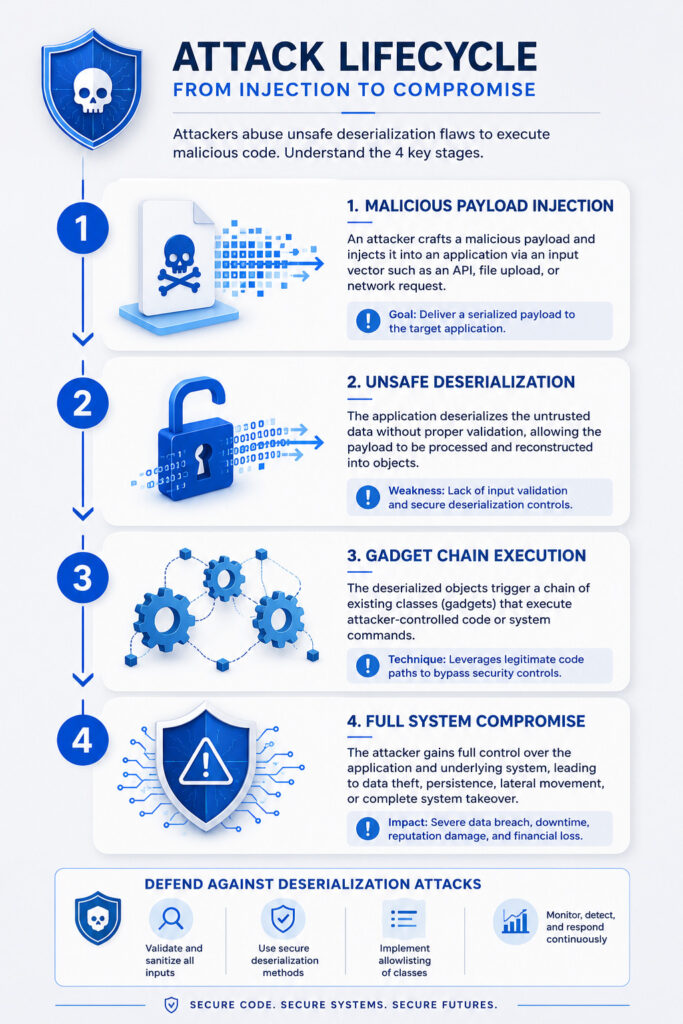
We once consulted for a large-scale logistics provider that suffered from a severe data breach linked to this exact vulnerability. Their system utilized a Java-based middleware to process shipping manifests sent from various partner portals.
The developers relied on native serialization to transmit these objects, assuming that the internal partner network was inherently trusted. An attacker compromised a secondary partner portal and injected a malicious serialized object into the shipping manifest stream.
When the middleware processed this stream, it triggered a gadget chain within a logging library the company had not updated in years. The exploit resulted in full code execution on the application server. The attacker leveraged this foothold to move laterally through the internal network, ultimately accessing the central database that contained sensitive client and manifest data.
“Deserialization vulnerabilities are often overlooked because they occur in the hidden layers of application logic”The use of untrusted data during deserialization can allow an attacker to inflict a denial of service, or even execute arbitrary code, by manipulating the data that is being deserialized.” – MITRE CWE
This incident demonstrated that even when your primary code is secure, the libraries you depend on can become the entry point for a catastrophic system compromise if you do not strictly control serialization processes. Understanding the remote code execution deserialization impact is essential to realizing why this is not just a minor bug, but a complete failure of application integrity.
How to approach proactive threat modeling for serialization?
Proactive threat modeling helps you identify deserialization risks before a single line of code is written. When designing your security architecture, refer to our techniques for preventing insecure deserialization in .NET and PHP to ensure you are shifting security to the left.
- Identify every interface where data crosses from an untrusted source to your application memory.
- Evaluate whether you truly need to use native serialization or if a flat data format suffices.
- Review your third-party dependencies specifically for known gadgets.
- Create a “deny-list” or “allow-list” architecture early in the design phase, ensuring that only expected object classes are permitted. This design-first approach shifts security to the left, reducing the likelihood of a major deserialization flaw reaching production.
FAQ
Can JSON or XML be vulnerable to deserialization attacks?
Can JSON or XML be vulnerable to deserialization attacks?
Yes, if the parser is configured to instantiate complex objects or execute code during parsing. You should always be aware of the data format deserialization risks with JSON and configure your parsers to treat data as simple key-value pairs rather than complex object structures.
Is this vulnerability specific to Java or .NET environments?
No, it affects many languages, including PHP, Python, and Ruby. While the exploitation techniques vary by language, the fundamental flaw of trusting serialized data remains the same.
How often should I audit my serialization logic?
Treat serialization logic as a high-risk surface. You should audit these components during every major library update or when you modify the object structure of your application.
Can a Web Application Firewall (WAF) detect these attacks?
A WAF can identify simple, known payloads, but it is rarely effective against custom gadget chains. Deep code analysis and strict input validation are mandatory for comprehensive protection.
What is the single most effective defense against deserialization?
Avoiding native serialization entirely in favor of platform-agnostic data formats like JSON is the most effective defense. If you must use native serialization, implement strict class whitelisting to control what can be instantiated.
Closing the Trust Gap in Deserialization
Dangers of Insecure Deserialization show how trusting unverified serialized data can expose applications to object manipulation, privilege escalation, and potentially severe system compromise. Validating incoming data, restricting allowed object types, and avoiding unsafe deserialization methods are essential steps for reducing these risks.
By treating serialized input as untrusted and integrating secure validation into the development lifecycle, organizations can limit attack opportunities and build applications that are more resilient against deserialization-based threats.
Ready to strengthen your secure development and security practices? Join the Secure Coding Practices Bootcamp and learn practical, hands-on techniques for handling untrusted data, preventing insecure deserialization vulnerabilities, and building more resilient applications.
References
- https://owasp.org/www-community/vulnerabilities/Deserialization_of_untrusted_data
- https://cwe.mitre.org/data/definitions/502.html
Related Articles
- https://securecodingpractices.com/common-vulnerabilities-attacks/
- https://securecodingpractices.com/what-is-insecure-deserialization-vulnerability-means/
- https://securecodingpractices.com/insecure-deserialization-attack-examples-java/
- https://securecodingpractices.com/preventing-insecure-deserialization-net-php/
- https://securecodingpractices.com/remote-code-execution-deserialization-impact/
- https://securecodingpractices.com/testing-insecure-deserialization-vulnerabilities/
- https://securecodingpractices.com/safe-object-serialization-practices-coding/
- https://securecodingpractices.com/data-format-deserialization-risks-json/
- https://securecodingpractices.com/using-integrity-checks-deserialization/
- https://securecodingpractices.com/owasp-deserialization-prevention-tips/
- https://securecodingpractices.com/alternative-data-formats-serialization/