


Testing for insecure deserialization is a fundamental responsibility for any security team. At Secure Coding Practices, we emphasize that Testing Insecure Deserialization Vulnerabilities is not just an occasional audit, but a systemic requirement for robust data handling.
At Secure Coding Practices, we emphasize that deserialization vulnerabilities are not merely code bugs but systemic failures in data handling that can lead to complete application compromise. This audit guide provides the framework necessary to identify, assess, and prioritize these risks within your infrastructure.
Core Deserialization Security Principles
To navigate the technical complexities of your security audit, keep the following core principles in mind:
- Insecure deserialization occurs when untrusted data is processed without sufficient validation, potentially allowing for malicious object instantiation.
- Proactive identification of gadget chains within third-party dependencies is essential for accurate risk assessment.
- Effective testing must move beyond basic input validation to analyze the entire application logic flow.
Why Is Testing Insecure Deserialization Vulnerabilities Critical?
The primary reason to prioritize this testing is the catastrophic nature of the vulnerability. When an application reconstructs an object from an untrusted byte stream, it often implicitly trusts the data, failing to verify the class type or content.
If your infrastructure lacks rigorous checks, you are at risk of the Dangers of Insecure Deserialization which frequently bypass traditional firewalls. Testing allows you to identify where your application blindly restores these objects.
Without specific testing, these flaws often remain hidden in the deep logic of your codebase, inaccessible to standard scanners that look only for common web vulnerabilities. By auditing these data interfaces, you gain visibility into how your application handles incoming serialized input and ensure that only authorized classes are instantiated.
What Are the Core Concepts of Deserialization?
To test effectively, you must understand the transition of data from storage to execution. Serialization transforms complex objects into a stream of bytes for efficient transmission or storage. Deserialization is the reverse, restoring that stream into an active object within your application memory.
The vulnerability emerges when the application does not constrain the reconstruction process. An attacker can manipulate the byte stream to force the application to instantiate unintended classes. Once these malicious objects are in memory, they can trigger gadget chains, which are sequences of existing code within your application that perform unauthorized actions.
- Data Stream: The input provided to the application, often containing serialized objects.
- Gadget Chain: A series of methods already present in the application code or libraries, which can be linked to perform an exploit.
- Sink: The specific code location where the untrusted data is processed.
What is the recommended methodology for vulnerability identification?

When you begin the process of Testing Insecure Deserialization Vulnerabilities, you must move beyond superficial checks. A systematic methodology ensures that you do not miss complex gadget chains. If you are aiming for long-term security, you should also review our best practices for preventing insecure deserialization net php to ensure that your defensive code mirrors your testing standards.
A structured plan for Testing Insecure Deserialization Vulnerabilities prevents critical oversights and ensures comprehensive coverage across all application modules.
| Phase | Focus Area | Recommended Method | Primary Objective |
| Recon | Data Entry Points | Manual Code Audit | Identify serialization sinks |
| Discovery | Dependencies | Dependency Checkers | Locate known gadget chains |
| Probing | Input Payloads | Burp Suite / Custom Scripts | Verify exploitability |
| Analysis | Data Flows | Static Analysis (SAST) | Map object instantiation paths |
If you are currently Testing Insecure Deserialization Vulnerabilities in a CI/CD pipeline, ensure that your automated tests are configured to detect gadget chains early.
- Passive Reconnaissance: Map out all areas where serialization is utilized. Look for base64 encoded strings, binary objects in cookies, or hidden form fields that suggest serialized data is being passed back and forth.
- Gadget Discovery: Analyze the libraries in use. Do not just test your own code; focus on the third-party dependencies. If your application uses popular logging or utility frameworks, check them against known vulnerability databases to see if they contain gadgets that can be weaponized.
- Active Probing: Attempt to send manipulated objects to see how the application reacts. Monitor tThe ultimate goal of Testing Insecure Deserialization Vulnerabilities is to identify flaws before they reach production, minimizing the risk of a breach.”
How do you set up a safe environment for deserialization testing?

You should never perform active testing against production systems. Deserialization attacks can cause severe instability, including service crashes that disrupt legitimate users. A proper lab environment is the cornerstone of your security audit.
- Isolate the Environment: Utilize a sandbox or a containerized environment that mirrors your production configuration but lacks connectivity to your live database or sensitive user data.
- Instrument the Application: Use debuggers and remote logging to capture the internal state of the application during the deserialization process. This allows you to observe what classes are being instantiated.
- Document Baseline Behavior: Before introducing payloads, ensure you have a baseline of how the application processes valid objects. This makes it easier to identify anomalies during your active testing phases.
“The vulnerability is often exploited by using pre-built gadgets that are available in the application’s classpath, which can then be chained together to execute arbitrary code or commands on the underlying system.” – Veracode
Testing in a controlled environment allows you to push boundaries without the fear of damaging critical infrastructure. It also provides the space to experiment with different gadget chain combinations that might be too unstable for a live system.
How can you detect complex gadget chains during analysis?

Detecting gadget chains requires a blend of static analysis and dynamic observation. You must look beyond your own code to understand the third-party libraries that compose your application stack. Many developers assume that using a standard, popular library ensures safety, but these libraries often contain complex gadget chains that attackers have already mapped out.
Many developers assume that using a standard library ensures safety, yet the complexity of modern codebases makes Testing Insecure Deserialization Vulnerabilities more difficult without a dedicated, hands-on approach.
“Gadget chains are a series of method calls that perform a chain of operations. When an attacker controls the serialized data, they can trigger these chains to perform unauthorized actions, leading to arbitrary code execution.” – OWASP Foundation
To identify these chains, follow these systematic analysis steps:
- Perform Static Code Analysis: Use automated tools to scan your codebase for dangerous sinks where untrusted data is deserialized. This identifies where you might be exposed.
- Map Classpath Dependencies: Document every library used in your application. Check these against databases that track known gadget chains to see if your dependencies are vulnerable.
- Trace Data Sinks: Follow the flow of user-controlled data into your application. If a byte stream reaches a deserialization sink without prior validation or sanitization, flag it for immediate manual review.
- Observe Runtime Behavior: In a sandbox environment, use debuggers to watch how objects are instantiated. If an unexpected class is called during the process, it may indicate a potential gadget chain vulnerability.
By mapping these chains, you gain the visibility required to remediate risks before they are exploited in the wild.
Why is the remote code execution deserialization impact so severe?
The primary danger of deserialization lies in the capability for an attacker to gain full server control; this is precisely why Testing Insecure Deserialization Vulnerabilities is essential to prevent full application compromise.
When an attacker successfully triggers a gadget chain, they can execute arbitrary commands with the same privileges as the application process. This allows them to:
- Exfiltrate Sensitive Data: Gain direct access to your database or configuration files, potentially leaking customer information or proprietary code.
- Establish Persistence: Install backdoors that ensure the attacker maintains access even after the application restarts or the initial vulnerability is patched.
- Lateral Movement: Use the compromised application as a pivot point to attack other internal systems that are not directly exposed to the internet.
- Deploy Malware: Run unauthorized processes, such as cryptominers or ransomware, directly on your production infrastructure.
The severity stems from the fact that the application itself executes the malicious payload. Because the server trusts the code that it is running, traditional security controls often fail to detect the attack, making this a high-priority threat for any organization that processes serialized data.
How should you report your testing findings?
Reporting your results after Testing Insecure Deserialization Vulnerabilities requires more than just identifying the presence of a flaw. Because these vulnerabilities are often complex, your report must clearly articulate the risk to stakeholders.
A high-quality report helps security teams prioritize remediation and justifies the necessary engineering resources.
When documenting your findings, ensure you include:
- Proof of Concept (PoC): Provide a clear, reproducible exploit payload that demonstrates the vulnerability without causing irreversible damage.
- Impact Assessment: Detail exactly what an attacker could achieve. For instance, describe how the flaw leads to unauthorized file access, remote code execution, or data manipulation.
- Gadget Chain Trace: If you identified a gadget chain, document the path from the sink to the final execution of the malicious command. This helps developers understand which specific libraries or methods are responsible.
- Business Context: Explain how this vulnerability affects specific business assets. Does it expose customer records, credentials, or sensitive proprietary algorithms?
- Remediation Roadmap: Suggest specific, actionable steps for the development team to mitigate the issue, such as replacing the serialization library or implementing strict class validation.
How can you remediate deserialization vulnerabilities?
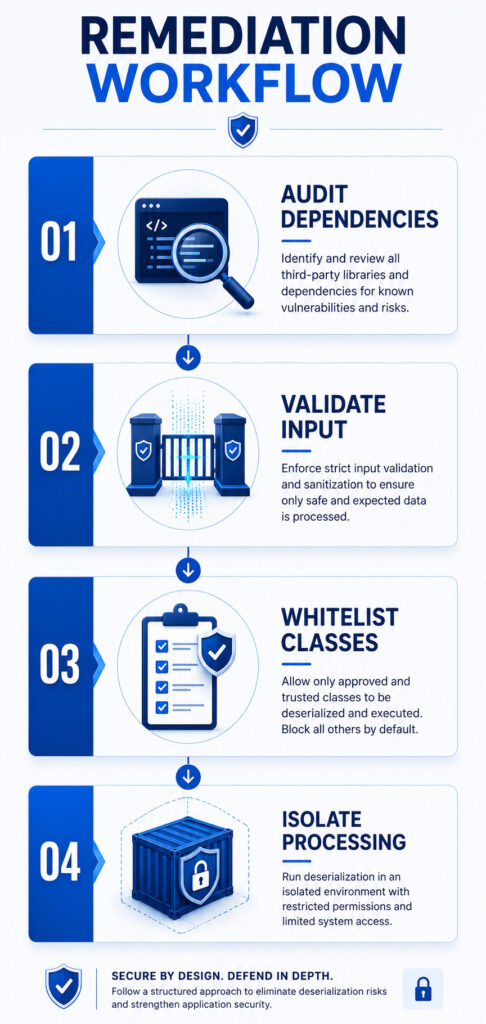
Remediation is not just about patching the code; it is about changing how your application handles data. Once you have finished Testing Insecure Deserialization Vulnerabilities and identified a vulnerability, you must prioritize moving your application toward a more secure data-handling architecture.
To secure your application, focus on these defensive strategies:
- Adopt Data-Only Formats: Whenever possible, migrate away from native serialization libraries (like Java Serialization or PHP Object Injection targets) to safe, platform-agnostic formats such as JSON or XML. These formats are much harder to manipulate into executable code.
- Implement Strict Integrity Checks: If you must use serialized data, always verify the integrity of the data stream using digital signatures or HMACs. This ensures that the data has not been tampered with in transit.
- Utilize Class Whitelisting: If your application relies on a deserializer that supports class filtering, implement a strict whitelist of permitted classes. Ensure that the application only deserializes types it absolutely needs, and reject anything else by default.
- Isolate Processing: Run deserialization tasks in a restricted, low-privilege container. If an attacker manages to trigger a malicious object, this containment limits the scope of the potential damage to the rest of your system.
- Update Dependencies: Regularly audit your third-party dependencies for known deserialization gadgets. If a library is not essential and contains vulnerabilities, remove it from your project entirely.
FAQ
Can I rely on automated scanners for all deserialization flaws?
No. While automated tools can detect obvious flaws, they often fail to identify custom gadget chains or business-specific logic vulnerabilities. Manual review remains a critical part of your testing process.
Why do security scanners often miss these vulnerabilities?
Scanners typically look for standard, known signatures. Deserialization vulnerabilities rely on complex gadget chains specific to your application’s classpath, which are difficult for scanners to model without deep context.
Is it ever safe to deserialize user input?
it is never safe to deserialize untrusted user input directly. You should always treat incoming serialized data as malicious and validate it rigorously before processing it in memory.
How can I prevent gadget chains if I cannot update my libraries?
If you cannot update your dependencies, you must apply compensating controls. This includes strictly restricting class instantiation through whitelisting or placing the deserialization process in a sandboxed, low-privilege environment.
Is there a “safe” way to use native serialization in my application?
If native serialization is strictly required, secure the process using cryptographically secure integrity checks and a strict class whitelist. Ultimately, migrating to data-only formats like JSON or Protocol Buffers remains the industry-standard recommendation for eliminating this vulnerability.
References
- https://sca.analysiscenter.veracode.com/vulnerability-database/security/insecure-deserialization/java/sid-153728
- https://cheatsheetseries.owasp.org/cheatsheets/Deserialization_Cheat_Sheet.html