


Secure Coding Practices recommends choosing the serialization format that fits your system instead of relying on JSON or XML by default. While both are still common, they aren’t always the right choice for modern applications. Performance, compatibility, and long-term maintenance can vary a lot depending on the workload.
We’ve seen that making the right decision early can reduce migration effort and avoid unnecessary complexity later. Small choice. Big impact. Keep reading to see how different serialization formats fit different architectures and what to consider before making your next design decision.
Alternative Data Formats Serialization: What to Remember
Choosing the right serialization format depends on your performance, compatibility, and security needs. A thoughtful decision today can make your systems easier to maintain and scale over time.
- Binary formats improve speed and reduce payload size.
- Schema driven formats simplify compatibility and versioning.
- Match the serialization format to your application’s data and communication needs.
What Is An Alternative Data Serialization Format?
A serialization format changes structured data into a form that another application can store, send, or read later. Some formats are easy for people to read. Others are built to move data faster or use less storage. There is no single format that works best for every project.
“JSON is a text format for the serialization of structured data.” – Internet Engineering Task Force (IETF)
The Internet Engineering Task Force (IETF) and the World Wide Web Consortium (W3C) describe serialization as a way for different systems to exchange structured information while keeping the data intact. Once the data reaches another application, deserialization rebuilds it into something the program can use again.
Teams typically compare payload size, parsing speed, schema support, compatibility, and maintenance because these factors become more important as applications grow.
Why Isn’t JSON Always The Best Choice?
JSON is still one of the most common serialization formats. There is a good reason for that. It is easy to read, easy to write, and almost every programming language supports it.
JSON stores everything as text. Property names appear over and over again, even when the same fields are repeated thousands of times. Those extra bytes may not matter for a small API. They can matter quite a bit once traffic starts growing.
Because JSON repeats property names, payloads can become larger as traffic grows. Compression helps, but binary formats often reduce payload size even further.
Schema management is another area where JSON can become harder to maintain. The format does not define strict rules by itself. Validation often depends on separate tools or application code.
As more services are added, keeping every team aligned becomes more difficult. Strong validation and OWASP deserialization prevention practices become increasingly important as applications exchange serialized data across multiple services.
What Problems Do Alternative Formats Solve?

Alternative serialization formats try to solve problems that appear as software grows. Better performance is one reason, but it is not the only one.
Many binary formats store information in a much smaller form than plain text. Smaller payloads move across the network faster. They also reduce storage needs, which can make a difference when applications process large amounts of data every day.
Schema based formats solve a different problem. They define the data structure ahead of time, making it easier to introduce new fields without breaking older applications. That makes versioning easier for development teams and reduces surprises during updates.
Even with a well-designed schema, developers should protect against insecure deserialization because serialized data from untrusted sources can introduce avoidable security risks.
Choosing a serialization format is one of those decisions. It may look like a small detail early in a project. Months later, it can affect deployment, compatibility, and even security.
Many engineering teams look for formats that offer:
- Smaller payloads
- Faster processing
- Better interoperability
- Easier schema changes
- Lower storage costs
The Apache Software Foundation also points out that schema aware formats improve consistency across distributed systems because the schema is managed separately from the application itself.
Which Binary Serialization Formats Are Worth Considering?
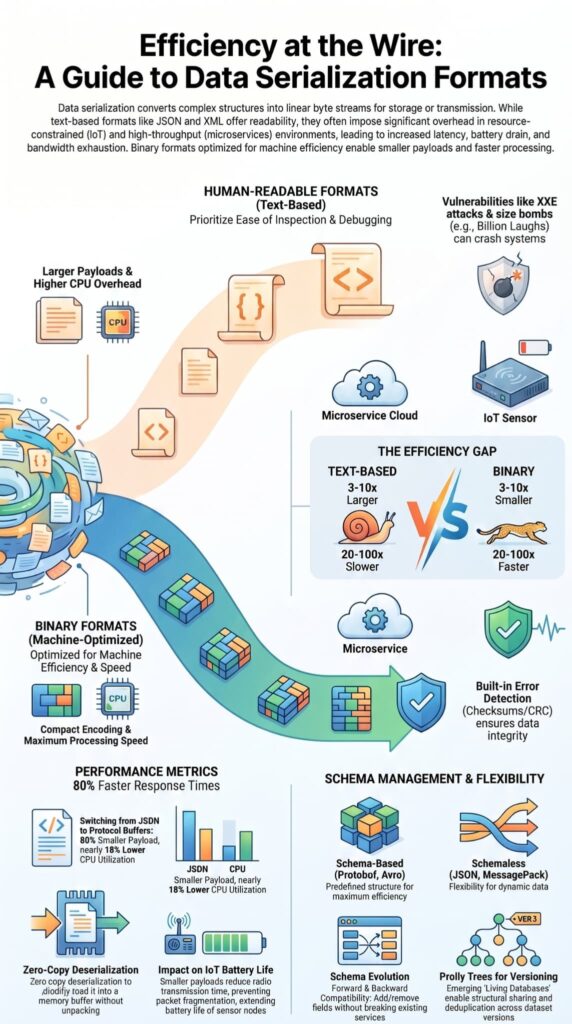
Binary serialization formats store data in a compact form that computers can process directly. They usually produce smaller payloads than text based formats and often require less work during parsing.
“The verbosity of standard data formats like JSON has motivated the adoption of more compact binary serialization protocols, particularly in resource constrained environments.” – Telecom (MDPI)
Still, performance numbers should never be the only reason to choose a format. We encourage teams to think about maintenance, language support, schema evolution, and available tooling before making a decision. A format that wins every benchmark is not always the one that makes life easier a year later.
Why Is Protocol Buffers Popular For Microservices?
Protocol Buffers, created by Google, use predefined schema files to serialize structured data into a compact binary format.
Instead of storing full property names every time, each field is represented by a numeric identifier. That reduces the amount of data being transmitted and helps applications parse messages quickly.
Protocol Buffers also support versioning, allowing services to evolve without breaking compatibility.
When Does Apache Avro Become The Better Choice?
Apache Avro, maintained by the Apache Software Foundation, was designed with changing data in mind.
Unlike Protocol Buffers, Avro can store schema information alongside the data or connect to a schema registry. That approach works well for event streaming, analytics, and other systems where the data model changes over time.
| Feature | Apache Avro |
| Schema | Embedded or registry based |
| Versioning | Strong |
| Data portability | High |
| Best use | Analytics and event streaming |
Avro may require a little more planning at the beginning. But once the data ecosystem grows, that investment often pays off through easier maintenance and more predictable schema updates.
Which Text Based Formats Still Matter Today?
Source: 0612 TV w/ NERDfirst
Configuration files are a good example. Developers review them during deployments, update them as applications change, and sometimes troubleshoot them late at night. Clear files save time. They also help prevent small mistakes from turning into bigger ones.
The Cloud Native Computing Foundation, or CNCF, continues to promote readable configuration formats across cloud environments. We see the value of that in our own work as well. If a teammate can understand a file without digging through documentation, everyone moves faster.
When Should You Use YAML?

YAML has been a favorite for infrastructure and automation for years. It handles nested data well, supports comments, and stays fairly readable even as files grow.
Some reasons teams choose YAML include:
- Easy to read
- Supports comments
- Good for nested data
- Common in cloud tools
YAML is sensitive to spacing. One misplaced indent can break a configuration file, and finding the problem is not always fun.
Security matters too. At Secure Coding Practices, we spend more time teaching safe parsing than debating file formats. An unsafe parser can create problems no matter which format is being used. Adding integrity checks before deserialization helps verify that serialized data has not been altered before an application processes it.
We encourage developers to validate input, use trusted libraries, and avoid deserializing untrusted data whenever possible.
FAQs
Can I use different data serialization formats in one application?
Yes, you can use multiple data serialization methods within the same application. Many teams choose a human-readable format for configuration files and a compact binary format for API payloads or microservices communication. This approach allows each component to use the most suitable serialization format, improving performance while keeping configuration and troubleshooting straightforward.
How do I choose a serialization format for a long term project?
You should begin by evaluating your data schema, expected schema evolution, and versioning requirements. If your structured data is likely to change over time, choose a format that supports backward compatibility and forward compatibility. This decision improves cross-platform compatibility, increases data portability, and reduces the risk of compatibility issues as your application evolves.
Does binary serialization always perform better than text serialization?
No, binary serialization does not always perform better than text serialization. Binary formats often provide better encoding efficiency, smaller payload size, and faster parsing speed, which can improve bandwidth optimization and latency reduction. However, text formats are easier to read, debug, and edit, making them a practical choice for many development and maintenance tasks.
Why does schema evolution matter in distributed systems?
Schema evolution is important because applications in distributed systems are often updated at different times. A well-designed schema definition, combined with proper versioning and a schema registry, allows services to exchange structured data without breaking existing integrations. This approach supports reliable data interchange and helps reduce compatibility issues during software updates.
What should I evaluate before switching to a new serialization library?
Before adopting a new serialization library, evaluate its support for deserialization, marshalling, unmarshalling, interoperability, and serialization benchmark results. You should also confirm that it meets your requirements for data structure, transport format, and machine communication. Testing the library with production-like workloads will help you identify compatibility and performance issues before deployment.
Building Reliable Systems Starts With Better Decisions
Choosing the right data format affects how your system performs, how easy it is to maintain, and how well it holds up over time. A faster option isn’t always the best fit if it creates extra work later. Keep security in mind from the start. It pays off.
At Secure Coding Practices, we help developers build safer software with practical skills they can use right away. If you want to improve secure development while building reliable systems, the Secure Coding Practices Bootcamp gives you hands on experience with secure coding techniques through real exercises. Join today and start writing safer code with more confidence.
References
- https://datatracker.ietf.org/doc/rfc8259/
- https://www.mdpi.com/2673-4001/7/2/43