
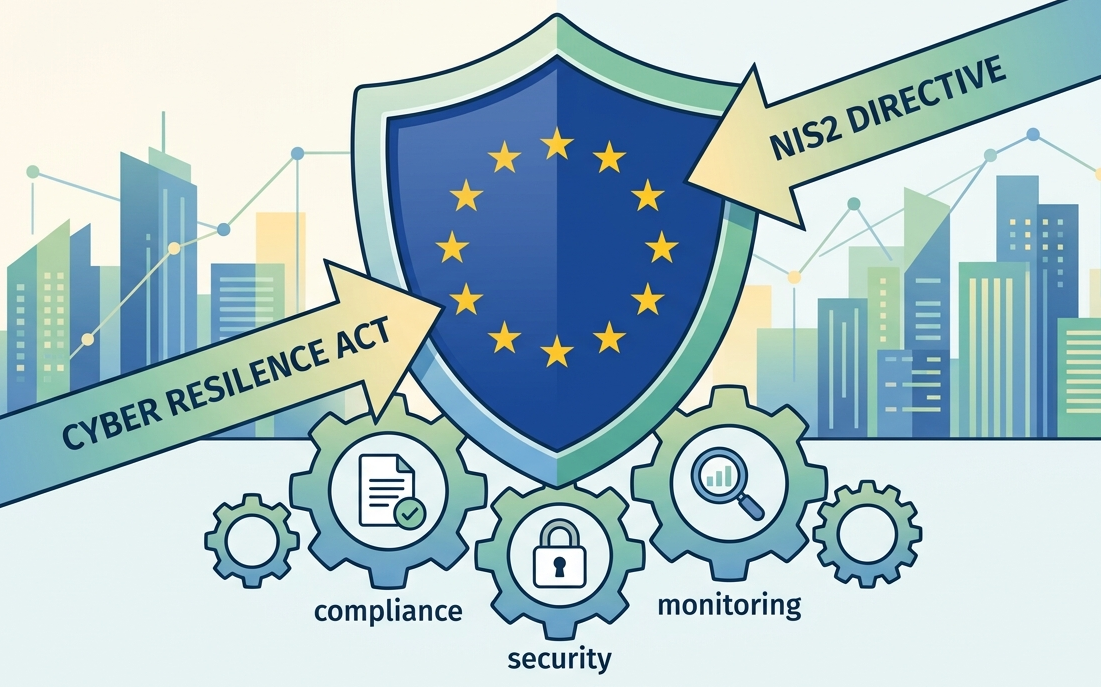

If you build software for the European market, cybersecurity is now a legal requirement, not an option. EU cybersecurity laws control how digital products are designed, built, tested, and maintained across their full lifecycle. Developers must follow rules like the Cyber Resilience Act (CRA) and the NIS2 Directive to ensure software is safe and compliant. Security must be included from the first design step and continue after release. Using secure coding and early risk checks helps reduce legal problems, protect users, and meet EU requirements.
Key Insight on Legal & Regulatory Context
Here are the most important points you should understand before diving deeper:
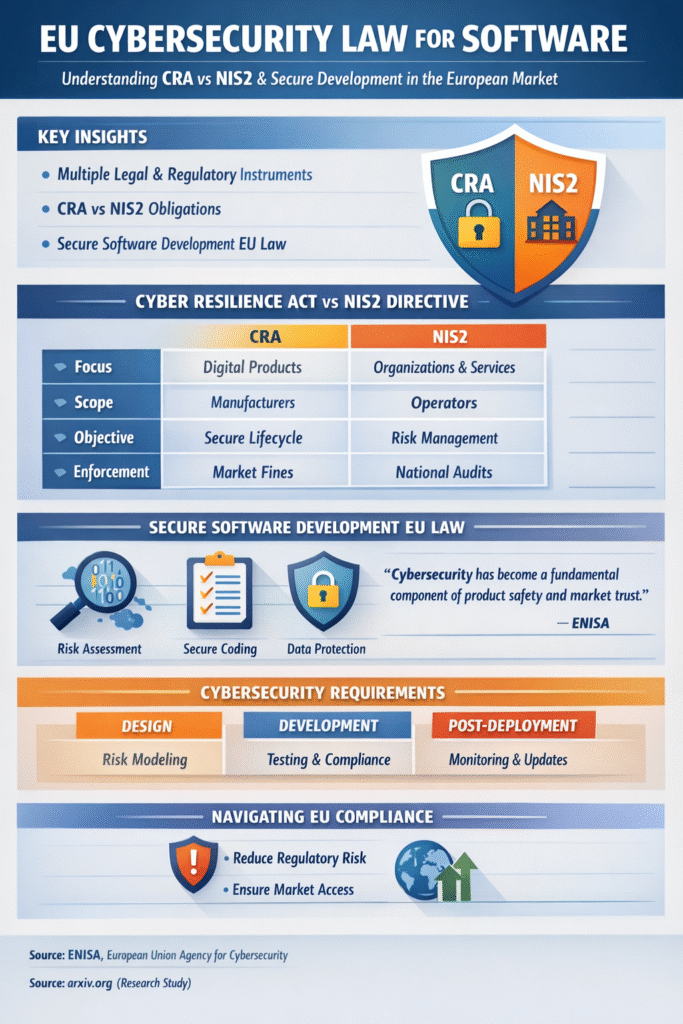
- EU cybersecurity law for software combines multiple legal and regulatory instruments, not a single rule
- Understanding cyber resilience act vs nis2 is essential to manage both product and organizational obligations
- Aligning with secure software development eu law and lifecycle requirements ensures compliance and market access
EU Cybersecurity Law for Software
EU cybersecurity law for software is not a single rule. It is a group of different laws that work together to manage digital security in the European market. These laws explain how software should be built, protected, and maintained.
Developers must follow rules that cover several areas:
- Product security requirements
- Data protection rules
- Risk management processes
- Incident reporting obligations
- Software maintenance responsibilities
- Supply chain security checks
These rules apply to almost all software products sold in the EU, whether they are apps, cloud systems, or embedded software.
“Cybersecurity has become a fundamental component of product safety and market trust in the digital economy.” – European Union Agency for Cybersecurity (ENISA)
The main purpose is to reduce cyber risks and make digital products more reliable and safe for users. In simple terms, software security is no longer just a technical choice. It is now a legal responsibility.
In addition, companies are expected to show proof of compliance. This means security is not only about doing the right thing, but also about documenting it clearly for audits and regulators.
Cyber Resilience Act vs NIS2
Credits: LawMint
| Aspect | Cyber Resilience Act | NIS2 Directive |
| Focus | Digital products & software | Organizations & services |
| Scope | Manufacturers, developers | Operators, providers |
| Objective | Secure product lifecycle | Risk & incident management |
| Enforcement | Market restrictions, fines | National audits, penalties |
The Cyber Resilience Act (CRA) and NIS2 Directive are two major EU cybersecurity laws. They are closely connected but focus on different areas.
CRA focuses on digital products such as software, apps, and connected devices. It ensures that products are secure throughout their full lifecycle, including design, development, release, and updates.
NIS2 focuses on organizations and companies. It requires strong cybersecurity management, internal policies, risk control, and fast incident response.
Simple difference:
- CRA = product security rules
- NIS2 = company security rules
CRA affects how developers design software. NIS2 affects how companies manage security internally. Together, they create full cybersecurity coverage for both products and organizations.
In practice, this means developers and managers must work together more closely. Engineering teams handle secure design, while leadership ensures policies, reporting, and compliance systems are in place. Without this alignment, companies may fail audits or face penalties.
EU Product Security Legislation Overview
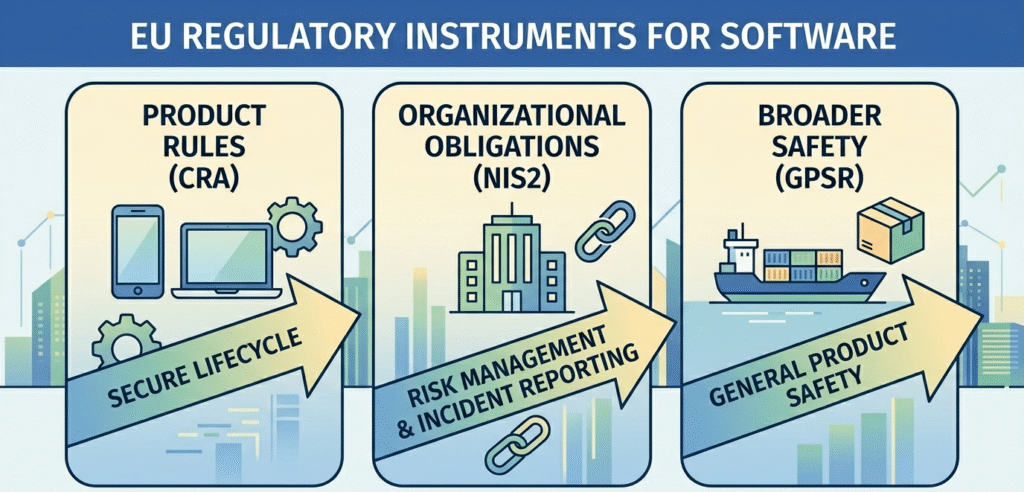
EU product security legislation is made up of several frameworks that work together to create a safe digital market.
Main regulations include:
- Cyber Resilience Act (CRA)
- NIS2 Directive
- General Product Safety Regulation (GPSR)
These laws also connect with data privacy and trade rules.
The goal is to ensure all digital products in the EU are safe before reaching users. Companies that follow these rules early can avoid delays and reduce compliance risks.
In addition, regulators expect companies to think about security as part of product design strategy. This includes planning updates, managing vulnerabilities, and ensuring long-term support for products.
Secure Software Development EU Law
EU law requires software to be secure from the beginning of development. Security must be included in design, coding, testing, and maintenance.
Developers must:
- Plan security during design
- Use secure coding practices
- Test for vulnerabilities early
- Protect user data
- Prepare for security incidents
- Maintain secure updates after release
Security is now part of legal compliance, not just best practice. Software must be built correctly from the start, not fixed later.
A key point is that “secure enough” is no longer acceptable. Developers must actively reduce risk, not just react to problems. This includes designing systems that fail safely and limit damage if attacks happen.
Cybersecurity Requirements for Software EU
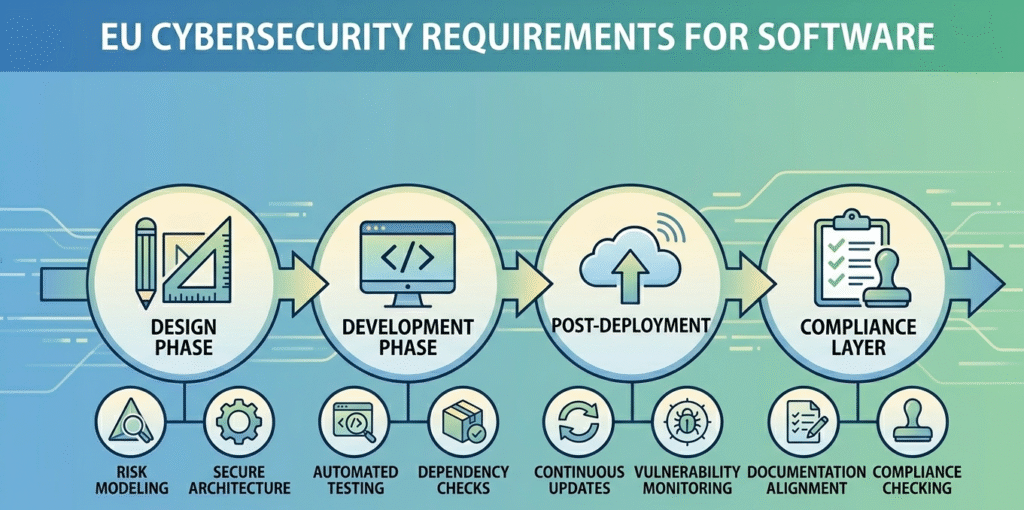
EU cybersecurity rules apply across the full software lifecycle.
Design phase
Developers must identify risks and design secure systems. Threat modeling is often used here.
Development phase
Security testing and code review must be done during coding. Developers must also track third-party libraries.
Deployment phase
Software must be released with secure default settings and minimal open access.
Post-deployment
Developers must provide updates and fix vulnerabilities quickly.
Compliance layer
All actions must be documented for audits and legal checks.
A key addition is traceability. Regulators want to see how a risk was found, how it was fixed, and when it was updated. This creates accountability across the entire lifecycle.
Cybersecurity Requirements for Software EU
EU cybersecurity rules apply across the full software lifecycle.
Design phase
Developers must identify risks and design secure systems. Threat modeling is often used here.
Development phase
Security testing and code review must be done during coding. Developers must also track third-party libraries.
Deployment phase
Software must be released with secure default settings and minimal open access.
Post-deployment
Developers must provide updates and fix vulnerabilities quickly.
Compliance layer
All actions must be documented for audits and legal checks.
A key addition is traceability. Regulators want to see how a risk was found, how it was fixed, and when it was updated. This creates accountability across the entire lifecycle.
Secure Coding Regulatory Expectations EU
EU regulators expect developers to write secure code that reduces risks.
Developers are expected to:
- Prevent common vulnerabilities
- Validate inputs correctly
- Use secure authentication
- Avoid unsafe libraries
- Follow coding standards
- Reduce attack surfaces
Security testing tools must also be used during development.
Secure coding is now a legal expectation, not just a good practice. Poor coding can directly affect compliance status and may lead to legal consequences.
Secure Coding EU Regulatory Context
Secure coding is part of the EU legal context system. It connects technical work with compliance rules.
Developers must understand:
- Secure coding supports legal compliance
- Poor coding can lead to penalties
- Security is checked during audits
- Evidence must be documented
This means coding decisions now have legal impact. Every vulnerability is not only a technical issue but also a compliance risk.
Software Security by Design EU
Software security by design means building security from the start.
It includes:
- Secure architecture planning
- Early risk analysis
- Safe default settings
- Strong system structure
- Controlled access design
Security must be part of planning, not added later.
This approach reduces long-term costs because fixing issues early is cheaper than fixing them after release.
Security by Design CRA Requirements
The Cyber Resilience Act requires security-by-design and security-by-default.
This means:
- Products must be secure when released
- Default settings must be safe
- Risks must be identified early
- Updates must continue after release
- Vulnerabilities must be reported and fixed
Companies must also prove how security is built into their product.
CRA ensures security is not optional. It becomes a core product feature.
Secure Coding Practices EU Law
Secure coding practices are now part of EU law.
Developers must:
- Write safe code
- Avoid known vulnerabilities
- Use trusted tools
- Update dependencies
- Follow security guidelines
- Monitor for weak points
These practices reduce risks and ensure compliance with CRA and NIS2.
FAQ
How does EU cybersecurity law affect daily software development work?
EU cybersecurity law affects daily software development by making security part of every stage of work. Developers must think about risks while planning features, writing code, testing, and releasing updates. Security is no longer a separate task at the end. It is included in normal workflows.
Developers must also check third-party libraries, protect user data, and use security tools during coding. Documentation is also required to show compliance. This makes development more structured, careful, and focused on long-term software safety.
What happens if a software product does not follow EU cybersecurity rules?
If a software product does not follow EU cybersecurity rules, companies can face fines, legal action, or market restrictions in the European Union. In serious cases, the product may be removed from the market or banned from being sold.
Companies can also lose certifications like CE marking, which are required for EU access. Besides legal problems, it can damage customer trust and company reputation. Fixing issues after release is also more expensive than building security early in development.
Why is documentation important for EU cybersecurity compliance?
Documentation is important because it proves that a company follows EU cybersecurity rules. It shows how risks were identified, how security testing was done, and how vulnerabilities were fixed. Without documentation, companies cannot prove compliance during audits, even if the software is secure. It is also required for certifications like CE marking.
Good documentation helps regulators understand the product lifecycle and security decisions. It also improves internal control by making development processes more organized and transparent.
How can developers prepare for EU cybersecurity requirements?
Developers can prepare for EU cybersecurity requirements by learning secure coding and understanding EU laws like CRA and NIS2. They should practice risk assessment to identify vulnerabilities early. Using security tools like scanners, testing systems, and dependency checkers also helps improve safety.
Developers should follow secure coding guidelines and keep software components updated. Training and teamwork with security experts are also important. Early preparation makes it easier to build compliant software and reduces mistakes during development.
What is the biggest challenge in EU cybersecurity compliance?
The biggest challenge in EU cybersecurity compliance is balancing fast software development with strict security rules. Developers must deliver features quickly while also doing risk checks, testing, and documentation. This can slow down work if not managed well.
Another challenge is keeping all software components, including third-party libraries, secure and updated. Regulations can also change over time, making compliance harder. Many companies solve this by using automation tools and building security into the development process from the start.
Navigating the EU Legal & Regulatory Context
EU cybersecurity laws require developers to treat security as a core part of software development. CRA and NIS2 require secure design, coding, testing, and maintenance throughout the software lifecycle. These rules reduce risks and protect users but also increase responsibility for developers and companies.
Early preparation helps avoid legal issues and improves product quality. To strengthen skills and meet EU requirements, teams should join a Secure Coding Practices program that helps build safe and compliant software from the start.
References
- https://industrialcyber.co/secure-by-design/enisa-playbook-calls-for-security-by-design-across-product-lifecycle-urges-shift-to-continuous-cybersecurity/
- https://arxiv.org/abs/2211.16987
Related Articles
- https://securecodingpractices.com/eu-cybersecurity-law-for-software/
- https://securecodingpractices.com/cyber-resilience-act-vs-nis2/
- https://securecodingpractices.com/eu-product-security-legislation-overview/
- https://securecodingpractices.com/secure-software-development-eu-law/
- https://securecodingpractices.com/cybersecurity-requirements-for-software-eu/
- https://securecodingpractices.com/secure-coding-regulatory-expectations-eu/
- https://securecodingpractices.com/secure-coding-eu-regulatory-context/
- https://securecodingpractices.com/software-security-by-design-eu/
- https://securecodingpractices.com/security-by-design-cra-requirements/