


The Cyber Resilience Act (CRA) changes how we approach software security. From our experience, risk assessment is no longer optional, it’s central to compliance. Teams must actively identify, evaluate, and manage risks throughout the product lifecycle.
Many organizations still treat this as a one-time checklist, but regulators expect continuous effort. In this guide, we break down the core risk assessment requirements Cyber Resilience Act using simple language and practical insights we’ve applied ourselves, keep reading.
Risk Assessment Requirements Cyber Resilience Act: Key Takeaways
Before going deeper into the risk assessment requirements Cyber Resilience Act, here are the key points you should understand.
- Risk assessment requirements Cyber Resilience Act demand continuous evaluation
- Documentation is essential to prove compliance and decision-making
- Security must be integrated early to meet Cyber Resilience Act expectations
What Are Risk Assessment Requirements Under the CRA?
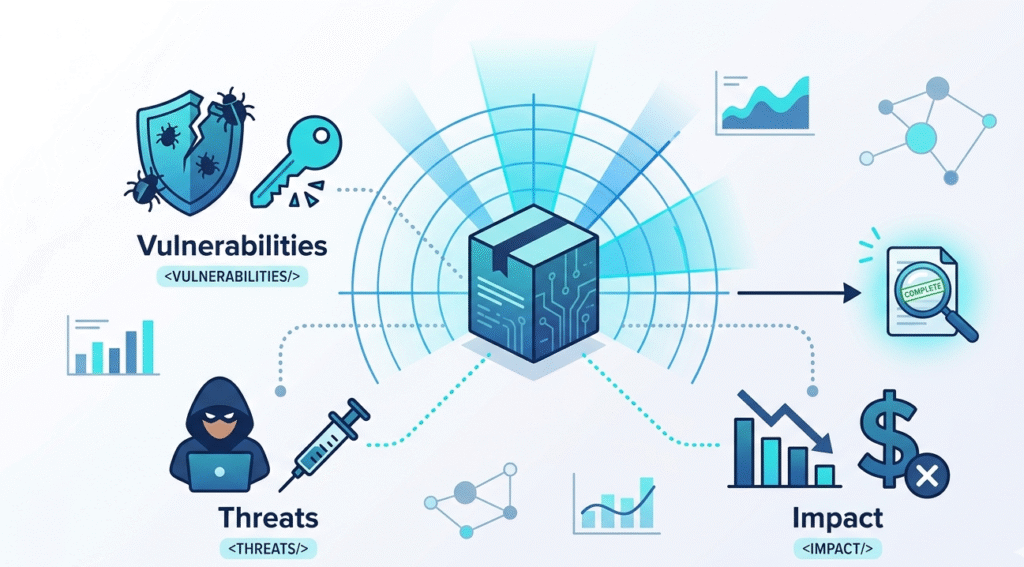
The risk assessment requirements Cyber Resilience Act require organizations to perform structured and ongoing risk assessments for digital products.
“Manufacturers shall, for the purposes of complying with the duty to provide products with digital elements with a high level of cybersecurity, ensure that those products are designed, developed and produced in such a way that they do not contain any known exploitable vulnerability.” – Regulation (EU) 2024/2847 (Cyber Resilience Act), Article 13
Key expectations include:
- Identify cybersecurity risks before product release
- Evaluate likelihood and impact of threats
- Document mitigation strategies clearly
- Update assessments during the lifecycle
- Align with secure development lifecycle practices. From what we’ve seen, teams that embed risk thinking early avoid expensive fixes later.
From what we’ve seen, teams that embed risk thinking early avoid expensive fixes later. Instead of reacting to incidents, they proactively reduce vulnerabilities and strengthen product trust.
Key Components of CRA Risk Assessment
To meet the risk assessment requirements Cyber Resilience Act, assessments must include core elements:
| Component | What It Means |
| Risk Identification | Detect potential vulnerabilities and threats |
| Risk Analysis | Assess likelihood and potential impact |
| Risk Evaluation | Prioritize risks based on severity |
| Risk Mitigation | Apply controls to reduce or eliminate risks |
| Continuous Monitoring | Regularly review and update risk status |
We’ve found that teams often skip documentation, but this is critical. Regulators expect clear evidence of how risks were handled, not just assumptions.
“Risk assessment in modern software ecosystems must move beyond static perimeter checks to a granular analysis of dependencies and automated mitigation, as the complexity of supply chains introduces latent vulnerabilities that manual reviews consistently fail to capture.” – MDPI
When Should Risk Assessments Be Performed?
Credits: Hogan Lovells
Under the Cyber Resilience Act secure development lifecycle, assessment must happen continuously across every phase of production.
Important stages include:
- During product design and planning
- Before release to the market
- After major updates or changes
- When new vulnerabilities are discovered
- During ongoing product maintenance
In our own projects, we integrate risk reviews into each development sprint. This keeps security aligned with fast-moving releases and avoids last-minute compliance issues.
Common Challenges in Meeting CRA Requirements
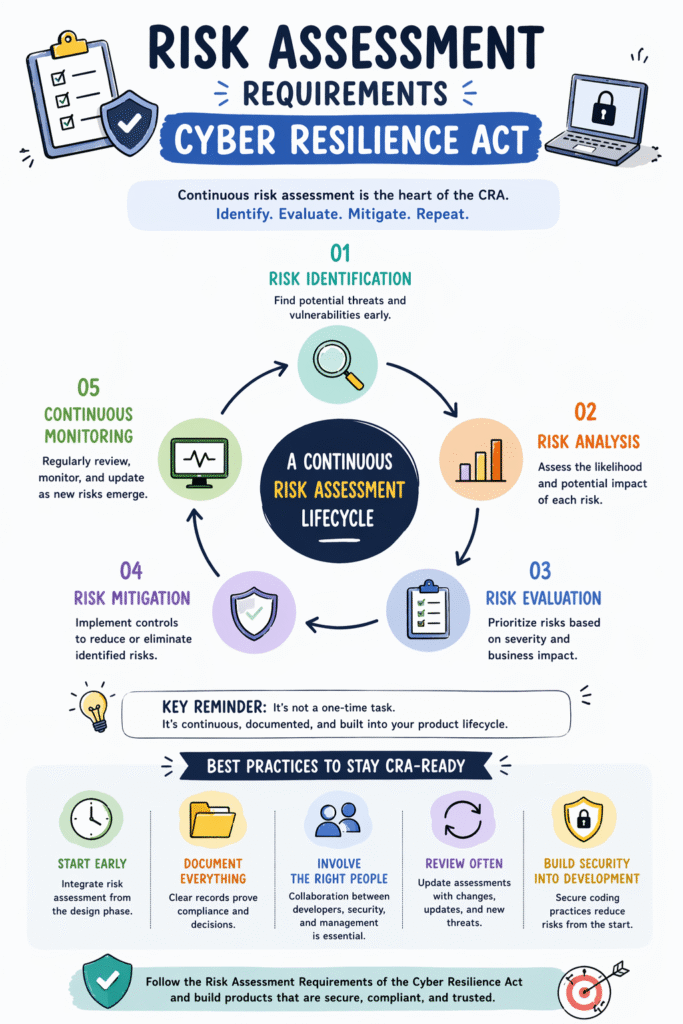
Many teams struggle to meet risk assessment requirements Cyber Resilience Act due to unclear processes.
Typical issues include:
- Treating risk assessment as a checklist
- Lack of security expertise in development teams
- Poor documentation practices
- Inconsistent updates over time
- Misalignment between security and development teams
We’ve seen firsthand that without clear ownership, risk assessments become outdated quickly. This creates gaps that can lead to non-compliance or security incidents.
How Secure Coding Practices Support CRA Compliance
At Secure Coding Practices, we align our workflow with the risk assessment requirements Cyber Resilience Act by making security part of development.
Our approach includes:
- Integrating risk assessment into coding workflows
- Training developers on real-world threat scenarios
- Applying secure coding standards like OWASP Top 10
- Embedding automated checks in development pipelines
- Continuously improving based on new risks
By doing this, we ensure risk management becomes natural for teams, not an added burden.
Best Practices for Risk Assessment Under CRA

To effectively meet requirements, adopting a structured approach to software risk management CRA is essential.
- Start risk assessment early in development
- Keep documentation simple and consistent
- Use real-world threat scenarios
- Review and update risks regularly
- Involve both developers and security teams
From experience, simplicity works best. Overcomplicated frameworks often slow teams down and reduce adoption.
FAQ
What are the main risk assessment requirements cyber resilience act expects?
The risk assessment requirements cyber resilience act focus on identifying, analyzing, and reducing cybersecurity risks across a product’s lifecycle. This means organizations must evaluate threats before release and keep reviewing them over time.
It’s not just about security checks, but also documenting decisions clearly to show how risks are handled and reduced properly.
How often should risk assessments be updated under cyber resilience act rules?
Under risk assessment requirements cyber resilience act, updates should happen regularly, not just once. Teams need to review risks during development, after updates, and when new threats appear. In practice, many organizations align this with their release cycles or sprints. This ensures risks stay relevant and are managed properly as systems evolve.
Why is documentation important in cyber resilience act risk assessment?
Documentation is a key part of risk assessment requirements cyber resilience act because it proves compliance. It shows what risks were identified, how they were evaluated, and what actions were taken. Without proper records, even good security practices may not meet requirements. Clear documentation helps teams stay consistent and accountable over time.
Who is responsible for meeting risk assessment requirements cyber resilience act?
Responsibility for risk assessment requirements cyber resilience act usually involves multiple roles. Developers, security teams, and management must work together.
Developers identify technical risks, security teams guide mitigation, and leadership ensures processes are followed. Without shared responsibility, risk assessment often becomes incomplete or inconsistent across different stages of development.
Building Risk Assessment Requirements Cyber Resilience Act
The risk assessment requirements Cyber Resilience Act demand continuous attention, not a one-time effort. Organizations that integrate risk evaluation into everyday development are better prepared for compliance and real-world threats. From what we’ve learned, combining structured processes with practical developer training makes the biggest difference.
To strengthen your approach, explore the Secure Coding Practices Bootcamp, a hands-on, expert-led training that helps developers apply secure coding, manage risks effectively, and ship safer software from day one.
References
- https://eur-lex.europa.eu/legal-content/EN/TXT/?uri=CELEX:32024R2847
- https://www.mdpi.com/journal/jcp