

Patch Management Requirements Cyber Resilience Act are reshaping how organizations handle software vulnerabilities across the entire lifecycle. Instead of reactive updates, CRA enforces structured, timely, and secure patching processes. This shift pushes teams to integrate security earlier and maintain continuous monitoring after release.
Organizations that adapt quickly reduce risk exposure and improve compliance readiness. Understanding these requirements is essential for building resilient systems and avoiding regulatory gaps. Keep reading to learn how to implement effective CRA-aligned patch management.
Key Insights: Cyber Resilience Act Patch Management Requirements
Patch Management Requirements Cyber Resilience Act requires a proactive, structured approach that integrates security into every phase of the software lifecycle while ensuring timely remediation and secure delivery.
- Patch management is now a regulatory requirement, not just best practice
- Vulnerabilities must be identified, prioritized, and remediated continuously
- Secure update mechanisms are essential for compliance
Cyber Resilience Act Patch Management Requirements Explained
The Cyber Resilience Act establishes a lifecycle-based approach to patch management. Organizations are expected to continuously monitor vulnerabilities, assess their impact, and deploy fixes within reasonable timeframes based on risk severity.
“Security is not a product, but a process,” – NIST
This means patching is no longer isolated to post-release maintenance. It becomes a continuous operational process that spans development, deployment, and long-term support, requiring a dedicated strategy for vulnerability and risk management throughout the product life.
A key shift is accountability. Organizations must demonstrate that vulnerabilities are not only fixed, but handled systematically with proper documentation and communication.
Cyber Resilience Act Patch Management Workflow
Credits: JumpCloud
| Stage | Purpose | Responsible Team |
| Detection | Identify vulnerabilities from scans or reports | Security Team |
| Assessment | Evaluate severity and exploitability | Security + Engineering |
| Prioritization | Rank vulnerabilities based on risk | Security + Compliance |
| Remediation | Develop and test fixes | Engineering |
| Deployment | Release patches securely to users | DevOps / IT |
| Communication | Inform users and stakeholders | Compliance / Support |
This structured workflow ensures that vulnerabilities are handled consistently and efficiently, reducing the likelihood of missed or delayed fixes.
Why Patch Management Is Critical Under CRA
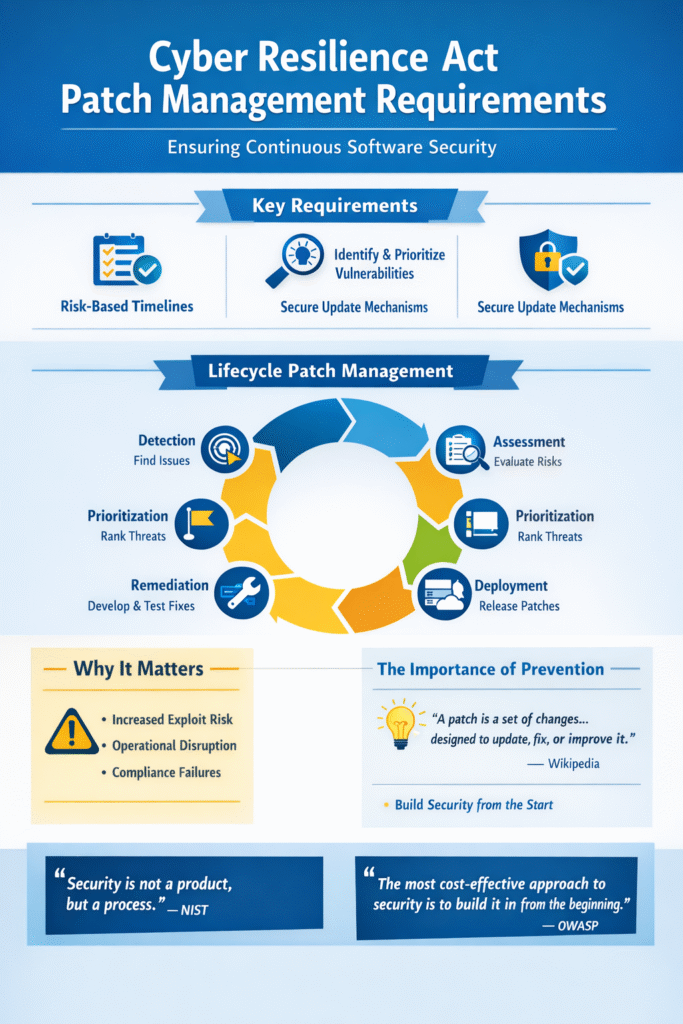
Unpatched vulnerabilities remain one of the most exploited attack vectors. The Cyber Resilience Act addresses this by enforcing timely remediation and accountability across organizations.
“A patch is a set of changes to a computer program designed to update, fix, or improve it,” – Wikipedia
In practice, delayed patching often leads to:
- Increased exploit risk
- Operational disruption
- Compliance failures
By requiring structured processes, CRA ensures that organizations maintain a consistent security posture. This includes establishing formal protocols for vulnerability handling rather than reacting only after incidents occur.
Common Challenges in CRA Patch Management
Organizations implementing CRA patch management requirements often face:
- Difficulty aligning multiple teams on priorities and timelines
- Pressure to meet strict remediation deadlines
- Managing outdated or legacy systems
- Ensuring secure delivery of updates
- Encouraging users to apply patches promptly
These challenges highlight the importance of standardized processes, strong internal coordination, and clear vulnerability disclosure channels to ensure all stakeholders are aligned.
The Role of Secure Development in Patch Management
Effective Patch Management Requirements Cyber Resilience Act starts long before a vulnerability is discovered. Secure development practices significantly reduce the number of issues that require remediation.
Teams that integrate security into development benefit from:
- Fewer critical vulnerabilities
- Faster patch cycles
- Lower compliance burden
This preventive approach allows organizations to focus resources on high-impact issues instead of constantly reacting to avoidable flaws.
Secure Patch Delivery Requirements

CRA also emphasizes the importance of secure update mechanisms. Organizations must ensure that patches are delivered safely without introducing new risks.
Key requirements include:
- Protecting update integrity through signing mechanisms
- Verifying the authenticity of update sources
- Preventing unauthorized modifications
- Ensuring reliable distribution channels
Without these safeguards, the patching process itself can become a security vulnerability.
FAQ
How does the Cyber Resilience Act define “timely” patching in practice?
CRA does not prescribe a fixed deadline but requires risk-based remediation timelines. Critical vulnerabilities, especially actively exploited ones, must be addressed quickly, often within days, while lower-risk issues follow defined SLAs supported by documented risk assessments.
What evidence is required to demonstrate patch management compliance under CRA?
Organizations must maintain auditable records, including detection logs, risk evaluations, remediation timelines, deployment reports, and user communications. Regulators expect full traceability across the vulnerability lifecycle.
How should organizations handle vulnerabilities in third-party components or dependencies?
Responsibility extends to the software supply chain. Teams must monitor third-party vulnerabilities, track disclosures, and apply patches or mitigations promptly. If patches are unavailable, compensating controls and risk acceptance must be formally documented.
What are the risks of relying solely on patching instead of preventive security practices?
Over-reliance on patching increases exposure windows and operational strain. As OWASP emphasizes, preventing vulnerabilities during development is more efficient than fixing them later.
Cyber Resilience Act Patch Management Requirements in Practice
The Cyber Resilience Act patch management requirements redefine vulnerability remediation. Moving from reactive fixes to structured, continuous processes reduces risk and ensures long-term software integrity. To meet these standards, developers must bridge the gap between compliance and practice.
Take the next step with the Secure Coding Practices Bootcamp. This 2-day, hands-on training equips you with practical skills like OWASP Top 10 and secure encryption. Join the Secure Coding Practices Bootcamp.
References
- https://www.nist.gov
- https://en.wikipedia.org/wiki/Patch_(computing)