


Sanitizing input using regex carefully is essential for development teams aiming to block injection vulnerabilities and secure modern web applications. At Secure Coding Practices, security architects emphasize that rigorous pattern evaluation protects enterprise databases from malicious payloads and unexpected runtime failures.
By implementing precise string validation rules before production deployment, your organization ensures resilient security operations and eliminates hidden vulnerabilities across all distributed backend services.
Structured Verification Safeguards Application Integrity
Implementing disciplined evaluation practices ensures backend systems remain resilient against malicious input manipulation.
- Integrating automated linting tools into continuous integration pipelines catches flawed pattern logic early.
- Simulating high-volume traffic through specialized fuzz testing uncovers hidden execution bottlenecks.
- Enforcing strict deterministic time limits prevents malicious payloads from locking core server threads.
Why Sanitizing Input Using Regex Carefully Protects Modern Backend Architectures?
When user data enters backend architectures through public-facing forms, failing to validate the string structure leaves systems open to injection attacks. Sanitizing input using regex carefully ensures that only expected character sets are processed by core application logic, preventing malicious actors from injecting unauthorized commands.
Furthermore, poorly constructed expressions can lead to catastrophic backtracking and performance degradation under high loads. Establishing strict boundary checks mitigates these operational risks, ensuring stable and predictable execution across all server endpoints. This foundational security practice safeguards sensitive enterprise data from persistent threats.
How Validation Strategies Compare When Sanitizing Input Using Regex Carefully?

When conducting thorough evaluations for safe regular expression use standards, development teams must compare various inspection strategies to ensure complete production readiness while sanitizing input using regex carefully.
| Validation Method | Execution Target | Error Detection Rate | Operational Overhead |
| Static Analysis Linters | Source Code Patterns | High (Syntax Flaws) | Minimal (CI/CD Integrated) |
| Pattern Matching Engines | Runtime Input Evaluation | High (ReDoS Risks) | Moderate (Load Testing) |
| Manual Code Review | Developer Logic Flow | Variable (Human Error) | High (Time Intensive) |
Why Sanitizing Input Using Regex Carefully Prevents Engine Lockups?
When processing complex data streams, unverified structural evaluations can allow malicious inputs to exploit execution flaws. Sanitizing input using regex carefully ensures that string patterns are evaluated within strict computational limits, protecting backend infrastructure from catastrophic slowdowns.
Industry security literature underscores the necessity of managing regex execution depth and engine states:
“Developers must carefully analyze expression performance and apply strict evaluation timeouts to prevent malicious inputs from inducing exponential backtracking delays.” – Microsoft Security Briefs
How Engineering Practices Support Sanitizing Input Using Regex Carefully?
Credits: IEEE Symposium on Security and Privacy
Integrating robust string validation requires careful handling of patterns to ensure enterprise application security. For comprehensive guidelines on safe string operations, developers should review our analysis on using regex securely input validation to safeguard backend APIs while sanitizing input using regex carefully.
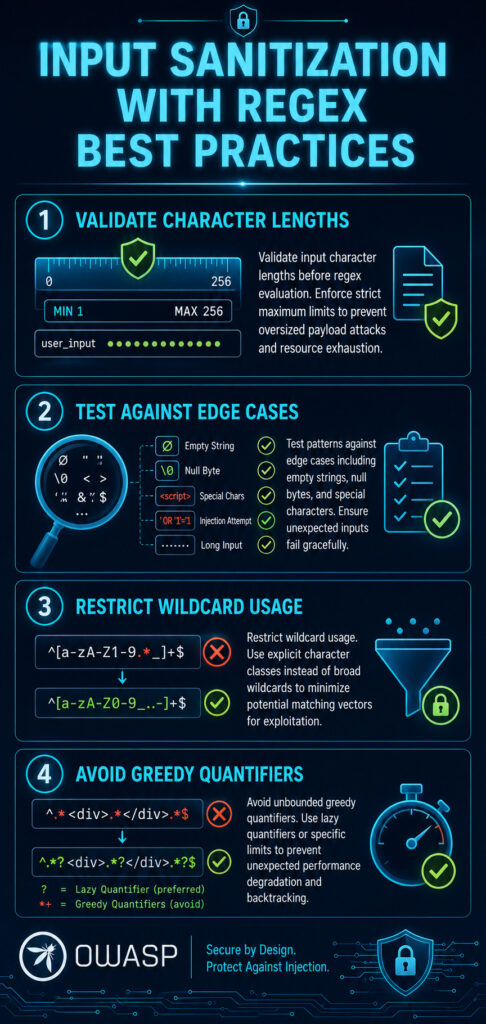
- Validating input character lengths prevents excessively long strings from overwhelming parsing engines.
- Testing patterns against edge cases ensures unexpected inputs fail gracefully without crashing services.
- Restricting wildcard usage minimizes potential matching vectors for malicious exploitation.
What Are The Academic Insights On Algorithmic Vulnerabilities?
Empirical research into regex-based execution flaws demonstrates that improper pattern validation remains a persistent security risk for modern software ecosystems. Researchers emphasize that rigorous analysis of input strings is vital to prevent catastrophic performance degradation across enterprise backends while sanitizing input using regex carefully.
Academic literature highlights the systemic risks associated with unverified pattern handling:
“Systematic evaluations of pattern matching engines reveal that input sanitization flaws frequently expose applications to severe availability risks.” – SoK: A Literature and Engineering Review of ReDoS
How Can Automated Tools Detect Flaws?
Integrating automated analysis into continuous development pipelines ensures that any hidden risks introduced while sanitizing input using regex carefully are identified immediately before production deployment.
- Automated linters flag risky nested quantifiers during pull requests.
- Scheduled fuzz tests expose hidden execution bottlenecks under heavy load.
- Centralized pattern registries prevent the reuse of vulnerable legacy expressions.
How Can Developers Avoid Critical Pattern Flaws?
When developers write custom expressions without accounting for edge cases, common traps like overlapping quantifiers often slip past initial reviews. Sanitizing input using regex carefully requires a deep understanding of these typical pitfalls to prevent unexpected runtime slowdowns across backend services.
Recognizing where architectural errors occur allows engineering teams to refactor legacy codebases proactively. For comprehensive examples of what to watch out for, review our detailed guide on common regex security mistakes avoid to enhance your overall defensive posture.
Maintaining clean and predictable parsing logic guarantees long-term application security.
- Avoiding unbounded greedy quantifiers prevents unexpected performance degradation.
- Disabling unnecessary capture groups reduces memory overhead during evaluation.
- Testing patterns against malicious payloads ensures robust defense mechanisms.
FAQ
What does sanitizing input using regex carefully involve?
Sanitizing input using regex carefully involves designing precise, bounded regular expression patterns that validate incoming string data without introducing performance bottlenecks or architectural vulnerabilities like catastrophic backtracking.
Why are unverified regular expressions dangerous for web applications?
Unverified expressions can allow malicious inputs to trigger exponential evaluation loops, consuming maximum CPU resources and causing regular expression denial of service (ReDoS) attacks that paralyze backend authentication and data services.
How can developers test their expressions for hidden vulnerabilities?
Development teams can integrate automated static analysis tools, specialized linters, and fuzz testing directly into their continuous integration pipelines to catch risky pattern configurations before code ever reaches production.
What are atomic groups and how do they improve security?
Atomic groups instruct the parsing engine to discard its backtracking checkpoints once a sub-expression matches, effectively eliminating recursive evaluation paths and neutralizing potential performance traps during string evaluation.
Do modern programming languages prevent regex-based performance issues?
While some modern runtimes implement deterministic linear-time regex engines, many standard language libraries still rely on traditional backtracking algorithms, making careful pattern design and strict execution timeouts essential for robust security.
Secure Your Enterprise Architecture Today
Implementing disciplined validation protocols and maintaining secure pattern evaluation practices guarantees long-term enterprise application stability across distributed web environments. Development teams must prioritize proactive pattern reviews, strict execution timeouts, and comprehensive static analysis within continuous integration pipelines to completely eliminate catastrophic backtracking risks.
Safeguarding backend infrastructure against sophisticated algorithmic complexity attacks requires continuous technical education and disciplined engineering standards.
To accelerate your organization’s expertise in building robust architectures while sanitizing input using regex carefully, explore our documentation and join our secure coding bootcamp today to elevate your team’s defensive capabilities seamlessly.
References
- https://learn.microsoft.com/en-us/archive/msdn-magazine/2010/may/security-briefs-regular-expression-denial-of-service-attacks-and-defenses
- https://arxiv.org/abs/2406.11618