


Regex is a powerful tool for processing text, but choosing the wrong library can create serious security risks. When evaluating regex libraries security features considerations, developers need to look beyond basic functionality and focus on built-in protections.
Features like execution limits, input validation support, and secure defaults can prevent vulnerabilities before they reach production. Following Secure Coding Practice means selecting tools that help reduce risks instead of creating new ones. Understanding these features is the first step, keep reading.
The Security Checklist Regex Libraries Security Features Considerations
A reliable regex library should not only match patterns efficiently but also help developers build safer applications. Look for these essential security features:
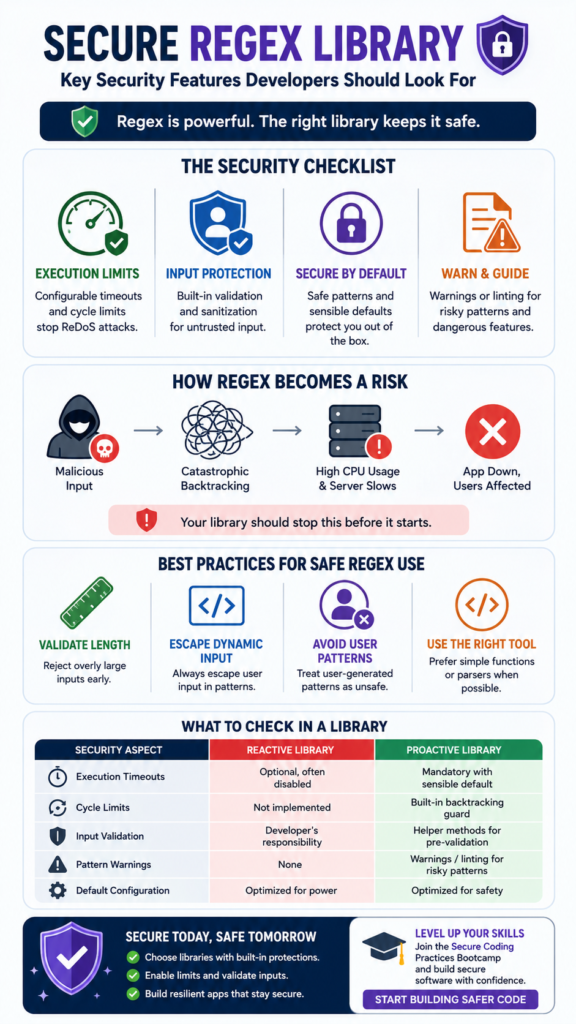
- Regex libraries must have configurable timeouts and cycle limits to prevent catastrophic ReDoS attacks.
- Built-in sanitization and validation helpers are essential for safely handling untrusted user input.
- The library’s design should encourage secure patterns by default, making the safe way the easiest way.
How Do Regex Libraries Become a Security Risk?
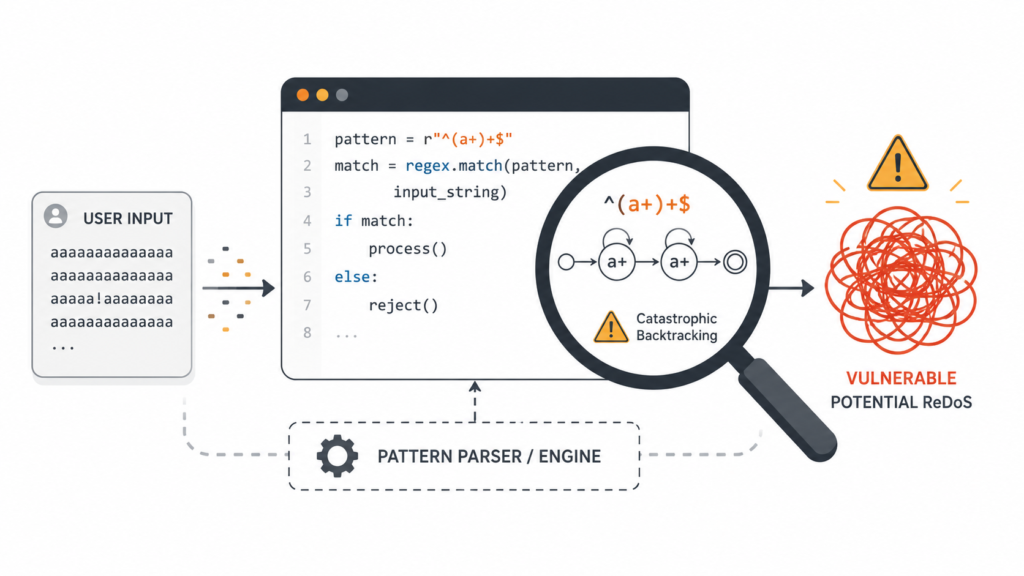
It starts with trust. You trust the library to match patterns, not to hang your server. The classic failure is ReDoS, or Regular Expression Denial of Service. It’s not about breaking in, it’s about burning everything down.
A maliciously crafted input string can cause a poorly written regex, or a library without safeguards, to enter catastrophic backtracking. The engine gets stuck in a loop, chewing through CPU cycles for minutes, even hours, on a single request.
We once watched a logging service melt down. A single malformed log entry, matched against a common but vulnerable pattern for email validation, sent 16 cores into a tailspin. The library had no concept of a timeout. It was just “do the work,” and it tried, forever.
That’s the core risk. You’re not just evaluating a string, you’re giving an unknown guest the keys to your server’s processing power. The library’s first job is to protect you from that.
What Are the Non-Negotiable Security Features?
You need guards at the gate. The first is a mandatory execution timeout. This isn’t a nice-to-have, it’s the emergency brake. A good library lets you set a hard limit, maybe 100 milliseconds. If the evaluation takes longer, it stops dead. It throws an error, logs a warning, and frees the thread. Your application stays responsive.
The second is cycle limiting or depth guarding. This is more granular than a blanket timeout. It monitors the engine’s internal backtracking steps. If the pattern and input conspire to create an exponential number of steps, the guard trips. Think of it as a circuit breaker for logic.
Without these two features, you’re flying blind, hoping every pattern you write is perfectly efficient. That’s a hope, not a strategy. You also want input length validation. Some libraries can check the size of the string before even attempting the match, rejecting obvious bombardment attempts instantly.
Why Is Safe Default Behavior Critical?
A library’s philosophy matters. Does it make the safe path the default path, or is security an afterthought you have to bolt on? The best tools are designed with misuse in mind. Following safe regex use principles means choosing libraries that reduce risky behavior through secure defaults and built-in protections.
They might default to a reasonable timeout. Their most powerful, and dangerous, features, like unbounded wildcards or complex lookaround assertions, might require an explicit flag to enable.
“The Rust Regex library purposefully excludes features that make Regex engines particularly vulnerable to ReDoS attacks. Those features are backreferences and look-around. Excluding those features allow Regex to guarantee linear time execution.” – Wikipedia
This is about shifting the burden. Instead of you having to remember a dozen security rules every time you write /.*@.*\.com/, the library nudges you toward safer constructs. It might offer safer alternative methods for common tasks.
For example, instead of using a complex regex to validate a zip code, it provides a simple, pre-vetted validator function. This design choice prevents a whole class of errors before a single line of your code runs. It protects junior developers from pitfalls experts know to avoid, and it protects experts from their own late-night mistakes.
How Do We Integrate Regex with Secure Coding Practices?
Credits: Fireship
Regex security depends not only on the library but also on developer practices. User input should never be trusted directly; it must be validated and sanitized before reaching the regex engine. Strong input validation helps ensure that only properly formatted data reaches the regex process, reducing exposure to malicious inputs.
Key practices include:
- Validate input length first to prevent extremely large inputs from exhausting resources.
- Escape dynamic regex components using built-in library functions.
- Treat user-generated patterns as unsafe and isolate them when necessary.
Developers should also consider whether regex is the right solution. Simpler tools like string functions or dedicated parsers are often safer and clearer. Secure coding means using the right tool and handling it carefully.
Can You Measure a Library’s Security Posture?
You can, and you should. It’s not just about checking a feature list. You have to look at its history and community. Scour its issue tracker and release notes.
How quickly are security vulnerabilities patched? Is there a responsible disclosure process? A library that’s transparent about past CVEs (Common Vulnerabilities and Exposures) is often more trustworthy than one that claims perfection.
Look at the documentation. Are security warnings prominently displayed next to dangerous features, or buried in a footnote? Check the default configuration. Install it fresh and see what the settings are. Are timeouts infinite by default, or set to a sane limit? This due diligence is part of the selection process.
You’re not just adopting a code dependency, you’re adopting its security track record. The table below contrasts the posture of different library approaches, though specific brands aren’t named here.
| Security Aspect | Reactive Library Posture | Proactive Library Posture |
| Execution Timeouts | Optional feature, often disabled by default. | Mandatory configuration, sensible default set. |
| Cycle Limits | Not implemented; relies on global timeout only. | Built-in backtracking guard with configurable thresholds. |
| Input Validation | Developer’s responsibility entirely. | Provides helper methods for pre-validation (length, charset). |
| Dangerous Pattern Warnings | None in documentation or runtime. | Compiler warnings or linting tools for known vulnerable patterns. |
| Default Configuration | Optimized for maximum power/flexibility. | Optimized for safety and predictable performance. |
What About Input Validation and Sanitization?
This is the front line, and the library can be a huge help or a hindrance. The core principle is simple: regex should operate on known, sanitized data. But how do you get there? A security-minded library will provide utilities to help with that preparation.
It might offer a function to safely escape all special characters in a string, so you can embed a user-provided search term into a larger pattern without fear of them breaking the regex syntax itself.
Even better, it might provide whitelist-based validation methods. Instead of writing a complex pattern to allow alphanumeric usernames, you’d call library.isAlphanumeric(input). This uses a pre-defined, optimized, and security-reviewed pattern internally.
It moves the dangerous regex logic from your code, where you might make a mistake, into the library’s maintained codebase. The library becomes a provider of safe abstractions, not just a raw engine. You validate with its tools, then you match with confidence.
How Do Execution Timeouts Prevent Catastrophe?
Execution timeouts act as the ultimate circuit breaker for regex operations. A regex process should never be allowed to run indefinitely, similar to allowing a single database query to consume system resources for hours.
Improving regex performance through safer patterns, execution limits, and efficient matching strategies helps maintain application stability while preventing resource exhaustion.
In practice, this is done by configuring a timeout parameter in the regex library API. The limit depends on the use case:
- High-traffic web form validation: around 10ms to keep responses fast.
- Heavy backend processing or batch jobs: potentially 500ms or more, depending on workload.
The biggest advantage of a timeout is that it changes how failures are handled. Without protection, a ReDoS attack can cause complete resource exhaustion, making the server slow or entirely unresponsive. With a timeout, the impact is limited to a single failed operation.
When the execution limit is reached:
- The regex attempt is automatically stopped.
- An exception or timeout error is returned.
- The application can respond safely by rejecting the input, recording an alert, or continuing with other tasks.
What Are Common Pitfalls Even with “Secure” Libraries?

Security features are tools, not magic. You can still shoot yourself in the foot. The biggest pitfall is complacency. “Our library has timeouts, so we’re safe.” Not quite. You must actually configure and use them. Passing timeout=0 (meaning infinite) is a common mistake.
Another is writing patterns that are inherently risky, like nested unbounded quantifiers (e.g., (a+)+), and relying solely on the timeout to save you. It will, but it’s like relying on the airbag in a crash instead of driving carefully.
“Safety is RE2’s primary goal. RE2 was designed and implemented with an explicit goal of being able to handle regular expressions from untrusted users without risk. One of its primary guarantees is that the match time is linear in the length of the input string.” – PYPI
Another pitfall is forgetting the context. A regex that’s safe in a controlled admin panel might be dangerous in a public API. You need to adjust the security parameters, timeout length, allowed input size, based on the trust level of the data source.
Also, avoid using regex for tasks it’s terrible at, like parsing complex HTML or XML. That’s asking for trouble, security-featured library or not. The library secures the engine, but you are responsible for using the engine wisely.
FAQ
Is a regex library with security features slower?
Often, the opposite is true. The guards that prevent runaway backtracking also stop legitimate but inefficient patterns from wasting time. They force better pattern design.
The overhead of a cycle counter or timeout check is microscopic compared to the CPU cost of a catastrophic backtracking loop. You’re trading a tiny, consistent performance tax for immunity from a total meltdown.
Can’t I just write perfect regex to avoid these issues?
In theory, maybe. In practice, no. Regex patterns can interact with input in complex, non-obvious ways.
What looks safe against your test data can explode with a cleverly crafted string. The industry’s best practice is to assume your patterns might have problems and to use a library that provides a safety net. It’s defense in depth.
Do I need these features for internal, trusted data?
The “trusted data” assumption is one of the most common sources of security breaches. Data has a way of becoming less trusted over time. An internal tool gets exposed to a wider network.
A log file starts receiving feeds from an external source. Baking in security from the start, even for internal use, creates resilient systems. It’s a good habit that costs little and protects greatly.
Are timeouts enough protection on their own?
No, they are the most important single feature, but they’re a last line of defense. You still need input validation, pattern review, and cycle limits where possible. A timeout will stop an attack, but a cycle limit might prevent it from even starting. Think of timeouts as the fire alarm, and other features as the fireproof building materials.
Making the Secure Choice for Regex
Choosing a secure regex library is only the beginning. Developers must combine built-in protections with strong coding practices to create resilient applications. Enable timeouts, validate inputs, and use security features wisely to reduce regex-related risks.
To strengthen your overall security skills, join the Secure Coding Practices Bootcamp and learn practical techniques for safer software development, including input validation, OWASP Top 10, authentication, and secure coding methods. Start building safer code today. Join Secure Coding Practices Bootcamp
References
- https://en.wikipedia.org/wiki/Regular_expression
- https://pypi.org/project/real-regex/2026.7.1/