
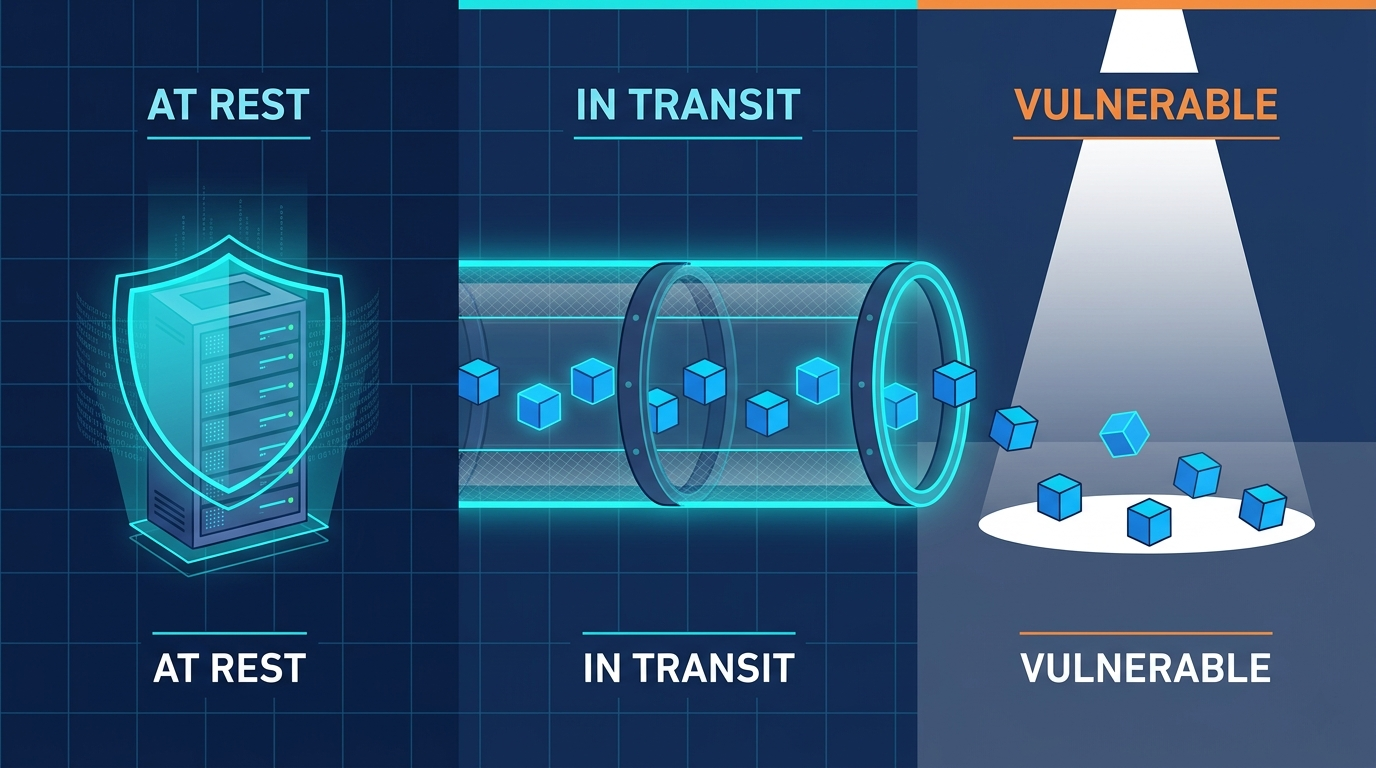

Most data protection guides only talk about encryption and HTTPS. That’s not the whole story. The bigger risk isn’t during transit; it’s when data reaches its destination and gets processed by your applications. This is where breaches often happen, in the gap between secure storage and active use.
Fixing this requires a shift to Secure Coding Practices. We’ll show you exactly where your current setup is likely leaking, and how to close those gaps. The most important security work happens after the encryption. Keep reading.
Protecting Data at Rest and in Transit: Essential Security Lessons
These protecting data rest transit examples highlight an important reality: encryption only works when every stage of the data lifecycle is protected.
- Disk encryption protects stolen hardware, but offers zero defense against a hacker who’s already inside your running system.
- TLS secures the trip, but the data is wide open the instant it’s decrypted on a server, often ending up in plaintext logs.
- True security layers encryption at rest, in transit, and crucially, integrates secure coding practices to control data the moment it’s in use.
Is Your Encrypted Drive Really Safe?
We mandate Full Disk Encryption on every laptop. We use BitLocker or FileVault. It feels secure, but here’s the reality. That encryption only matters for physical theft.
If an attacker gets remote access while the laptop is on, the encryption is transparent. The system serves plaintext files without question. We’ve seen phishing incidents bypass this layer completely. The data is, logically, unprotected.
This is the critical misunderstanding. Encryption at rest is a static, physical defense. It’s a padlock on a storage unit. Once you’re inside, everything is up for grabs.
In our training, we treat this as a compliance checkbox. For cloud servers, it’s not a real security barrier. Real protection must happen closer to the data, before it hits the disk.
As database admins, we know TDE only protects cold disks. Once booted, the engine decrypts into memory. It serves plaintext to any compromised app. If that app has a vulnerability, the data is exposed.
The disk is locked, but the house is wide open.
Does Your Secure Tunnel End Too Soon After HTTPS?
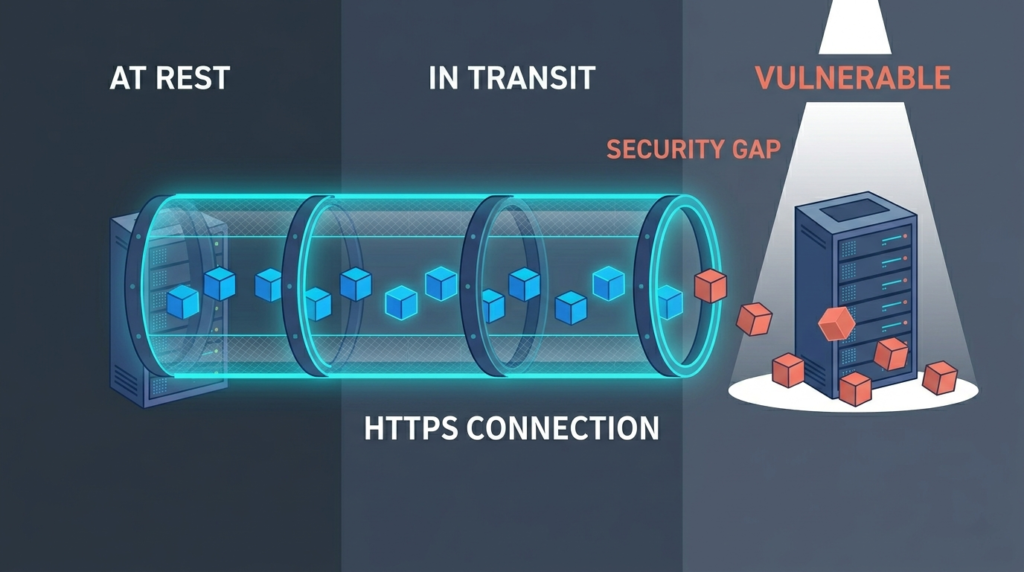
We enforce TLS 1.3 everywhere. Our API endpoints have the padlock. Data in transit seems secure.
Follow a credit card number’s path. It’s encrypted from the browser. It hits our load balancer, which terminates TLS. For a split second, it’s decrypted.
Then it’s re-encrypted to travel onward. The app server decrypts it to process the payment. Where is it then? In memory. In logs. In temporary variables.
The TLS tunnel is a sealed train. But when the cargo is unloaded, it’s unprotected. That platform is your application. When logging captures raw request bodies, card data hits your disk.
TLS didn’t fail; your architecture did. We use tokenization gateways at the edge to intercept this.
Internal traffic needs attention. “It’s inside our firewall” is a risk. A compromised microservice creates data exposure risk. Mutual TLS closes this loop.
Could Your Logs Already Be Leaking Sensitive Data?
Credits: SkillCurb
Our labs show a common reality. Verbose frameworks trick developers. Default middleware and ORMs print raw inputs into debug logs.
These tools are great for debugging. They’re also data leakage firehoses. This is exactly where sensitive data gets exposed through routine activity.
You encrypt the database. You use TLS. Then your logger writes a social security number to a file due to a validation error. That log gets rotated and sent to a server.
Is the archived log encrypted? Often, no. You protect a secret, then spray it onto a text file. A minor mistake can become a consequences of data exposure breach.
Fixing this is a mindset shift. We train to never log sensitive fields. We configure loggers to redact credit card patterns.
We treat logs like the primary database. This means encrypting log volumes and strict retention policies.
As noted by arXiv
“The presence of sensitive information in these logs poses significant privacy concerns, particularly regarding Personally Identifiable Information (PII) and quasi-identifiers that could lead to re-identification risks.” – arXiv
What Does a Practical Dual-State Pipeline Look Like?
How do you build something resilient? Stop thinking in two states. Start thinking in a continuous pipeline. Data must be under control from entry until destruction.
First, use strong data encryption for data at rest. We use cloud provider encryption with our own keys in AWS KMS. For databases, we use TDE, knowing it protects backups, not query results.
For data in transit, TLS is the floor. We enforce it everywhere. Mutual TLS is essential inside private networks. We treat every connection as hostile.
| Data State | Primary Protection | Common Risk |
| At Rest | Disk or database encryption | Compromised application access |
| In Transit | TLS or Mutual TLS | Unencrypted internal traffic |
| In Use | Secure coding controls | Memory exposure and log leaks |
The bridge between these states is secure coding. This is the application logic that decides how data is handled. It means:
- Tokenizing sensitive data before it touches primary systems, storing only a reference token.
- Implementing field-level or application-level encryption for specific data before storing it.
- Rigorously sanitizing all logs, error messages, and debugging outputs.
- Using secure memory handling to avoid leaving secrets in plaintext RAM longer than necessary.
This layer is where we have the most control. It’s also the most skipped. It requires discipline, but it’s the only way to close the final gap.
What Is the Ghost in the Machine When It Comes to Data in Use?
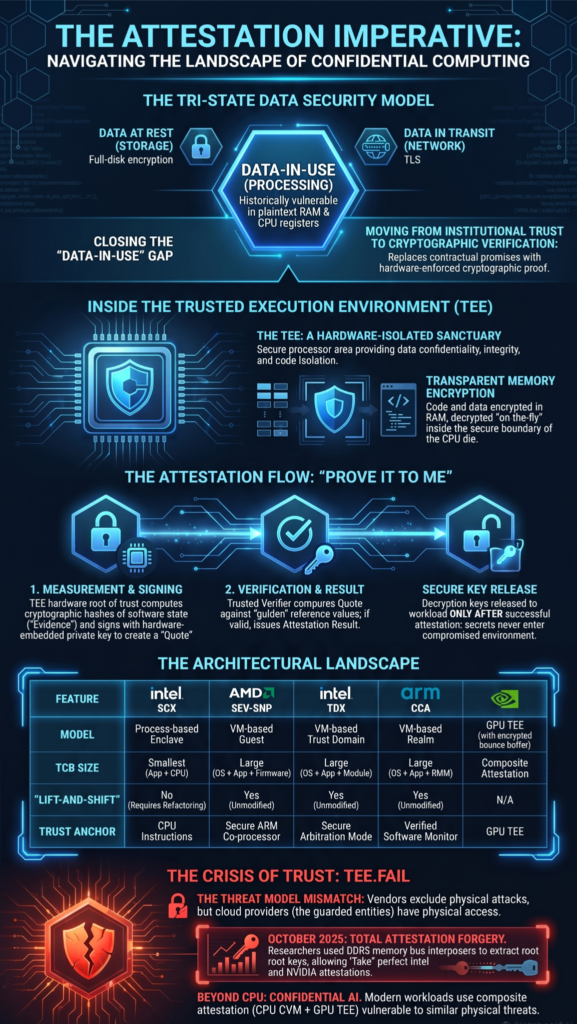
We’ve covered data at rest and in transit. But what about data being worked on? This is the third state: data in use. It’s when an encrypted record is pulled from the database, decrypted into your application’s memory, and processed. During this time, it’s completely vulnerable.
A memory-scraping attack or a simple library flaw could expose it. That’s why protecting sensitive data memory has become a major focus in our advanced modules.
This is the current frontier. In our most secure architectures, we isolate data in use by deploying hardware-based CPU enclaves like AWS Nitro. This processes sensitive payloads inside an encrypted sandbox, entirely hidden from a compromised host OS. While not mainstream yet, it points to the future: a world where the encryption chain is truly unbroken.
Research from Confidential Computing Consortium shows
“Traditional security measures like encryption effectively safeguard data at rest (storage) and in transit (network transmission), but they falter when data is actively being processed.” – Confidential Computing Consortium
FAQs
How often should encryption keys be rotated?
Organizations should rotate encryption keys regularly based on risk, compliance requirements, and data sensitivity. Frequent API key rotation reduces the impact of leaked credentials and limits unauthorized access.
What is the difference between client-side and server-side encryption?
Client-side encryption protects data before it leaves a user’s device, while server-side encryption protects data after it reaches the server. Both methods help secure sensitive information during storage and processing.
Why are encrypted backups important for security?
Encrypted data backups protect sensitive information if backup files are stolen, copied, or accessed without permission. Backup encryption at rest helps organizations recover data without exposing confidential records.
When should mutual TLS authentication be used?
Mutual TLS authentication should be used when both the client and server must verify each other’s identity. This approach strengthens mTLS REST security and reduces the risk of unauthorized connections.
How do we stop frameworks from logging PII?
We deploy automated regex filters at the log-engine level to instantly mask credit cards and keys before they hit disk.
Does Security End with Encryption?
Encrypting data at rest and in transit is essential, but it’s only the first layer of protection. Sensitive data can still be exposed after it reaches your application through logs, internal services, debugging tools, misconfigured access controls, or everyday coding mistakes.
Review how data flows across your systems, monitor data handling practices, and identify security gaps that encryption alone cannot solve or prevent effectively.Build secure software with practical, hands-on skills through the Secure Coding Practices Bootcamp. Learn more at Secure Coding Practices Bootcamp.
References
- https://confidentialcomputing.io/2024/
- https://arxiv-org.ezproxy.obspm.fr/abs/2409.11313