
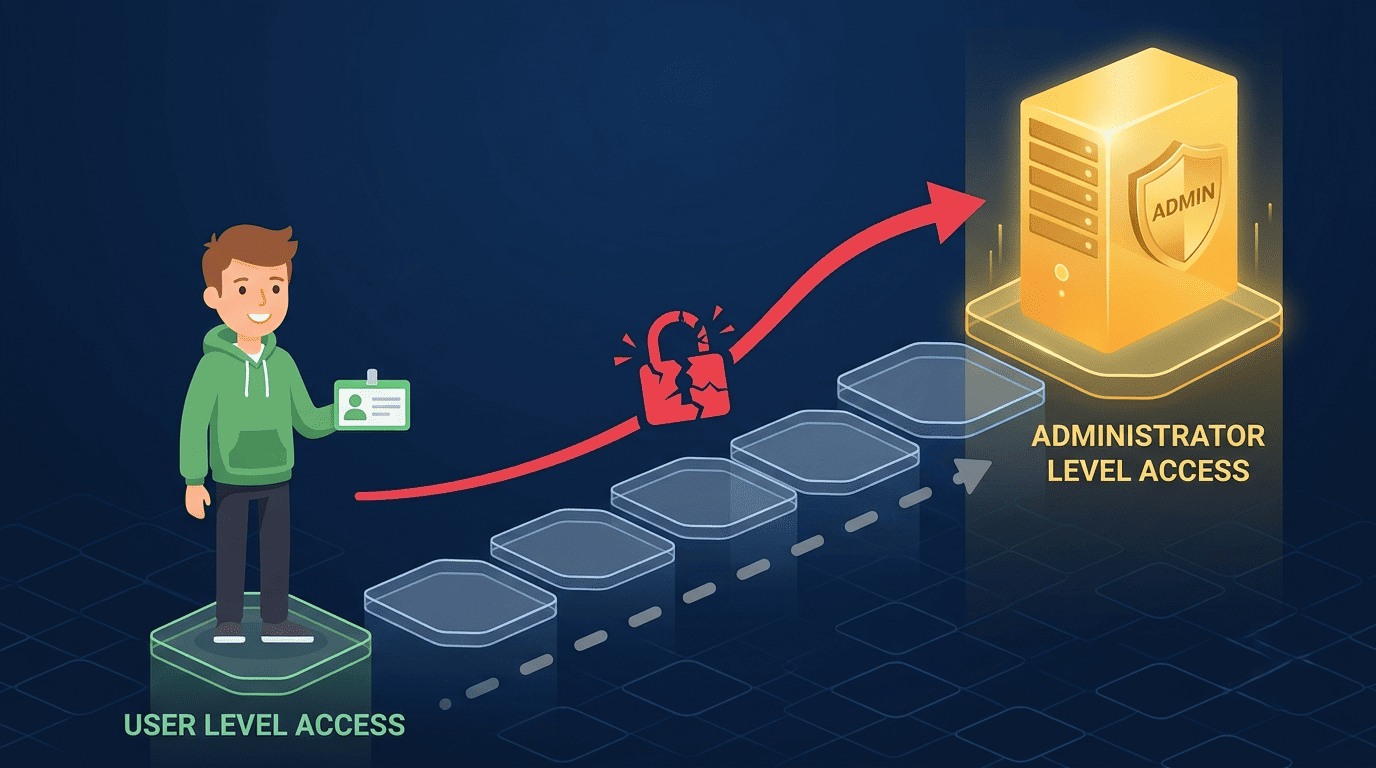

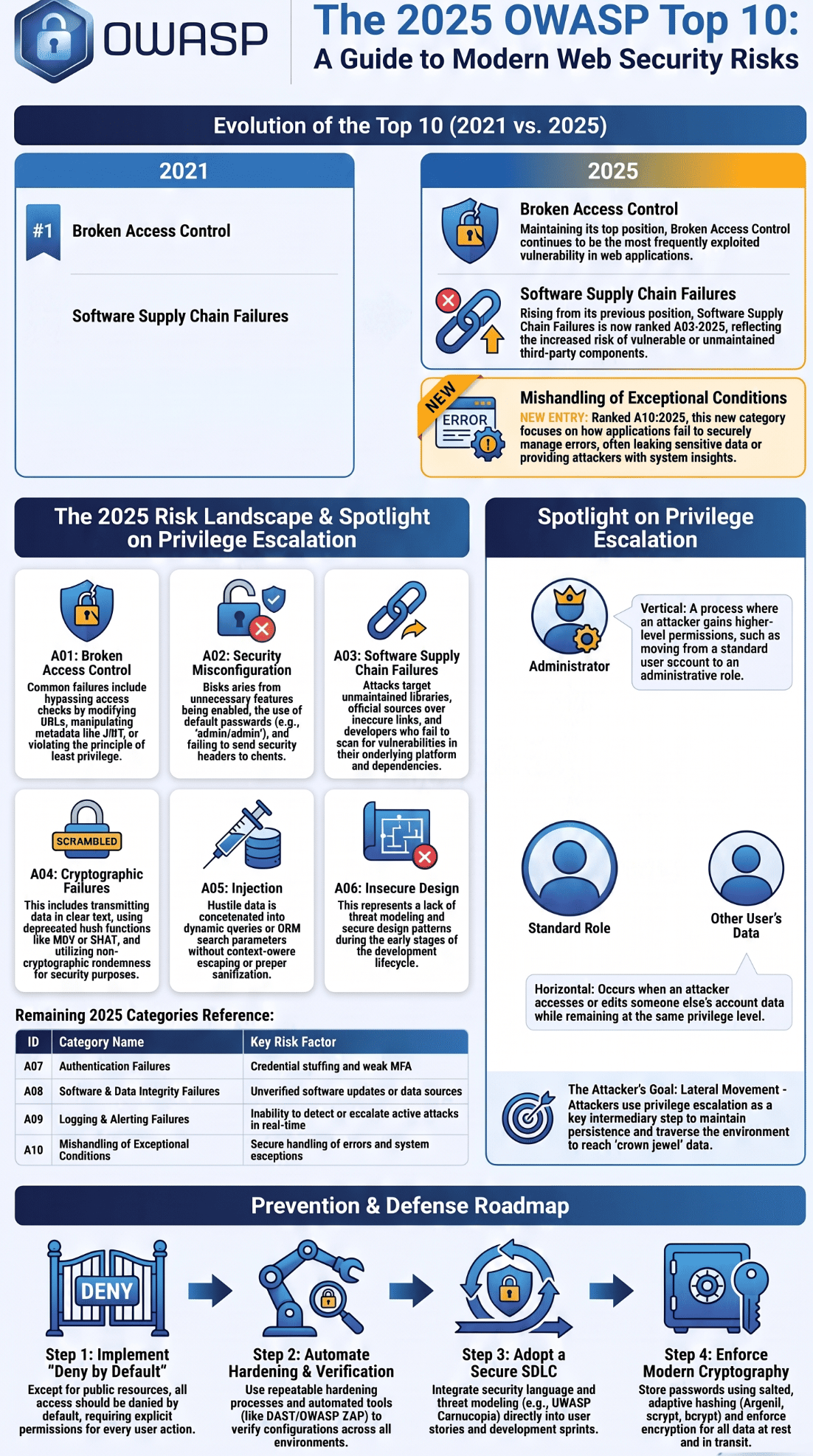
Vertical privilege escalation explained: a user gets admin rights they shouldn’t have. A burglar is already inside. They don’t just look around, they find the master key to every room. The real attack starts from that small foothold. Logs show a normal account suddenly accessing forbidden data.
Simple coding errors usually cause this. The solution is consistent Secure Coding Practices. Keep reading to see how to stop it for good.
Vertical Privilege Escalation at a Glance
Vertical escalation is dangerous. It can turn a small security problem into a full system compromise. Attackers can gain unauthorized administrative access. Understanding common causes is important. Strong authorization checks can stop these attacks.
- Vertical escalation turns a limited breach into a full system compromise.
- It often exploits weak or missing server-side authorization checks.
- Prevention is built on the principle of least privilege and secure coding from the start.
Why Is Client-Side Security an Illusion?
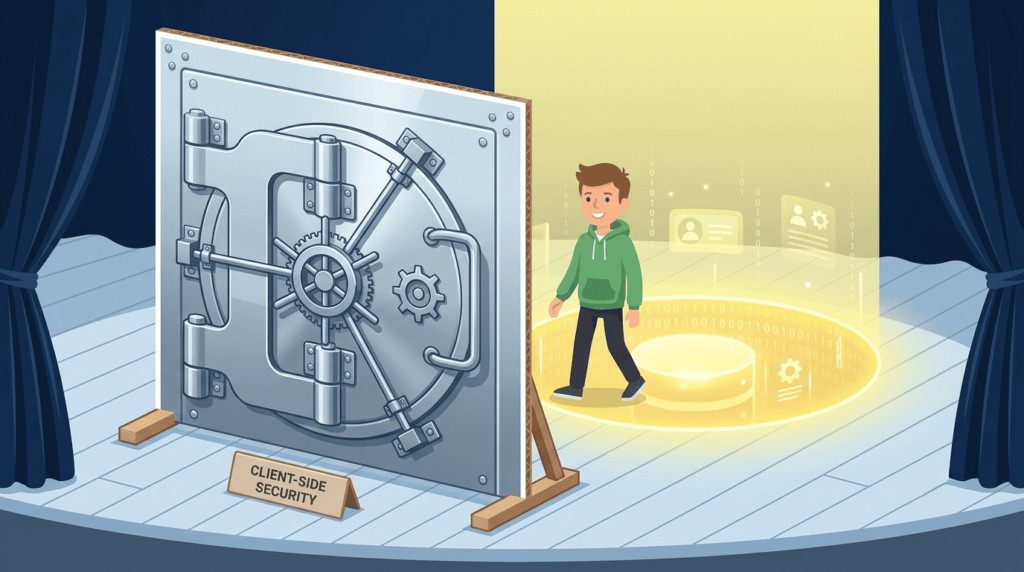
We teach this first: you cannot trust the client. Teams forget it constantly. A disabled button is for user experience, not security. A hidden menu is just a design. The browser’s developer tools exist. An attacker can find a hidden admin URL in your JavaScript or replay a captured request. If your server doesn’t verify every action, you have broken access control.
Research from IEEE Xplore shows
“Most developers pay attention to only the realization of functions, and tend to ignore security issues. On the other hand, they lack the understanding of security policies or security knowledge, especially in Web applications” – IEEE Xplore
Consider a JWT with a “user” role. The server checks it at login, then often does nothing else. If a user edits that token to say “admin” and the server doesn’t re-validate it, you’ve handed them the keys.
Common vectors we see:
- Modifying role parameters in POST requests.
- Guessing or brute-forcing admin endpoint URLs.
- Exploiting insecure direct object reference flaws.
- Manipulating session variables for roles.
Why Is Internal Authorization Your Last Line of Defense?
Credits: Double Take
Firewalls guard the moat, keeping obvious threats out. But what about the servant already inside? Vertical privilege escalation is an inside job. The attacker has some access, often low-level, and aims to expand it. Your internal authorization is the last line of defense here.
The principle of least privilege is non-negotiable. Every component, service account, and user must run with the bare minimum access. A web server shouldn’t have database owner rights. A user role shouldn’t access the user-deletion API. When we code, we ask, “Does this function need this access?” Not “Could it ever possibly use it?” That distinction is everything.
We built a microservice that needed to read a config table. In a rush, a developer gave it db_owner rights. It worked. Later, an API vulnerability allowed an injection. The attacker didn’t just read configs; they owned the entire database. The real fix was rolling back permissions to SELECT only. Secure coding practices force this question early, before it becomes a disaster.
How Can a Small Flaw Turn Into a Chained Exploit?
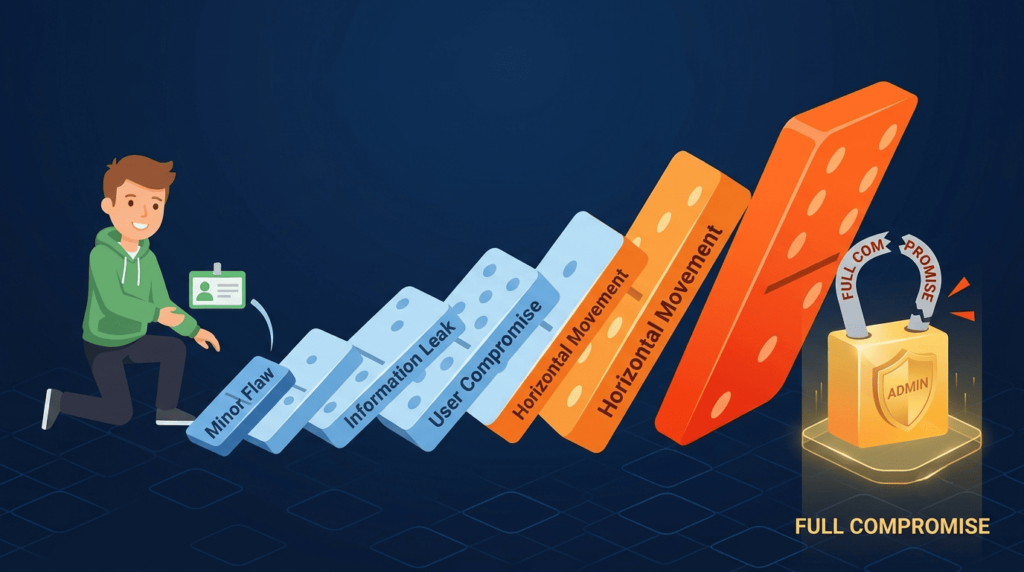
Real attacks don’t rely on one bug. They chain smaller oversights. A system might log verbose debug messages a standard user can read. Those logs could leak a file path. That path might point to a config file with a database connection string. That database could have a vulnerable stored procedure running with high privileges. You see the climb.
Each step is a failure. A world-writable directory. An unquoted service path. A scheduled task running as SYSTEM that pulls from a user-writable location. Attackers use tools like WinPEAS to find these seams. We must leave them none.
As noted by IEEE Xplore
“Privilege escalation attacks occur when attackers exploit system vulnerabilities or misconfigurations to bypass normal permission restrictions, thereby gaining unauthorized operational privileges that can lead to severe consequences, including data breaches, tampering, or even complete system failure” – IEEE Xplore
Consider these stages:
- Initial foothold: Compromised low-privilege user account.
- Reconnaissance: Scanning for misconfigurations, weak permissions, outdated software.
- Exploitation: Chaining findings to execute code in a higher context.
- Consolidation: Stealing credentials, creating backdoors, taking full control.
How Does Secure Coding Prevent Authorization Flaws?
So how do we code against this? It’s not a magic library. It’s a mindset baked into every line. Authorization checks are not a feature you add later. They are the skeleton of the application. Every request that touches data or triggers an action must pass through a gate that asks, “Are you allowed?” Catching a missing authorization gate is far cheaper at the design stage than after deployment, tools like Prime Security use AI to review architecture and flag places where an authorization check should exist but doesn’t, before a single endpoint is written.
We enforce server-side authorization. Always. Preventing IDOR vulnerabilities starts with trusted role validation. We implement proper role-based access control (RBAC), ensuring role hierarchies can’t be bypassed. We audit permissions regularly. We write unit tests that simulate unauthorized users trying to access admin functions; these “negative test cases” are more valuable than the happy paths.
Here’s what that looks like in practice:
- Centralize authorization logic in a single, validated module.
- Use access control lists (ACLs) for complex permission scenarios.
- Regularly audit user and service account privileges.
- Log all authorization failures for immediate review.
How Is AI Changing Automated Privilege Attacks?
Now, consider an AI agent with permissions to deploy code. If a prompt injection attack can make it run sudo rm -rf /, that’s vertical escalation via a new vector. The agent’s identity had too much power. The principle of least privilege applies doubly here.
An AI helper shouldn’t have the keys to the kingdom. It should have a limited set of tools, and its actions should be sandboxed. This is the next battlefield, and the same old rules apply. Grant only the access that is absolutely necessary, and verify every request.
| AI Capability | Security Risk | Recommended Control |
| Deploy application code | Unauthorized production deployment | Require approval workflows and least-privilege permissions |
| Access cloud resources | Excessive IAM permissions leading to privilege escalation | Restrict roles and perform regular permission audits |
| Execute administrative tasks | Prompt injection resulting in unauthorized admin actions | Validate every request with server-side authorization |
FAQs
How can developers prevent vertical privilege escalation in web applications?
Developers can prevent vertical privilege escalation. They should enforce authorization on the server side. Validate every request. Use secure role enforcement. Remove client-side role enforcement. Regularly audit permissions for protected resources.
Why does API privilege escalation often go unnoticed?
API privilege escalation often goes unnoticed. Missing access checks can be a problem. Broken role validation is another issue. JWT role tampering can also lead to unauthorized privilege gain. These happen through legitimate requests. They don’t cause obvious errors or alerts.
What causes a role-based access control flaw?
A role-based access control flaw occurs when improper authorization, insecure role assignment, or bypassing role checks lets users access restricted functions, resulting in unauthorized admin endpoint access and privilege escalation.
Why must applications enforce authorization on the server?
Applications must enforce server-side authorization. Insecure role parameters are a risk. Access token privilege abuse is dangerous. Token claim escalation can bypass client-side checks. This exposes sensitive administrative functions to unauthorized users.
What should privilege escalation testing include?
Privilege escalation testing is crucial. It should include negative authorization test cases. Automated privilege scanning is helpful. Access control unit tests are important. Log authorization failures. Remediate privilege escalation issues. This identifies endpoint privilege flaws before software deployment.
Build Security Into Every Feature
Stopping privilege escalation starts long before an attack, with code that follows least privilege by default. Every permission should be intentional, verified, and easy to audit.
If you want practical, hands-on training that helps developers prevent flaws like these from day one, join the Secure Coding Practices Bootcamp. You’ll learn secure coding through real coding labs, without unnecessary security jargon, so you can build safer applications with confidence.
References
- https://ieeexplore.ieee.org/document/11178545
- https://ieeexplore.ieee.org/document/8834935/citations#citations