


Insecure Direct Object Reference (IDOR) is a broken authorization flaw. You’re logged in, so the server trusts you. Change a number in the URL or swap a user ID, and it hands over data it shouldn’t. This isn’t hacking; it’s the system failing to check permissions. UUIDs don’t fix this. The only real solution is implementing proper authorization by Secure Coding Practices. Keep reading to lock it down.
IDOR Reality Check: What Actually Breaks Access Control
IDOR is fundamentally a silent authorization flaw that lets users access data or actions they were never meant to reach.
- IDOR is an authorization failure, not an authentication failure. Logging in successfully doesn’t mean you can see everything.
- Using random IDs (UUIDs) only slows down attackers; it does not prevent unauthorized access if the authorization check is missing.
- Modern IDOR happens deep within API payloads and business logic, far beyond simple URL parameter changes.
What Exactly Are You Referencing?
A direct object reference is just a pointer. It’s the handle your code uses to fetch a specific thing from the backend. Everyone uses them.
In our training, we see this all the time: a database primary key like user_id = 5021, a filename like invoice_5021.pdf, or a storage bucket key. The modern favorite is a UUID, something like de305d54-75b4-431b-adb2-eb6b9e546013. These are all just pointers.
The problem with the Insecure part happens when our application takes that pointer directly from a client request and uses it. It fetches the data without ever stopping to ask the one question that matters: “Does the person making this request actually own the thing they’re asking for?”
We’ve built features that work perfectly until someone changes a single ID in a request and accesses data that was never meant for them. That’s the gap we have to close.
What Is the Difference Between Authentication and Authorization?
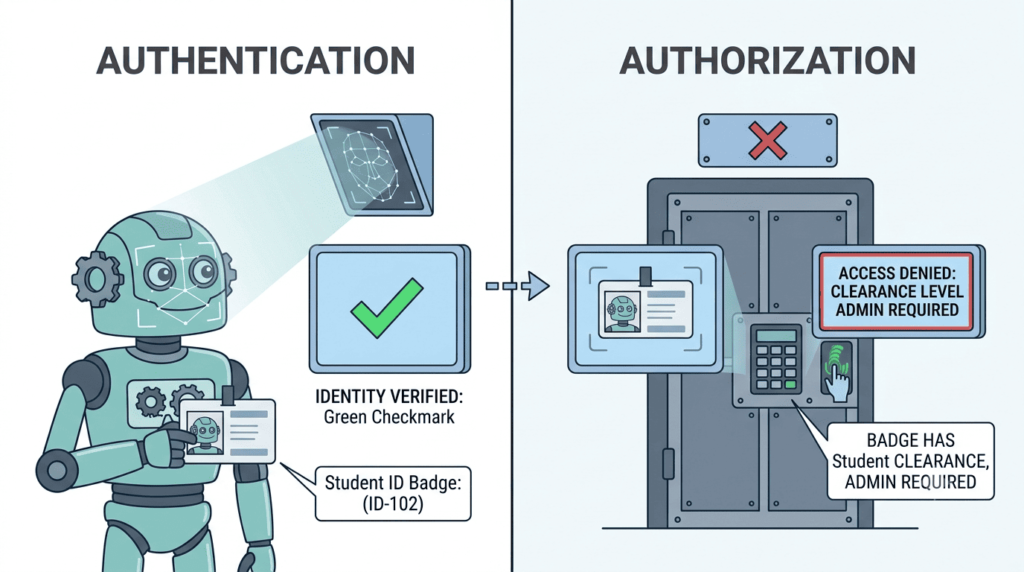
Authentication checks your ID at the door. Authorization decides if you get into the VIP lounge. IDOR is a failure in that second step.
OWASP classes this under Broken Access Control. The CWE calls it Authorization Bypass Through User-Controlled Key. The sequence is simple: the user is authenticated, they control a key in the request, and authorization is bypassed.
We see it play out like this. You sign in. Your profile loads from /api/profile/12345. You change the ID to 12346 in a new request. The server sees your valid session, fetches the new profile, and sends it back. Our code never checked if you owned that data.
The breakdown is clear:
- The user authenticates.
- The app exposes an internal object identifier.
- That identifier is modified.
- The server uses the modified ID.
- No check validates the user’s right to the object.
- Unauthorized access is granted.
The textbook example is a bank statement URL. Change the id parameter. A 403 response means security. A served statement means IDOR. Our server must always validate ownership.
What Does the Modern Attack Surface Look Like?
The modern IDOR attack surface has moved. Simple integers in a URL are just the start of what bug hunters call “tutorial hell.”
Today, applications run on APIs. The flaw is inside the data packet. It’s swapping a “userId” field in a JSON body for a PUT request. It’s altering a node ID in a GraphQL query. The server still trusts the reference, but the context is different.
In our bootcamps, we see the real hunting ground now. It’s about business logic. Does the endpoint check ownership? The attack vectors include:
- REST API endpoints with predictable paths.
- GraphQL queries and mutations.
- JSON bodies in update or delete requests.
- Mobile app backends.
- Multi-tenant systems missing tenant filters.
In a recent analysis by arXiv
“IDOR/BOLA “attack groups” defined by endpoint properties and manipulation technique, then mapped these groups to OpenAPI specification fields to enable automated detection.” – arXiv
IDOR is no longer a web page flaw. It’s an API authorization flaw.
Do UUIDs Really Prevent IDOR Attacks?
No. It’s a dangerous myth.
A UUID stops easy guessing but does nothing if an attacker already has one. UUIDs leak into browser history, error logs, API responses, and shared links. If our server doesn’t validate that the session owns the requested UUID, it’s still IDOR. We just hid it better.
The rule is absolute: authorization stops IDOR, obscurity does not. UUIDs are not access control.
| Common Misconception | The Reality |
| UUIDs stop IDOR. | Authorization stops IDOR. |
| Random IDs are secure. | Object ownership still requires validation on every request. |
| It’s not guessable, so it’s safe. | If the reference is exposed, the lack of a check is exploitable. |
Bug hunters often get pushback when reporting UUID-based IDOR, with platforms claiming the ID is “unguessable.” The identifier’s complexity is irrelevant. The missing check is the flaw.
What Are the Different Forms of Broken Authorization?
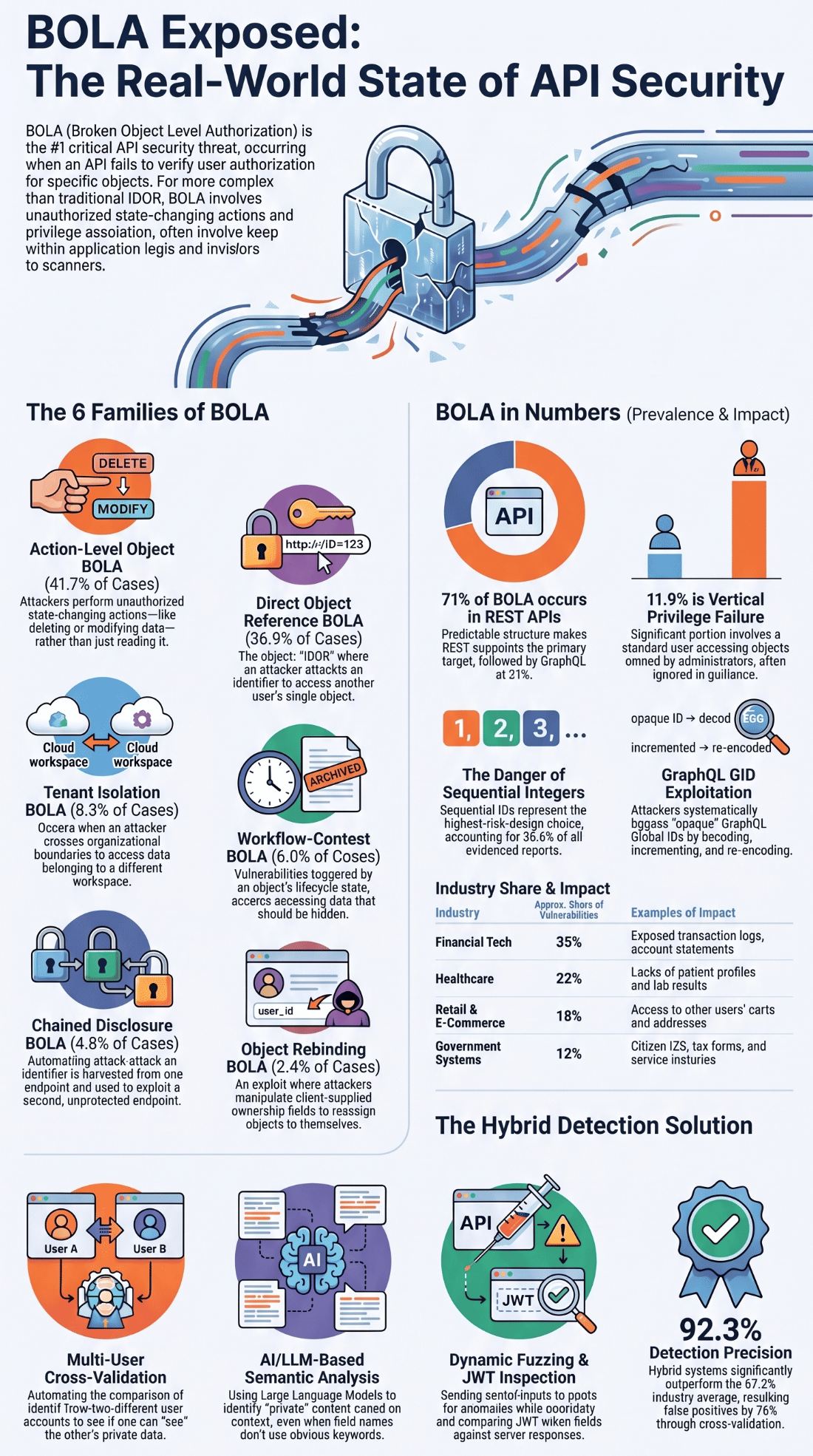
IDOR enables different types of privilege escalation, breaking the intended access model. It’s among the most common types of broken access control.
Horizontal privilege escalation is most common. This is accessing another user’s data at the same level, like viewing their invoice or private messages.
Vertical escalation is more dangerous. It means accessing functions or data for higher-privilege users, like admins, by manipulating an ID.
The direct path is account takeover. IDOR on a password reset or email change endpoint lets you hijack an account by swapping a user ID.
We built a flagging feature once. The endpoint took a contentId. A hacker showed us that changing this ID lets users flag anyone’s private content for review. We forgot to check ownership. Many broken access control examples start with this mistake. The logic worked, but the authorization was missing.
Where Do IDOR Vulnerabilities Hide Today?
IDOR vulnerabilities hide in modern development patterns. Multi-tenant applications are particularly risky. A missing tenant filter in a query can leak one company’s data into another’s dashboard.
The endpoints need guarding touch user-specific resources: profile APIs, file downloads, billing panels, and administrative functions. Team management features in systems with complex hierarchies are critical. Does the “remove editor” function check if the caller owns this project?
Often, the “hidden” internal APIs cause problems. Endpoints built for frontend dropdowns, like GET /api/internal/users/search, might leak IDs and emails if they don’t respect permissions. Developers assume they’re safe because they’re not in the UI, but attackers find them. We’ve seen this cause major data exposure.
When Does Authorization Logic Fail?

Authorization logic fails in the gaps between systems. Real-world IDOR isn’t about guessing IDs.
One pattern is session misbinding. In a Mozilla case, an account deletion flow verified the user’s SSO session but then deleted the account specified in the request body. An attacker could authenticate, swap the target account in the payload, and delete it. The session wasn’t bound to the action’s target.
Another is hierarchical blind spots. Revive Adserver checked campaign-level permissions for banner deletion but didn’t verify the specific banner belonged to that campaign. Knowing a banner ID lets you delete any banner.
Cross-tenant leakage happens when query logic forgets tenant filters. A /bugs.json endpoint with a query parameter could leak private reports across organizations if it performed a global search.
These failures happen where permission logic bends or breaks.
What Should Be on Every Developer’s Authorization Prevention Checklist?
To stop IDOR, bake object-level authorization into your application’s core. For every request that touches a resource, the server must answer: “Does this user have permission for this action on this specific object?”
Never trust the client for access decisions. Hidden fields, cookies, and URL parameters are user-controllable suggestions, not decrees. The authorization check belongs on the server, in your business logic, every time.
Implement a central authorization middleware. Before a controller runs, have code extract the user and target object ID, then query a policy engine: “Can user U perform action A on object O?” It checks ownership or ACLs and returns yes or no. Consistent code-level checks are key to preventing IDOR. This pattern, applied consistently, eliminates IDOR.
The principle is “deny by default.” Assume no access unless a rule explicitly grants it. This flips the script from blocking bad requests to explicitly allowing good ones. It’s more work, but it’s the only reliable defense.
How Can You Find the Authorization Vulnerabilities You’ve Missed?
Credits: SisiNerdTV
Research from IEEE Xplore shows
“BOLA vulnerabilities are challenging to detect automatically because they do not cause crashes or produce explicit error messages, requiring deep domain knowledge to identify.” – IEEE
The workflow to find the authorization vulnerabilities is systematic:
- Enumerate sensitive endpoints (user profiles, file downloads, admin actions).
- For each, create two user accounts with similar privileges.
- Capture a legitimate request from User A.
- Replay it from User B’s session, altering the object reference.
- Analyze the response. A successful
200 OKwith another user’s data is the smoking gun.
Which Code Patterns Lead to Broken Access Control?
Most IDOR flaws come from assuming authentication means authorization. The code looks clean but is fatally trusting:
function getInvoice(invoice_id) {

    user = session.getCurrentUser();

    invoice = db.query("SELECT * FROM invoices WHERE id = ?", invoice_id);

    return invoice; // Missing: AND user_id = ?

}
It fetches by request ID, never checking if the user_id matches. Missing role checks, trusting hidden inputs, or skipping object ownership validation are other failures.
Business logic traps include workflows that don’t re-validate rights on a final action, or assuming project access implies task edit rights. Every data access needs a permission gate.
How Do You Build Strong Authorization From the Ground Up?
Eradicating IDOR means weaving secure authorization into your entire development lifecycle.
During design, threat modeling should map data flows and ask, “Who can access this object? How do we enforce it?” In development, the standard becomes writing an ownership check first: if not user.owns(object): return 403. Code reviews then verify these checks exist on every data-accessing endpoint.
Testing includes manual IDOR hunting, ideally automated in CI/CD pipelines. Deployment is supported by monitoring that detects failed authorization attempts.
The goal is to build authorization into the plumbing. Use a central policy engine so checks happen automatically. Adopt a “default deny” stance. This discipline transforms IDOR from a common bug into a rare failure.
FAQs
What is IDOR vulnerability in broken access control?
IDOR vulnerability in broken access control occurs when object-level authorization is missing, allowing direct object reference access to resources improperly.
How does parameter tampering cause insecure object reference?
Parameter tampering changes predictable identifiers in requests, leading to insecure object reference and causing access control failure in applications systems.
What are IDOR attack examples in web applications?
IDOR attack examples in web applications include forced browsing, URL parameter manipulation, resource enumeration, and insecure API endpoint exploitation cases.
How is IDOR detected during pentesting and code review?
IDOR pentesting detects issues using fuzzing, scanning tools, code review, detection rules, and manual testing of object access paths carefully.
What is an IDOR mitigation and secure coding approach?
IDOR mitigation requires object-level authorization, UUIDs, secure coding, logging, strict access control enforcement, and continuous monitoring of requests traffic analysis.
Authorization, Not Obscurity, Is the Lock
Security failures don’t come from exposed IDs, they come from missing authorization checks that assume those IDs are safe. The fix is consistent verification across every endpoint so only the right user can access the right data. Secure Coding Practices Bootcamp helps developers build that habit through hands-on labs covering OWASP Top 10, authentication, encryption, and secure APIs. Learn more and join the program here Secure Coding Practices Bootcamp.
References
- https://ar5iv.labs.arxiv.org/html/2605.25865
- https://ieeexplore.ieee.org/ielx8/6287639/10820123/10942340.pdf