


Top SCA tools comparison overview helps engineering teams evaluate Software Composition Analysis solutions based on the capabilities that matter most, not just the number of features. The strongest platforms improve vulnerability management, license compliance, SBOM generation, and software supply chain visibility while fitting naturally into existing development workflows.
At Secure Coding Practices, we’ve seen that teams achieve better results when they combine SCA with secure development habits instead of relying on automated scanning alone. Choosing the right tool depends on your organization’s priorities, including developer experience, governance, remediation, and supply-chain protection. Keep reading to find the approach that best fits your team.
SCA Selection Snapshot
Choosing the right SCA platform is about improving development workflows, security, and compliance, not simply comparing feature lists. Focus on the capabilities that support your team’s long-term software delivery goals.
- Prioritize developer-friendly workflows with reachability analysis, automation, and CI/CD integrations to reduce remediation time.
- Evaluate governance and compliance through license management, SBOM generation, policy enforcement, and audit support.
- Strengthen software supply-chain security by combining SCA with Secure Coding Practices for better visibility, risk reduction, and long-term adoption.
What Does an SCA Tool Actually Do?
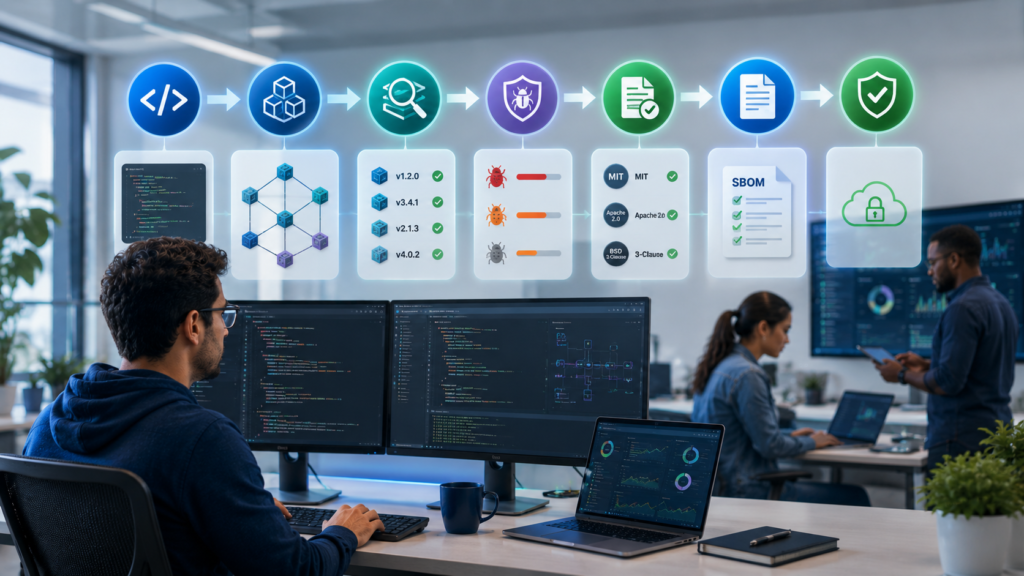
Software Composition Analysis helps organizations understand the open-source code inside their applications. It scans project dependencies, identifies known vulnerabilities, checks software licenses, and keeps track of risk throughout the software development lifecycle.
Most modern applications rely heavily on open-source packages. Whether developers install packages from npm, Maven, PyPI, NuGet, or Cargo, every dependency becomes part of the application’s security picture. One outdated package can introduce risk, even if nobody remembers adding it years ago.
During our own secure development workshops, we often see teams surprised by what dependency scans uncover. The biggest issue usually isn’t a direct dependency. Instead, hidden transitive dependencies account for many of the unexpected findings. Those packages sit several layers deep, making them easy to overlook without an SCA tool.
A strong SCA solution typically includes:
- Direct dependency scanning
- Transitive dependency scanning
- Known vulnerability detection
- License compliance checks
- SBOM generation
- Continuous monitoring
- Automated remediation support
Many platforms also connect directly with common CI/CD pipelines, helping developers find and fix dependency issues before code reaches production.
Why Has SCA Become Essential?
Applications today include hundreds, and sometimes thousands, of open-source components. That makes dependency management much harder than it was only a few years ago. Security teams can no longer rely on manual reviews or occasional scans to keep everything updated.
As projects grow, dependency graphs become more complex. One vulnerable library may affect dozens of services across multiple teams. We have seen organizations discover the same outdated package repeated across many internal projects because nobody realized it had spread that far.
Modern SCA platforms help solve this problem by continuously monitoring dependencies and highlighting changes as they happen. Understanding the importance of SCA dependency management makes it easier to see why early visibility reduces risk before software reaches production.
Instead of reacting after a release, developers receive earlier feedback while code is still being written, supporting a shift-left approach without creating unnecessary delays.
Most mature solutions now provide features such as:
- SBOM generation
- License auditing
- Dependency tracking
- Version recommendations
- Policy enforcement
- Continuous monitoring
Our experience has shown that combining these capabilities with secure coding practices creates better habits across development teams. Finding vulnerable packages is useful, but choosing safer dependencies from the beginning reduces repeat issues over time.
Why Are Modern SCA Tools No Longer All the Same?
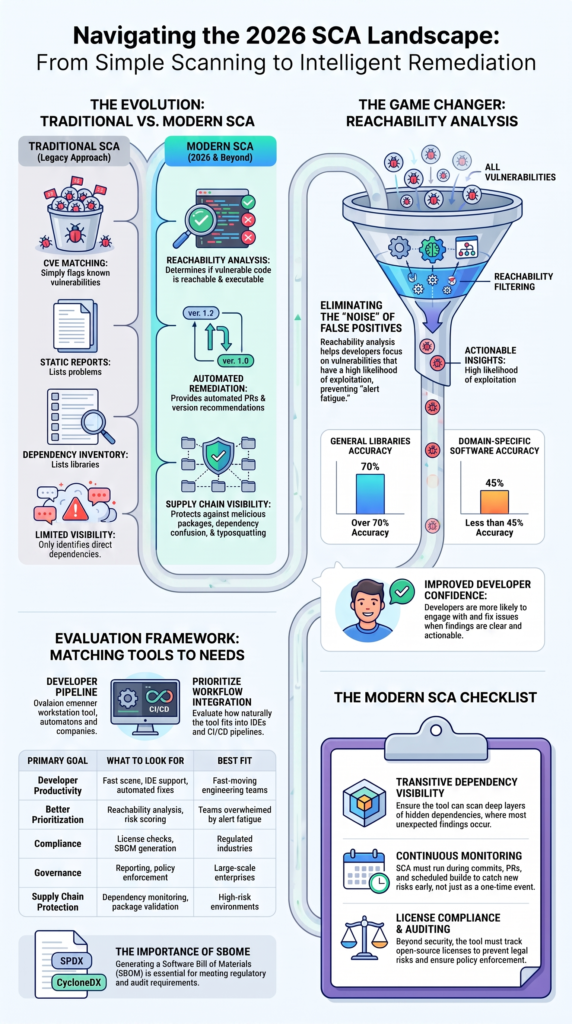
Not long ago, many SCA tools worked in similar ways. They compared dependency versions against public vulnerability databases and listed anything with a known security issue. That still matters, but today’s platforms do much more than simple CVE matching.
Developers quickly learned that long reports did not always mean high risk. Some vulnerabilities were never reachable by the application, while others required very specific conditions to be exploited. Spending time on every alert slowed teams down without improving security very much.
Modern SCA tools focus more on helping teams prioritize their work. Instead of showing every possible issue, they provide context that helps developers decide what deserves attention first.
| Traditional SCA | Modern SCA |
| CVE matching | Reachability analysis |
| Static reports | Automated remediation |
| Dependency inventory | Supply chain visibility |
| Manual upgrades | Pull request automation |
| Basic tracking | Risk prioritization |
From what we have seen during secure development training, developers respond much better when findings are clear and actionable. Fewer high-quality alerts almost always beat hundreds of low-value notifications.
Which Evaluation Criteria Matter Most?
Choosing an SCA platform starts with understanding how people build software every day. A long feature list may look impressive, but it does not always translate into better security or easier adoption. We encourage teams to evaluate tools inside their existing workflow before making a decision.
If scanning slows builds or produces too many false positives, people will eventually ignore the results. On the other hand, tools that fit naturally into IDEs and CI/CD pipelines are more likely to become part of everyday development.
Several capabilities deserve close attention during an evaluation:
- Reachability analysis
- Dependency tracking
- Automated remediation
- License compliance
- Policy enforcement
- SBOM generation
- CI/CD integration
- IDE support
- Clear remediation guidance
- Continuous monitoring
Beyond features, consider how well the platform explains risk. Developers need enough context to fix problems without spending extra time researching every alert. From our experience, that balance leads to stronger adoption and a healthier security culture across engineering teams.
Research from IEEE Access shows
“The results show that SCA tools reach over 70% accuracy in detecting general libraries and the accuracy drops to less than 45% for libraries in domain-specific software. Commercialized tools exhibit better efficiency and practicalness than academic tools.” – IEEE Access, 2024
Which Features Usually Matter Most to Developers?
Developers want security tools that help them move faster, not slower. We have seen this many times while working with engineering teams. If an SCA tool interrupts normal development or creates hundreds of alerts without clear guidance, it often gets ignored. A smoother experience encourages people to fix issues while the code is still fresh in their minds.
The most useful platforms fit naturally into existing workflows. They scan dependencies during development, provide clear explanations, and suggest practical fixes instead of leaving developers to figure everything out on their own. That saves time and helps teams stay productive.
Features developers often value include:
- Fast scan times
- Accurate results
- Low alert fatigue
- Clear remediation steps
- IDE integration
- Pull request checks
- Continuous monitoring
- Reliable CI/CD support
Our experience has shown that simple, accurate feedback usually has a bigger impact than dozens of advanced features. When developers trust the findings, they are far more likely to act on them. That leads to better security without adding unnecessary friction to the software development process.
Which SCA Tool Is Best for Developer Productivity?
Credits: Code Kamikaze
The best SCA platform for developers is the one that fits naturally into their daily workflow. We have found that security improves much faster when developers receive feedback where they already work instead of switching between multiple dashboards and portals.
Many modern platforms integrate with popular IDEs and CI/CD pipelines. That allows dependency issues to appear during development or as part of a pull request, giving teams the chance to fix problems before deployment.
Organizations that understand the benefits of using SCA throughout the development lifecycle are better positioned to shift security earlier, making it a natural part of everyday development instead of a final review
Different platforms often focus on different priorities.
| Focus Area | Main Benefits | Best Fit |
| Developer productivity | Fast scans, IDE support, automated fixes | Fast-moving engineering teams |
| Governance | Policy controls, reporting, compliance | Large organizations |
| Supply chain security | Dependency monitoring, package protection | High-risk environments |
From what we have seen, developers adopt security tools more willingly when the experience feels helpful instead of disruptive. The easier it is to understand and resolve an issue, the more likely it gets fixed.
Is Reachability Analysis the Biggest Differentiator?
For many teams, the answer is yes. Reachability analysis has become one of the most valuable improvements in modern software composition analysis because it helps separate real risk from background noise.
Traditional SCA tools report every vulnerable dependency they find. That approach creates long lists of findings, even when the affected code is never used by the application. Developers often spend valuable time reviewing issues that have little chance of affecting production.
Reachability analysis adds another layer of context. Instead of asking whether a vulnerable package exists, it asks whether the application can actually execute the affected code. That helps teams focus on vulnerabilities with a higher likelihood of being exploited.
The biggest advantages include:
- Better risk prioritization
- Fewer false positives
- Faster remediation
- Improved developer confidence
- More efficient security reviews
We have noticed that teams become much more engaged once they stop chasing every alert equally. They spend their time fixing problems that matter most, which improves both productivity and overall security. Reachability analysis should not replace other SCA capabilities, but it makes vulnerability management much more practical for everyday development.
Which Platforms Excel at Enterprise Governance?
Large organizations often have different priorities than smaller development teams. Along with finding vulnerable dependencies, they also need consistent policies, compliance reporting, software inventories, and clear visibility across many projects.
Enterprise-focused SCA platforms are designed to support those broader requirements. They help security and compliance teams apply the same standards across multiple development groups while reducing manual work. That becomes increasingly important as organizations grow and manage larger software portfolios.
Common governance capabilities include:
- License compliance
- Policy enforcement
- SBOM generation
- Centralized reporting
- Risk dashboards
- Repository integration
- Compliance support
- Continuous monitoring
In our training programs, we often remind teams that governance is most effective when developers understand the reason behind each policy. Strong security should support development rather than create unnecessary barriers. When security teams and developers work toward the same goals, adoption becomes much smoother and compliance efforts become easier to maintain.
As noted by The International Journal of Public Policies in Egypt
“The study found that SCA tools are effective in reducing technical debt, especially security debt, and organizations should consider the type of application, development methods, and the organization’s security posture when choosing an SCA tool.” – The International Journal of Public Policies in Egypt, 2024
Why Are Supply Chain Security Features Becoming Essential?
Software supply chain attacks have become a growing concern because attackers no longer focus only on application code. They also look for weaknesses in third-party packages, build systems, and dependency ecosystems. A single compromised package can spread risk to many applications before anyone notices.
That is why modern SCA platforms now inspect much more than known vulnerabilities. They also help teams identify suspicious packages before they become a larger problem. We encourage developers to review new dependencies with the same care they give their own code.
Many platforms now include features such as:
- Dependency confusion detection
- Typosquatting detection
- Malicious package analysis
- Package reputation checks
- Binary repository protection
- Continuous dependency monitoring
We’ve seen that running dependency scans throughout development works far better than waiting until release day. Problems are easier to fix when they are caught early, and developers spend less time dealing with last-minute surprises. Pairing continuous scanning with secure coding practices also helps teams avoid introducing unnecessary risk in the first place.
How Should Different Teams Choose an SCA Tool?
There is no single SCA platform that fits every organization. The right choice depends on how a team builds software, manages risk, and handles compliance. We always recommend starting with real business needs instead of comparing feature counts alone.
A startup focused on rapid delivery may care most about fast scans and automated remediation. A larger enterprise may place greater value on governance, reporting, and policy management. Both approaches can be successful if the platform supports the team’s daily workflow.
This simple framework can help guide the evaluation.
| Primary Goal | What to Look For |
| Developer productivity | IDE support, CI/CD integration, automated fixes |
| Better prioritization | Reachability analysis, risk scoring |
| Compliance | License checks, SBOM generation |
| Governance | Reporting, policy enforcement |
| Supply chain protection | Dependency monitoring, package validation |
Before making a final decision, ask a few practical questions.
- Does it reduce false positives?
- Does it support pull requests?
- Does it monitor transitive dependencies?
- Does it generate SBOMs?
- Does it automate remediation?
- Does it fit existing workflows?
In our experience, adoption matters as much as technical capability. Even the most advanced platform delivers limited value if developers avoid using it.
What Do Practitioners Actually Discuss?

Conversations among engineering teams often sound very different from product marketing. Developers usually care less about long feature lists and more about solving everyday problems that slow them down.
In practice, Software Composition Analysis (SCA) becomes far more valuable when it provides actionable guidance that fits naturally into existing development workflows rather than adding another layer of complexity.
Across the DevSecOps community, several topics appear again and again. Teams want fewer noisy alerts, better automation, and clearer guidance on which vulnerabilities deserve immediate attention. Those practical improvements have a much bigger impact than simply reporting more issues.
The most common discussion points include:
- Reachability analysis
- Better vulnerability context
- Automated pull requests
- Faster dependency scanning
- Transitive dependency visibility
- Reduced alert fatigue
This matches what we see in our own secure development training. Developers engage more when security tools provide relevant findings instead of overwhelming reports.
Clear recommendations also make it easier for new team members to build secure habits from the start. Good security becomes part of everyday development instead of another task waiting until the end of the release cycle.
FAQ
How often should software composition analysis run during development?
Software composition analysis is most effective when it runs continuously throughout the development process instead of only before a release.
Many teams perform dependency scanning during commits, pull requests, and scheduled builds to identify new risks early. Continuous scanning strengthens vulnerability management, keeps outdated libraries under control, and supports shift-left security without slowing development or disrupting normal workflows.
How can teams reduce false positives from SCA tools?
Teams can reduce unnecessary alerts by using reachability analysis, exploitability scoring, and a clear risk prioritization process.
Reviewing direct dependencies separately from transitive dependencies also helps teams focus on vulnerabilities that are more likely to affect production systems. This approach improves false positive reduction, making security findings more accurate, actionable, and easier for developers to address.
What should startups prioritize when choosing SCA tools?
Startups should prioritize developer experience, CI/CD integration, and automated remediation before investing in advanced governance features.
Reliable dependency tracking, consistent policy enforcement, and continuous open-source security monitoring help small teams maintain a strong security posture while supporting rapid development. These capabilities allow startups to scale securely without creating unnecessary operational complexity.
How does SBOM generation support compliance requirements?
SBOM generation creates a complete inventory of software components, helping organizations meet regulatory requirements, simplify license compliance, and improve software supply chain security. Support for SPDX compliance and the CycloneDX format makes it easier to document dependencies, prepare for audits, and maintain accurate records of third-party software used across applications.
Why should SCA be combined with other security testing?
Software composition analysis focuses on third-party dependencies, while static analysis and dynamic analysis identify vulnerabilities in custom code and running applications.
Using these methods together strengthens developer security, improves third-party risk management, and creates a more effective DevSecOps pipeline. This layered approach also supports continuous monitoring throughout the software development lifecycle.
Choose an SCA Strategy That Lasts
The right Software Composition Analysis strategy supports developers as much as security. When SCA is integrated into daily workflows and backed by secure coding habits, teams can reduce software supply chain risk, improve visibility, and respond to vulnerabilities with greater confidence.
Build stronger development practices with Secure Coding Practices. Learn hands-on secure coding and DevSecOps skills that help your team get more value from SCA every day.
References
- https://library.cnu.ac.kr/eds/detail/edseee_edseee.10352114
- https://search.emarefa.net/en/detail/BIM-1711737-comparative-evaluation-of-software-composition-analysis-tool