


Server Side Request Forgery (SSRF) represents a critical vulnerability in modern web architectures. At Secure Coding Practices, we recognize that as applications grow more distributed, the risk of unauthorized outbound requests increases significantly.
When an application fetches data from a user-supplied URL, it can inadvertently expose sensitive internal systems. Attackers exploit this by forcing the server to interact with services it should never reach, such as internal admin panels or cloud metadata endpoints.
Understanding and neutralizing these risks is paramount for developers who aim to build secure, robust, and resilient web applications in today’s rapidly evolving threat landscape.
Understanding Core SSRF Dynamics
Understanding the core dynamics of SSRF is essential for maintaining a secure and reliable application architecture.
- SSRF allows unauthorized actors to force an application server to send malicious requests to internal resources.
- Cloud-native environments are at heightened risk due to the presence of sensitive instance metadata services.
- Implementing strict validation and network-level segmentation is the most effective approach to preventing exploitation.
What are the mechanics of Server Side Request Forgery?
To effectively defend your systems, you must first define the attack vector clearly. For a foundational perspective, our guide on SSRF vulnerability explained in simple terms provides the necessary clarity on how these requests deviate from legitimate traffic.
At its core, SSRF occurs when an attacker influences the URL or path used by the server to fetch data. Because the request originates from the trusted server’s IP address, internal firewalls or Access Control Lists (ACLs) often permit the traffic, erroneously assuming it is internal and safe.
This bypasses the typical perimeter security controls that would otherwise block external entities from accessing internal databases, administrative interfaces, or cloud metadata endpoints.
Why is Server Side Request Forgery critical for web security?
SSRF is often categorized among the most severe security flaws because it serves as a gateway to broader system compromise. While developers often focus on external threats, it is vital to understand the wider landscape of common vulnerabilities and attacks to ensure your security strategy is comprehensive.
When an application is vulnerable to SSRF, the server essentially becomes a proxy for the attacker. This proxying capability allows attackers to perform several high-risk actions:
| Risk Factor | Potential Impact | Security Consequence |
| Port Scanning | Mapping internal infrastructure | Reconnaissance and footprinting |
| Data Exfiltration | Accessing internal APIs | Leakage of sensitive configuration data |
| Cloud Metadata | Accessing cloud instance secrets | Full cloud environment compromise |
| Service Disruption | Interacting with admin panels | Denial of Service attacks |
How does Server Side Request Forgery manifest in cloud environments?
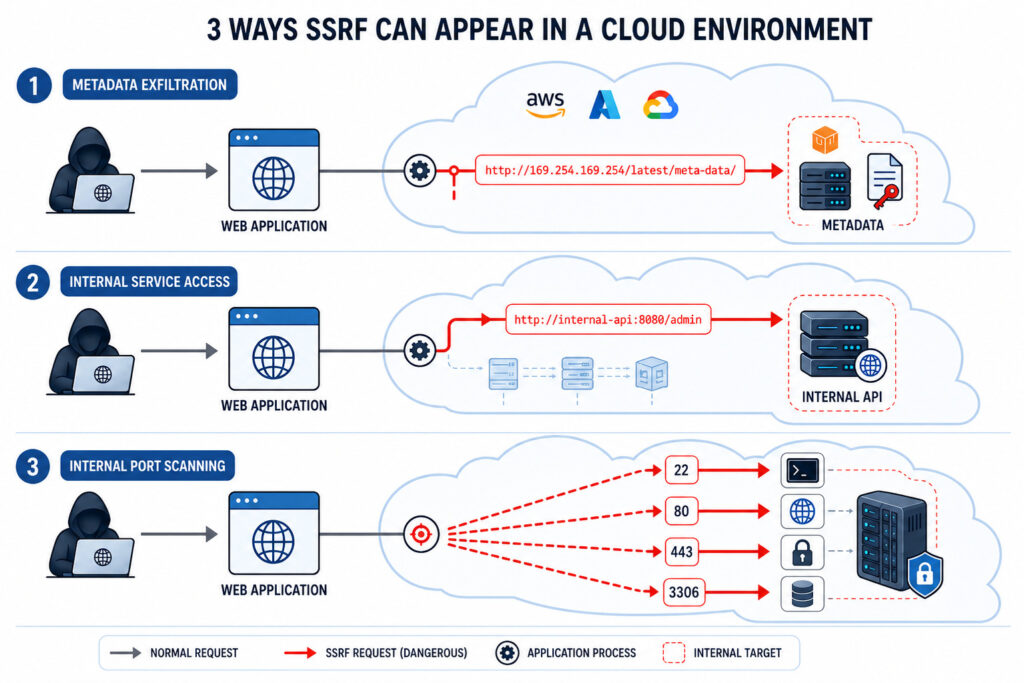
Modern cloud deployments provide a massive surface area for SSRF exploitation. In these environments, applications are not just talking to the internet; they are constantly communicating with management services.
For deep insights into how these attacks manifest in real-world scenarios, review our analysis on SSRF attack examples in cloud environments. Many cloud providers expose a Metadata Service at a specific non-routable IP address. This service contains sensitive information, including temporary security credentials, configuration details, and instance identities.
If an application allows a user to input a URL that is then fetched by the server, an attacker can simply input this metadata URL. The server then fetches these credentials and potentially returns them to the attacker, leading to a complete compromise of the cloud instance’s identity and privileges.
How can developers prevent SSRF vulnerabilities in application code?
Prevention starts with writing secure code that never trusts user input. You must implement robust logic that strictly governs how your application interacts with external and internal services.
Our comprehensive guide on preventing SSRF vulnerabilities in application code provides the actionable coding patterns required to stop these requests at the source.
- Avoid Direct URL Consumption: Never pass user input directly to a server-side request library without strict validation.
- Enforce Allow-listing: Compare the parsed host against a strict list of allowed domains rather than using block-listing.
- Disable Unused Protocols: Restrict requests to
httpandhttpsonly, explicitly disablingfile://,gopher://, ordict://protocols. - Validate DNS Resolution: Prevent attackers from pointing domains to internal IP addresses by enforcing DNS resolution checks before requests.
Where should security teams focus when testing for SSRF potential vectors?
Effective testing requires a systematic exploration of every entry point that accepts URL input. You must treat these vectors as high-risk, as they are often the first targets for automated scanning tools.
For a structured approach, consult our methodology on testing for SSRF potential vectors to identify where your application might be leaking internal connectivity.
| Test Vector | Description | Priority |
| URL Parameters | Manipulating GET/POST params | Critical |
| Import Features | Providing URLs to remote files | High |
| Webhook Callbacks | Triggering server-side callbacks | High |
| PDF Generation | Loading external CSS/images | Medium |
- Identify Input Fields: Locate all form fields, API parameters, and headers that accept URL-based input.
- Probe Internal Hosts: Attempt to access internal IP addresses and services from the server-side perspective.
- Test URL Schemes: Verify if the application attempts to process dangerous protocol schemes like
file://orftp://.
What is the true impact of successful SSRF exploitation?

Understanding the consequences of a breach is vital for prioritizing your remediation efforts. A successful exploit can lead to total system compromise, rendering perimeter defenses irrelevant.
Review our detailed report on the impact of successful SSRF exploitation to quantify the business risk to your internal infrastructure.
- Data Breach: Access to internal databases and proprietary files via unauthorized API calls.
- Credential Theft: Exposure of cloud metadata services, granting attackers temporary access keys.
- Resource Hijacking: Using the compromised server to launch further attacks against other internal assets.
- Infrastructure Mapping: Using the server to perform internal network reconnaissance and identify further vulnerabilities.
How can you implement robust mitigation techniques?
Mitigating SSRF requires a multifaceted strategy that moves beyond simple perimeter defenses to granular, application-level restrictions. By adopting a “defense-in-depth” mindset, you create barriers that prevent attackers from leveraging your server as an intermediary for unauthorized requests. To implement these controls effectively, refer to our comprehensive guide on SSRF mitigation techniques using allowlists.
“To protect against SSRF, you must ensure that your server-side application only makes requests to trusted and explicitly allowed resources.” – PortSwigger
- Implement Strict Allowlisting: Configure your application to accept only pre-approved domains and IP ranges. Never rely on blocklists, as attackers can easily circumvent them using alternative representations.
- Restrict Protocols: Explicitly limit the allowed URL schemes to https and http. Disable support for dangerous protocols like file://, gopher://, or dict:// within your request libraries.
- Control Redirects: Configure your HTTP client to disable automatic redirects. If redirects are business-critical, manually validate the destination URL against your allowlist before following the request.
Why is URL validation critical for security?
Input validation is the foundational layer of SSRF prevention. Without it, you provide attackers with an open interface to probe your internal network and manipulate backend processes. Because the server performs the request, it inherently carries higher privilege levels than the originating client. For best practices on sanitizing these inputs, review our documentation on validating user-supplied URLs securely.
- Parse and Validate: Always parse the URL string into components before validation. Ensure that hostnames, ports, and schemes match expected patterns.
- Normalize Input: Normalize the URL to prevent obfuscation techniques, such as using IP encodings or different character sets to bypass filters.
- Reject Malicious Patterns: Deny any request attempting to access internal loopback addresses (e.g., 127.0.0.1, localhost, ::1) or private network ranges.
“Server‑Side Request Forgery (SSRF) is a vulnerability that allows an attacker to make network requests to arbitrary destinations. SSRF makes these requests originate from within a server itself, which typically has broader access than an external client.” – MDN Web Docs
What are the core differences between SSRF and CSRF?
Credits : Hussein Nasser
Misunderstanding the distinction between these two vulnerabilities often leads to misaligned defense strategies. While both involve making requests on behalf of a user or system, the execution context is fundamentally different. A detailed breakdown of these differences can be found in our article: Difference between SSRF and CSRF explained clearly.
- Execution Context: SSRF occurs on the server, leveraging the server’s network location. CSRF occurs in the user’s browser, exploiting the user’s session credentials.
- Target Infrastructure: SSRF targets internal infrastructure or restricted services within the server environment. CSRF targets actions taken by the user within the application context.
- Mitigation Strategy: SSRF is mitigated via network segmentation and strict input allowlisting. CSRF is mitigated primarily through the use of anti-CSRF tokens and SameSite cookie attributes.
How can you identify common filter bypass techniques?
Attackers frequently attempt to evade simple validation logic to reach restricted internal endpoints. Our comprehensive analysis of SSRF filter bypass techniques awareness details how malicious actors use DNS rebinding, malformed IP addresses, and URL encoding to circumvent weak filters. You must ensure your validation logic is resilient against these obfuscation tactics by normalizing all inputs before evaluation.
- DNS Rebinding: Attackers resolve a domain to a safe IP initially, then change the resolution to an internal IP (like
127.0.0.1) once the application initiates the request. - IP Obfuscation: Using decimal, octal, or hexadecimal representations of IP addresses to confuse simple regex-based filters.
- Redirect Chains: Utilizing open redirectors on trusted domains to bypass initial domain-based allowlisting.
What does OWASP recommend for comprehensive SSRF prevention?
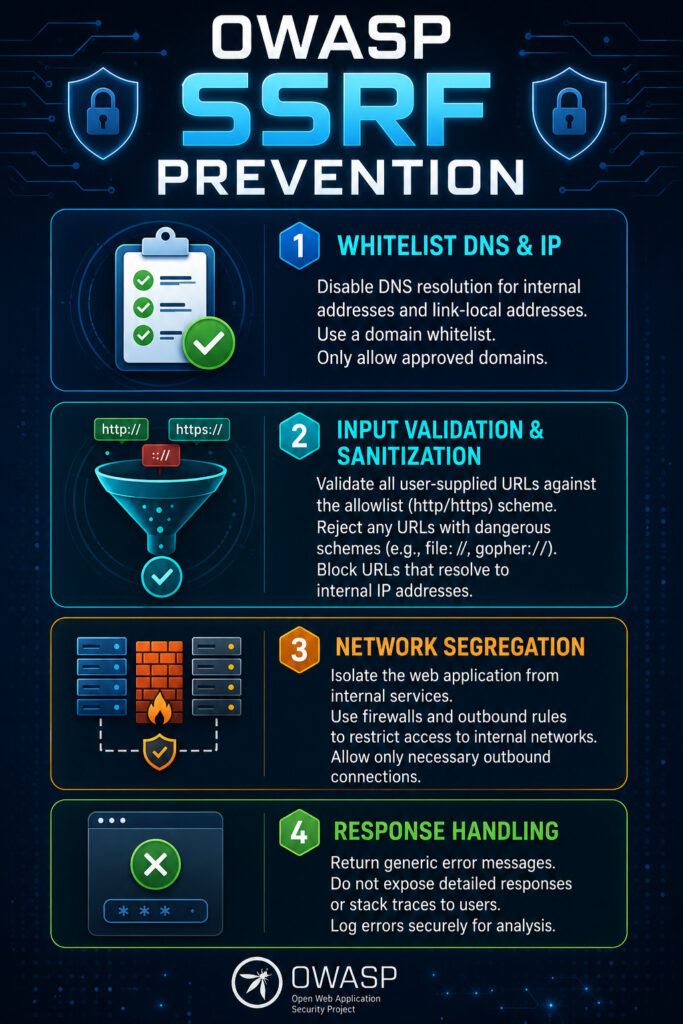
Adherence to industry-standard benchmarks is critical for maintaining long-term security. The OWASP SSRF prevention measures guide emphasizes the importance of defense-in-depth, advocating for network-level security alongside application-level checks. This holistic approach ensures that even if one layer is compromised, internal assets remain protected from lateral movement.
- Segment Networks: Use firewalls to restrict the application server’s outbound access to only necessary services.
- Enforce Authentication: Do not assume that internal requests are inherently trusted; require authentication for all inter-service communication.
- Use Modern Libraries: Leverage up-to-date HTTP clients that support safe configuration defaults and robust handling of redirects.
FAQ
What is SSRF?
It is a vulnerability where an attacker forces a server to make unintended network requests to unauthorized destinations.
Why is it dangerous?
It allows attackers to access internal services and sensitive data that are normally blocked from the public internet.
Does HTTPS prevent SSRF?
No, HTTPS only encrypts the data during transit; it does not validate the security or safety of the destination URL.
How can I prevent SSRF?
Implement strict allowlisting for domains, restrict network access, and disable unnecessary URL schemes like file:// or gopher://.
Are cloud environments at risk?
Yes, attackers frequently target cloud metadata services to steal sensitive instance credentials and configuration secrets.
Strengthening Defenses Against Unauthorized Server Requests
Server Side Request Forgery (SSRF) is a critical vulnerability that allows attackers to manipulate server-side requests and access internal resources that should never be exposed. Preventing SSRF requires strict input validation, destination allowlists, network segmentation, and continuous monitoring of outbound requests.
By incorporating these security controls into your development and deployment processes, organizations can significantly reduce attack surfaces and better protect sensitive systems from unauthorized access.
Ready to strengthen your secure development and security practices? Join the Secure Coding Practices Bootcamp and learn practical, hands-on techniques for preventing SSRF vulnerabilities, securing application architectures, and building resilient software from day one.
References
- https://portswigger.net/web-security/ssrf
- https://developer.mozilla.org/en-US/docs/Web/Security/Attacks/SSRF
Related Articles
- https://securecodingpractices.com/common-vulnerabilities-attacks/
- https://securecodingpractices.com/ssrf-vulnerability-explained-simple-terms
- https://securecodingpractices.com/ssrf-attack-examples-cloud-environments
- https://securecodingpractices.com/preventing-ssrf-vulnerabilities-application-code
- https://securecodingpractices.com/testing-for-ssrf-potential-vectors
- https://securecodingpractices.com/impact-successful-ssrf-exploitation
- https://securecodingpractices.com/ssrf-mitigation-techniques-allowlist
- https://securecodingpractices.com/validating-user-supplied-urls-securely
- https://securecodingpractices.com/difference-ssrf-csrf-explained-clearly/
- https://securecodingpractices.com/ssrf-filter-bypass-techniques-awareness/
- https://securecodingpractices.com/owasp-ssrf-prevention-measures/