


validating user supplied urls securely is a critical security practice for modern web applications that process dynamic external links, preventing server-side request forgery and malicious redirects.
When engineering teams fail to implement strict boundary validation, attackers can easily manipulate input parameters to probe internal network resources or execute unauthorized file retrievals.
At Secure Coding Practices, experts emphasize that deploying rigorous URL parsing protocols helps organizations intercept dangerous payloads, isolate backend HTTP clients, and maintain absolute security compliance across all active cloud infrastructure environments.
Enforcing Strict Protocol Validation Protects Backend Infrastructure
Systematically inspecting external inputs ensures that applications never process malicious parameters or execute unauthorized network routing.
- Enforce strict protocol allowlists to permit only safe schemes like HTTPS while blocking dangerous handlers like file or gopher.
- Parse URIs using robust native URL libraries to prevent host confusion and path traversal exploits.
- Resolve and validate IP destinations against known internal ranges to block server-side request forgery attempts.
Why Is Input Sanitization Essential for External Link Processing?
When applications accept untrusted inputs from users, failing to implement proper sanitization creates severe architectural vulnerabilities that can be weaponized by malicious actors.
By validating user supplied urls securely, development teams establish a trustworthy boundary that ensures only authorized domain names and safe structural formats pass through to backend execution layers.
This proactive defense mechanism prevents attackers from injecting arbitrary parameters, bypassing network perimeters, or manipulating HTTP request libraries into targeting sensitive local environments.
How Do URL Processing Flaws Enable Exploitation?
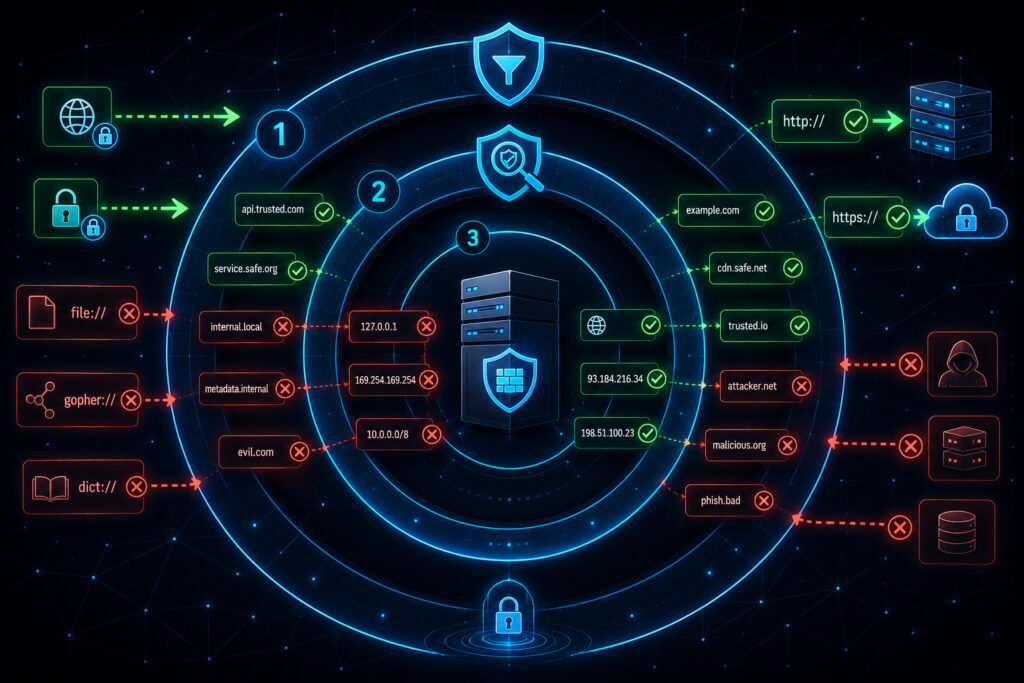
When developers neglect comprehensive parsing logic, applications become highly vulnerable to server-side request forgery flaws, allowing malicious actors to manipulate outbound network requests. Consistently validating user supplied urls securely ensures that backend systems reject malformed inputs before any socket connection is established.
| Validation Layer | Control Mechanism | Prevention Objective |
| Protocol Inspection | Restricting traffic to approved schemes | Eliminates local file and proxy execution |
| Hostname Verification | Checking destinations against explicit lists | Blocks unauthorized domain communication |
| IP Resolution Checks | Resolving and filtering internal IP ranges | Stops access to cloud metadata services |
What Do Industry Frameworks Recommend for Input Validation?
When designing enterprise defenses, consistently validating user supplied urls securely aligns application architecture with recognized industry benchmarks. Security guidelines emphasize that developers must never trust raw parameters passed directly from client requests without rigorous parsing.
“Applications that accept URLs from users must validate, filter, and sanitize the input to ensure that requests are only made to expected destinations and approved protocols.” – OWASP SSRF Prevention Cheat Sheet
Adopting these standardized defense patterns guarantees that applications maintain operational resilience while continuously validating user supplied urls securely across every service boundary, effectively minimizing potential exposure to injection attacks.
How Do Unchecked Inputs Trigger SSRF Vulnerabilities?
Credits: ZACK0X01
When developers overlook the importance of validating user supplied urls securely, malicious actors can easily exploit structural gaps in application routing. By exploring SSRF vulnerability mechanics, engineering teams can better appreciate why strict input filtering remains an indispensable defense mechanism for modern web applications.
- Monitor outbound socket connections for anomalies during runtime execution.
- Isolate internal service ports and metadata endpoints from public-facing web layers.
- Implement centralized logging for all rejected connection attempts to detect active reconnaissance.
How Do Built-in Parsing Libraries Enhance Application Defense?
Leveraging native language parsers and strict syntax verification rules allows developers to intercept malformed input before any network handshake takes place. When validating user supplied urls securely, engineering teams must ensure that custom string parsing does not replace robust, standardized URI parsing mechanisms.
“Improper URL validation can lead to serious security vulnerabilities, such as server-side request forgery, URL redirection, and host header injection, allowing attackers to gain unauthorized access to internal resources.” – Guidewire Secure Coding Guidelines
Consistently validating user supplied urls securely protects critical backend assets from unexpected protocol handlers and host manipulation. By pairing language-native parsing utilities with explicit allowlist enforcement, development teams eliminate hidden blind spots and ensure long-term stability across all distributed microservices.
How Do You Test URL Validation Defenses?
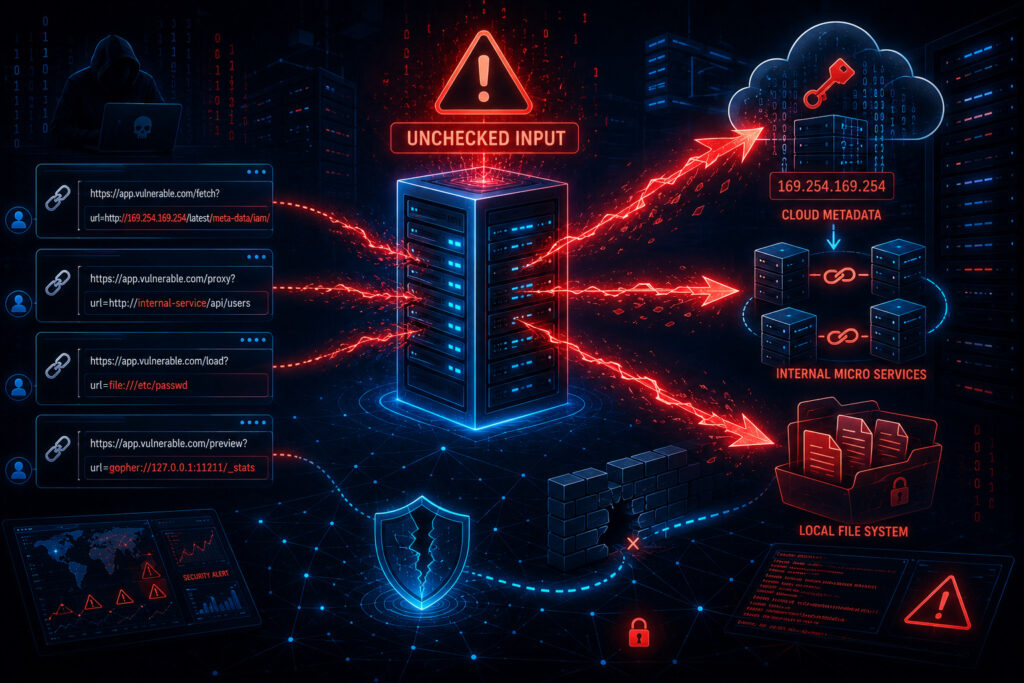
Implementing robust security automation and routine penetration testing is essential for ensuring that validating user supplied urls securely remains effective against evolving bypass techniques. Developers must simulate malicious payload attacks to identify any weaknesses in their parsing logic before deployment.
- Run automated security scanners to detect unvalidated input fields and open redirects.
- Perform fuzzing tests with malformed URI schemes and encoded IP addresses.
- Conduct manual code reviews focusing on HTTP client configuration and network boundary rules.
How Do OWASP Guidelines Shape Defensive Architectures?
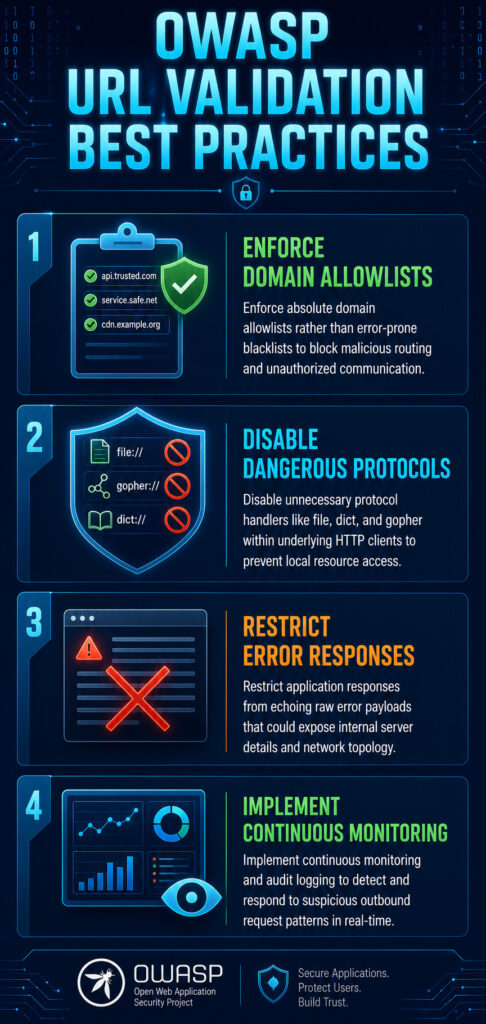
Adhering to established industry standards is paramount when validating user supplied urls securely within enterprise web applications. By following the OWASP SSRF prevention measures, development teams can implement comprehensive defenses that neutralize sophisticated input tampering vectors.
- Enforce absolute domain allowlists rather than error-prone blacklists to block malicious routing.
- Disable unnecessary protocol handlers like
file,dict, andgopherwithin underlying HTTP clients. - Restrict application responses from echoing raw error payloads that could expose internal server details.
FAQ
Why is validating user supplied urls securely important for web applications?
It prevents attackers from exploiting server-side request forgery, unauthorized file reads, and internal network port scanning by ensuring only trusted domains are accessed.
What are the primary risks of skipping URL validation?
Skipping validation exposes backend infrastructure to malicious redirects, cloud metadata theft, and unauthorized communication with internal microservices.
Are blacklists effective for filtering untrusted URLs?
No, blacklists are easily bypassed using alternative IP representations, encodings, or DNS rebinding techniques, making strict allowlists essential.
Which URI schemes should be completely disabled?
Dangerous legacy and file-handling protocols like file, dict, gopher, and ftp must be disabled to prevent local resource access.
How can developers test their URL parsing implementation?
Developers should use automated fuzzing tools, security scanners, and manual code reviews to simulate bypass attempts and verify boundary controls.
Securing Applications Through Rigorous Verification
Mastering the essential art of validating user supplied urls securely requires a proactive and disciplined security approach that combines strict protocol allowlists, robust URI parsing, and comprehensive egress filtering across all active microservices.
When development teams prioritize rigorous input sanitization, they eliminate critical blind spots and protect backend infrastructure from sophisticated injection and server-side request forgery attacks.
Ready to elevate your software security posture and build resilient web architectures? Join the Secure Coding Practices Bootcamp to master advanced defensive coding techniques, hands-on remediation strategies, and enterprise-grade security standards that safeguard critical digital assets from emerging cyber threats today.
References
- https://cheatsheetseries.owasp.org/cheatsheets/Server_Side_Request_Forgery_Prevention_Cheat_Sheet.html
- https://docs.guidewire.com/security/gosu-secure-coding-guidelines/INJ05-G/