
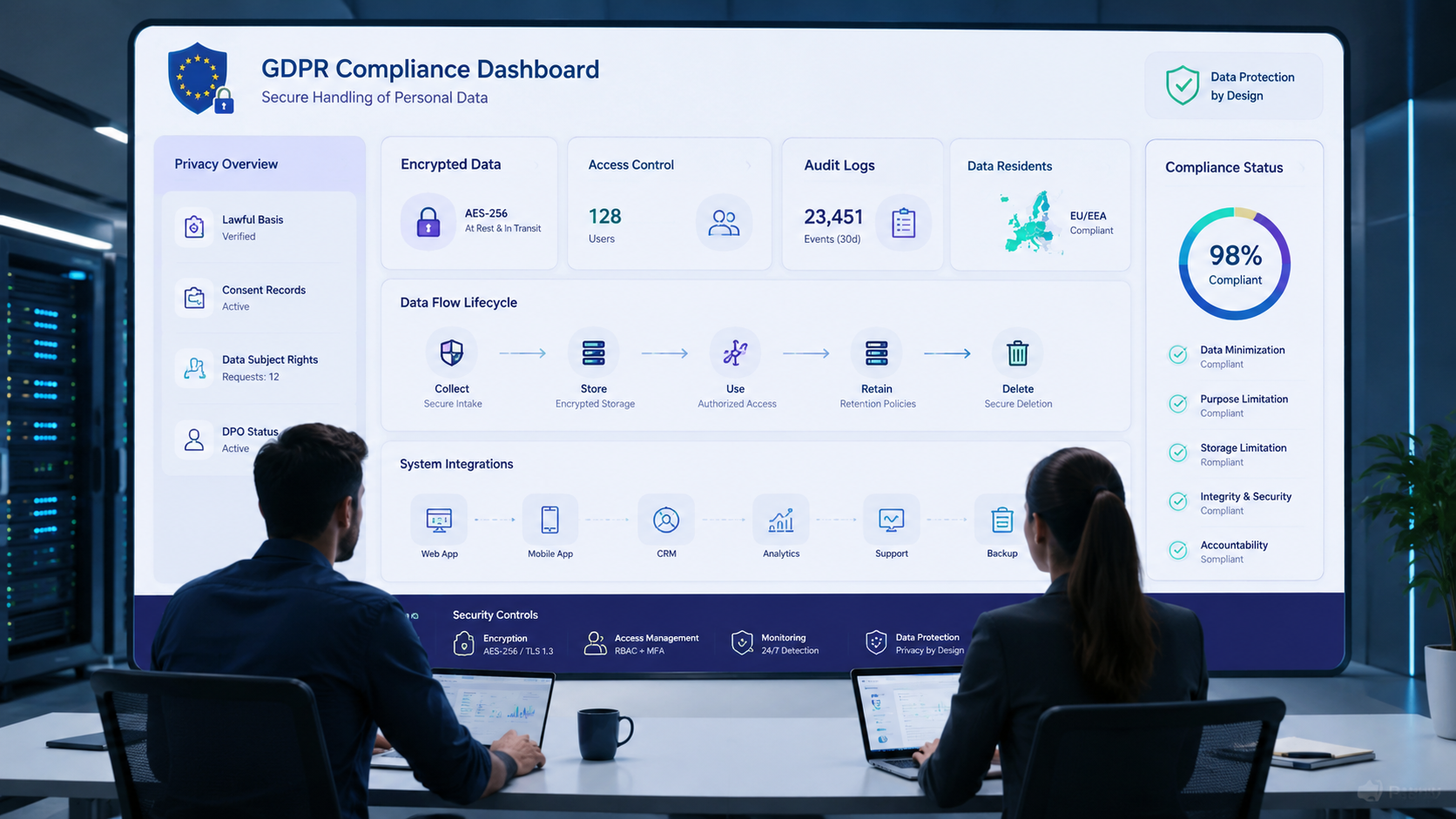

Secure handling PII data GDPR requires organizations to protect personal data through its entire lifecycle while meeting legal and security obligations. GDPR compliance depends on more than encryption alone. In our Secure Coding Practices training, we regularly see teams discover unknown data flows and retention problems long before security tools become the issue.
The European Data Protection Board continues to emphasize accountability, lawful processing, and data minimization. Organizations that build privacy into their systems early usually avoid expensive remediation projects later. Keep reading to understand the technical and operational decisions that support long-term GDPR compliance.
GDPR Security Snapshot
These key points summarize how secure handling PII data GDPR requirements influence security architecture, compliance decisions, and long-term data governance.
- GDPR requirements shape both technology and operations. Compliance affects architecture, workflows, retention policies, and everyday data handling decisions.
- Security controls support privacy obligations. Encryption, access controls, monitoring, and secure development practices work together to protect personal data.
- Retention and deletion strategies require careful design. Organizations need documented processes for access control, data retention, and secure deletion to remain compliant without disrupting business operations.
What Must Every Team Understand Before Handling Personal Data?
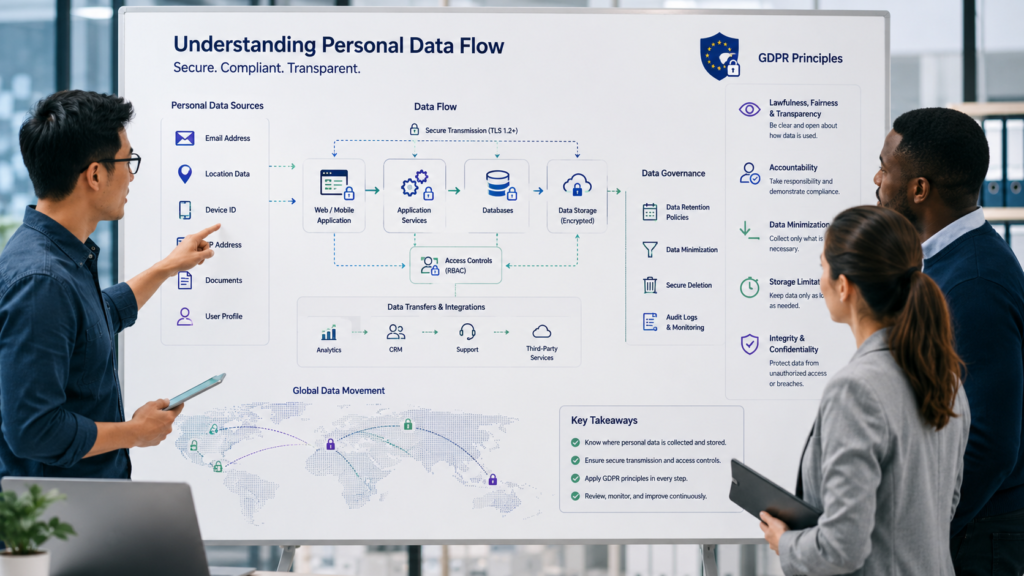
GDPR regulates personal data, which is a broader category than traditional “personally identifiable information.” It includes names, email addresses, IP addresses, location data, device identifiers, cookie IDs, biometric information, and many other data points that can identify someone, directly or indirectly.
We find the foundation for securely handling PII starts with understanding that compliance is wider than just data security. You need to grasp a few key concepts.
Personal data covers both direct and indirect identifiers. GDPR Article 5 establishes seven governing principles. Accountability means your organization must be able to demonstrate compliance. Security controls support compliance, but they don’t replace governance.
Many organizations kick things off with an encryption project. They often discover, later on, that undocumented data flows, unmanaged exports, and retention issues create bigger risks. One of the first surprises in our compliance workshops is how quickly teams realize they can’t fully explain where personal data travels inside their own systems.
According to GDPR Article 5, everything revolves around seven core processing principles that govern every single activity involving personal data.
Why Does GDPR Care About More Than Traditional PII?
Taking out names or email addresses doesn’t automatically remove your GDPR obligations. This is a common misconception. Engineering teams usually learn this the hard way while reviewing logs, telemetry systems, analytics pipelines, or monitoring platforms.
So, why can anonymous-looking data still be personal data? Several data types might still identify individuals when combined with other information. Think device identifiers, browser fingerprints, session IDs, cookie identifiers, or even truncated IP addresses. This creates what many compliance pros call the “PII myth.”
Companies frequently focus on obvious identifiers while completely overlooking contextual ones that remain linkable to individuals. For instance, an application log with timestamped device identifiers might seem harmless. But if those identifiers can be reasonably connected back to a specific person, GDPR still applies.
A lesson that keeps coming up in our developer forums is that truncating an IP address often represents pseudonymization, not true anonymization. Re-identification can still be possible when combined with other datasets.
Treat any persistent identifier as personal data unless you can confidently show that re-identification is no longer reasonably possible. The GDPR’s data minimization principle supports this approach by reducing unnecessary collection before compliance problems even emerge.
How Do the Seven GDPR Principles Shape Secure Data Handling?
Every security control you implement should align with a specific GDPR principle. Let’s break down what that looks like.
| GDPR Principle | What It Means for Security |
| Lawfulness | You’ve documented a legal basis for processing. |
| Transparency | Your privacy notices are clear and accessible. |
| Purpose Limitation | Data is only used for the reason it was collected. |
| Data Minimization | You collect only what you need, reducing your attack surface. |
| Accuracy | You keep records reliable and up-to-date. |
| Storage Limitation | You control how long data is kept. |
| Accountability | You’re ready for an audit and can prove your compliance. |
Which principle gets ignored most often? In our experience, it’s data minimization. Organizations frequently collect information “just in case” some future business need pops up. GDPR explicitly discourages that practice.
The data minimization principle actually reduces your exposure because you have fewer records to protect, audit, transfer, or delete later. Sure, teams sometimes worry that collecting less information could limit future opportunities. That concern is understandable.
Yet, many organizations discover that excessive collection creates operational burdens, increases storage costs, and expands the impact of a potential breach. From a pure security standpoint, fewer records generally mean fewer risks.
What Causes the Data Mapping Shock During GDPR Audits?
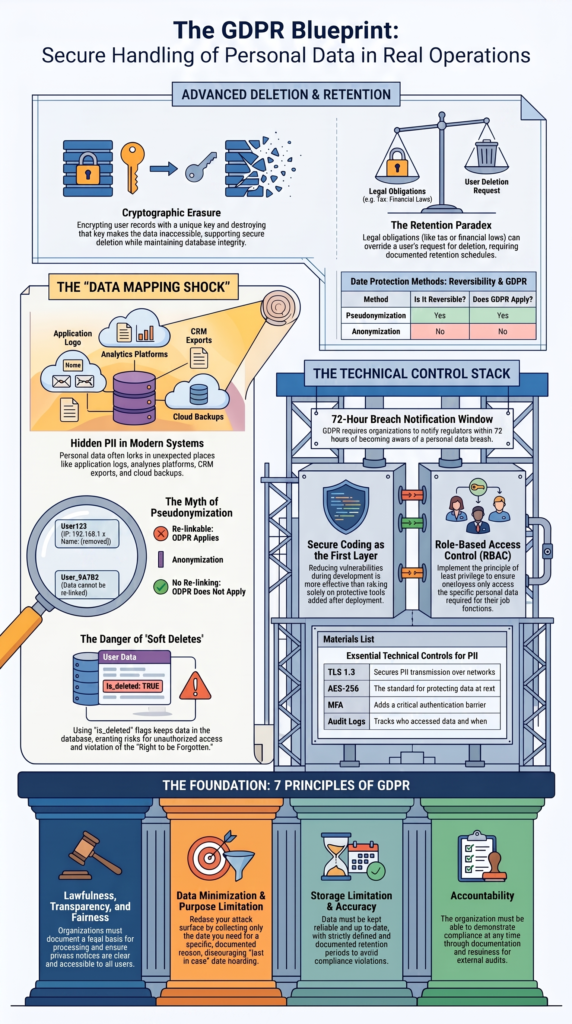
Most organizations struggle to trace personal data across all their systems. This challenge is so frequent that many practitioners call it the “data mapping shock.”
Where does hidden personal data usually appear? It’s often lurking in application logs, backups, analytics platforms, CRM exports, data warehouses, customer support tools, and third-party integrations. The difficulty comes from modern systems constantly duplicating information.
A single user record might exist in production databases, observability platforms, cloud backups, dev environments, reporting systems, and external processors all at once. During audits, teams often find forgotten exports or legacy integrations that are still processing personal information.
The question “Where does this data go?” can become one of the most expensive questions a company faces during a compliance review. We’ve seen it happen. In many situations, properly identifying sensitive data within application code helps teams discover hidden data flows before they become compliance problems.
Here’s a basic checklist to start with:
- Document every point where you collect data.
- Track internal transfers between systems.
- Identify all your data processors.
- Review any data exports.
- Define clear retention periods.
- Validate that your deletion workflows actually work.
Which Technical Controls Should Protect Personal Data?
Credits: IBM Technology
Encryption, access management, monitoring, and secure development practices form your baseline security stack. Before we list specific controls, we always stress that secure coding is the first layer of defense.
Your security architecture is much stronger when developers reduce vulnerabilities before deployment, instead of relying only on protective tools added afterward.
Core Security Controls
| Control | Its Purpose |
| TLS 1.3 | Secures PII transmission over networks. |
| AES-256 Encryption | Meets GDPR standards for data at rest. |
| Role-Based Access Control (RBAC) | Limits who can see PII. |
| Multi-Factor Authentication (MFA) | Adds a critical barrier to account access. |
| Comprehensive Audit Logs | Tracks who accessed what and when. |
Why is the principle of least privilege so important? Controlling access to PII relies heavily on limiting it. Employees should only access the information they absolutely need for their job. This approach directly supports role-based access control, creates a reliable audit trail, and lets you monitor data access effectively.
You need to track data access events, administrative changes, export activities, permission modifications, and authentication attempts. Many organizations also rely on practical protecting data at rest and in transit examples to help developers understand how encryption and transport security work together in real environments.
How Do Pseudonymization and Anonymization Differ?
Pseudonymization lowers risk, while true anonymization can place data outside GDPR rules. Many teams mix up these two concepts, especially during early security reviews.
| Method | Is It Reversible? | Does GDPR Still Apply? |
| Pseudonymization | Yes | Yes |
| Anonymization | No | No |
The confusion usually starts when developers remove names or email addresses and assume the data is anonymous. In many cases, that is not enough. If someone can reconnect the information to a person, GDPR may still apply.
During our secure coding practices training, we often review logs and analytics systems that appear harmless at first. Yet device IDs, session tokens, or customer identifiers can still point back to individuals.
Common pseudonymization methods include:
- Tokenization
- Data masking
- Identifier replacement
- Separate storage of encryption keys
True anonymization is much harder to achieve. The process must make re-identification impossible.
From our experience working with development teams, organizations often believe their datasets are anonymous when they are not. That mistake can create compliance problems and increase risk during audits or security reviews.
Why Are Soft Deletes Creating GDPR Risks?
Soft deletes hide records from users, but the data still stays in the database. Many applications use an is_deleted flag because it is easy to implement and helps recover records if mistakes happen.
The problem appears when teams assume the data is gone. During our secure coding practices training, we often see developers surprised to learn that deleted records can still be queried, exported, or restored.
Several risks can appear when personal data remains in the system:
- Query errors that expose deleted records
- Unauthorized access to hidden data
- Retention violations
- Incomplete deletion requests
From our experience reviewing application designs, soft deletes often stay in place for years. A user may appear deleted in the application while their information still exists in multiple tables. These situations often demonstrate the broader risks of sensitive data exposure when personal information remains accessible long after users believe it has been removed.
Many organizations now use stronger approaches, including:
- Segregated database partitions
- Filtered views
- Secure deletion procedures
- Cryptographic erasure workflows
If personal data can still be recovered, regulators may decide that deletion requirements have not been met. This becomes especially important when organizations must support a user’s right to be forgotten.
How Can You Design for the Right to Be Forgotten?
Deletion must extend far beyond your main production database. Personal data frequently spreads into analytics platforms, backups, search indexes, data lakes, cloud environments, and AI pipelines.
One technique we discuss is cryptographic erasure. Here, a user’s records are encrypted with a unique key. When you destroy that key, the encrypted information becomes computationally inaccessible. This can support secure deletion while keeping your database’s structural integrity intact.
As highlighted by the Information Commissioner’s Office (ICO)
“The key issue is to put the backup data ‘beyond use’, even if it cannot be immediately overwritten. You must ensure that you do not use the data within the backup for any other purpose… Provided this is the case it may be unlikely that the retention of personal data within the backup would pose a significant risk.” – ICO
What should a proper deletion workflow include?
- A secure process to verify the user’s identity.
- Analysis of data dependencies across systems.
- Notifications to any third-party processors.
- A review of backup lifecycles.
- Full documentation for the audit trail.
A challenge engineers often talk about involves AI systems and embeddings. Once information gets into downstream training or retrieval environments, deletion becomes far more complex. Designing for deletion from the start is almost always cheaper than trying to retrofit it later.
How Do You Handle the Retention Paradox Legally?
Sometimes you have to keep records available despite a user’s deletion request. Legal obligations can override the right to erasure.
| Data Type | Typical Treatment Under GDPR |
| Marketing Data | Usually deleted upon request. |
| Support Records | Evaluate if retention is necessary. |
| Tax Records | Retain for the period required by law. |
| Financial Ledgers | Retain under legal obligation. |
Why does this create confusion? Organizations face competing obligations. A user might request deletion while accounting regulations demand you keep transaction records for seven years. The solution is to develop documented, clear retention schedules.
Research from the Data Protection Commission (DPC)
“If you are required by law to process individuals’ personal data, then the right to erasure will not apply.” – DPC
These schedules should define the legal basis for processing, specific retention periods, the triggers for deletion, and procedures for legal holds. The GDPR framework recognizes that some information needs longer storage when supported by other laws.
What Role Do DPAs and Processors Play in Compliance?
Every company that shares personal data with a service provider should have a proper Data Processing Agreement (DPA) in place. GDPR Article 28 sets the rules, but many teams do not fully understand how important these agreements are.
During our secure coding practices training, we often meet development teams that focus heavily on application security while overlooking vendor relationships. In many cases, third-party services handle large amounts of personal data every day.
A standard DPA usually defines:
- The purpose of processing
- How long data is kept
- Types of personal data involved
- Security responsibilities
- Audit rights
- Deletion requirements
Cloud services, analytics tools, customer support systems, and business platforms often require these agreements. We have seen organizations discover missing contracts only after an audit or security review begins.
Good governance also goes beyond signing documents. Teams should review vendors regularly and understand how data moves outside their own environment.
A strong processor review often includes:
- Vendor security assessments
- Sub-processor reviews
- Breach notification procedures
- Audit responsibilities
- Verification of data protection controls
These steps help organizations reduce risk and support long-term GDPR compliance.
How Should Organizations Respond to a Personal Data Breach?
A personal data breach can happen faster than many teams expect. That is why organizations need an incident response plan before an event occurs. Trying to build a response process during a breach often leads to delays and confusion.
During our secure coding practices training, we regularly hear from teams that discovered gaps in their response plans only after running security exercises. Many organizations realize that roles and responsibilities were never clearly assigned.
A typical response process includes:
- Detecting and containing the breach
- Assessing the impact and affected data
- Documenting findings and actions
- Notifying regulators when required
- Informing affected individuals if risk is high
Many breach plans fail because important details are missing. Weak logging can slow investigations, while poor data inventories make it difficult to understand what information was exposed.
Our experience shows that clear ownership and regular testing make a major difference. Incident response should connect with forensic investigations, disaster recovery plans, and ransomware defenses.
The GDPR 72-hour notification period starts once the organization becomes aware of the breach. Preparation before an incident often determines how successful the response will be.
What Does Future-Proof GDPR Security Look Like?
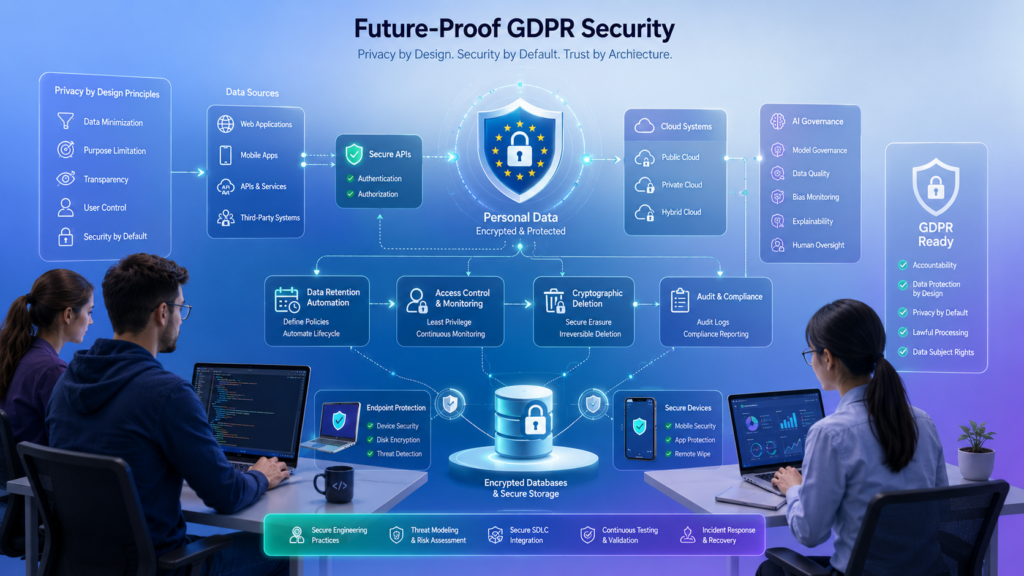
Future-ready GDPR security starts long before an audit. Organizations that build privacy into their systems early often face fewer problems later. In our training sessions, we regularly see teams spend more time fixing old designs than building secure ones from the start.
Modern security programs now focus on several areas:
- Privacy by design and default
- Automated retention controls
- Regional data governance
- Cryptographic erasure
- AI data governance
- Strong protection for APIs
Many development teams are handling personal data through multiple services and cloud applications. As systems become more connected, REST APIs and GraphQL endpoints create additional exposure points. Our secure coding practices courses often show how a single unsecured API can expose sensitive information across several systems.
Endpoint security also remains important. Personal data does not always stay inside central servers. Employees frequently access information through laptops, mobile devices, and workstations.
From our experience, organizations that combine secure engineering with privacy planning are better prepared for future regulations. Security teams, developers, and business leaders all share responsibility for protecting personal data. Building privacy early usually costs less than fixing problems after deployment.
FAQ
How do GDPR data subject rights affect personal data requests?
GDPR data subject rights PII give individuals the right to access, correct, delete, or transfer their personal information. Organizations must verify a person’s identity before sharing or removing data. The right to access PII GDPR and the right to erase PII GDPR require clear internal procedures. These rights help support secure personal data processing EU requirements and improve accountability.
Why is GDPR consent management important for PII data?
GDPR consent management PII data ensures that organizations collect personal information legally. Consent must be clear, specific, and easy to withdraw. Companies must also establish a lawful basis processing PII GDPR before using personal data. Maintaining accurate consent records helps organizations meet GDPR PII compliance requirements and reduces legal and operational risks.
How does cloud storage affect GDPR PII compliance?
Cloud storage PII GDPR compliance depends on where personal information is stored and who can access it. Organizations should review security controls, retention policies, and data transfer agreements. GDPR cross border PII transfer rules may apply when information moves outside the European Union. Regular GDPR vendor PII security audit activities help identify risks and improve data protection.
Why are access controls important for GDPR compliance?
PII access controls GDPR compliance limit access to personal information based on job responsibilities. Role based access control GDPR PII helps employees view only the data required for their work. Multi factor authentication GDPR PII adds another layer of protection. Logging PII access GDPR compliance also creates audit records that support security investigations and compliance reviews.
What security measures protect personal data during transmission?
GDPR article 32 security measures require organizations to protect personal information while it moves across networks. TLS encryption PII GDPR compliance helps secure data during transmission.
VPN secure PII transfer GDPR controls and secure email PII GDPR transmission reduce interception risks. Secure transmission PII over networks GDPR requirements also support authentication, monitoring, and encrypted communication.
Build GDPR Readiness Into Daily Development
GDPR compliance becomes difficult when privacy decisions happen late in the process. Small gaps in data handling can create bigger risks during audits. The best results come from secure development habits that support privacy, stronger access controls, and safer coding decisions from the start.
Practical training helps teams apply these skills in real projects and build systems that stay secure over time. Start building GDPR-ready development skills today with Secure Coding Practices.
References
- https://ico.org.uk/for-organisations/uk-gdpr-guidance-and-resources/individual-rights/individual-rights/right-to-erasure/
- https://www.dataprotection.ie/en/individuals/know-your-rights/right-erasure-articles-17-19-gdpr