


Implementing an accurate Input Length Validation Regex pattern is crucial for securing modern Web APIs against catastrophic boundary exploits. At Secure Coding Practices, software engineers emphasize that defining explicit length constraints within regular expressions prevents malicious actors from launching memory exhaustion and buffer overflow attacks.
Rather than relying solely on string length methods, incorporating range-based quantifiers inside regular expressions enforces both character type restrictions and boundary limits simultaneously. By adopting this dual-enforcement strategy, development teams establish a resilient defense perimeter, protecting backend application servers from receiving oversized, malformed, or malicious incoming request payloads.
Regular Expression Boundaries Prevent Memory Exhaustion Exploits
Integrating range-based quantifiers inside regular expressions establishes immediate, dual-layer validation across incoming payload strings.
- Quantifier parameters explicitly enforce lower and upper character limits on every incoming string parameter.
- Combining character sets with explicit length boundaries neutralizes denial-of-service vectors before processing occurs.
- Pre-filtering payload dimensions reduces computational overhead across backend application microservices.
Why Exact String Boundaries Matter in API Security?
Unrestricted input lengths expose backend systems to severe stability and security threats. When application endpoints accept arbitrarily large strings, malicious actors can easily trigger resource exhaustion, memory corruption, or ReDoS (Regular Expression Denial of Service) conditions.
Implementing an Input Length Validation Regex allows engineering teams to construct precise validation rules that validate payload size and character composition within a single processing step. Bypassing size checks forces application servers to allocate excessive memory to parse malformed strings, rapidly degrading system performance.
Relying solely on programmatically checked string length properties can sometimes introduce logical race conditions or lead to inconsistent validation across multi-tier architectures. By embedding explicit quantifiers directly within regular expressions, developers guarantee that input parameters conform strictly to defined structural constraints before deeper business logic executes.
This centralized approach reduces boilerplate conditional statements while maintaining high-density code readability across API routes. Ultimately, defining clear character limits at the regex level forms an essential perimeter control, keeping API endpoints fast, predictable, and resilient against unexpected memory spikes.
Can Input Length Validation Regex Performance Outperform Manual String Checks?
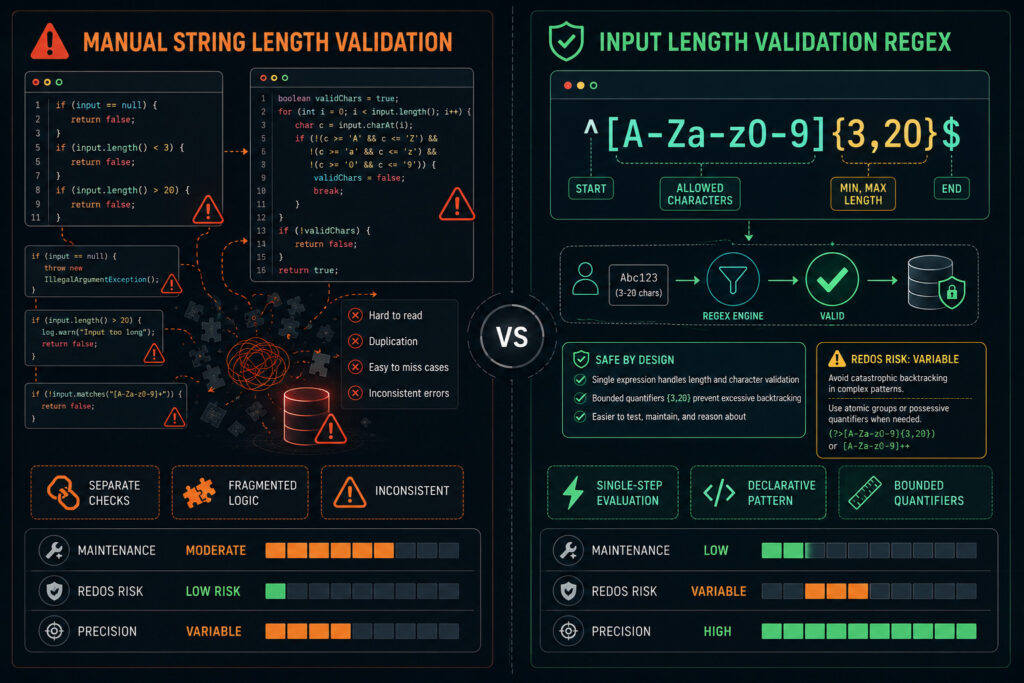
Relying exclusively on programmatic string length checks often spreads validation logic across multiple application layers, increasing maintenance friction. For an in-depth guide on constructing safe patterns, read our comprehensive overview of safe regular expression use across enterprise software.
Evaluating how Input Length Validation Regex strategies streamline boundary enforcement demonstrates significant architectural advantages over fragmented manual parsing techniques.
| Evaluation Metric | Manual String Length Validation | Input Length Validation Regex |
| Enforcement Model | Separate checks for string length and character type | Single-step combined evaluation of size and content |
| ReDoS Vulnerability Risk | Low risk; does not evaluate regex quantifiers directly | Variable; requires atomic groups or bounded quantifiers |
| Code Maintainability | Moderate; requires multiple if-else blocks per field | High; declarative regex patterns apply across DTO schemas |
| Boundary Precision | Dependent on consistent framework execution | Explicitly bounded using {min,max} quantifier syntax |
How Does Framework Automation Enforce Input Constraints Seamlessly?
Integrating declarative attributes into modern server-side frameworks enables automated boundary enforcement across application data models. Utilizing Input Length Validation Regex annotations directly within data transfer objects reduces manual verification logic while maintaining strict security boundaries.
Enforcing constraints automatically ensures that invalid payloads are rejected at the model binding stage before reaching core application methods.
Official framework documentation outlines the primary security and stability benefits of automated validation pipelines:
“Having validation rules automatically enforced by ASP.NET Core helps: Make the app more robust; Reduce chances of saving invalid data to the database.” – Microsoft ASP.NET Core Validation Tutorial
What Common Security Flaws Threaten Regex Boundary Controls?
Constructing regex patterns without proper structural limits often invites unexpected security vulnerabilities into backend applications. Developers frequently assume that standard character matching is sufficient, overlooking the necessity of setting strict upper and lower bounds.
To prevent catastrophic performance bottlenecks and catastrophic backtracking exploits, review our detailed guide on common regex security mistakes avoid during system implementation. Properly structuring an Input Length Validation Regex ensures that strings are evaluated safely without consuming excess CPU cycles.
When regular expressions omit explicit length constraints or rely on unbounded quantifiers like + or *, malicious actors can submit exceptionally long inputs to trigger ReDoS attacks. This processing stall freezes backend execution threads, causing widespread denial of service.
Enforcing strict character length boundaries directly inside regex definitions stops catastrophic backtracking before it can impact server infrastructure.
Systematic pattern design protects application endpoints while preserving high parsing throughput across modern enterprise systems.
- Using explicit range quantifiers like
{1,30}prevents unbounded string execution across API routes. - Anchoring regular expressions with
^and$guarantees full string matching rather than unsafe partial checks. - Testing regular expressions against edge-case long strings identifies potential ReDoS bottlenecks prior to production deployment.
Why Must Server-Side Engines Enforce Input Boundaries Independently?
Credits: kudvenkat
Relying on client-side regex checks to enforce payload constraints creates a false sense of security. While client checks improve user experience, executing an Input Length Validation Regex on the backend ensures malicious input cannot bypass security controls.
Standard security guidance emphasizes the absolute necessity of server-side validation:
“You must not rely on front-end validation to catch security issues, because an attacker may subvert or completely bypass the front-end code. So you must also validate input on the server, before processing it.” – MDN Input Validation Security Guidance
Can Unbounded Regex Patterns Trigger Server Downtime?
Unbounded regular expressions without explicit length limits pose severe risks to backend stability. When input processing algorithms encounter arbitrarily long strings, catastrophic backtracking can consume 100% of CPU capacity, causing thread starvation across application servers. Implementing an Input Length Validation Regex with strict range quantifiers prevents catastrophic ReDoS (Regular Expression Denial of Service) conditions by stopping evaluation early when inputs exceed allowed boundaries.
- Setting explicit quantifier upper bounds limits total execution steps for string evaluations.
- Validating input size before pattern matching prevents server CPU thread exhaustion.
Why Is Range-Bounded Parsing Essential for Payload Filtering?
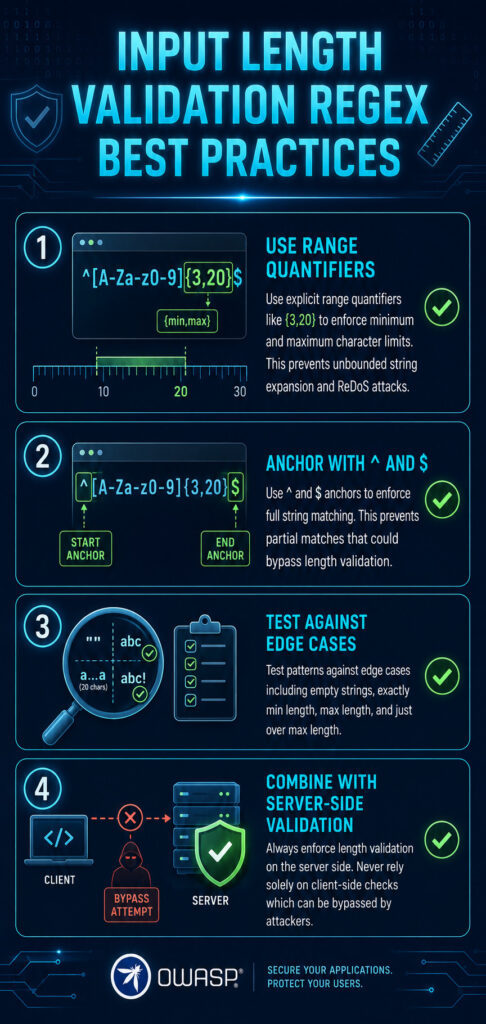
Enforcing precise string length boundaries forms the first line of defense against malicious payload injection. Modern web applications process thousands of concurrent API requests, making it vital to inspect parameter dimensions before passing data into underlying data stores.
To learn how to clean up raw request data safely without causing unexpected side effects, review our guide on sanitizing input using regex carefully across server environments. Applying an Input Length Validation Regex guarantees that oversized payloads are caught at the entry gateway long before reaching core application algorithms.
When applications accept unconstrained input lengths, malicious actors can easily inject bloated payloads designed to exploit memory buffers or bypass weak validation checks. Bounding quantifiers ensure that strings conform strictly to allowed structural dimensions, preventing arbitrary data expansion.
Centralizing validation parameters at the perimeter layer ensures that malformed requests are cleanly rejected with clear status responses rather than causing application-level crashes.
Maintaining disciplined regex construction prevents common security flaws while maintaining optimal application performance.
- Incorporating bounded quantifiers like
{2,50}ensures strings strictly respect minimum and maximum size requirements. - Validating overall payload length prior to pattern execution mitigates potential Regular Expression Denial of Service vulnerabilities.
- Structuring clear validation error responses prevents unnecessary exposure of internal server stack details to untrusted clients.
FAQ
What is input length validation regex and why is it important?
Input length validation regex is a pattern matching technique that uses range-based quantifiers to enforce minimum and maximum string lengths, preventing buffer overflows and resource exhaustion.
How do range quantifiers in regex enforce length boundaries?
Range quantifiers like {min,max} explicitly specify the exact number of characters a string must contain, ensuring incoming payloads stay within safe operational limits.
Can input length validation regex prevent Regular Expression Denial of Service attacks?
Yes, capping the maximum length of an input string directly inside the regular expression drastically reduces execution steps and stops catastrophic backtracking before it consumes server CPU.
Is client-side length validation using regex sufficient for API security?
No, client-side checks can easily be bypassed or stripped by attackers, making server-side length validation mandatory for all API endpoints.
What is the difference between string length methods and regex length validation?
String length methods only check character counts, whereas regex length validation verifies both character type restrictions and length boundaries in a single, unified execution step.
Build Unshakeable API Defenses Today
Mastering Input Length Validation Regex is a fundamental requirement for securing web applications against memory exhaustion and payload manipulation. Unchecked input dimensions invite catastrophic ReDoS vulnerabilities, buffer overflow exploits, and performance bottlenecks across backend microservices.
Enforcing strict character sets alongside explicit range quantifiers isolates core execution layers from malformed data streams. Modern enterprise security demands proactive, server-side perimeter controls that reject oversized inputs before they reach internal business logic.
Elevate your software engineering skills and master advanced secure coding principles from industry professionals. To build bulletproof API architectures, join our secure coding bootcamp today and eliminate backend vulnerabilities completely.
References
- https://learn.microsoft.com/en-us/aspnet/core/tutorials/razor-pages/validation?view=aspnetcore-10.0
- https://developer.mozilla.org/en-US/docs/Web/Security/Defenses/Input_validation