
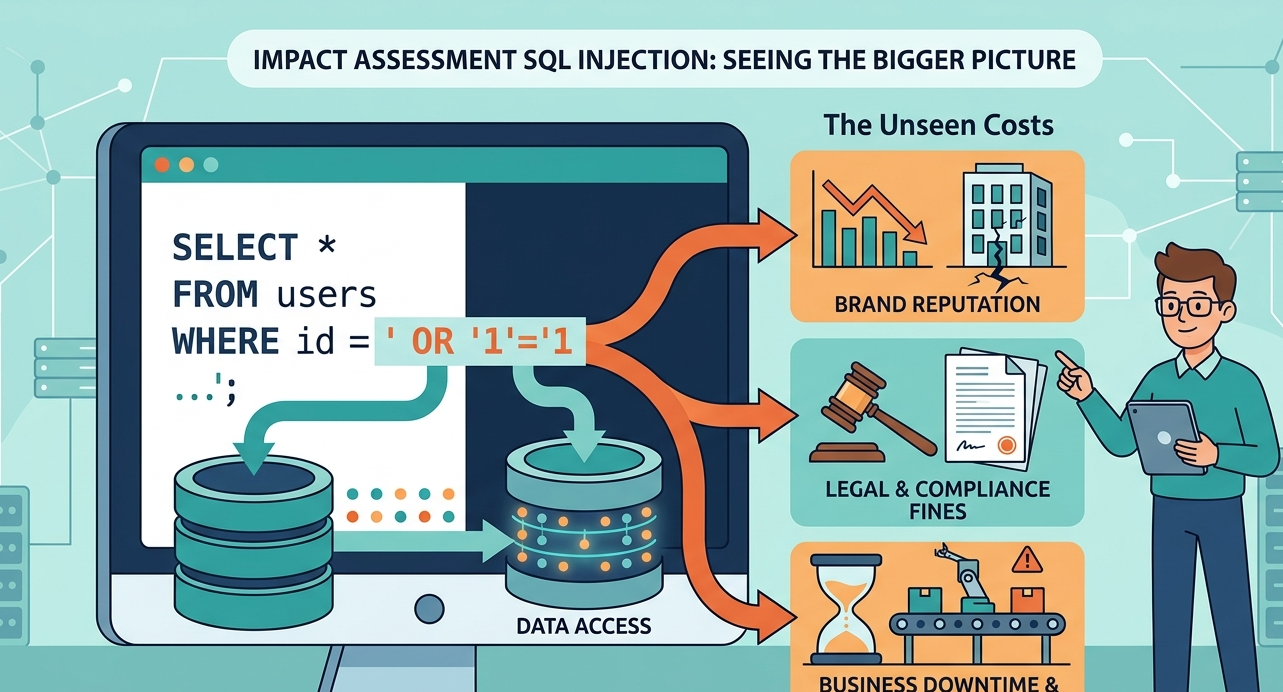

Impact assessment SQL injection breach is never just about the data stolen. The real cost, the one that cripples operations and bleeds budgets, lives in the aftermath. It’s in the forensic investigation, the system rebuilds, the legal notices, and the shattered customer trust.
Understanding this full impact is what separates a contained incident from a business-ending event. We’ll walk you through what a real assessment looks like, so you know exactly what’s at stake. Keep reading to see how to measure the true blast radius.
What Actually Matters Most
Here’s the real impact in simple terms before we dive deeper:
- An SQL injection’s financial impact extends far beyond fines, encompassing massive operational recovery costs.
- The reputational damage and loss of customer trust often outweigh the immediate technical fixes.
- A structured impact assessment is your only map through the crisis, guiding legal and communication steps.
A Real Breach Story From the Field
I remember the first time I saw a live attack in action. It wasn’t in a textbook, it was on a client’s e-commerce dashboard late on a Tuesday. Truly understanding SQL injection risks changes how you view a crisis. The numbers were wrong, orders were vanishing, and a quiet panic set in. The initial thought was always about the data, credit cards, addresses.
But the real story, the expensive one, unfolded in the weeks after. It was the 300 hours of developer time to rebuild, the $45,000 in forensic consulting, and the 15% drop in sales the next quarter from eroded trust. That’s the impact. That’s what we need to talk about.
Hidden Costs Most Teams Miss
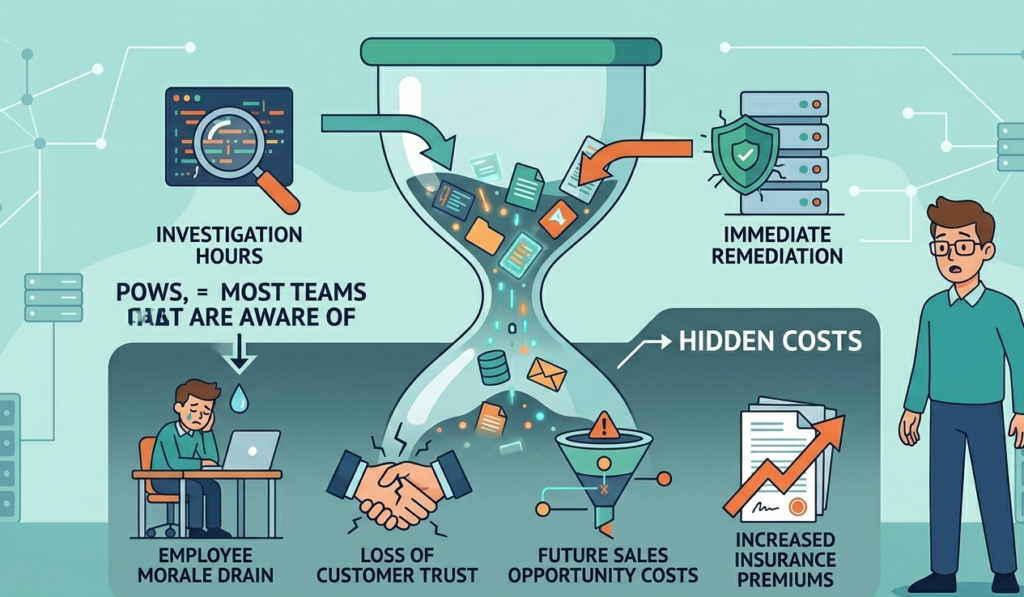
Most reports only show direct costs, but the hidden impact is where the real damage grows:
- Productivity loss across non-security teams pulled into crisis mode
- Delayed product releases due to frozen development pipelines
- Increased friction in engineering workflows after stricter controls are added
- Long-term insurance premium increases after breach reporting
- Higher customer support volume for weeks or months
“The indirect consequences of SQL injection vulnerabilities often outweigh direct remediation costs due to long-term operational disruption and recovery overhead.” – ScienceDirect
These costs rarely appear in incident reports, but they significantly increase total breach impact.
The Operational Domino Effect
One corrupted database table can halt shipping logistics. A compromised admin panel can freeze content updates. When development teams aren’t properly escaping user input, a simple ‘ OR ‘1’=’1 payload becomes a key that unlocks not just data, but control.
Suddenly, your teams are paralyzed. The help desk is flooded. Marketing can’t launch campaigns. Everything slows down.
What You’re Really Assessing After the Breach
Credits: Hacksplaining
When the alert fires, your mind jumps to the database. What got out? But the assessment starts with the business, not the server. You have to ask different questions.
How many customer records were touched? Which internal systems are now unstable? What regulatory bodies need to be informed, and what’s their 72-hour clock? The technical fix, patching the injection point, might take an hour. The business recovery takes months.
The financial tally is brutal and multifaceted. It’s never one line item.
- Forensic Investigation & Containment
- System Restoration & Data Repair
- Legal & Regulatory Compliance Fees
- Customer Notification & Credit Monitoring
- Operational Downtime & Lost Revenue
Beyond the invoice, the reputational decay is a slow bleed. Customers forgive a lot, but a breach of their personal data lingers. You’ll see it in support ticket volume, in social sentiment, and in the hesitation at the checkout page. This isn’t a theoretical risk, it’s a measurable dip in your key performance indicators.
The Operational Domino Effect
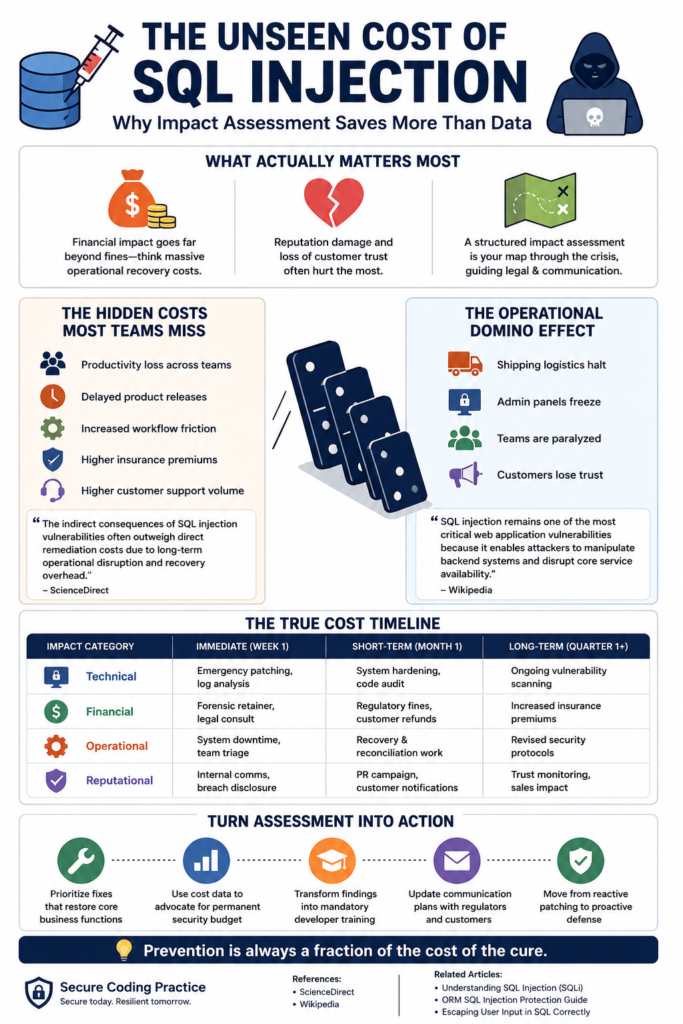
One corrupted database table can halt shipping logistics. A compromised admin panel can freeze content updates. The SQL injection’s payload, often a simple ‘ OR ‘1’=’1, becomes a key that unlocks not just data, but control.
Suddenly, your teams are paralyzed. The help desk is flooded with calls about password resets they can’t process. The marketing team can’t launch the campaign because the asset server is isolated.
“SQL injection remains one of the most critical web application vulnerabilities because it enables attackers to manipulate backend systems and disrupt core service availability.” – Wikipedia
The recovery timeline is where costs multiply. Let’s say your team patches the vulnerability in Day One. The assessment might reveal you need to roll back to a clean database backup from 36 hours prior.
Now you’re manually reconciling two days of legitimate orders. That’s customer service hours, developer hours, and manager hours all diverted. The table below sketches how these costs can manifest across a mid-sized business.
| Impact Category | Immediate (Week 1) | Short-Term (Month 1) | Long-Term (Quarter 1+) |
| Technical | Emergency patching, log analysis | System hardening, code audit | Ongoing vulnerability scanning |
| Financial | Forensic retainer, legal consult | Regulatory fines, customer refunds | Increased insurance premiums |
| Operational | System downtime, team triage | Recovery & reconciliation work | Revised security protocols |
| Reputational | Internal comms, breach disclosure | PR campaign, customer notifications | Trust monitoring, sales impact |
You’re not just fixing code. You’re rebuilding processes and, harder still, confidence. The developers now have to justify every query. The managers require sign-offs for simple updates. This cultural shift, born from necessity, adds friction to every project that follows.
Turning Assessment Into Action
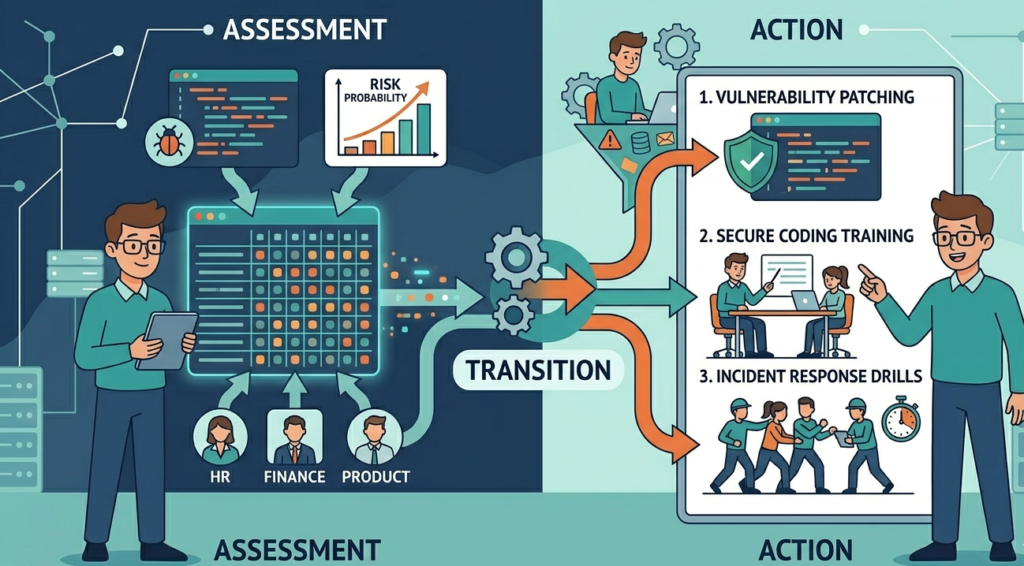
So you’ve mapped the damage. The system is back online. The real work begins now. The impact assessment isn’t a post-mortem document to file away. It’s the blueprint for your response and your strongest argument for change.
It translates technical failure into business language that the board understands. It shows the direct line from a lazy parameterized query or a poorly configured ORM SQL injection defense layer to a $200,000 loss.
This is where perspective matters. An internal team is deep in the crisis, making emotional, costly decisions to just make it stop. An external partner, like an MSSP, lives in this space. We’ve seen the patterns. We can separate the critical from the catastrophic quickly.
Our role is to bring a structured assessment framework to the chaos, to ensure you’re measuring the right things, not just the obvious ones. We help you ask, “What’s the business function of this server?” not just, “What’s the database version?”
The action plan becomes clear.
- Prioritize fixes that restore core business functions first.
- Use the cost data to advocate for permanent security budget.
- Transform incident findings into mandatory developer training.
- Update communication plans with regulators and customers.
The goal is to move from reactive patching to proactive defense. The assessment proves that the cost of prevention is always a fraction of the cost of the cure.
FAQ
What is an impact assessment after an SQL injection attack?
An impact assessment after an SQL injection attack is the process of evaluating the full damage caused by the breach. It goes beyond identifying stolen data and includes operational downtime, financial losses, legal obligations, and reputational harm.
The goal is to understand the complete business “blast radius” so organizations can prioritize recovery actions and prevent similar incidents in the future.
What should be the first step after detecting an SQL injection?
The first step is containment. This means isolating affected systems, blocking the injection vector, and preventing further unauthorized access. After containment, teams should preserve logs and evidence for forensic analysis.
Only then should recovery begin. Acting too quickly without understanding scope can lead to data loss, incomplete fixes, or repeated exploitation through the same vulnerability.
How do companies measure the financial impact of SQL injection?
Companies measure financial impact by combining direct and indirect costs. Direct costs include forensic investigation, legal fees, system recovery, and customer compensation. Indirect costs include downtime revenue loss, productivity disruption, higher insurance premiums, and customer churn.
Over time, reputational damage can significantly increase long-term revenue loss, making it one of the most expensive hidden consequences.
How can SQL injection attacks be prevented in the long term?
Long-term prevention relies on secure coding practices such as parameterized queries, input validation, and least-privilege database access. Regular security testing, code reviews, and vulnerability scanning are also essential.
Training developers to recognize injection risks reduces human error. When combined with continuous monitoring, these practices significantly reduce the likelihood and impact of future SQL injection attacks.
Your Roadmap Through the Aftermath
An SQL injection leaves a mark, that’s inevitable. But its legacy doesn’t have to be a scar. A thorough impact assessment does more than count the losses, it lights the path forward. It transforms a narrative of failure into a plan for resilience. It shows you precisely where your shields failed so you can reinforce them.
The data you protect next time isn’t just in the tables, it’s in the very continuity of your operation. Let this assessment be the tool that turns a breach from an ending into a recalibration. Start building your assessment framework with Secure Coding Practice, before you ever need it.
References
- https://www.sciencedirect.com/science/article/abs/pii/S0167404813000904?via%3Dihub
- https://en.wikipedia.org/wiki/SQL_injection