
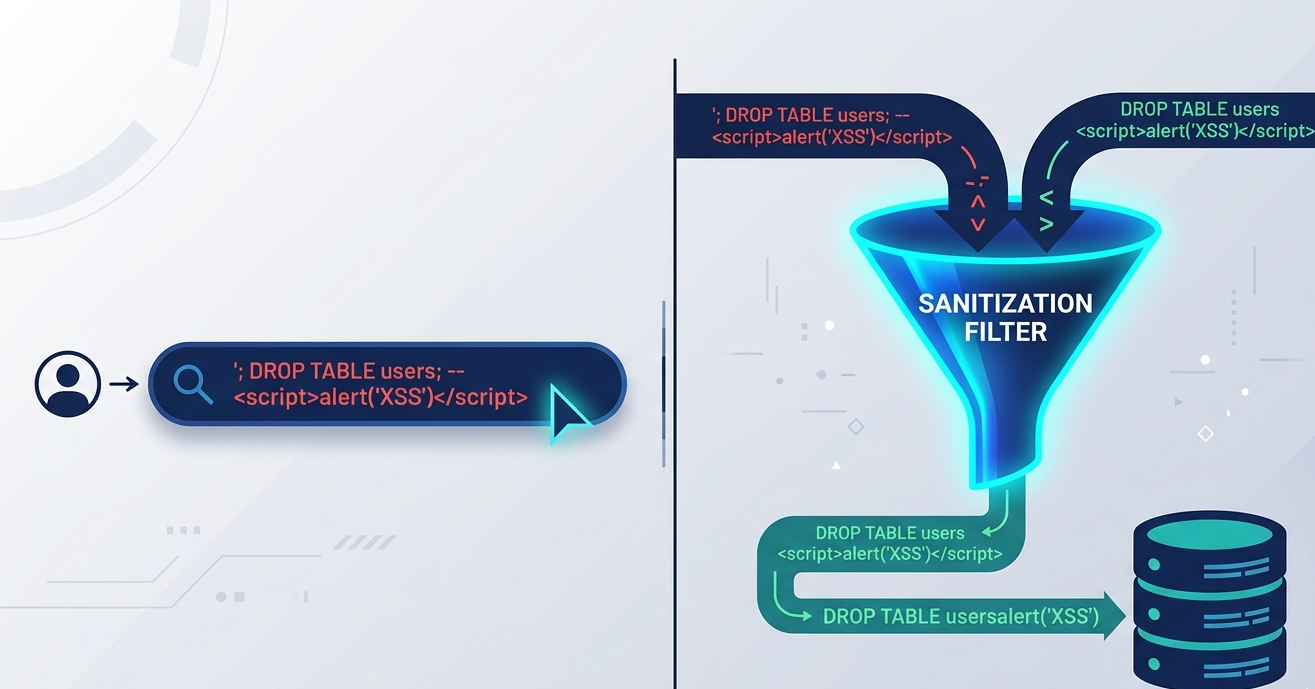

SQL injection attacks still affect many websites and applications because unsafe user input handling remains common. Small coding mistakes can expose sensitive database information and create major security risks.
In our experience, developers reduce many vulnerabilities by handling input more carefully and using safer query methods. This article explains practical ways of escaping user input SQL correctly and improving database security in modern applications. Keep reading.
Safer Input Handling Starts With Better Coding Habits
Database security depends heavily on how applications process user input.
- Unsafe input handling can expose databases
- Escaping helps reduce malicious query manipulation
- Secure Coding Practices supports safer development workflows
What Does Escaping User Input Mean?
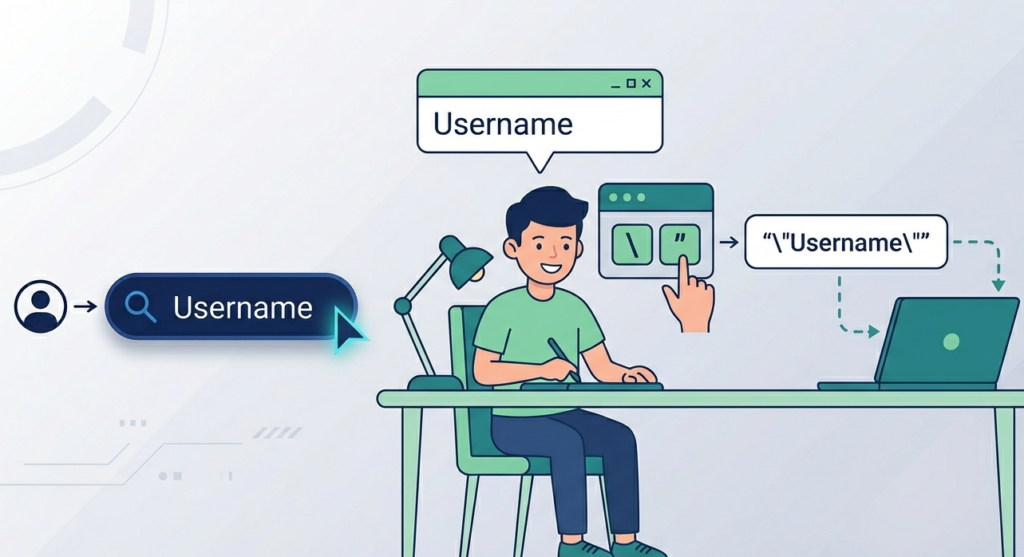
Escaping user input means treating special characters safely before sending data into SQL queries.
Special characters may include:
- Single quotation marks (‘)
- Double quotation marks (“)
- Semicolons (;)
- Comment symbols (–)
- Escape characters (\)
The goal is to prevent databases from interpreting user input as executable SQL commands.
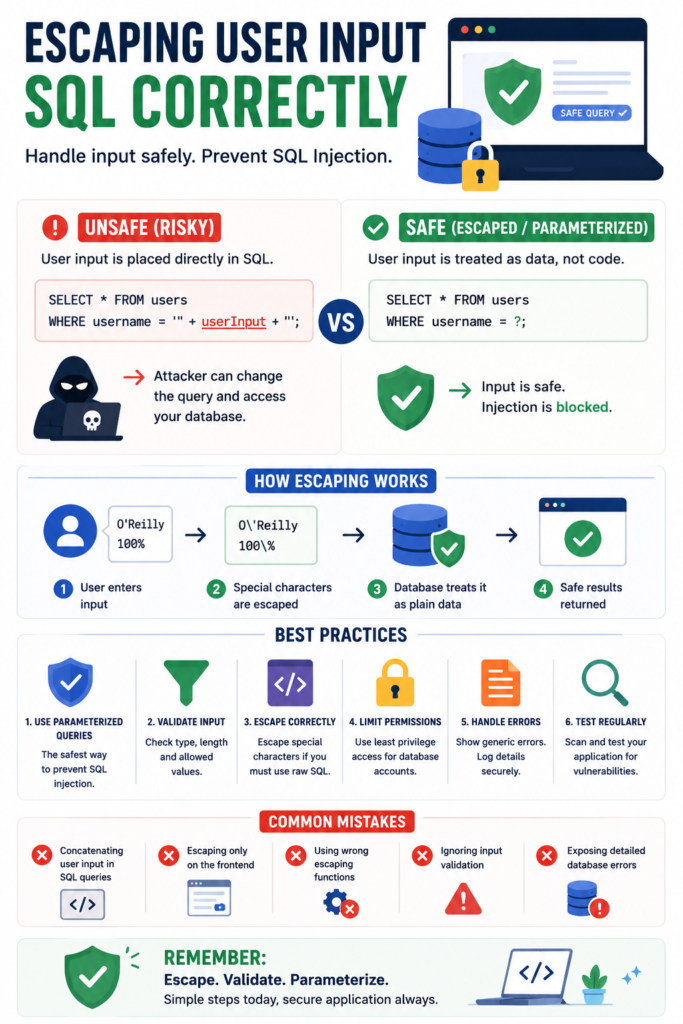
Unsafe example:
SELECT * FROM users WHERE username = ‘userInput’;
Without protection, attackers may manipulate the query structure and gain unauthorized database access.
Why Escaping Alone Is Not Enough
Escaping user input can help reduce risk, but it should not be the only security method.
“Escaping or filtering functions are often insufficient because they rely on an exhaustive list of ‘bad characters’ or patterns, which can often be bypassed using different character encodings or database-specific syntax.” – CWE. Mitre
Limitations include:
- Different databases handle escaping differently
- Incorrect implementation may still allow attacks
- Dynamic SQL queries remain risky
- Human error can create inconsistencies
We regularly observe that applications relying only on escaping techniques often remain vulnerable, which is why understanding SQL injection and its various bypass methods is critical for defense.
Parameterized Queries Provide Stronger Protection
Parameterized queries separate SQL commands from user-provided data.
“The use of prepared statements (with parameterized queries) is the most effective defense against SQL injection, as it ensures that the interpreter treats the user-supplied data as content rather than as part of the SQL command.” – Cheatsheetseries
Safer example:
SELECT * FROM users WHERE username = ?;
Benefits include:
- Preventing query manipulation
- Treating user input as data only
- Reducing developer mistakes
- Improving database consistency
In many real-world applications, implementing parameterized queries to prevent unauthorized command execution significantly improves security and reduces injection exposure.
Input Validation Still Matters
Credits: quidsup
Validation helps block malicious or unexpected data before it reaches the database.
Helpful validation methods:
- Limiting input length
- Checking expected formats
- Using allowlists
- Rejecting malformed characters
- Sanitizing user-generated content
We often notice stronger application security when validation happens on both frontend and backend systems instead of depending on browser-side controls alone.
Common Mistakes When Escaping User Input SQL Correctly
Some applications remain vulnerable because developers apply escaping inconsistently.
Frequent mistakes include:
- Mixing escaped and raw queries
- Trusting ORM defaults completely
- Ignoring API parameter validation
- Using unsafe string concatenation
- Exposing database error messages
| Common Mistake | Security Risk | Better Practice |
| Raw SQL Concatenation | SQL injection exposure | Use parameterized queries |
| Weak Validation | Malicious input accepted | Validate all input |
| Unsafe Error Messages | Information leakage | Use generic errors |
| Overprivileged Accounts | Larger attack impact | Apply least privilege |
ORM Frameworks and Escaping Risks
ORM frameworks reduce direct SQL usage, but maintaining ORM SQL injection protection requires developers to maintain secure coding habits even when using abstraction layers.
Risks may appear through:
- Raw query execution
- Dynamic filtering logic
- Unsafe custom SQL
- Weak API validation
Benefits of ORM systems:
- Cleaner query management
- Reduced manual SQL handling
- Faster development workflows
However, secure coding remains essential because ORMs cannot automatically protect unsafe custom implementations.
Secure Error Handling Improves Protection
Detailed database errors may help attackers understand application weaknesses.
Safer practices include:
- Displaying generic error messages
- Logging technical details internally
- Restricting debug access
- Monitoring failed query attempts
During security reviews, we frequently find exposed SQL errors that simplify exploitation attempts. Proper error handling reduces information leakage and limits attacker visibility.
Database Permission Management

Applications should only receive the minimum database permissions necessary.
Important security practices:
- Use least privilege access
- Separate administrative accounts
- Restrict modification permissions
- Review database access regularly
Overprivileged accounts often increase damage during successful attacks. Limiting access helps reduce the impact of compromised applications.
FAQ
What does escaping user input SQL correctly mean?
It means safely handling special characters in user input so databases do not interpret them as executable SQL commands.
Is escaping user input enough to stop SQL injection?
No. Escaping helps reduce risk, but parameterized queries and validation provide much stronger protection.
Why are parameterized queries safer?
Parameterized queries separate SQL commands from user data, preventing attackers from manipulating database queries.
Can ORM frameworks fully prevent SQL injection?
No. ORMs reduce risk, but unsafe raw queries and poor validation can still create vulnerabilities.
Building Safer Applications With Better Input Security
Stronger input security requires a layered defense. While proper escaping is a start, true resilience comes from combining parameterized queries, strict validation, and least-privilege permissions. Integrating these habits into your daily workflow ensures security is built-in, not bolted on.
Ready to move beyond basic techniques? The Secure Coding Practices Bootcamp offers hands-on labs covering the OWASP Top 10, encryption, and more to help you ship safer code. Join the Bootcamp.
References
- https://cwe.mitre.org/data/definitions/89.html
- https://cheatsheetseries.owasp.org/cheatsheets/SQL_Injection_Prevention_Cheat_Sheet.html