


Understanding How Parameterized Queries Prevent Sql Injection is critical for developers safeguarding modern web applications. At Secure Coding Practices, security architects emphasize that keeping executable logic separate from user-supplied data completely neutralizes malicious injection vectors.
By implementing robust database abstraction standards before production deployment, engineering teams ensure resilient backend operations and eliminate critical database vulnerabilities across all distributed services.
Core Mechanisms Behind Database Injection Defense
Adopting secure data handling strategies ensures database interactions remain completely isolated from untrusted user inputs.
- Pre-compiling query structures stops malicious payloads from altering execution paths.
- Treating inputs strictly as parameters eliminates raw string concatenation risks.
- Enforcing strict type checking guarantees reliable backend data processing under load.
How Does Understanding How Parameterized Queries Prevent Sql Injection Protect Modern Databases?
Modern web applications constantly face sophisticated threats, with database injection remaining one of the most perilous vectors for enterprise data breaches. When developers thoroughly understand How Parameterized Queries Prevent Sql Injection, they can fundamentally change how backend database management systems handle incoming user requests.
Traditional query building often relies on dynamic string concatenation, which inadvertently gives malicious users a direct path to execute arbitrary database commands. By shifting to a parameterized approach, the underlying database engine evaluates user-supplied data strictly as literal values rather than executable code instructions. This architectural separation stops injection attacks entirely.
How Does Knowing How Parameterized Queries Prevent Sql Injection Transform Backend Defense?
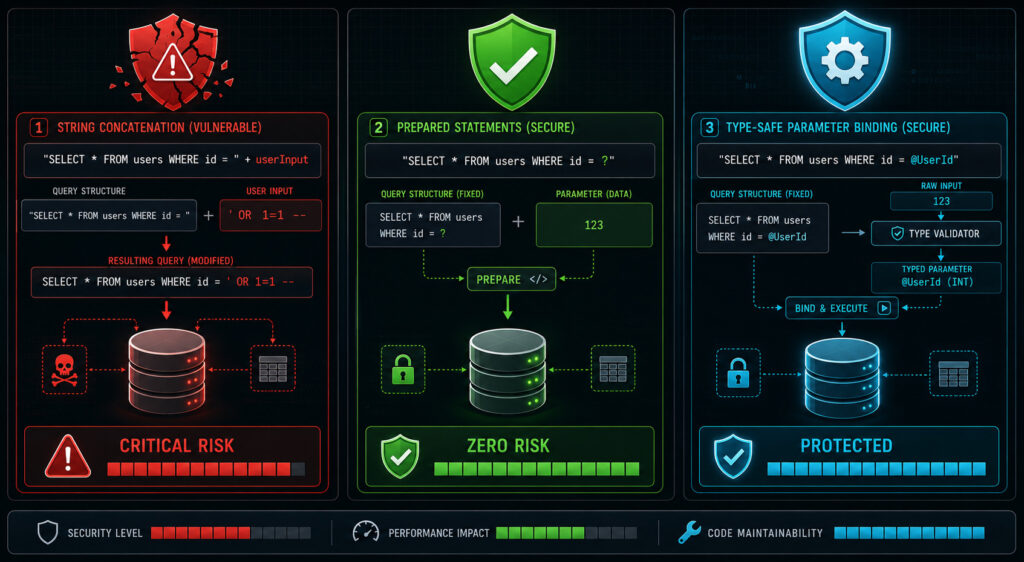
When designing secure software, development teams must thoroughly understand How Parameterized Queries Prevent Sql Injection to eliminate severe security flaws across their infrastructure. For a broader overview of foundational database safety measures, check out our comprehensive guide on parameterized queries for db security to elevate your organization’s implementation standards.
| Attack Vector | Vulnerable Approach | Secure Approach | Risk Level |
| SQL Injection | String Concatenation | Prepared Statements | Critical vs Zero |
| Data Manipulation | Direct Input Execution | Type-Safe Parameter Binding | High vs Safe |
| Schema Exfiltration | Dynamic SQL Building | Compiled Execution Plans | Severe vs Protected |
What Does Architectural Research Reveal About How Parameterized Queries Prevent Sql Injection?
Engineering vulnerability reports consistently highlight that structural flaw exploitation stems from mixed command-and-data contexts. Analyzing How Parameterized Queries Prevent Sql Injection demonstrates why security architects prioritize native binding mechanisms over custom string sanitization routines.
Standardized vulnerability frameworks emphasize the critical nature of keeping execution syntax completely isolated:
“To prevent SQL injection, applications must separate the query structure from user data through proper parameterization, ensuring user input is never interpreted as executable code.” – MITRE Common Weakness Enumeration (CWE-89)
How Does Exploring the Benefits of Parameterized Queries Support Secure Development?
Recognizing How Parameterized Queries Prevent Sql Injection goes hand in hand with measuring overall application performance gains. To dive deeper into optimization metrics and defensive advantages, review our dedicated guide on benefits parameterized queries security performance to maximize backend efficiency.
- Pre-compiled execution plans minimize database processing overhead for repetitive queries.
- Standardized bindings eliminate the performance cost of complex custom sanitization functions.
- Consistent syntax structures simplify code maintenance across enterprise development teams.
What Do Security Standards Recommend Regarding How Parameterized Queries Prevent Sql Injection?
Credits: Vickie Li Dev
Industry-standard cybersecurity frameworks consistently highlight that relying on proper database abstraction layers effectively shields backend systems from malicious tampering. Understanding How Parameterized Queries Prevent Sql Injection helps development teams build resilient applications that withstand complex injection vectors.
Global security organizations outline explicit architectural recommendations for robust database defense:
“Parameterization ensures that the database treats user input strictly as data and never as executable code, completely neutralizing injection threats.” – OWASP SQL Injection Prevention Cheat Sheet
How Does Testing Prove How Parameterized Queries Prevent Sql Injection?
Validating database security configurations requires rigorous testing protocols to ensure that custom application code properly leverages How Parameterized Queries Prevent Sql Injection under various stress conditions. Automated verification frameworks help engineering teams catch potential structural flaws before code ever reaches production environments.
- Simulating automated SQL injection attacks verifies that parameter bindings block malicious input manipulation.
- Inspecting database execution logs confirms that query structures remain strictly isolated from user values.
- Reviewing unit test coverage ensures no legacy dynamic string concatenations remain in active code paths.
How Does Eliminating Dynamic SQL Enhance How Parameterized Queries Prevent Sql Injection?
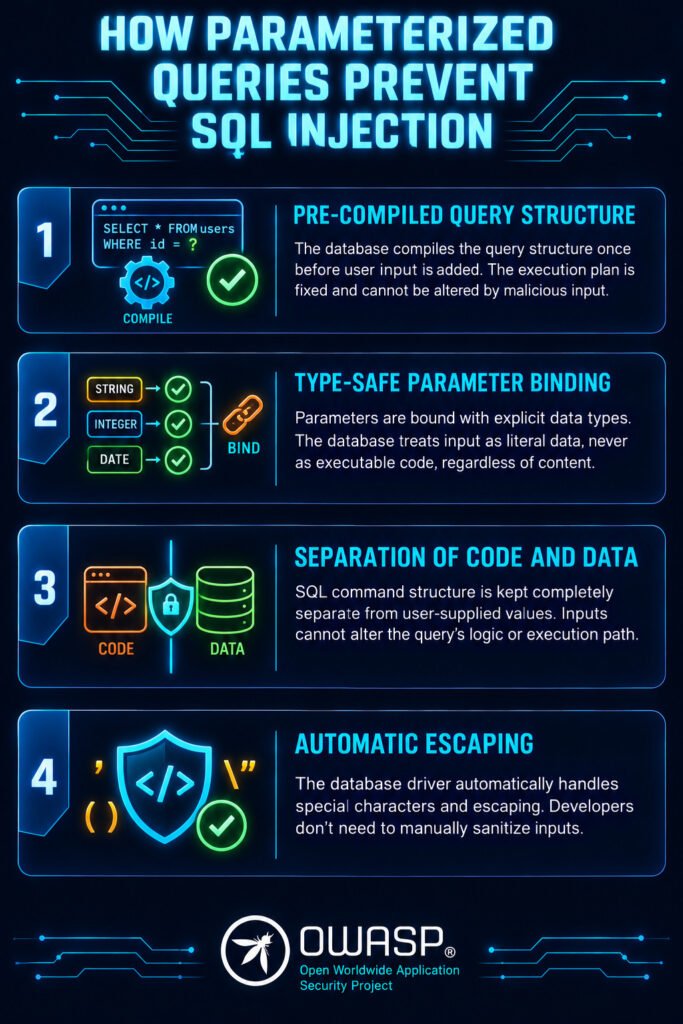
When engineering teams transition away from risky runtime string concatenation, they significantly strengthen their overall backend defensive posture. For practical strategies on purging hazardous patterns from your codebase, review our technical guide on avoiding dynamic sql query construction to ensure your database operations align with modern security standards while leveraging How Parameterized Queries Prevent Sql Injection effectively.
Complete reliance on secure query parameters ensures that even if malicious input enters the system, the underlying database interpreter treats it safely as literal data rather than command syntax. This fundamental architectural shift eliminates the primary vulnerability window traditionally exploited by malicious actors.
Maintaining clean database interaction standards protects the entire application stack.
- Removing runtime string interpolation stops malicious inputs from altering core database logic.
- Standardized query templates reduce the likelihood of developer implementation errors during feature development.
- Consistent type enforcement prevents unexpected type-casting exploits during runtime query execution.
FAQ
How does understanding how parameterized queries prevent sql injection help developers write safer code?
It helps developers recognize the critical distinction between query structure and user data, ensuring they never use vulnerable string concatenation when building database queries.
Can parameterized queries protect against all types of database attacks?
While they completely neutralize SQL injection vulnerabilities by treating input as literal data, applications must still implement proper authentication, authorization, and input validation for comprehensive security.
Why do legacy applications still use vulnerable dynamic SQL instead of parameters?
Legacy systems often rely on older architectural patterns built before modern secure coding standards became mandatory, requiring systematic refactoring to adopt native parameter binding.
Do object-relational mapping tools automatically utilize parameterized queries?
Most modern ORM frameworks use prepared statements and parameter binding by default for built-in operations, but developers must remain cautious when writing custom raw SQL queries.
How can teams verify that their implementation of parameter binding is effective?
Engineering teams can use automated security scanners, static code analysis tools, and comprehensive penetration testing to verify that all database access points are properly secured.
Master Advanced Database Defense Strategies
Mastering How Parameterized Queries Prevent Sql Injection is essential for maintaining enterprise-grade web application security and protecting sensitive backend assets from malicious actors. Development teams must systematically eliminate dynamic string concatenation, enforce strict type bindings, and integrate comprehensive automated testing into continuous integration pipelines.
Securing database architectures requires continuous technical discipline and advanced engineering expertise. To accelerate your team’s capability in building robust, resilient backend systems and mastering defensive patterns, join our secure coding bootcamp today to elevate your organization’s overall cybersecurity posture seamlessly.
References
- https://cwe.mitre.org/data/definitions/89.html
- https://cheatsheetseries.owasp.org/cheatsheets/SQL_Injection_Prevention_Cheat_Sheet.html