


Understanding the benefits parameterized queries security performance is critical for building resilient, high-throughput enterprise web systems. At Secure Coding Practices, software engineers emphasize that parameter binding provides an unbreakable defense against SQL injection by isolating executable commands from variable data.
Beyond robust defense, compiling execution plans before binding parameters enables database engines to reuse cached query plans, drastically reducing server CPU and memory overhead. Adopting parameterized architectures ensures that backend systems maintain top-tier database integrity without sacrificing operational speed or execution responsiveness.
Structural Parameterization Delivers Dual Defense and Speed Advantages
Implementing pre-compiled query templates creates an impenetrable security perimeter while unlocking massive execution efficiency for high-concurrency database environments.
- Parameter binding completely isolates SQL command syntax from incoming variable values to eliminate SQL injection risks.
- Database drivers reuse cached query execution plans to cut CPU overhead and accelerate response times across API endpoints.
- Centralized parameterization simplifies code maintenance and ensures consistent security compliance across multi-language backend architectures.
How Do Benefits Parameterized Queries Security Performance Impact Modern Software Architecture?
Parameterized queries help engineering teams build secure backend systems that handle demanding workloads. By separating SQL commands from user-supplied values, they prevent input data from being interpreted as executable SQL. Database drivers and engines handle parameter binding according to the database system and driver implementation. This separation can also support execution plan reuse, reducing query processing overhead when statements are executed repeatedly.
This structural isolation guarantees that malicious input streams are treated purely as inert data literals, preventing unauthorized execution. From an operational perspective, pre-compiling query structures enables database servers to cache execution plans and reuse them across thousands of concurrent requests.
Rather than re-parsing dynamic SQL strings on every transaction, the database engine simply binds new input values directly into memory. This drastically reduces CPU utilization, decreases query latency, and stabilizes memory usage during high-traffic spikes. Furthermore, adopting a unified parameterization model simplifies technical maintenance and eliminates complex string sanitization routines across development pipelines.
Engineering teams no longer need to maintain fragile escaping logic or worry about character encoding mismatches breaking application security. The resulting architecture delivers deterministic security protection while maximizing database processing throughput.
What Key Advantages Distinguish Parameterized Queries From Legacy Concatenation?
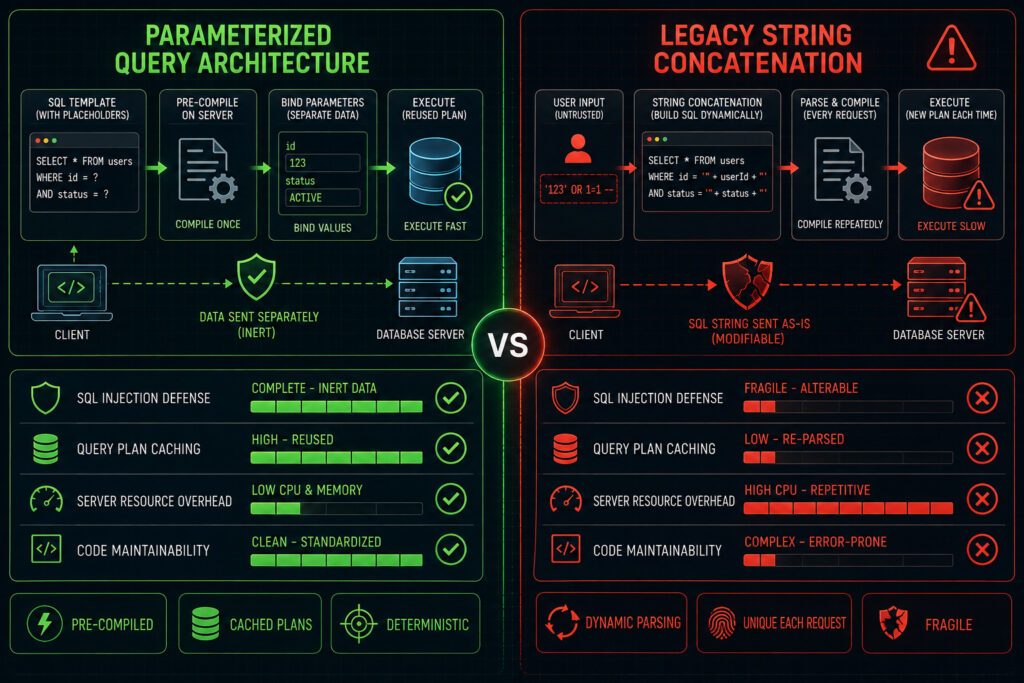
Parameterized queries improve database security by separating SQL commands from user-supplied values, reducing the risk of SQL injection. They can also improve performance when database systems reuse execution plans, though the benefits depend on the database engine and query patterns.
By contrast, concatenating raw user input into SQL statements can expose applications to malicious queries and add unnecessary processing overhead. These differences make parameterized queries for database security an important consideration when designing secure, efficient database access layers.
By implementing strict parameter binding, application layers communicate intent to the database driver before applying user inputs. The table below compares how parameterized architectures outperform legacy query concatenation across critical operational dimensions:
| Architectural Dimension | Parameterized Query Architecture | Legacy String Concatenation |
| SQL Injection Defense | Complete; inputs are treated strictly as inert data literals | Fragile; user input can alter executable SQL command logic |
| Query Plan Caching | High; execution plans are pre-compiled and reused efficiently | Low; database parsers must re-compile dynamic strings repeatedly |
| Server Resource Overhead | Low CPU and memory footprint under heavy concurrent traffic | High CPU utilization caused by repetitive statement parsing |
| Code Maintainability | Clean, standardized driver APIs across multi-tier backend code | Complex, error-prone manual escaping and sanitization routines |
Why Do Global Security Frameworks Standardize on Query Parameterization?
Global application security standards recommend query parameterization because it separates SQL commands from user-supplied values, helping prevent SQL injection. This consistent approach allows development teams to handle untrusted input more safely across applications and programming environments.
When applications build SQL statements by concatenating user input directly into query strings, malicious input can alter the intended commands. This creates opportunities for SQL injection, potentially exposing sensitive records or allowing unauthorized database operations.
With parameterized queries, the database handles SQL structure separately from the values supplied at execution time. This separation helps prevent user input from being interpreted as executable SQL. It also supports consistent database access patterns across multi-tenant systems and can improve efficiency when statements are reused. However, parameterization does not eliminate every database security risk, so applications still need appropriate access controls and other safeguards.
Global application security resources consistently point developers toward parameterization examples across various programming environments:
“The Bobby Tables site (inspired by the XKCD webcomic) has numerous examples in different languages of parameterized Prepared Statements and Stored Procedures.” – OWASP Query Parameterization Cheat Sheet
How Do Pre-Compiled Query Templates Neutralize Injection Payloads?
Pre-compiled query templates help prevent SQL injection by keeping SQL commands separate from user-supplied values. The database processes input as data rather than executable SQL, making it harder for malicious payloads to alter the query’s intended logic. Depending on the database engine and driver, reusing prepared statements may also reduce query parsing overhead.
Database drivers handle parameter values separately from SQL syntax, so user input cannot change the intended query structure when parameters are used correctly. This separation is explained in how parameterized queries prevent SQL injection, including how the approach protects applications across different backend environments.
The database engine maps variable values directly into memory placeholders without re-evaluating the surrounding query syntax. Consequently, even if an input contains complex SQL operators or multi-byte characters, the database evaluates the payload strictly as a literal data value.
- Pre-compiled query templates freeze structural command logic before user values are evaluated by the database driver.
- Dedicated binary transport protocols prevent untrusted inputs from altering the intended SQL execution tree.
- Automated parameter binding eliminates the need for complex, error-prone manual string escaping routines.
How Does Pre-Compilation Accelerate High-Volume Query Execution?
Credits: Vickie Li Dev
Pre-compiling queries can improve performance by reducing repeated parsing and planning when database systems reuse prepared statements or execution plans. This can be particularly helpful when applications execute similar queries frequently with different parameter values. The actual performance gains depend on the database engine, driver, and query workload. Parameterization also helps prevent SQL injection by keeping user-supplied values separate from SQL commands.
This architecture allows high-throughput backend applications to execute identical statement logic repeatedly while substituting parameter values in memory. Pre-compiling statement templates removes the CPU-intensive parsing and optimization phases from subsequent query requests.
The database engine caches the compiled execution path, binding incoming variable values directly to memory placeholders without re-evaluating query semantics. This optimization significantly reduces latency and minimizes database server memory fragmentation under heavy concurrent loads.
Enterprise database driver specifications explicitly define how pre-compilation unlocks performance gains across backend runtime environments:
“A SQL statement is precompiled and stored in a PreparedStatement object. This object can then be used to efficiently execute this statement multiple times.” – Oracle JDBC PreparedStatement API Documentation
Can Parameterized Queries Reduce Server Overhead?
Parameterized queries can reduce server overhead when database systems reuse prepared statements or execution plans across multiple requests. By separating SQL commands from user-supplied values, applications can avoid rebuilding query strings for every request. In contrast, dynamic SQL string concatenation may require repeated parsing and compilation, depending on the database engine and its query plan caching mechanisms. This can increase CPU usage and processing time, particularly when applications execute similar queries frequently.
In contrast, parameterized queries allow database engines to compile the SQL template once and reuse the cached execution plan across thousands of concurrent transactions by simply binding new variables into memory placeholders.
- Compiling SQL templates once eliminates repetitive query parsing overhead on primary database nodes.
- Reusing execution plans accelerates response times across high-concurrency API endpoints and backend microservices.
How Do Modern Runtime Languages Implement Parameterized Queries Safely?
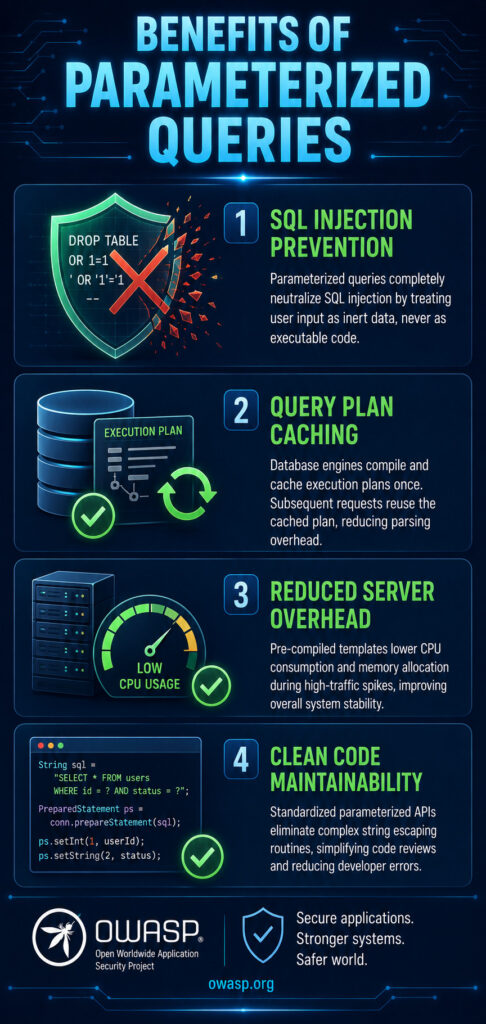
Native parameter binding helps application runtimes separate SQL commands from user-supplied values, reducing the risk of SQL injection while supporting consistent database operations. Whether building high-concurrency microservices in Java or dynamic web applications in PHP, developers can use prepared statements to handle variable inputs without mixing them with SQL logic.
The implementation differs across languages and frameworks, as shown in prepared statements in Java and PHP. These practices also support the security and performance benefits of parameterized queries, helping teams apply consistent database interaction patterns across applications without relying on ad hoc input sanitization.
Modern database drivers utilize binary transport protocols that transmit SQL statement structures and variable parameters over distinct communication channels. When an application executes a query, the database server compiles the statement template into an execution plan before binding the parameter data into isolated memory placeholders.
This structural separation prevents user inputs from modifying the underlying SQL logic, effectively neutralizing SQL injection risks regardless of character encodings or unusual input payloads.
Standardizing native prepared statement implementation across engineering teams establishes a deterministic defense strategy that simplifies technical maintenance and enhances runtime efficiency.
- Native driver APIs isolate query execution logic from parameter payloads across enterprise application architectures.
- Pre-compiled templates eliminate character set bypass vulnerabilities commonly associated with legacy string escaping functions.
- Reusing cached query execution plans lowers CPU consumption and speeds up response times during heavy traffic spikes.
FAQ
How do parameterized queries enhance database security?
Parameterized queries isolate executable SQL statements from variable inputs by pre-compiling the command template before binding user parameters. This structural separation ensures that untrusted data is evaluated strictly as literal values rather than executable code, eliminating SQL injection vulnerabilities.
Do parameterized queries improve database performance under heavy loads?
Yes, database engines compile and cache the execution plan for a parameterized template once. Subsequent requests with different parameters reuse the cached plan, drastically reducing CPU overhead and memory allocation during peak traffic periods.
What is the difference between string escaping and query parameterization?
String escaping modifies input strings by inserting escape characters before concatenating them into dynamic SQL statements, which can be bypassed using encoding tricks. Query parameterization transmits templates and values over separate channels, providing a deterministic security guarantee.
Are parameterized queries supported natively by modern ORMs and database drivers?
Nearly all modern database drivers, abstractions, and Object-Relational Mapping (ORM) frameworks support and automatically enforce parameter binding when query parameters or literal value wrappers are utilized in application code.
Do parameterized queries protect against all types of web vulnerabilities?
Parameterized queries completely solve SQL injection at the database layer. However, web applications must still implement additional defense-in-depth measures such as input validation, output encoding, and proper access controls to guard against Cross-Site Scripting (XSS) and broken authorization flaws.
Building High-Performance Database Systems With Secure Parameterization
Parameterized queries help protect databases from SQL injection by keeping SQL commands separate from user-supplied values. They can also reduce processing overhead when database systems reuse prepared statements or execution plans, though the performance gains depend on the database engine and workload.
Dynamic SQL string concatenation can expose applications to injection risks when untrusted input is inserted directly into query strings. Using parameter binding across backend services helps prevent this by treating supplied values as data rather than executable SQL.
Engineering teams should make parameterized queries a standard part of secure database development. To strengthen your team’s practical skills, join our secure coding bootcamp and learn how to apply secure coding techniques in real-world applications.
References
- https://cheatsheetseries.owasp.org/cheatsheets/Query_Parameterization_Cheat_Sheet.html#references
- https://docs.oracle.com/javase/8/docs/api/java/sql/PreparedStatement.html