
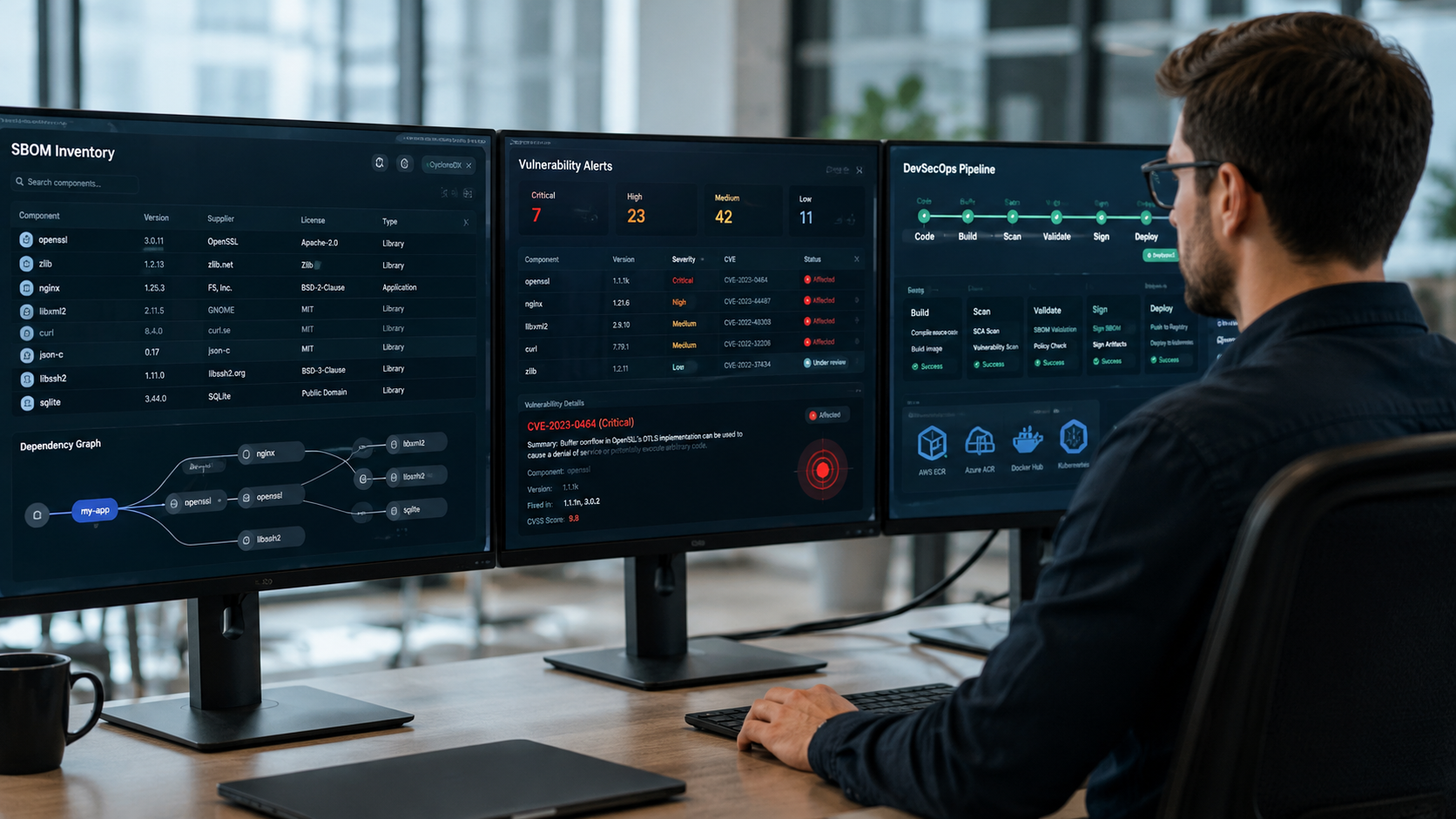

Creating software bill materials SBOM gives organizations a clear inventory of the software components, dependencies, and licenses within an application, making it easier to identify security risks and respond to new vulnerabilities. Instead of treating an SBOM as a compliance document, many teams now use it to strengthen software supply chain security and improve visibility across development.
At Secure Coding Practices, we encourage integrating SBOM generation into secure development workflows so it remains accurate and useful throughout the software lifecycle. Keep reading to learn practical steps for creating an SBOM that delivers lasting security value beyond compliance.
SBOM Snapshot: Security Wins at a Glance
A well-managed SBOM is more than an inventory, it becomes a practical security tool that helps teams understand their software, respond to vulnerabilities faster, and support secure releases throughout the development lifecycle.
- Build SBOMs into development workflows. Generate, validate, sign, and update SBOMs automatically as part of every release instead of creating them only for compliance.
- Maintain complete software visibility. Include direct and transitive dependencies, suppliers, versions, and metadata to improve vulnerability management and incident response.
- Combine SBOMs with secure development practices. Integrating Secure Coding Practices, governance, and DevSecOps automation keeps SBOMs accurate, useful, and aligned with real security needs.
What Should You Know Before Creating an SBOM?

An effective SBOM identifies software components, suppliers, dependency relationships, versions, and metadata using standardized formats such as CycloneDX or SPDX.
The beginning with an understanding of what software composition analysis is and how it improves visibility into application dependencies. Teams that focus on writing secure code and using repeatable build processes usually create cleaner and more accurate SBOMs.
Most modern applications depend on far more code than many developers realize. A single project may include hundreds or even thousands of direct and indirect dependencies. An SBOM gives development and security teams a clear view of what is inside every release, making later investigations much easier.
An SBOM is not limited to application packages. It can also describe container images, firmware, embedded systems, IoT devices, operating systems, cloud workloads, libraries, and complete software releases. The wider the visibility, the easier it becomes to manage software risk throughout the product lifecycle.
Every successful implementation starts with a clear scope.
- Inventory every software component.
- Capture direct and transitive dependencies.
- Record suppliers and versions.
- Include creation metadata.
- Choose a standardized SBOM format.
We have found that teams spend far less time fixing inventory gaps when they agree on the scope before automating SBOM generation.
Why is an SBOM often compared to an ingredient list?
People often compare an SBOM to an ingredient label because both explain what is inside something that is already packaged. The comparison is useful, but an SBOM goes much further. It records relationships between components, tracks dependency chains, and identifies where each package came from.
That extra detail becomes valuable during vulnerability investigations. When a security issue affects a widely used library, teams do not have to search every project by hand. They can quickly identify affected applications, including software that depends on vulnerable packages indirectly.
We regularly demonstrate this during secure development workshops, and it usually surprises participants how many hidden dependencies exist in even small applications.
Which software artifacts should receive an SBOM?
Organizations gain the most value when they create SBOMs for every release that reaches production, not only their primary application.
Common examples include:
- Applications
- Container images
- Operating system packages
- Microservices
- Release bundles
- Firmware
- Kubernetes workloads
Each of these changes over time. Keeping SBOMs current makes vulnerability management, incident response, and software updates much easier than relying on outdated inventories.
Why Are SBOMs Becoming a Standard Requirement?
Credits: CNCF [Cloud Native Computing Foundation]
Software supply chain attacks have changed how organizations think about transparency. Customers, regulators, and security teams now expect vendors to understand exactly what is included in every software release. An SBOM helps answer those questions quickly instead of relying on spreadsheets or manual records.
We have also seen expectations change during secure development training. Several years ago, most discussions focused on compliance. Today, teams ask how an SBOM can improve vulnerability response, automate security checks, and support continuous delivery. Organizations want tools that help them work faster, not documents that sit untouched after an audit.
Major supply chain incidents showed why visibility matters. During events like Log4Shell, organizations with reliable component inventories could identify affected systems much faster than those searching through source code and deployment records. Faster visibility often meant faster remediation, reduced downtime, and lower business risk.
| Event | Why it mattered |
| Log4Shell | Exposed hidden vulnerable libraries quickly. |
| Supply chain attacks | Increased focus on software transparency. |
| Procurement requirements | Made SBOM delivery more common. |
| Security audits | Encouraged continuous inventory tracking. |
An SBOM also supports communication between development, operations, and security teams. Everyone works from the same inventory instead of maintaining separate records, reducing confusion during high-pressure incidents.
Why do customers now request SBOMs?
Customers increasingly expect software vendors to provide more transparency. Before approving a product, many organizations want proof that software components can be identified, tracked, and reviewed throughout the development lifecycle.
Common reasons include:
- Vendor risk assessments
- Regulatory compliance
- Faster vulnerability analysis
- Third-party software reviews
- Better software transparency
From our experience, customers are not asking for an SBOM only because regulations encourage it. They also want confidence that their vendors understand what they are shipping and can respond quickly if a new vulnerability appears.
How Do You Create an SBOM That Supports Security?
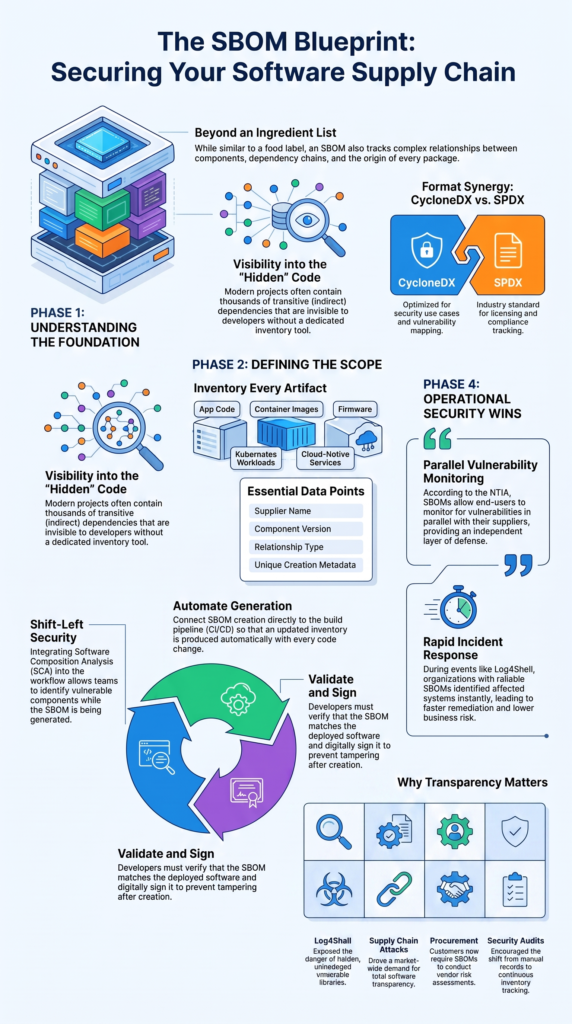
Creating an SBOM is not difficult, but making it useful takes planning. Many teams generate one at the end of a project because a customer or auditor asks for it. We encourage a different approach. Build the SBOM into the development workflow so it stays current with every release.
Automation makes a huge difference. Instead of creating inventories by hand, connect SBOM generation to the build pipeline.
Integrating Software Composition Analysis (SCA) into the same workflow helps identify vulnerable components while automatically producing an updated SBOM that reflects the software exactly. This reduces mistakes and keeps records consistent across environments.
The next step is validation. An SBOM is only valuable if the information is accurate. We teach developers to verify that dependencies, versions, and suppliers match the software being deployed. It also helps to sign the SBOM so teams can confirm it has not been changed after it was created.
Good practices include:
- Generate SBOMs automatically.
- Validate every release.
- Sign important artifacts.
- Store previous versions.
- Review updates regularly.
An SBOM should grow with the software. When it becomes part of the release process, security teams spend less time collecting information and more time responding to real risks.
How Does an SBOM Improve Vulnerability Management?
Finding vulnerable software is one of the biggest reasons organizations invest in SBOMs. Without an accurate inventory, every new security advisory turns into a manual search. That slows response times and increases the chance.
With an SBOM, teams can compare software components against known vulnerabilities much faster. Instead of asking, “Do we use this library?” they already have the answer. That allows security teams to focus on assessing risk and planning updates rather than hunting through projects.
We often demonstrate this during training using sample applications with dozens of hidden dependencies. Most developers recognize the packages they added directly, but many are surprised by the number of indirect dependencies installed automatically. Those transitive dependencies can introduce risk even when developers never interact with them directly.
Research from NTIA demonstrates
“One of the biggest differences and greatest sources of value for SBOMs is the ability for end users to monitor vulnerabilities in parallel with whatever vulnerability management is conducted by the supplier.” – NTIA
An SBOM also supports ongoing monitoring. As new vulnerabilities are disclosed, organizations can continuously compare existing inventories against updated security databases. This approach reduces response time and helps prioritize fixes based on actual exposure instead of guesswork.
How Can DevSecOps Make SBOM Management Easier?

An SBOM delivers the most value when it fits naturally into everyday development. That is why many organizations include it as part of their DevSecOps pipeline instead of treating it as a separate task after development is complete.
Every code change can trigger dependency analysis, SBOM generation, validation, and security scanning without requiring extra manual work. Understanding how SCA tools work makes it easier to integrate these automated checks into the pipeline while developers continue building software and the inventory updates in the background.
As noted by NIST
“To help with that process, the NIST SSDF (SP 800-218) recommends ‘generating and publishing SBOMs for each software release.’ The SSDF calls these ‘machine-readable, SBOM data files’ to help automate the process of checking for vulnerable components.” – NIST
Our experience has shown that teams adopt SBOM practices more easily when the process feels automatic. Integrating the work into existing build and deployment pipelines keeps the process consistent and repeatable.
Organizations should also establish clear ownership. Developers create software, security teams review risk, and operations teams manage deployments. An up-to-date SBOM gives each group access to the same information, reducing confusion during releases or security incidents.
FAQ
How do I choose between CycloneDX SBOM and SPDX SBOM formats?
Both CycloneDX SBOM and SPDX SBOM are standardized SBOM formats for documenting software components. CycloneDX is designed with security use cases in mind, while SPDX is widely used for software licensing and compliance.
The right choice depends on your security goals, regulatory requirements, and existing development tools. Many organizations support both formats to meet different business and technical needs.
What are the biggest SBOM implementation challenges for development teams?
Many teams face SBOM implementation challenges such as tracking transitive dependencies, maintaining accurate metadata, and keeping inventories up to date after every release.
Strong SBOM governance and a well-defined SBOM policy help assign responsibilities and maintain consistency. Automating updates and regular reviews also improves accuracy while reducing manual effort throughout the software development lifecycle.
How do SBOM signing and verification improve software security?
SBOM signing, SBOM verification, and SBOM attestation help confirm that an SBOM has not been modified after it was created. These practices protect the integrity of software inventory data and build trust between software producers and consumers. They also strengthen SBOM security by ensuring that organizations can verify the authenticity of software releases before deployment or distribution.
Why is an SBOM important for containers, Kubernetes, and cloud-native applications?
Modern applications often rely on containers and distributed services, making SBOM for containers, SBOM for Kubernetes, and SBOM for cloud native applications essential for tracking software components. A current SBOM improves visibility into dependencies, simplifies software updates, and helps security teams identify affected workloads more quickly when new vulnerabilities are disclosed.
How does an SBOM support vulnerability management after software is released?
A current software bill of materials helps organizations quickly identify affected components when new vulnerabilities are announced.
Combining SBOM vulnerability management, SBOM and CVE mapping, and SBOM monitoring allows security teams to assess exposure, prioritize remediation, and respond faster to security incidents. This approach reduces investigation time and improves software security throughout the entire software lifecycle.
Build Security Into Every Release
An SBOM delivers real value when it’s part of everyday security, not just a compliance task. Keeping it current helps teams find risks faster, understand every release, and respond with confidence instead of searching for answers.
Take the next step with Secure Coding Practices. Learn practical secure coding and DevSecOps skills through hands-on training that helps you build safer software from day one.
References
- https://www.ntia.gov/sites/default/files/publications/software_consumers_sbom_acquisition_management_and_use_-_final_0.pdf
- https://csrc.nist.gov/pubs/sp/800/218/final