
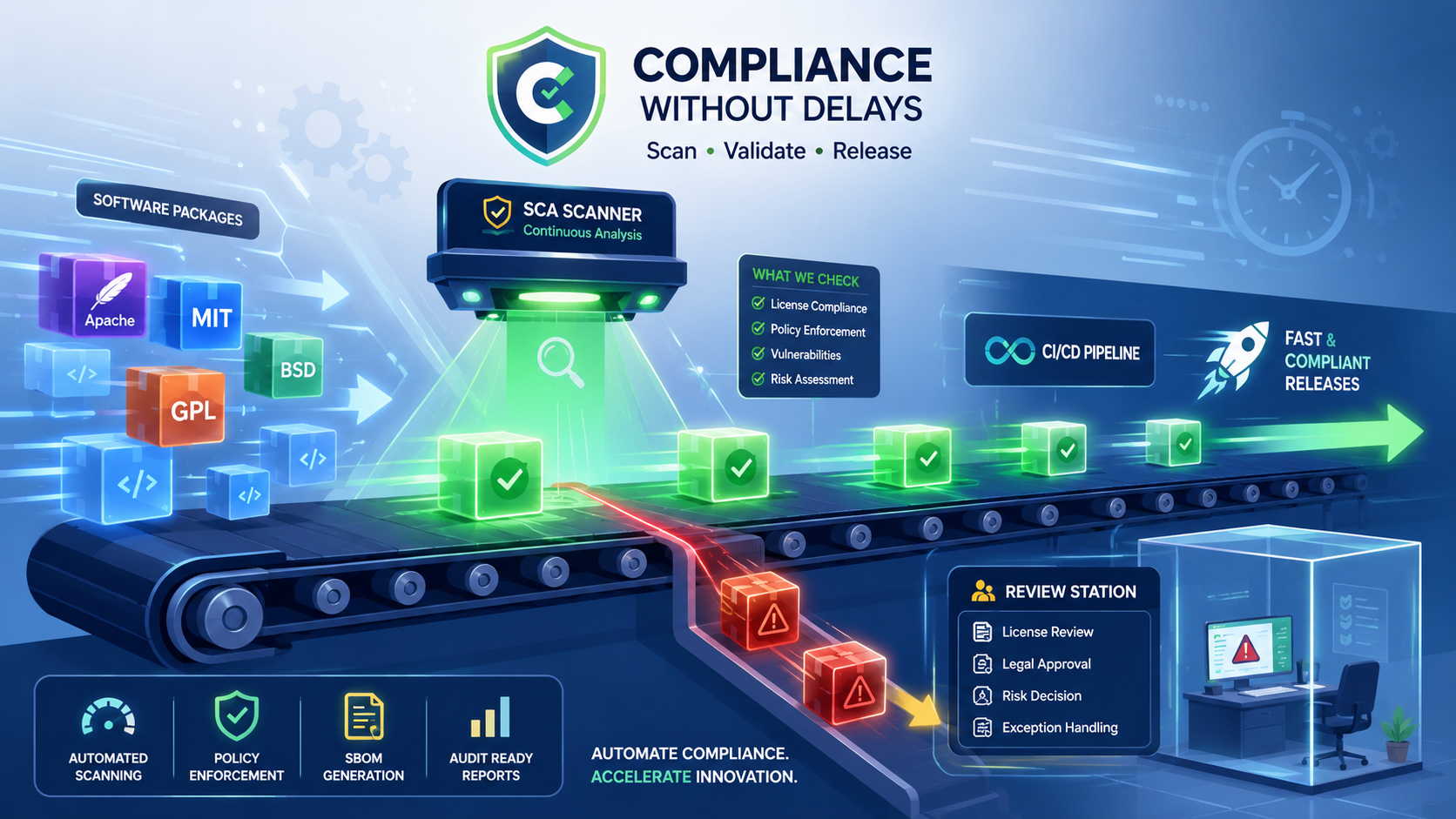

Open source license compliance SCA helps organizations identify license obligations, manage open-source dependencies, and reduce legal risk before software reaches production. Automated Software Composition Analysis (SCA) gives development teams continuous visibility into licenses, dependencies, and policy violations throughout the software lifecycle.
At Secure Coding Practices, we’ve seen that combining automation with clear governance helps teams maintain compliance without disrupting development. Keep reading to see how effective compliance programs work, where teams commonly struggle, and how to build a process that supports faster, more predictable releases.
Compliance Snapshot: The Essentials
Building an effective open source license compliance program is about making compliance part of everyday development instead of a final checkpoint. These three takeaways summarize what matters most for reducing risk while keeping software delivery efficient.
- Automate license compliance early with SCA. Continuous scanning helps identify license obligations, dependency changes, and policy violations before they delay releases.
- Combine governance with clear engineering policies. Well-defined approval processes, SBOM generation, and documented responsibilities make audits and customer reviews much easier.
- Treat compliance as part of Secure Coding Practices. Integrating compliance into the Secure SDLC helps teams reduce legal risk, improve software supply chain visibility, and deliver software with greater confidence.
What Is Open Source License Compliance?
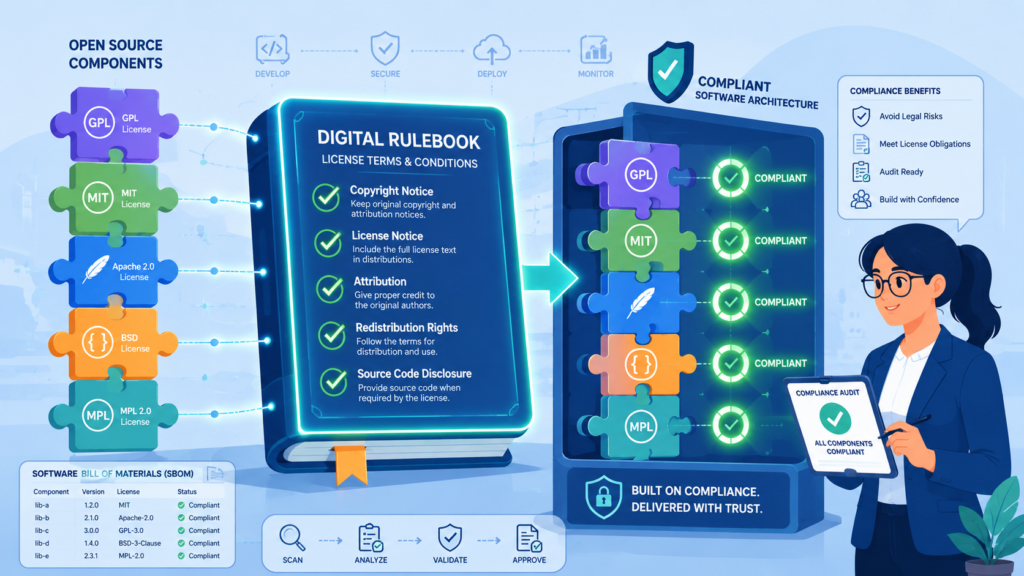
Open source license compliance means following the legal terms attached to every open-source component included in software. That sounds simple at first. But it rarely stays simple for long.
Most development teams use open-source packages every day, and those packages often bring dozens or even hundreds of additional dependencies. We’ve seen projects that began with only a few libraries but quickly expanded into large dependency trees after the first build. Without a clear process, it’s easy to lose track of what entered the project and what obligations came with it.
License compliance isn’t only about knowing whether software uses the MIT License or Apache License. Teams also need reliable license metadata, an accurate license inventory, and records showing how components were reviewed. Those details matter during customer security reviews, procurement checks, or internal audits.
Some common responsibilities include:
- Keep copyright notices.
- Include required license text.
- Preserve attribution.
- Follow redistribution terms.
- Record approved exceptions.
Our experience as a secure development training provider has shown that teams struggle less when compliance becomes part of everyday engineering instead of a rushed task before release. It’s easier to stay organized that way, and developers don’t have to guess what was added months earlier.
Why does compliance matter?
Following open source licenses helps avoid legal issues, project delays, and unnecessary rework.
We’ve worked with teams preparing software for customer reviews, and one pattern keeps showing up. The application performs well, yet the biggest questions come from documentation rather than code. Missing notice files, incomplete records, or unclear package history can slow approval even when there are no technical problems.
Good compliance also improves software quality. Teams that maintain an updated Software Bill of Materials (SBOM), review component origins, and check package licenses regularly usually have healthier software supply chains. We think that’s one of the biggest benefits because better visibility often leads to better engineering habits too.
Compliance also helps organizations:
| Benefit | Why it matters |
| Faster audits | Documents are ready. |
| Smoother releases | Fewer surprises. |
| Better governance | Clear ownership. |
| Customer trust | Easier due diligence. |
Done well, license compliance becomes another part of secure software development instead of another last-minute problem to solve.
Why Is Software Composition Analysis (SCA) Essential?
Credits: The Linux Foundation
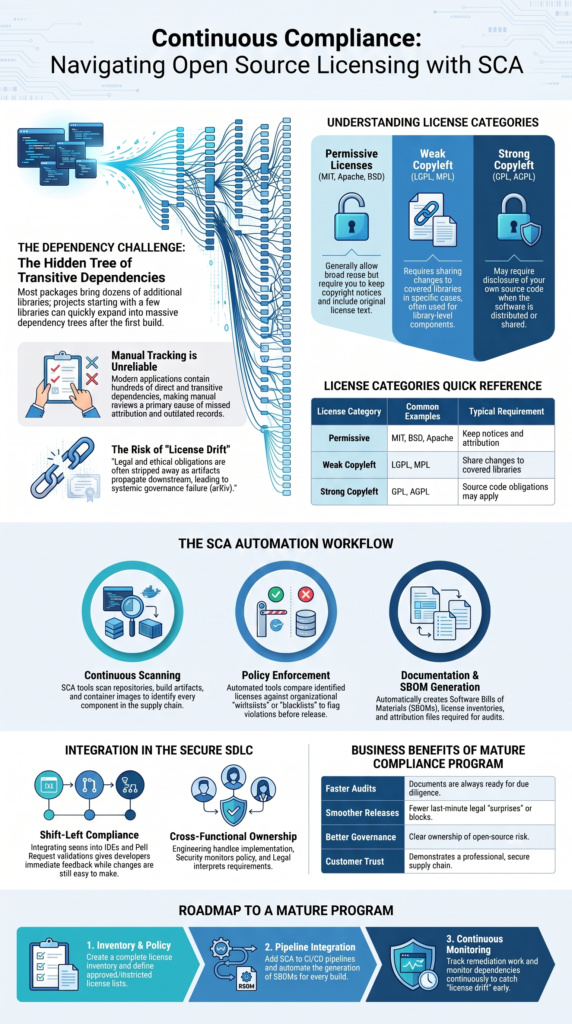
Keeping track of open-source software manually no longer works for modern applications. Even small projects often contain hundreds of direct and transitive dependencies, making manual reviews difficult to maintain.
Software Composition Analysis (SCA) automates this process by identifying components, checking license obligations, comparing them against organizational policies, and producing documentation for audits.
We’ve reviewed projects where approved libraries unexpectedly introduced additional dependencies with different licensing requirements. Those discoveries reinforced why automated scanning has become a normal engineering practice rather than a final compliance step.
A mature SCA workflow typically helps teams:
- Scan repositories, build artifacts, and container images.
- Identify direct and transitive dependencies.
- Verify license information against trusted databases.
- Generate Software Bills of Materials (SBOMs).
- Flag policy violations before release.
Continuous scanning also creates a historical record showing when dependencies were introduced, which versions were approved, and whether remediation was required.
Instead of waiting until release, developers receive immediate feedback while changes are still easy to make, reducing compliance risks and supporting a more predictable software delivery process.
Which Open Source Licenses Should You Understand?
Not every open-source license works the same way. Some give developers plenty of freedom, while others come with extra conditions that must be followed when software is shared or modified. Learning the basics makes it much easier to avoid problems later.
Most licenses fall into three broad groups: permissive, weak copyleft, and strong copyleft. We’ve noticed that many developers recognize names like the MIT License or GPL, but they’re not always sure what each one requires. That’s understandable because projects often combine many different licenses in one application.
The key is knowing what your team is responsible for before adding a new dependency.
| License Category | Common Examples | Typical Requirement |
| Permissive | MIT, BSD, Apache | Keep notices and attribution |
| Weak copyleft | LGPL, MPL | Share changes to covered libraries in some cases |
| Strong copyleft | GPL, AGPL | Source code obligations may apply when distributed |
We encourage developers to review licenses during dependency selection instead of after development is finished. That habit saves time and helps avoid difficult conversations close to release.
How do permissive licenses differ?
Permissive licenses are usually easier to work with because they allow broad reuse. But they don’t remove every responsibility.
The MIT License, BSD License, and Apache License all require organizations to keep copyright notices and include the license text when distributing software. The Apache License also includes patent language that isn’t found in every permissive license, so teams shouldn’t assume they’re all identical.
Our instructors often remind students not to stop after reading the license name. Check the details. Review the package source. Confirm the metadata matches the project. Those small reviews take very little time, yet they help prevent confusion later when customers request compliance documentation.
Understanding these differences early makes software development smoother, especially as dependency lists continue to grow.
Why Are Transitive Dependencies a Compliance Challenge?
Transitive dependencies make license compliance much more complicated than reviewing only the libraries developers intentionally install. Every package can automatically introduce dozens of additional components, each carrying its own licensing obligations and documentation requirements.
We’ve seen projects where teams believed every dependency had already been approved, only to discover unexpected packages after generating a complete license inventory. While those hidden libraries were not necessarily risky, they still required updated attribution, revised documentation, or additional legal review before release.
Managing these dependencies is difficult because package ecosystems change continuously. Updates may introduce new components, replace existing libraries, or modify license metadata without affecting application functionality.
Common challenges include:
- Hidden dependency chains.
- Mixed license types.
- Automatic package updates.
- Missing notice files.
- Outdated package records.
Manual tracking quickly becomes unreliable as dependency trees evolve, which is why effective SCA dependency management helps organizations maintain visibility across complex software supply chains.
Continuous repository scanning, artifact analysis, and automated SBOM generation provide ongoing visibility into these changes, allowing teams to focus on resolving actual compliance issues instead of manually reviewing hundreds of packages every time software is updated.
How Does License Compliance Fit Into Secure SDLC?
License compliance delivers the greatest value when it becomes part of the Secure Software Development Lifecycle (SDLC) rather than a final release activity.
Integrating automated license checks into everyday development helps developers identify issues while changes are still small and easy to resolve, reinforcing the benefits of using SCA throughout the development lifecycle as part of a mature Secure SDLC.
We’ve watched teams answer licensing questions in minutes because automated scans highlighted problems during development. The same issues, discovered shortly before release, often require documentation updates, legal reviews, and schedule adjustments that delay delivery.
An effective Secure SDLC typically includes:
- IDE dependency scanning.
- Pull request validation.
- CI/CD pipeline scanning.
- Build verification.
- Release approval gates.
- Automated policy enforcement.
Scanning repositories, dependency manifests, build artifacts, and container images throughout development provides continuous feedback instead of relying on a single review at the end of the project.
Early detection gives developers time to replace restricted packages, update documentation, or request approvals before additional work depends on those components. This proactive approach reduces compliance risk while making software releases more predictable and easier to manage.
What Policies Should Engineering Teams Create?
Automated tools improve visibility, but effective license compliance still depends on clear engineering policies. Every team should understand which licenses are approved, which require additional review, and how new dependencies are evaluated before becoming part of a project.
We’ve worked with organizations that invested in excellent scanning tools but lacked written guidance. Developers repeatedly asked the same licensing questions, approvals slowed down, and decisions became inconsistent. Once simple policies were documented, those delays were significantly reduced.
A practical policy should define:
- Approved and restricted licenses.
- Package approval procedures.
- Exception request processes.
- Documentation requirements.
- License inventory maintenance.
- Audit record retention.
- Team responsibilities.
Policies should also clearly identify who reviews new dependencies and what evidence must be retained for customer audits or internal governance. Keeping guidance practical encourages developers to follow the process rather than searching for shortcuts.
When policies are easy to understand and consistently applied, compliance becomes a routine engineering activity instead of an administrative obstacle that interrupts software development.
Who owns compliance?
License compliance isn’t one person’s job. Engineering handles implementation. Security checks that policies are followed. Legal interprets licensing requirements, while leadership decides what level of risk the organization accepts.
We’ve found the strongest programs share ownership across teams. Everyone has a role, so compliance becomes part of normal development instead of a task handed to one department.
How Do Mature Organizations Govern Open Source?
As organizations grow, open-source governance becomes more important. A few developers can manage dependencies informally, but larger engineering teams need a repeatable process that works across multiple products.
We’ve watched organizations struggle when every team follows its own approval process. One team documents everything, another keeps almost no records, and a third interprets licenses differently. That inconsistency creates confusion during audits and customer reviews.
Good governance brings everyone onto the same page without slowing development.
Many mature programs focus on:
- Clear ownership.
- Policy enforcement.
- Developer training.
- Compliance automation.
- Vendor reviews.
- Audit preparation.
Automation supports governance, but it doesn’t replace it. Someone still needs to define policies, update guidance, and help developers understand how those rules apply in real projects.
What is an OSPO?
An Open Source Program Office (OSPO) helps coordinate an organization’s approach to open-source software.
Responsibilities often include creating policies, supporting developers, reviewing compliance, improving documentation, and working with legal and security teams.
The purpose isn’t more bureaucracy.
It’s consistent. We’ve seen that organizations with clear ownership usually spend less time resolving the same licensing questions over and over.
When should companies create one?
Not every company needs a formal OSPO right away. Smaller teams can often manage compliance through documented policies and shared responsibilities.
As organizations grow, though, governance becomes much more valuable. A structured approach often makes sense when companies:
- Build multiple products.
- Work in regulated industries.
- Face regular customer audits.
- Have large engineering teams.
From our experience, governance doesn’t slow development. When it’s done well, it removes uncertainty and helps developers move forward with more confidence.
Which Industries Face Higher Compliance Expectations?
Some industries require much stronger evidence of software license compliance than others. Healthcare, financial services, government agencies, and critical infrastructure organizations often expect vendors to demonstrate that open-source software is governed through documented, repeatable processes rather than occasional license scans.
We’ve helped development teams prepare for customer security reviews where the primary focus wasn’t whether software had been scanned once, but whether compliance was continuously maintained throughout the software lifecycle. Organizations with current documentation consistently completed those reviews more efficiently.
Common compliance documentation includes:
- Software Bills of Materials (SBOMs).
- License inventories.
- Audit trails.
- Policy documents.
- Approval records.
- Risk assessments.
- Legal notices.
Maintaining these records supports both regulatory obligations and customer due diligence requirements. Even organizations outside heavily regulated industries increasingly receive requests for software supply chain documentation during procurement and vendor assessments.
Keeping documentation accurate and up to date eliminates the need to reconstruct evidence during audits while demonstrating that software components are managed through consistent governance practices rather than informal review processes.
What Are Common License Compliance Mistakes?
Most license compliance problems develop gradually as software evolves rather than from intentionally ignoring licensing requirements. Documentation often falls behind package updates, while dependency changes introduce new obligations until automated scans identify them.
We’ve reviewed projects where trusted libraries appeared fully compliant, only for later scans to uncover missing attribution, outdated license records, or previously unnoticed transitive dependencies. Although these issues were generally straightforward to fix, they still delayed releases and increased review effort.
Common compliance mistakes include:
- Ignoring transitive dependencies.
- Missing attribution notices.
- Outdated license inventories.
- Incomplete documentation.
- Manual approval processes.
- Skipped repository scans.
- Unreviewed dependency updates.
The most effective way to avoid these problems is through continuous monitoring rather than periodic reviews. Automated license scanning, dependency tracking, policy enforcement, and regular reporting provide ongoing visibility into software changes.
Research from arXiv indicates
“A systemic governance failure is occurring at every stage of this chain, driven by license drift: the process by which legal and ethical obligations are stripped away as artifacts propagate downstream.” – arXiv
How Can You Build an Effective Open Source License Compliance Program?
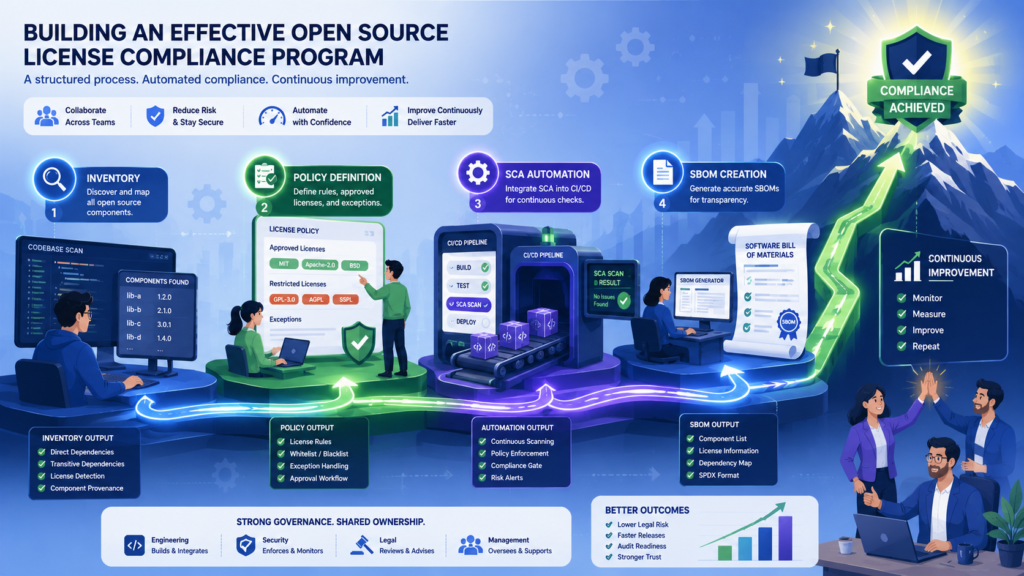
A strong compliance program doesn’t rely on one tool or one final review. It combines automation, clear policies, developer education, and regular monitoring throughout the software lifecycle.
From what we’ve seen, the most successful teams build compliance into their daily workflow. Developers think about licenses when they add new packages, security teams review policy results automatically, and documentation stays current instead of being rebuilt before release.
That approach fits naturally with the secure development practices we teach. When developers receive fast feedback, they solve licensing issues while the work is still fresh. That’s easier for everyone involved.
A practical roadmap looks like this:
- Create a complete license inventory.
- Define approved license policies.
- Add SCA to CI/CD.
- Document approval workflows.
- Generate SBOMs automatically.
- Track remediation work.
- Monitor dependencies continuously.
Those steps help organizations stay organized without adding unnecessary friction to development.
As noted by Karlsruher Institut für Technologie (KIT)
“The team had to do a lot of retrospective work to meet these requirements, highlighting the need for an SBOM from the beginning to avoid legal and financial complications later.” – KIT (Karlsruher Institut für Technologie)
How does this support Secure Coding Practices?
Strong compliance and secure development support each other.
When automated license scanning, build validation, and policy checks run alongside security testing, developers receive feedback much earlier. Problems are smaller, fixes take less time, and releases become more predictable.
We’ve seen teams gain confidence once compliance became another routine engineering practice instead of a last-minute legal review. That shift improves software quality while strengthening the overall software supply chain.
FAQ
How does open source license compliance reduce legal risk?
Open source license compliance helps organizations meet license obligations before software is released. It verifies license notices, copyright notice requirements, and attribution requirements while maintaining a complete license inventory.
Combined with software bill of materials (SBOM) compliance and regular compliance reporting, this process creates clear documentation that supports audits, customer reviews, and ongoing legal due diligence.
How is a permissive license different from strong copyleft?
A permissive license, such as the MIT license, Apache license, or BSD license, generally allows broad software reuse as long as organizations preserve attribution and required notices.
Strong copyleft licenses often require source code disclosure or access to the corresponding source code when software is distributed. Weak copyleft licenses, including LGPL compliance and MPL compliance, usually apply only to specific covered components.
Why is license scanning important for transitive dependencies?
License scanning helps identify both direct dependencies and transitive dependencies that developers may not realize are included in a project. It supports dependency license audit, package license detection, and dependency mapping, making it easier to find licensing issues before release.
Regular scanning also improves component provenance, keeps license metadata current, and reduces compliance gaps as software changes.
How can teams automate software composition analysis for compliance?
Teams can automate software composition analysis by integrating repository scanning, artifact scanning, container license scanning, and package manager scan processes into their development pipeline.
Automated policy enforcement, build gate, release gate, and compliance gate checks identify licensing issues early. This approach strengthens compliance automation, reduces manual work, and helps teams maintain consistent compliance throughout development.
What should an effective open source policy include?
An effective open source policy should define approved licenses, forbidden licenses, license whitelist, and license blacklist rules. It should also document the legal approval workflow, license exceptions, exception handling, and risk acceptance process.
Clear developer policy, audit trail requirements, and consistent governance help engineering, legal, and security teams make informed decisions and maintain long-term compliance.
Make Open Source Compliance Part of Daily Development
Open source license compliance works best when it’s built into everyday development. Automated checks, current SBOMs, and clear policies help teams reduce risk, fix issues sooner, and keep software delivery moving without extra overhead.
See how Secure Coding Practices helps developers build secure software, strengthen software supply chain security, and apply Software Composition Analysis with confidence.
References
- https://ar5iv.labs.arxiv.org/html/2509.09873
- https://publikationen.bibliothek.kit.edu/1000183052