


Validating email address regex secure methodologies are essential for modern software engineering teams striving to prevent injection flaws and invalid data processing. As complex backend applications increasingly handle user registrations and contact forms, unoptimized pattern matching logic can expose server infrastructure to severe denial-of-service vulnerabilities and massive resource exhaustion.
At Secure Coding Practices, security architects emphasize that implementing robust evaluation methodologies and automated validation checks protects critical enterprise assets against sophisticated algorithmic complexity attacks.
By systematically auditing your parsing logic before production deployment, your organization ensures resilient operations and eliminates hidden performance bottlenecks across all distributed web services.
Comprehensive Testing Ensures Long-Term Backend Resilience
Implementing structured evaluation practices safeguards production environments from hidden vulnerabilities and unexpected operational failures.
- Integrating static analysis pipelines into continuous integration workflows catches flawed pattern logic early.
- Simulating heavy traffic loads through specialized fuzz testing reveals underlying performance bottlenecks.
- Enforcing strict deterministic time limits prevents malicious payloads from locking server execution threads.
Why Is Validating Email Address Regex Secure Crucial For User Data Integrity?
When user accounts are created through web interfaces, ensuring that email submissions follow strict syntactic rules prevents invalid formats from poisoning downstream databases. Without precise pattern matching, applications risk storing corrupted information that disrupts communication channels and automated notification systems.
Furthermore, improper verification logic can introduce security loopholes that malicious actors exploit to inject unintended characters or execute payload strings. Implementing rigorous evaluation safeguards ensures that only clean, verified strings pass through the initial application layers. This precision prevents downstream failures.
How Do Parsing Approaches Compare In Validating Email Address Regex Secure?
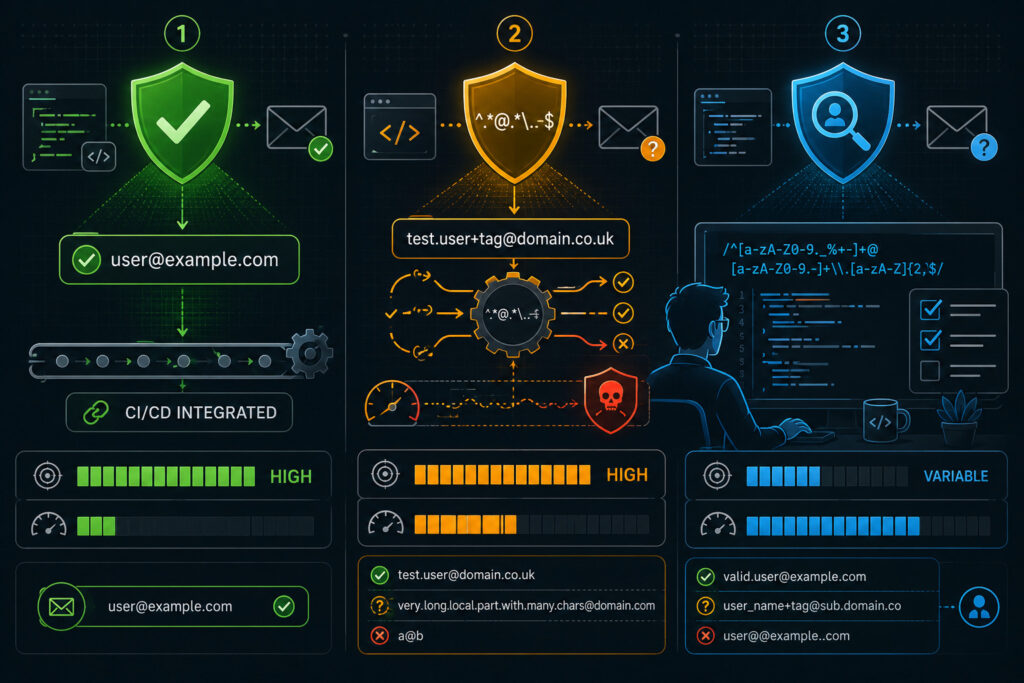
When conducting thorough evaluations for validating email address regex secure configurations, development teams must evaluate various inspection strategies against safe regular expression use standards to ensure complete production readiness.
| Validation Method | Execution Target | Error Detection Rate | Operational Overhead |
| Static Analysis Linters | Source Code Patterns | High (Syntax Flaws) | Minimal (CI/CD Integrated) |
| Pattern Matching Engines | Runtime Input Evaluation | High (ReDoS Risks) | Moderate (Load Testing) |
| Manual Code Review | Developer Logic Flow | Variable (Human Error) | High (Time Intensive) |
What Are The Standard Compliance Requirements For Input Sanitization?
Ensuring that backend services accept only correctly formatted email identifiers requires strict adherence to established internet specifications rather than relying on loose pattern assumptions. Implementing standardized evaluation protocols prevents malformed inputs from bypassing security perimeters.
Industry engineering standards emphasize the importance of rigorous specification alignment:
“Internet standards define specific syntactic rules for email addresses that extend far beyond simple alphanumeric character matching.” – IETF RFC 5322 Official Specification
How Can Engineering Teams Optimize Performance During Validating Email Address Regex Secure Procedures?
Implementing advanced performance tunings during validating email address regex secure procedures ensures that high-throughput authentication gateways never experience processing bottlenecks. Development teams can apply practical techniques detailed in our guide on optimizing regex performance secure coding to minimize CPU overhead and enhance execution speed.
- Compiling regular expressions once during application startup prevents redundant processing overhead on every incoming request.
- Limiting input string lengths prior to evaluation blocks excessively large payloads from triggering resource exhaustion.
- Replacing complex wildcards with explicit character classes reduces the search space for the parsing engine.
How Do Standard Runtimes Handle Expression Compilation?
Credits: NDC Conferences
Ensuring that string evaluations execute efficiently across production nodes requires a deep understanding of underlying runtime mechanics. Developers must configure their pattern compilation strategies to prevent unnecessary overhead during high-frequency API calls and user authentication steps.
Official runtime documentation highlights the technical mechanics behind optimized pattern execution:
“It is important to note that most regular expression operations are available as module-level functions and methods on compiled regular expressions for performance optimization.” – Python Regular Expression Operations Documentation
How Can Automation Streamline Pattern Checks?
Integrating automated verification tools into development pipelines eliminates human error during pattern construction. Continuous integration workflows ensure every modification maintains strict compliance before reaching production environments.
- Automated linters flag risky nested quantifiers during pull requests.
- Scheduled fuzz tests expose hidden execution bottlenecks under heavy load.
- Centralized pattern registries prevent the reuse of vulnerable legacy expressions.
What Role Do Specialized Libraries Play In Validating Email Address Regex Secure Architectures?
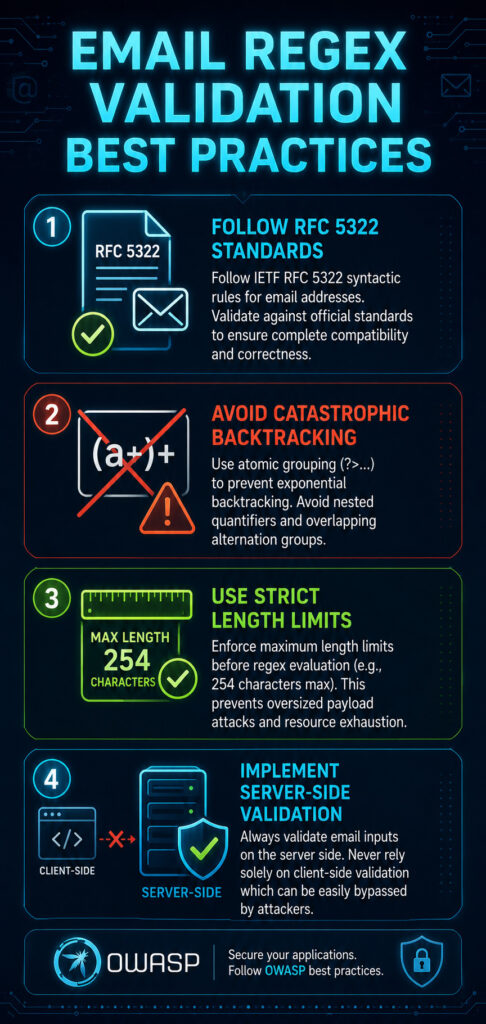
Selecting advanced parsing libraries with native safeguards forms a critical barrier against malicious injection attempts during validating email address regex secure operations. Standard framework engines often lack built-in execution limits, leaving backend architectures vulnerable to runaway processes and thread starvation during peak user registration loads.
Evaluating third-party dependencies carefully ensures your application supports deterministic evaluation rules and safe compilation flags. Reviewing our analysis on regex libraries security features considerations provides actionable criteria for selecting robust parsing tools.
- Enforcing native timeout controls stops malicious payloads from locking core execution threads.
- Verifying support for atomic groups eliminates unwanted recursive backtracking paths.
- Tracking vendor security patches ensures outdated parsing dependencies are upgraded promptly.
FAQ
What is validating email address regex secure?
Validating email address regex secure processes involve systematically checking string inputs against predefined patterns to ensure they comply with syntactic standards while guarding against injection attacks and performance bottlenecks.
Why do unoptimized email patterns cause server issues?
When matching patterns contain ambiguous nested structures, malicious inputs can force the parsing engine into exponential evaluation loops, consuming maximum CPU resources and stalling core application threads.
How can developers automate regex vulnerability detection?
Engineering teams can integrate static analysis tools and automated linters directly into continuous integration pipelines to catch risky pattern configurations and syntax flaws before code reaches production.
What are atomic groups and how do they help?
Atomic groups instruct the parsing engine to discard its backtracking checkpoints once a sub-expression matches, effectively eliminating recursive evaluation paths and neutralizing denial-of-service risks.
Do modern programming languages protect against regex vulnerabilities?
While certain modern runtimes implement deterministic linear-time algorithms, many standard language libraries still rely on traditional backtracking engines, making explicit validation and timeout controls necessary.
Ensure Long-Term System Security
Implementing rigorous validation protocols and maintaining secure pattern evaluation practices guarantees long-term enterprise application stability across distributed web environments. Development teams must prioritize proactive pattern reviews, strict execution timeouts, and comprehensive static analysis within continuous integration pipelines to completely eliminate catastrophic backtracking risks.
Safeguarding backend infrastructure against sophisticated algorithmic complexity attacks requires continuous technical education and disciplined engineering standards.
To accelerate your organization’s expertise in building robust, uncompromised architectures, explore our advanced security documentation and join our secure coding bootcamp today to significantly elevate your team’s defensive capabilities and protect critical production systems from emerging security threats seamlessly.
References
- https://datatracker.ietf.org/doc/html/rfc5322
- https://docs.python.org/3/library/re.html