
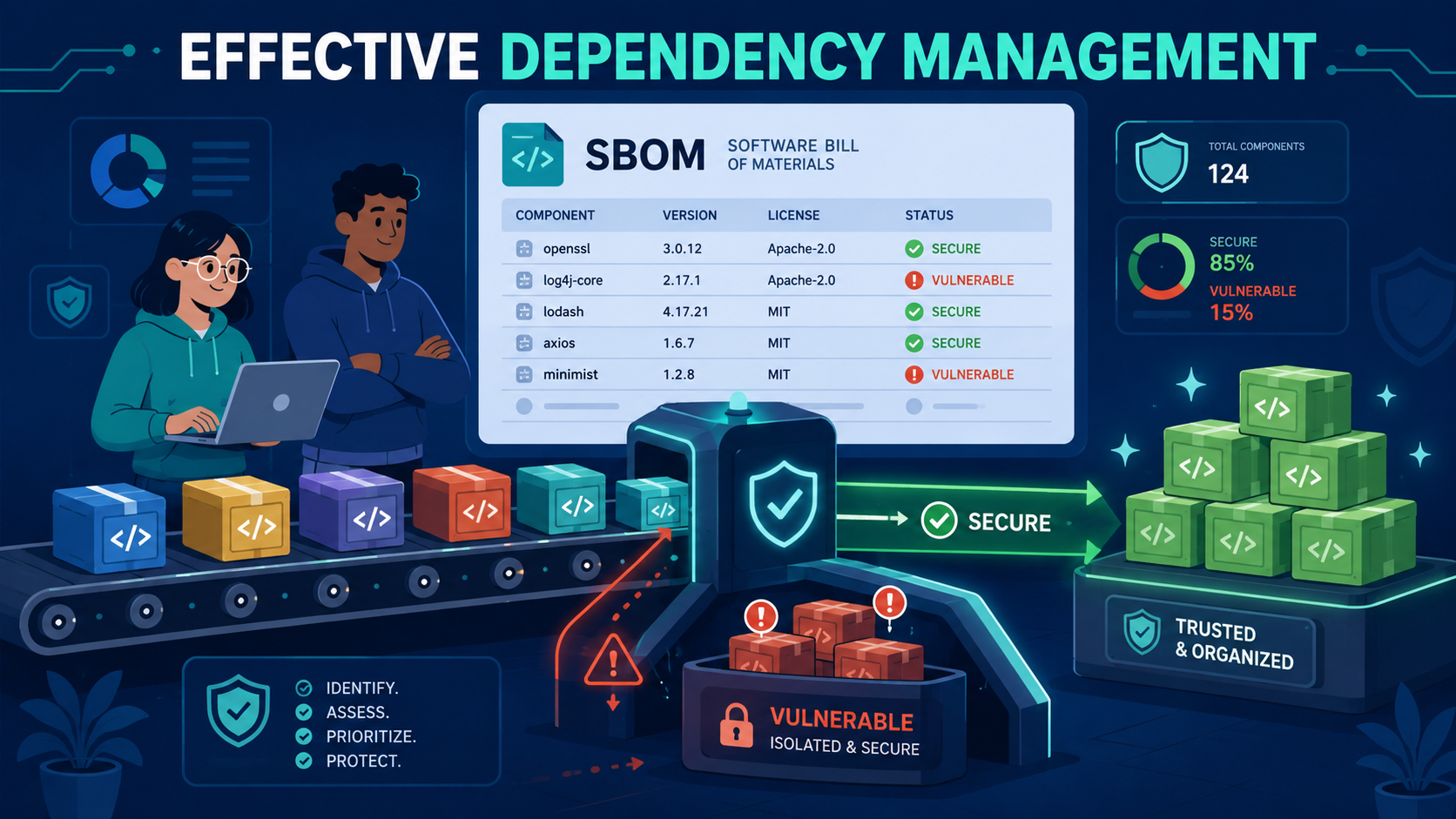

Managing vulnerable third party libraries is essential for modern software security. Your software is only as strong as its weakest dependency. Open-source code speeds development but requires continuous security work. The challenge is knowing which vulnerabilities to fix first to reduce alert fatigue and broken builds.
Forget chasing every CVE. You need a practical process. First, know your dependencies. Second, understand the real danger. Third, fix things with control. We’ve built this logic into our Secure Coding Practices. It’s an engineer-first method to secure your app without killing momentum. Keep reading for the details.
Smarter Ways to Manage Vulnerable Libraries
These practices help teams manage vulnerable third-party libraries. They also reduce software supply chain risk over time.
- First, build a complete dependency inventory. You cannot secure libraries your software uses if you don’t know about them.
- Prioritize vulnerabilities. Base this on reachability and exploitability. Do not rely only on CVSS scores. This reduces unnecessary work.
- Automate dependency updates. Include validation, testing, and controlled rollout policies. This improves security. It also prevents disrupting development.
What Makes the Vulnerability Management Lifecycle a Continuous Loop Instead of a Checklist?
Thinking of this as a one-time audit sets you up for failure. Dependency security is a continuous discipline, a loop you bake into your SCA development lifecycle. It has four stages that feed into each other.
First, Discovery & Inventory. This is generating and maintaining that accurate SBOM. It’s not a static document, it updates with every commit, every build, supporting effective software composition analysis.
Second, Continuous Scanning. Automated tools constantly compare your SBOM against updated vulnerability feeds. This generates the initial list of potential issues.
Third, Triage & Prioritization. This is the critical, context-aware filter. Here, you ask: Is this vulnerability actually exploitable in our application? This step kills the noise.
Fourth, Mitigation & Remediation. Prioritize your actions. You can upgrade a library. You can apply a patch. You can use a workaround. Or you can accept the risk.
The cycle repeats. New dependencies are added, new vulnerabilities are published, the loop continues. The tools exist to support this cycle, not replace the judgment within it.
What Tools Do You Need Beyond a Vulnerability Scanner?
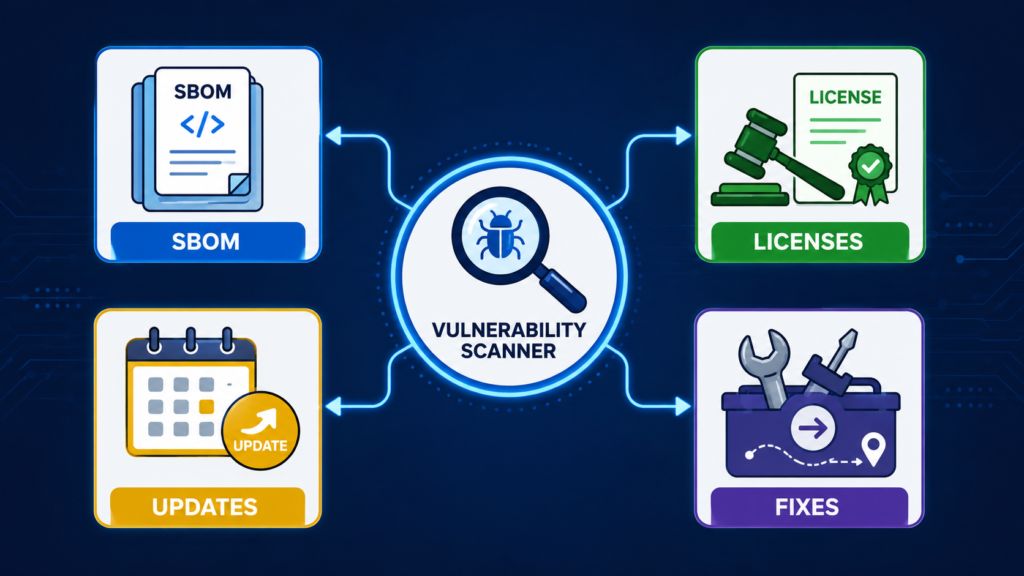
Relying on one tool is like using a hammer for every job. Different tools solve different parts of the problem. Broadly, they fall into a few categories.
Software Composition Analysis (SCA) tools are the most common. Think Snyk, Dependabot, or OWASP Dependency-Check. They parse your manifest files, identify dependencies, and flag known CVEs, showing how SCA tools improve visibility.They’re essential, but they often lack context.
SBOM Generators, like Syft or Trivy, focus specifically on creating that comprehensive inventory in standard formats (SPDX, CycloneDX). They tell you what’s there.
The most advanced category is Reachability Analysis tools. These use static analysis to trace your code’s execution paths. They answer the crucial question: Does our application actually call the vulnerable function? If not, the risk plummets. Using a combination of these tools is how you move from a blizzard of alerts to a shortlist of genuine threats.
How Do You Triage Alerts and Fix What Actually Matters?
When the scan report shows hundreds of items, you need a framework to decide what to do first. Blindly following CVSS scores will waste your team’s time. You need to consider context.
| Factor | High Priority | Lower Priority |
| Reachability | Vulnerable code is executed | Vulnerable code is never called |
| Exploitation | Listed in CISA KEV or actively exploited | No known active exploitation |
| Exposure | Internet-facing or production systems | Internal or isolated environments |
This triage process is what separates a reactive team from a strategic one. It’s about applying engineering judgment to security data.
Does a High CVSS Score Always Mean You Should Panic?
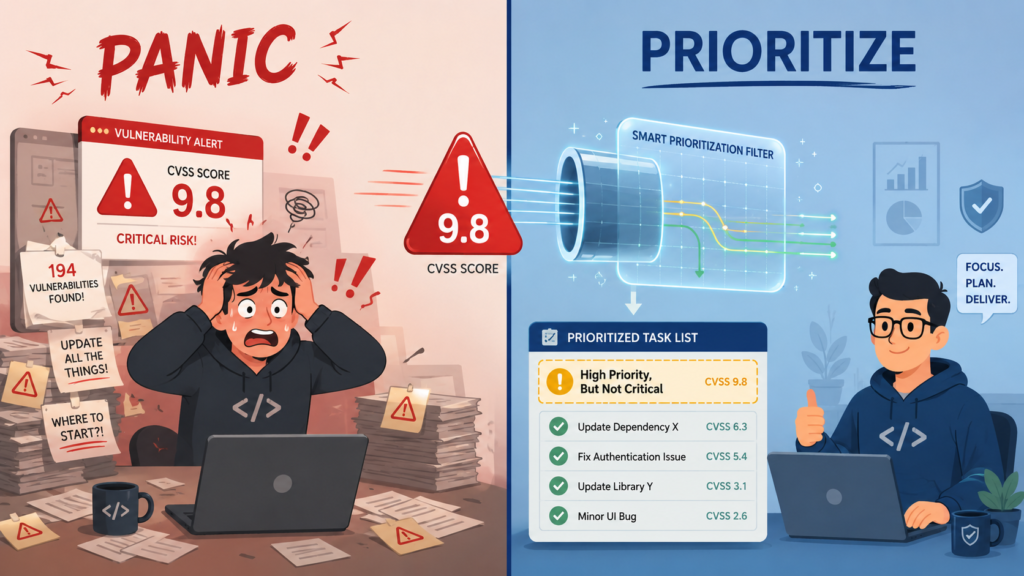
We once had a scanner flag a “Critical” vulnerability in a Docker image used solely for compiling legacy documentation. The system was air-gapped, used once a quarter. The CVSS score was 9.8. The actual risk to our organization was near zero. We documented the risk and accepted it, saving days of work for a theoretical threat.
The CVSS system measures inherent severity, not exploitability in your specific context. A high-scoring vulnerability might be low priority. This is true if it’s not reachable. It’s also true if it’s in a non-critical system. A medium-scored flaw in a key system can be higher priority. This is especially true if the system faces the internet.
Research from IEEE Xplore shows
“CVSS measures theoretical severity of vulnerabilities in isolation, not their likelihood of exploitation in real-world attacks. This leads organizations to face overwhelming numbers of ‘critical’ vulnerabilities that are never actually exploited.” – IEEE Xplore
This is the core of reducing alert fatigue. By filtering out the non-reachable, the non-exploitable, you focus your team’s energy on the vulnerabilities that could actually lead to a breach. It turns security from a compliance chore into a genuine engineering improvement.
How Does Reachability Analysis Help Cut Through the Noise?
Reachability analysis sounds complex, but the concept is straightforward. It’s about building a call graph of your application. If your code main() calls function A() in a library, and A() calls the vulnerable function B(), then the path is reachable. If your code never calls A(), or if B() is in a module your application doesn’t import at runtime, it’s not reachable.
Modern tools can automate much of this analysis. They trace data flows and function calls statically. The result is a dramatic reduction in false positives. Reachability analysis can greatly reduce false positives. The exact reduction depends on your code and tools.
As highlighted by ar5iv.lab
“SBOM-based scanners that match only library versions against vulnerability databases generate high false positive rates because vulnerable code may never be invoked by the application. This creates alert fatigue and wastes developer time on irrelevant issues.” – ar5iv.lab
Now your team can act decisively. This isn’t about ignoring vulnerabilities, it’s about applying intelligent prioritization. It respects your developers’ time and directs it toward meaningful risk reduction.
How Can You Control the Chaos of Dependency Updates?
Automated update tools like Dependabot are a double-edged sword. They’re great for staying current, but blind auto-merging is a recipe for broken builds and supply chain attacks.
A malicious package takeover can poison an update that gets automatically merged into your main branch. The strategy isn’t to avoid automation, but to control it.
We learned this the hard way. An automatic update to a utility library caused problems. It broke a core interface. This happened because the maintainer ignored semantic versioning. The patch release changed a function signature.
Our CI caught it, but it wasted half a day. Some teams wait a short time. They observe major updates before adopting them. This depends on their risk tolerance and the update’s importance. This lets the community find the poisoned packages or breaking changes first.
- Avoid auto-merging major updates, and gate minor updates behind tests and policy checks.
- Require all dependency PRs to pass full CI/CD pipelines.
- Use lockfiles (package-lock.json, Gemfile.lock) religiously.
- Consider grouped updates for large projects to reduce merge overhead.
Automation should serve stability, not undermine it. The goal is predictable, secure updates, not constant churn.
How Do You Build Defenses Against Supply Chain Attacks?
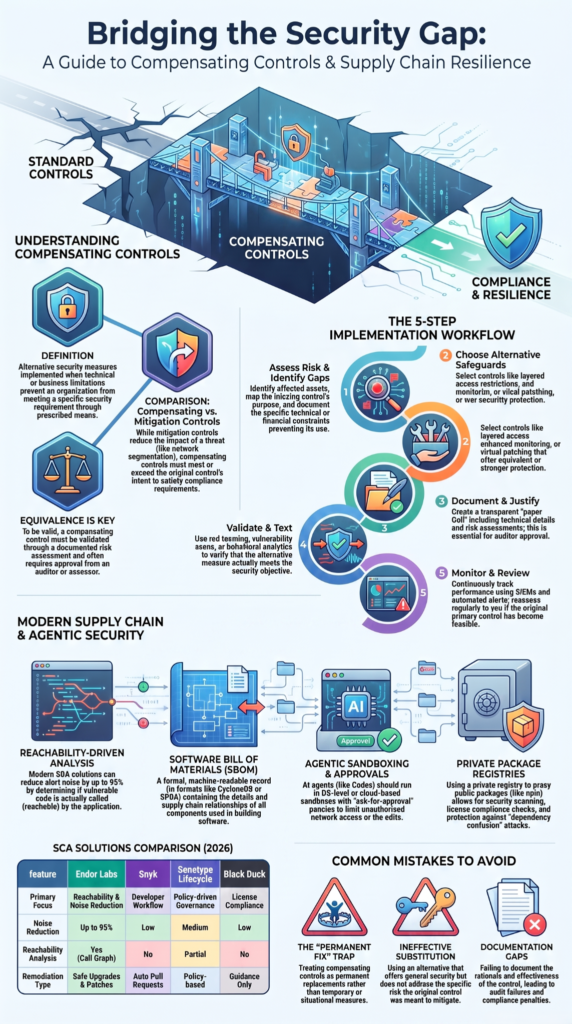
The update mechanism itself can be an attack vector. Defending your supply chain requires more than just scanning. It’s about creating friction for malicious code.
A private package registry is your first line of defense. It proxies public repositories, allowing you to block known-malicious packages and control what enters your environment. For critical dependencies, pin immutable versions or checksums where the ecosystem supports it. Tags can be moved, commits are immutable.
For ultimate control, use network-isolated CI builders. These systems have no internet access at build time.
All dependencies must be pre-cached in an internal, curated repository. It’s a forcing function for governance. It stops a compromised package from being downloaded during a build. It also prevents tools like npx from dynamically pulling and executing unknown code, a common bypass for SBOM controls.
What Should You Do When There Is No Security Patch?
Sometimes, you find a critical vulnerability in a library that’s abandoned. No patch exists. What then? You need a playbook for un-patchable flaws.
| Option | Best Used When | Trade-Off |
| Fork the library | Critical dependency with no maintainer | Ongoing maintenance responsibility |
| Replace the library | Reliable alternative exists | Migration effort and testing |
| Apply compensating controls | Immediate replacement isn’t possible | Risk is reduced, not eliminated |
FAQs
How can I improve dependency vulnerability management without slowing development?
You can improve dependency vulnerability management. Use automated dependency scanning. Triage vulnerabilities. Remediate based on risk. This identifies and fixes high-risk issues first.
Why is a dependency inventory important for managing vulnerable dependencies?
A complete dependency inventory helps you identify managed vulnerable dependencies. It also tracks transitive dependency risk. You can support package auditing. It improves dependency risk assessment across your applications.
How often should I install security updates for third-party libraries?
Continuously review security advisories. Install security updates based on risk. Verify every patch. Perform security testing before deploying updated libraries.
How does software bill of materials management improve software security?
Software Bill of Materials (SBOM) management increases dependency observability. It strengthens library compliance. It supports open-source dependency governance. It improves software supply chain defense with accurate component records.
What practices reduce open-source package security risks over time?
You can reduce open-source package security risks. Enforce dependency policies. Maintain dependency hygiene. Review vulnerable modules regularly. Follow a consistent approach.
Make Dependency Security Part of Everyday Development
Dependency security isn’t about chasing zero vulnerabilities. It’s about understanding your risks, fixing what matters first, and building a process your team can trust. That’s what makes long term security easier to manage.
If you want to strengthen secure coding skills with practical experience, the Secure Coding Practices Bootcamp is a smart next step. Developers learn through hands-on labs covering safe dependency use, secure authentication, input validation, encryption, and more.
References
- https://ieeexplore.ieee.org/abstract/document/11397608
- https://ar5iv.labs.arxiv.org/html/2511.20313