
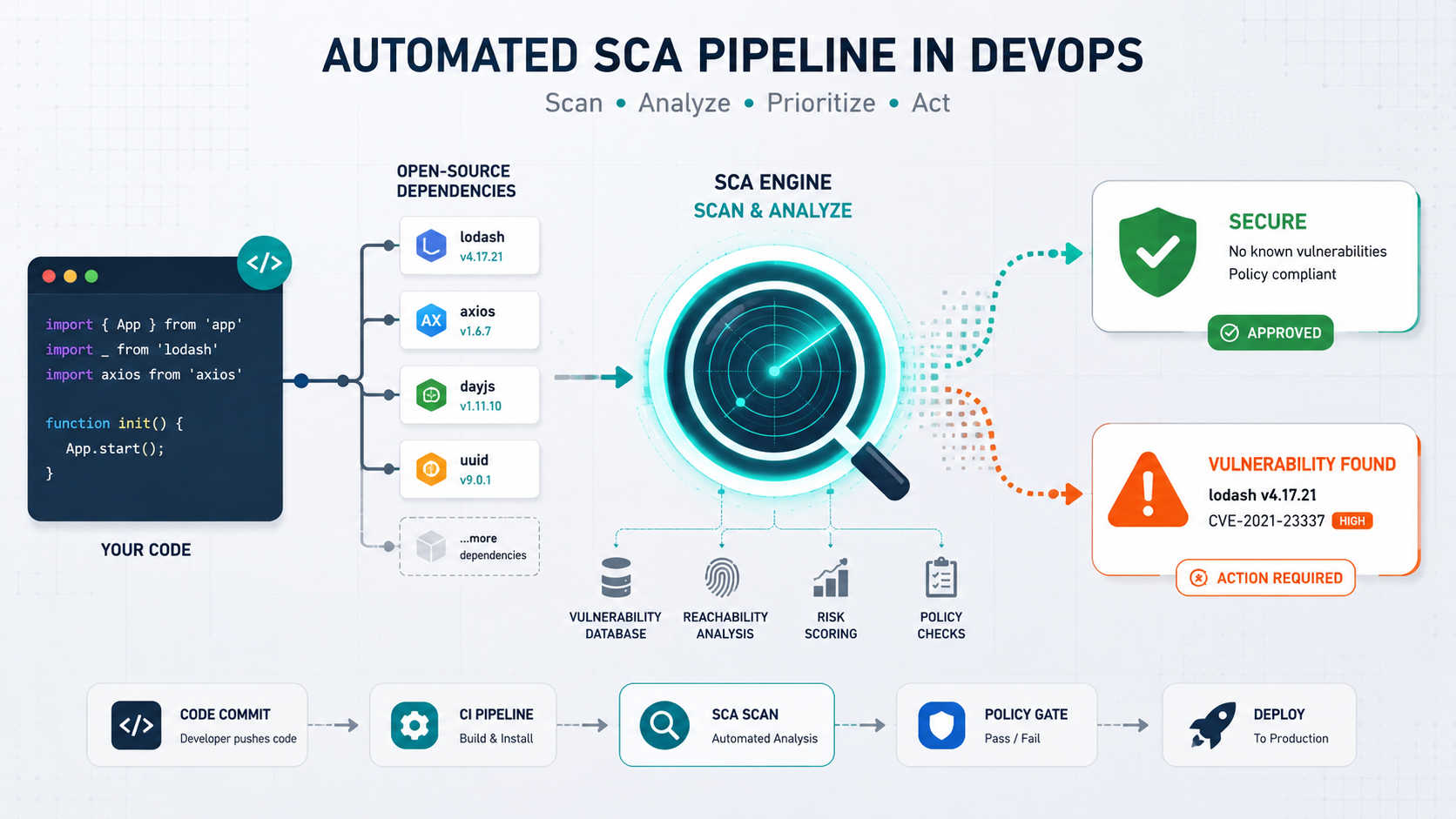

How SCA tools work process begins with identifying the open-source parts used in your software. A Software Composition Analysis (SCA) tool shows you what those parts are. It creates a list called an SBOM, checks for security flaws and licensing problems, and can block risky code from being used. We call this the SCA work process. It’s essential for security, but basic tools cause alert fatigue by flooding teams with false alarms.
Modern SCA platforms from Secure Coding Practices are more precise, cutting through the noise to highlight real threats. Keep reading to see how they do it.
SCA Process in a Nutshell
Understanding this process makes it easier to use Software Composition Analysis effectively and strengthen software supply chain security throughout development.
- SCA tools identify every open-source component used in your software.
- They build a complete dependency map and check each component for known vulnerabilities and license risks.
- Modern SCA tools prioritize vulnerabilities that are actually exploitable, helping teams focus on the most important fixes.
How does an SCA tool discover open-source dependencies?
An SCA tool finds open-source dependencies by scanning your project’s files. We always check the manifest first, like package.json or pom.xml. This is your declared list, but version numbers can be loose. That’s why the scanner hunts for lockfiles immediately after.
Lockfiles are the real inventory. They tell us the exact version of everything installed.
package-lock.jsonyarn.lockCargo.lockPipfile.lock
These files list every package and sub-dependency precisely. It’s the difference between your recipe and a kitchen audit.
As noted by Wiz Academy
“SCA scanners analyze codebases, build files, container images, and package manifests to identify third-party components, including both direct and transitive dependencies.” – Wiz Academy
We also look for code that was just copied in, like a library pasted into your src folder. To catch these, tools use binary fingerprinting on compiled code or source snippets, matching them to known open-source parts. It’s a deeper check that closes a major security gap.
How are dependency graphs and SBOMs generated?
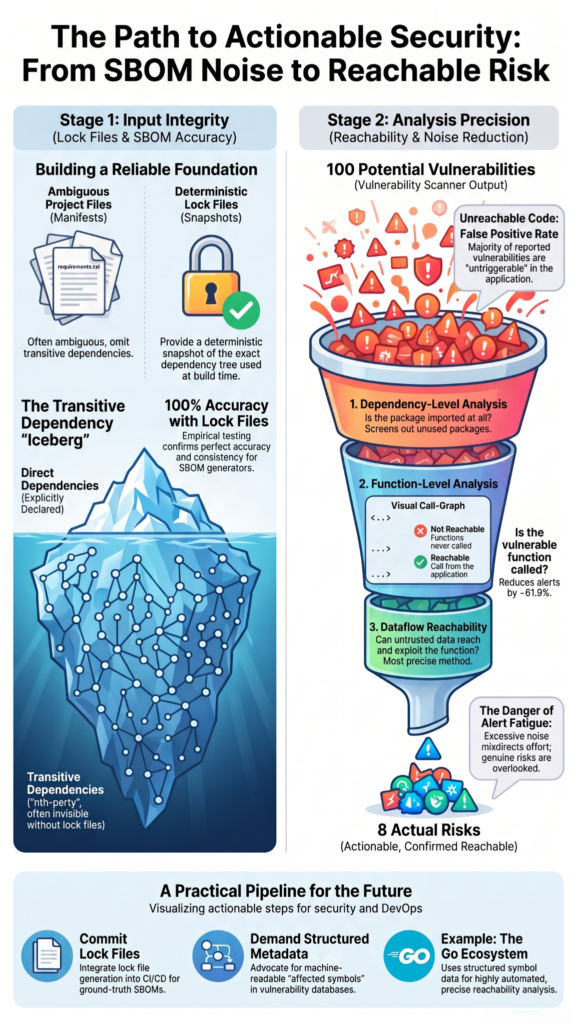
The scanner’s next job is mapping the chain. You see your direct dependencies, the ones you added. But each of those pulls in more libraries, these are transitive dependencies. We trace this entire web to build a dependency graph. It strengthens dependency management by revealing the real foundation your code rests on.
We formalize this graph into a Software Bill of Materials (SBOM), the foundation of Software Composition Analysis for security, compliance, and operations. It catalogs every component, its version, license, and place in the hierarchy.
| SBOM Format | Primary Purpose |
| CycloneDX | Best for security and vulnerability management. |
| SPDX | Focused on software licensing and legal compliance. |
An SBOM answers critical questions. Is a vulnerable library in our container or just a build tool? Generating one automatically creates a living artifact that gives us essential visibility into our software supply chain.
How do SCA tools identify known vulnerabilities?
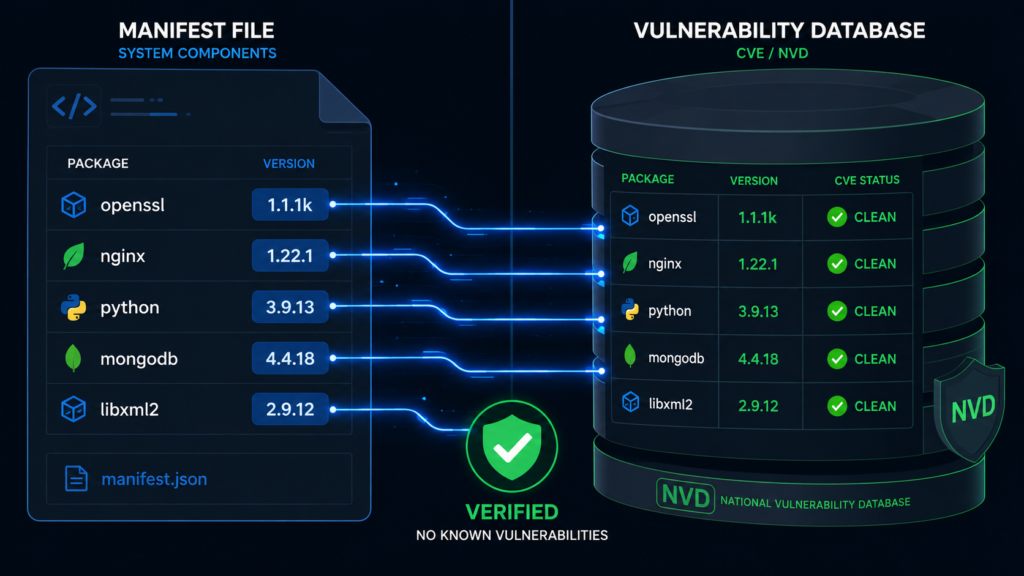
With a complete list of components from the SBOM, the tool starts checking for known vulnerabilities. It compares each library and exact version against major security databases.
We rely on several sources. The National Vulnerability Database (NVD) is the public baseline, but it can be slow. For faster, more actionable data, the tool also checks:
- The GitHub Advisory Database, which includes clear remediation steps.
- The Open Source Vulnerabilities (OSV) database, designed for automation.
- Proprietary feeds from commercial vendors, which often provide earlier warnings.
The core task is version matching. A CVE entry states the affected version range, like “log4j-core from 2.0-beta9 to 2.15.0.” If your installed version falls inside that range, it’s flagged. The tool attaches the CVE ID, a CVSS severity score, a description, and fix links to the finding.
This process runs continuously. New vulnerabilities published anywhere can trigger a re-scan of your existing SBOMs, keeping your security posture updated automatically.
How do SCA tools evaluate license compliance?
While security flaws grab attention, license risks are just as important. Every open-source package has a legal license, and the SCA tool extracts this from the package metadata to build a full license inventory for your SBOM.
Most licenses, like MIT or Apache 2.0, are permissive. They’re business-friendly, usually just requiring attribution. The tool notes them and moves on. The real focus is on copyleft licenses, like the GPL family. These have conditions often requiring that any derivative work be released under the same license. Including a GPL component in proprietary software you distribute can create serious legal problems.
We configure the tool with our own policy rules, such as “No GPLv3 in distributed products” or “LGPL requires legal review.” When a component’s license breaks a rule, the tool flags it like a security vulnerability. This automation replaces a manual, error-prone audit of hundreds of dependencies, acting as a guardrail against legal risk and protecting our intellectual property.
How do SCA tools enforce security policies?
Finding a vulnerability is one thing. Acting on it is what matters. We set specific policies in the SCA tool to automate this. You create rules like, “Block any merge with a critical flaw in a direct dependency,” or, “Only flag license issues in dev tools, don’t stop the build.”
The tool enforces these rules after every scan. It evaluates findings against your policies and triggers a defined action. This bakes security directly into the workflow.
- In the IDE: A warning appears when you try to import a vulnerable library.
- At Pull Request: A check fails, blocking the merge.
- In CI/CD: The build fails, halting a risky artifact.
- As a Notification: Alerts go to Slack, Jira, or email.
- As Remediation: It can auto-open a PR to update to a safe version.
The point is to make secure behavior the default. It shifts the blame from “security said no” to “the automated gate failed, here’s how to fix it.” This builds consistent, scalable controls into the development process itself.
Why do traditional SCA tools create alert fatigue?
Credit: OWASP Austin
Traditional SCA tools often create alert fatigue by reporting every single match. Their logic is simple: if a vulnerable version is in your dependency tree, it raises an alert. But real software use isn’t that straightforward.
Imagine a library with ten different modules. A critical CVE might affect just one function in one module. If your application only uses a completely different, unaffected module from that same library, the tool still flags it as a critical issue. You now have a high-priority ticket for a vulnerability you aren’t actually exposed to.
Scale this up across hundreds of dependencies. Your dashboard fills with red alerts, most demanding engineering time for no real security gain. These are practical false positives. They erode trust.
Research from appsecsanta.com shows
“Modern SCA tools add reachability analysis on top of basic CVE matching.” – appsecsanta.com
Developers begin to see the security tool as unreliable, the proverbial boy who cried wolf. Eventually, they start ignoring the alerts or disabling the tool entirely. The constant noise completely drowns out any real signal.
How does reachability analysis improve SCA accuracy?
Reachability analysis fixes alert fatigue by checking if vulnerable code can actually run. Modern tools analyze your source code, tracing whether your app ever calls the flawed function. If there’s no path to it, the risk is just theoretical.
| Traditional SCA | Modern SCA with Reachability |
| Flags the library version. | Flags the vulnerable code path. |
| High noise, many false positives. | Higher signal, better prioritization. |
| Answers “Is it there?” | Answers “Can it be exploited?” |
This changes the game. Instead of 50 critical alerts, you might get 5 critical, reachable ones and 45 low-priority, unreachable notes. It lets developers focus on real threats, turning a blunt tool into a precise one that earns back trust.
What technical edge cases can confuse SCA scanners?
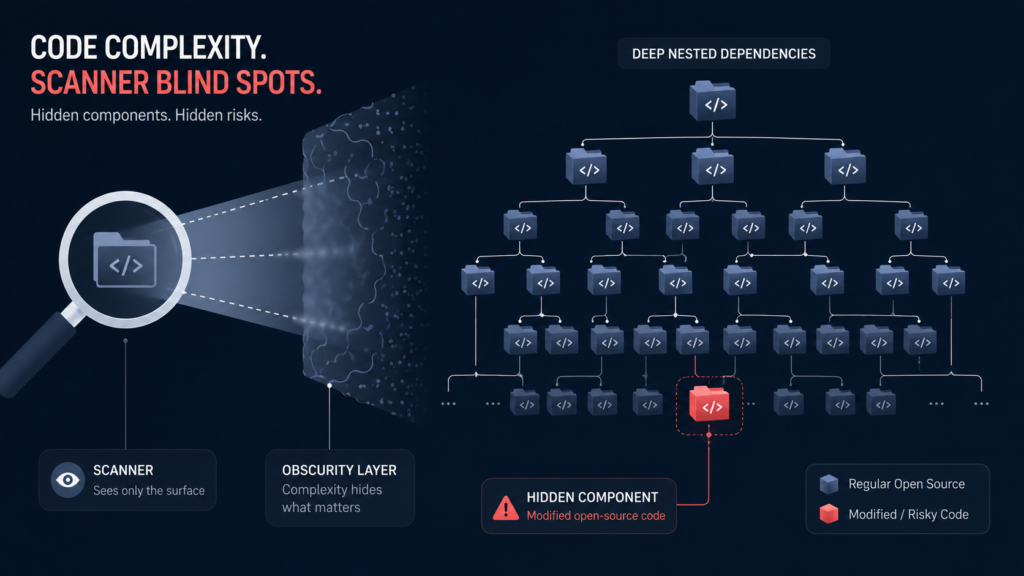
SCA tools can get confused by real-world code. Dynamic imports, like const lib = await import(someVariable), hide dependencies from static scanners. They only appear at runtime.
Building systems also cause trouble. A lockfile like Cargo.lock might list dependencies for both Linux and Windows targets. If you only ship a Linux container, the scanner will still flag Windows library vulnerabilities as false positives.
Developers create problems too. Copying a single function from a library into your project bypasses package managers. Basic scanners see it as your own code, missing the original vulnerability.
These edge cases mean an SBOM isn’t perfect. You should use it as a guide, not absolute truth, and know where its blind spots are.
FAQs
How does dependency scanning differ from source code analysis?
Dependency scanning identifies risks in third-party components, while source code analysis evaluates custom code. Using both methods provides stronger application security and software supply chain security.
Why are transitive dependencies harder to manage than direct dependencies?
Transitive dependencies are often added automatically and remain hidden within the dependency graph. This makes package identification, vulnerability lookup, and risk prioritization more challenging.
How do SBOM generation and license compliance improve software security?
SBOM generation creates a software bill of materials that supports license compliance, open source inventory, compliance checking, and better software inventory management throughout development.
Can container scanning detect risks that repository scanning misses?
Yes. Container scanning analyzes release artifacts, binary files, and deployed components, while repository scanning focuses on source files. Combining both methods provides broader software supply chain scanning coverage.
What methods reduce false positives during SCA scanning?
Reachability analysis, vulnerability correlation, analyst validation, dependency intelligence, and findings review help reduce false positives and improve remediation workflow decisions.
Turn Visibility Into Better Security Decisions
You can scan every dependency, but the real win comes from how you act on the results. Focus on reachable, critical risks, cut unnecessary noise, and make security part of everyday development. That’s what keeps your team moving. Simple as that.
If you want to build stronger secure coding habits, the Secure Coding Practices Bootcamp is a practical next step. Through hands-on labs and real coding examples, you’ll learn skills you can use right away, from secure authentication to safe dependency use.
References
- https://www.wiz.io/academy/application-security/oss-sca-tools
- https://appsecsanta.com/sca-tools