
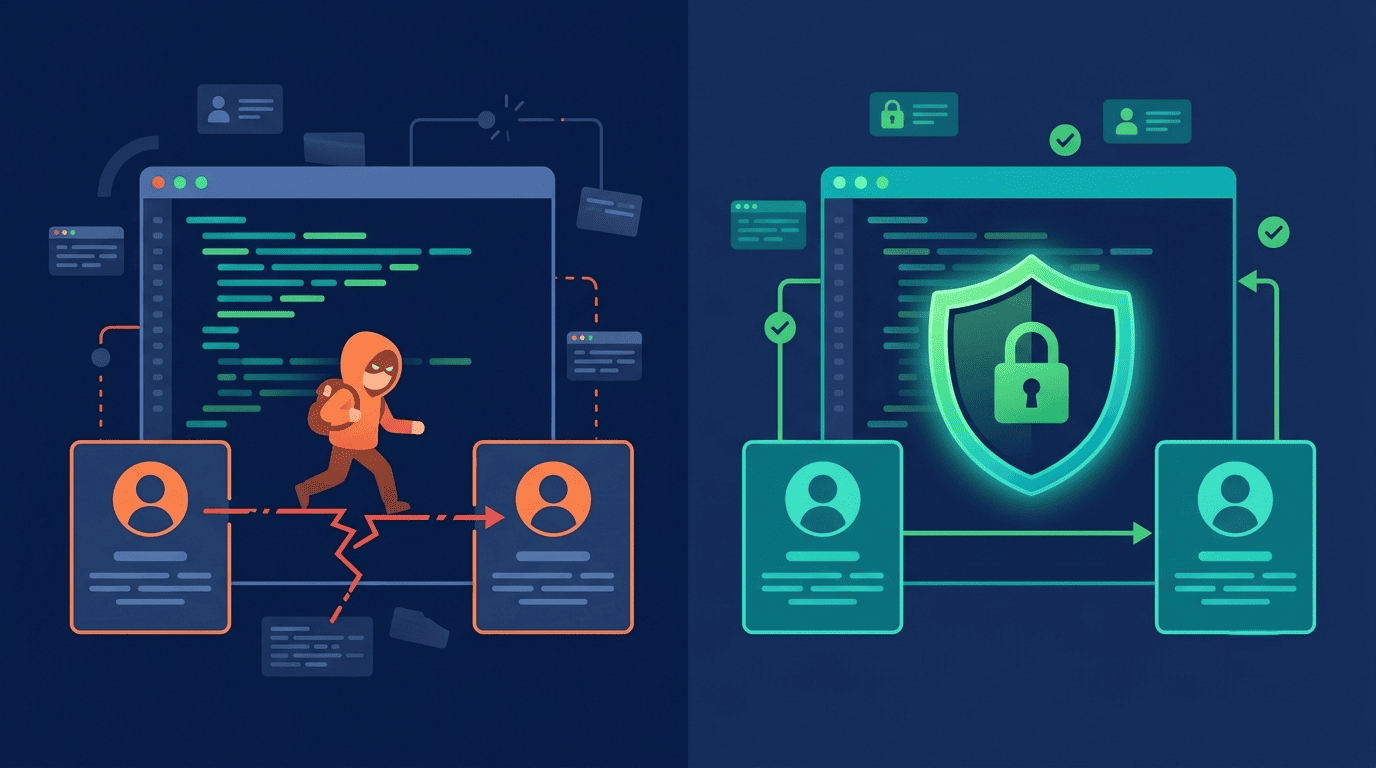

Preventing horizontal privilege escalation means stopping a user from accessing another user’s resources. It’s a lateral move. Imagine one bank customer seeing a different customer’s account.
The solution isn’t stricter passwords. It’s consistent, resource-level authorization that checks every single request. You don’t just verify identity at the front door; you must check they have a key to the specific room they’re trying to open. Building this verification into your app’s foundation is a core part of Secure Coding Practices. Read on to see how to do it.
What Actually Stops Horizontal Privilege Escalation in Practice
Authorization failures happen when systems trust users too much at the wrong layer. Real protection comes from enforcing checks at every access point, not just at login.
- Authorization must be checked at the resource level, not just during login.
- Database-level security can be an important defense-in-depth control.
- Continuous testing with multiple user sessions is one of the most effective ways to find these flaws.
What Is the Gap Between Login and Access?
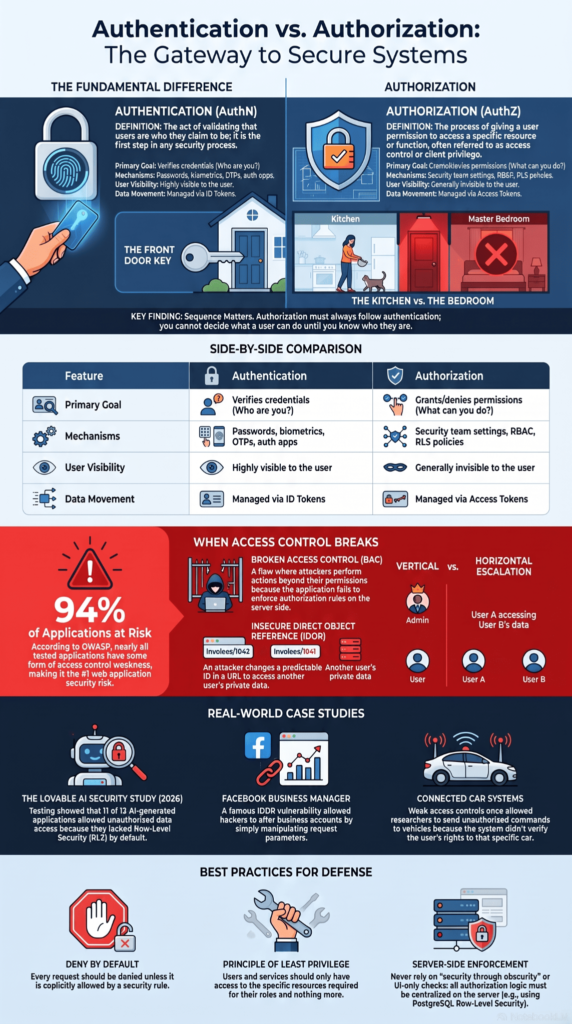
The gap between logging in and accessing data is where security fails. Frameworks handle authentication, but authorization is our job. Our code fetches data; it doesn’t ask who’s calling. We must add that check, every time.
Take GET /api/invoices/5012. The JWT is valid. The user is ‘alice’. The code returns invoice 5012. But if it belongs to ‘bob’, nothing stops it. Authentication passed. Authorization failed. This is Broken Object Level Authorization (BOLA), a common broken access control flaw.
Research from arXiv shows
“When building an API service, a developer can start with the API design (specification) or its code. In both cases, a set of mechanisms are introduced to help developers mitigate and reduce the prevalence of BOLA” – arXiv
Our rule: never trust a client’s ID to prevent IDOR vulnerabilities.
- Validate the user against the resource owner on every request.
- Indirect reference maps help, but you still must validate.
| Layer | Purpose | What It Verifies |
| Authentication | User identity | Who the user is |
| Authorization | Permission rules | What the user can do |
| Resource Ownership Check | Object-level security | Whether the user can access this specific data |
Why Does Your Development Environment Hide This?

You test alone. You’re the only user in the system. You create data, you view it. The user ID in your session and the owner ID on the data always match. It works perfectly.
The bug only appears when a second person exists. Your development environment is a single-tenant world, but you’re building a multi-tenant application.
Our fix starts here. Seed your database with at least two real user accounts from day one: test_user_a and test_user_b. When you build a new endpoint, open two different browsers, or use two different session tokens in your API client. Act as User A and try to access User B’s resource ID.
It sounds simple. It’s embarrassingly effective. We’ve seen this manual, multi-user testing catch more authorization flaws than any initial automated scan. The tools can miss the context, but you won’t. Make it your first gate.
How Can You Move Authorization Closer to the Data?
Authorization checks scattered across controllers will be missed. Everyone misses one. We learned to move the rule to the data itself.
Database-level security is the answer. Let the database handle filtering, not your app code. PostgreSQL’s Row-Level Security (RLS) is a prime example. Enable it on a table with a policy like USING (user_id = current_setting('app.current_user_id')::integer). Your app sets the user context on connection. Now, every SELECT * FROM invoices; only returns rows for that user. A missing WHERE clause in your controller is less likely to expose data, but app-layer authorization is still required.
As highlighted by arXiv
“Defending against BOLA attacks involves isolating the injection point (i.e., the resource ID) within the narrowest permission boundary that aligns with the application’s logic” – arXiv
This concept exists in other systems too. It’s a shift. You stop trying to make every line of code perfect and build a safe foundation where mistakes have less impact. The app layer should still check permissions. But the database is the final guard.
What Is the API Gateway Authorization Trap?
Credits: Radware
Modern setups often use an API Gateway. It handles authentication, validates tokens, and routes requests. It’s tempting to think, “The gateway checked the token, so my service can trust this request.” That’s the trap.
If the gateway only validates the token but doesn’t pass strict ownership context downstream, horizontal escalation is wide open. A user sends a valid token to update /api/service/profile/123. The gateway passes it through. The internal service gets the request. But does profile 123 belong to the user in the token? The service must check that. It can’t rely on the gateway’s yes/no authentication.
Every service must make this contextual authorization decision to stop horizontal privilege escalation. A zero-trust architecture means no request is trusted, even from inside your network.
- Gateways handle authentication and routing.
- Downstream services must perform object-level authorization.
- Pass essential user claims (like sub from a JWT) to services for validation.
Document these responsibilities clearly so every development team understands which authorization checks belong at the gateway and within each individual service.
How Do You Build a Test to Catch It All?
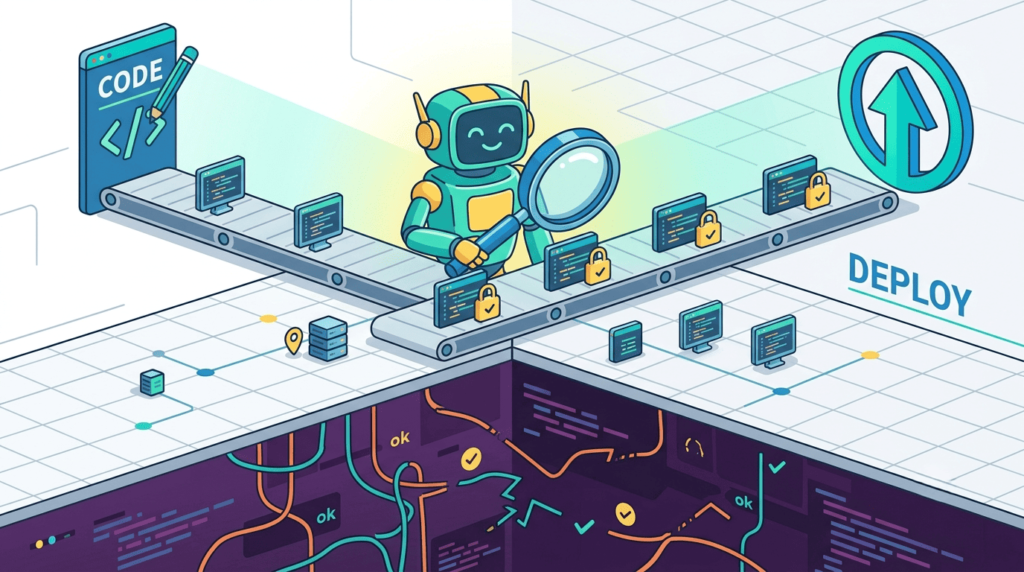
Preventing horizontal privilege escalation also requires automated testing that verifies users cannot access another user’s resources. We added a specific test to our CI/CD pipeline. It mimics an attacker. The test creates two users. It gets a session token for User A. It then uses that token to try accessing a resource owned by User B. The test expects a 403 Forbidden or a 404. If it gets a 200 OK, the pipeline fails. This runs against every endpoint exposing a user-owned resource ID.
Tools help scale this. Burp Suite’s Authorize extension is made for it. You configure it with a low-privilege and a high-privilege user session. It automatically replays requests from the low-privilege session using the high-privilege token, hunting for cases where access is wrongly granted. It’s like having an automated attacker in your staging environment.
You can also use SAST tools to scan for patterns where controller methods fetch data by ID without a clear ownership check. The signals aren’t perfect, but they point to the risky code.
How Do You Make It Part of Your Development Process?
This can’t be a one-time audit. It has to be part of the craft. In our secure coding practices, we made it a standard. Any function that fetches a user-specific resource must accept the current user’s ID as a parameter.
The function’s first operation is to validate that the resource belongs to that user. We built a simple middleware for our API routes that extracts the user ID from the validated token and injects it into the request context. Developers don’t have to remember to fetch it, it’s just there.
The code review checklist has a line item: “Object-level authorization verified?” It’s as routine as checking for null pointers. We also schedule quarterly “lateral movement” tests.
Someone takes two employee test accounts and tries to access each other’s data across the entire application. It’s tedious. It’s also the only way to be sure. The goal is to make the secure path the default, easy path. The insecure code should look and feel wrong, like a missing error handler.
FAQs
How can developers effectively prevent horizontal privilege escalation in application design?
Preventing horizontal privilege escalation requires least privilege enforcement and strict object-level authorization checks. RBAC and ABAC can both support secure defaults, but the key requirement is to validate access to each requested resource at runtime.
What is the role of access control testing in detecting authorization flaws early?
Access control testing helps identify authorization flaws early through cross-user negative tests and secure code review.
Why are object-level authorization checks important for IDOR prevention strategies and secure direct object reference handling?
Object-level authorization checks prevent IDOR by enforcing ownership validation on every request. Secure direct object reference handling and IDOR prevention strategies ensure users cannot access unauthorized resources only at runtime.
How do session isolation techniques, JWT claim validation, and token scope restrictions reduce lateral access risk?
Session isolation techniques separate user contexts, while JWT claim validation and token scope restrictions limit access. These controls reduce lateral access risk during authentication and session handling processes overall protection.
What monitoring and audit logging methods improve anomaly detection and authorization failure tracking?
Monitoring and audit logging track authorization failures, while real-time anomaly detection identifies unusual patterns. Secure logging and tamper-evident audit trails improve authorization failure tracking and system accountability overall security posture.
Build Walls That Enforce User Boundaries
Preventing horizontal privilege escalation is not about trust, it is about checking every request where the data lives. You keep users separated by design, not assumption, and every access decision gets verified at the source.
Getting that separation right “by design” is easier when it’s checked before the first endpoint is coded, tools like Prime Security use AI to review API and service architecture for missing ownership checks between users and resources, catching gaps like BOLA at the design stage rather than through a CI/CD test after the fact.
To make this practical in real systems, the Secure Coding Practices Bootcamp helps you apply OWASP Top 10, authentication patterns, and secure coding habits so gaps get closed before they ever ship.
References
- https://arxiv.org/html/2507.02309v2
- https://ar5iv.labs.arxiv.org/html/2212.06606