
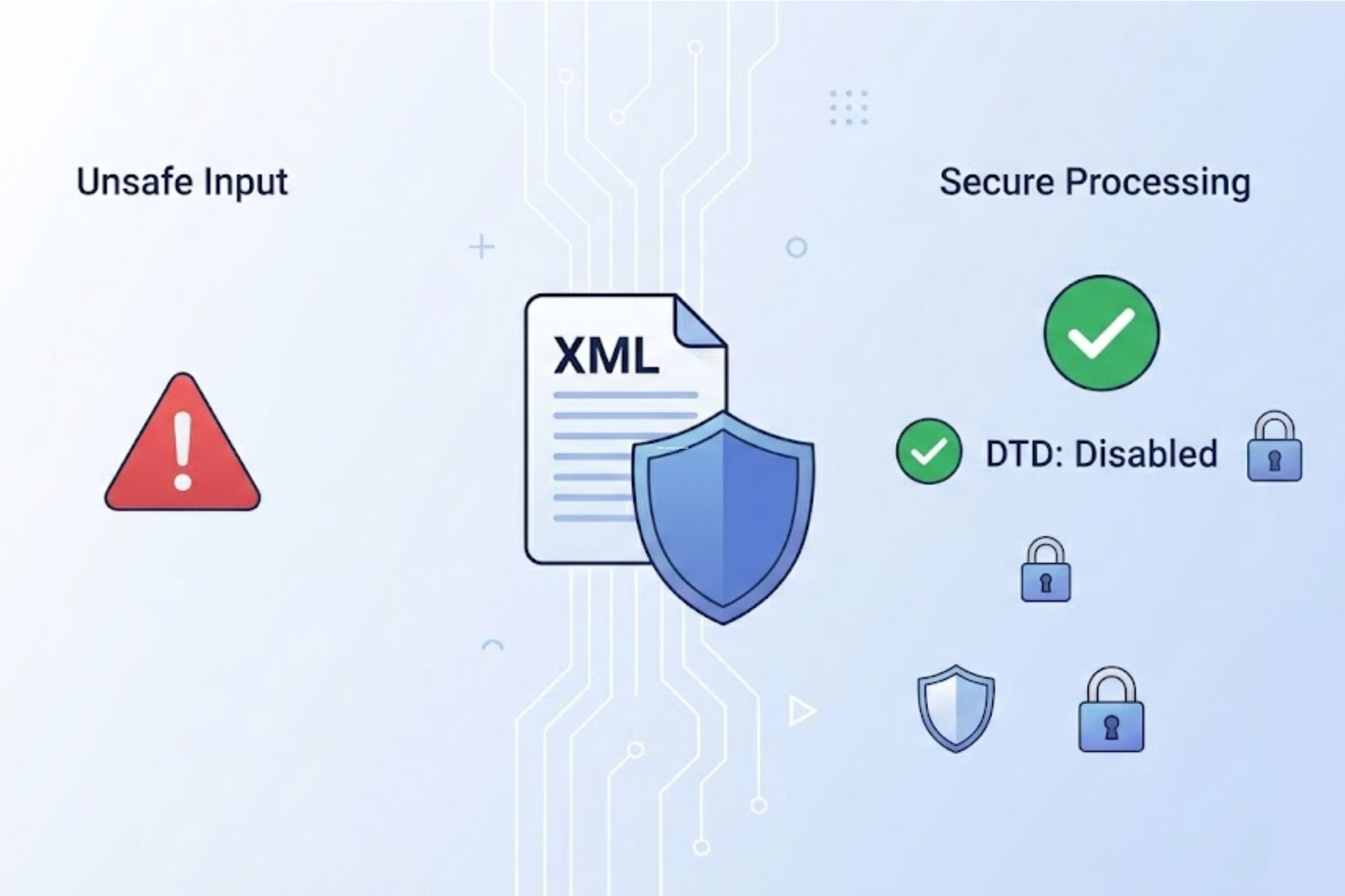

XXE vulnerabilities appear when XML parsers process external entities without strict controls. Parser defaults matter more than many teams expect. In real systems, XXE often slips into routine parsing logic, not obvious insecure paths. That is why checking parser defaults should happen early.
This is where file disclosure, SSRF, and denial of service risks begin to build. Most teams miss the issue during basic reviews, and it often appears after integration work, not from advanced exploits.
For Secure Coding Practices, hardening XML parsing early helps reduce downstream exposure in APIs and backend services. This overview sets the context for deeper prevention steps and safer implementation patterns. Keep reading.
Security Clues Worth Noticing Before XML Becomes a Risk
Most XML security issues come from parser configuration choices, not the XML format itself. Early secure coding practices help reduce exposure before the system even runs.
- XML risks often come from optional features like DTDs and external entities.
- Most attacks exploit unsafe configurations, not XML itself.
- Secure coding practices reduce exposure before parsing begins.
How Does DTD Behavior Become the Root Cause of XXE Attacks?
DTD is where the risk starts. It allows XML to define external references. That feature becomes a problem when attackers control input.
And in practice, we’ve seen this recommendation hold up consistently during training labs.
This is why understanding xxe vulnerability attack is essential before applying mitigation strategies in real systems.
What External Entities Do in Practice?
They change XML from static data into something that can reach outside the system.
This behavior is explicitly defined in the XML specification:
“When an entity reference is recognized, it is replaced by its replacement text and parsing continues as if the replacement text were part of the document.” – W3C XML 1.0
This explains why external entity processing becomes dangerous when applied without restriction in untrusted XML environments.
Why DTD is Still Enabled?
Compatibility. That’s usually the reason.
- Older schemas depend on it
- Legacy systems expect it
- Migration hasn’t finished yet
So teams leave it on. Temporarily. Which often becomes permanent.
Why is Disabling DTDs Considered the Strongest XXE Defense?
Because it removes the entire mechanism XXE depends on.
“Completely disabling external entities within XML parsers is the most effective approach for preventing XXE attacks.” – IEEE Access
No DTD. No entity expansion path. Less room for manipulation.
We teach this early in secure coding workshops because it simplifies everything.
What Actually Changes When DTD is Off?
- External entity parsing stops
- Attack surface shrinks immediately
- Many payload classes fail by default
That’s a strong baseline.
When Teams Can’t Disable It?
Sometimes systems depend on DTD. In those cases:
- Disable external entities explicitly
- Lock parser features tightly
- Add secondary validation layers
But configuration still leads the defense. Always.
How Should Java XML Parsers be Hardened in Real Applications?
Java shows up a lot in enterprise systems we review. And XML handling there is flexible sometimes too flexible.
So we treat parser setup as security code, not configuration noise.
Core Hardening Areas
We focus on three controls:
- DTD processing control
- Entity resolution blocking
- Expansion limits
Miss one, and exposure returns.
In enterprise systems, this approach is often reinforced through preventing XXE in Java environments, where parser-level configuration is treated as part of secure application design rather than optional setup.
Java Hardening Snapshot
| Parser Type | Risk Area | Secure Setting | Effect |
| DocumentBuilderFactory | DOCTYPE handling | disallow-doctype-decl=true | Blocks entry point |
| SAXParserFactory | External entities | external-general-entities=false | Stops injection path |
| XMLInputFactory | DTD parsing | SUPPORT_DTD=false | Removes DTD support |
In training labs, this table becomes a turning point for many learners. It shows how small flags change outcomes.
Where Do .Net XML Parsing Misconfigurations Occur?
.NET is usually safer today, but legacy apps still carry old behavior. That’s where we keep finding issues during secure code reviews.
And the pattern is almost always the same: upgrades happen, but config inheritance doesn’t fully reset.
What Controls DTD Behavior?
DtdProcessing is the key switch.
- Prohibit → blocks DTD completely
- Ignore → skips parts but still risky in legacy flows
We’ve seen systems where “Ignore” was treated as safe. It isn’t.
Why Legacy .NET Systems Stay Exposed?
- Older runtime defaults
- Shared libraries overriding configs
- Partial migration between versions
So exposure doesn’t come from one mistake. It builds up quietly across updates.
How Does PHP XML Processing Become Vulnerable?
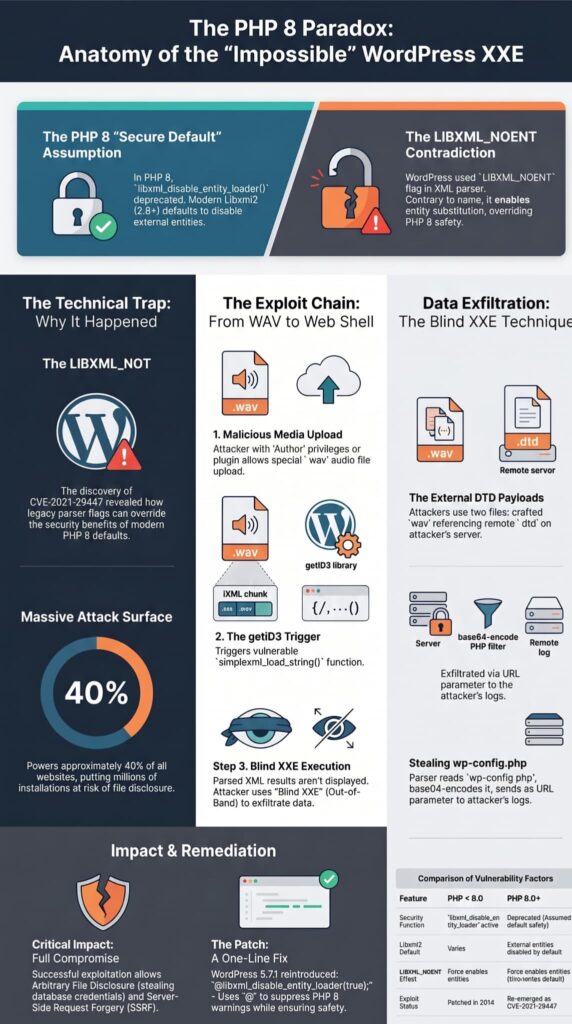
PHP relies on libxml2, and that history matters. Older defaults were more permissive with external entities.
Modern versions improved things, but legacy code still lingers in production systems we audit.
What Changed in Newer PHP?
Newer builds disable external entity loading by default.
That reduced baseline risk. But not all systems updated cleanly.
Where We Still See Issues?
- LIBXML_NOENT used carelessly
- Untrusted API XML inputs
- Old DOMDocument patterns reused
And once that pattern is in place, it tends to get copied forward.
What Makes Python XML Parsing Risky Without Safeguards?
Python is flexible. That flexibility creates uneven security behavior across libraries.
So depending on the library, risk changes a lot.
Why Defusedxml is Recommended?
We use defusedxml in training environments because it blocks unsafe entity expansion by default.
Less guesswork. Fewer footguns.
Library Risk Comparison
| Library | Entity Handling | Risk Level | Recommendation |
| xml.etree | Partial support | Medium | Avoid untrusted input |
| lxml | Full control | High | Manual hardening needed |
| defusedxml | Disabled | Low | Preferred option |
Most beginner mistakes come from picking the wrong library first. That choice sticks.
How Do WAF, SAST, and Schema Validation Help?
Security tools help, but they don’t replace correct configuration.
We repeat this in training often: tools support decisions, they don’t fix bad defaults.
This is why xml external entity prevention is still fundamentally dependent on secure parser configuration rather than detection tools alone.
What WAF Catches?
- Known XXE patterns
- Suspicious XML structures
- Malformed entity strings
Useful, but reactive.
Where SAST Fits?
Static analysis catches unsafe parser configs early in development.
That’s where it’s most effective.
Why Schema Validation is Not Enough?
XSD checks structure. Not behavior.
So it won’t stop:
- Entity expansion
- External file access
- SSRF triggers
That gap is where issues slip through.
Should Modern Systems Remove XML Completely?
Not always possible, but worth reducing.
In real systems, we see a gradual shift rather than full removal.
- JSON replaces most API payloads
- Protobuf reduces parsing complexity
- XML remains for legacy integration
So the goal isn’t elimination everywhere. It’s limiting where it still exists.
Less XML. Less attack surface.
What is the Most Effective Long-Term XXE Prevention Strategy?
Source: Elyes Doudech
This is where engineering discipline matters more than single fixes.
We see the strongest teams treat XML as a controlled boundary, not just input data.
Why Secure Defaults Matter Most?
Misconfiguration returns faster than vulnerabilities get patched.
That’s the uncomfortable part.
How We Approach It in Secure Bootcamps?
- Centralized parser configs
- CI/CD enforcement rules
- Continuous XML handling audits
- Threat modeling for all XML entry points
And one more thing: consistency matters more than complexity.
FAQs
What is the OWASP XXE prevention cheat sheet used for in XML security?
The OWASP XXE prevention cheat sheet is a practical guide that helps developers reduce risks from XML External Entity attacks. It explains how unsafe XML parser configurations can create vulnerabilities when processing untrusted XML input.
It is commonly used to apply XML external entity prevention techniques during development, especially to prevent XML injection in applications that process external data.
How does XML parser security help prevent XXE attack prevention?
XML parser security helps prevent XXE attack prevention by ensuring that XML parsers do not process unsafe external content. When secure XML parsing is configured correctly, external entity resolution and DTD processing are disabled.
This prevents attackers from accessing local files or internal services through XML input and reduces the risk of file disclosure and SSRF via XML.
What are key XXE mitigation techniques in secure XML parsing?
XXE mitigation requires disabling external entities and parameter entities in XML parsers. Developers must also enforce secure configuration and apply parser hardening to reduce exposure.
These measures help prevent directory traversal via XML, local file inclusion, and other attacks that exploit unsafe entity processing. Proper entity resolution control is essential when handling untrusted XML input.
How can XML security best practices reduce parser vulnerabilities?
XML security best practices reduce parser vulnerabilities by enforcing strict input validation before XML processing begins. Developers should use XML schema validation and whitelist validation to ensure only expected data structures are accepted.
Server-side input validation and secure coding practices also help prevent security misconfiguration and improve overall XML processor security in applications that rely on XML data.
What methods are used to detect XXE vulnerabilities early?
XXE vulnerabilities are detected using security testing techniques such as penetration testing, static code analysis, and manual code review. Security testing tools can also simulate malicious XML payloads to identify weaknesses in parser configurations.
These methods help detect XML denial of service risks, out-of-band XXE behavior, and unsafe parser settings before applications are deployed to production.
Final Take on OWASP XXE Prevention
XXE prevention comes down to controlling how XML parsers handle untrusted input before anything is processed. When unsafe defaults stay enabled, small gaps can lead to data exposure or SSRF issues. The real risk is not complexity but misconfiguration.
A secure baseline guided by OWASP helps teams lock down XML processing early and keep it consistent across services. For teams that want hands on support and structured guidance, Jetdigitalpro can help reinforce Secure Coding Practices and reduce configuration mistakes before deployment.
References
- https://ieeexplore.ieee.org/document/10779957
- https://www.w3.org/TR/xml/