


TLS configuration mistakes data exposure remains a serious problem because encryption alone does not guarantee security. Many organizations still experience data leaks caused by weak settings, failed certificate checks, outdated protocols, and unnoticed downgrade paths. The issue is often not the absence of encryption but gaps in configuration and validation.
At Secure Coding Practices, we regularly see systems with TLS enabled but not properly enforced. Even modern environments can expose sensitive data when these problems go unnoticed. Keep reading to see which misconfigurations still matter and how to address them before they become security incidents.
TLS Exposure Quick Scan
These are the main TLS mistakes that continue to expose sensitive data in 2026 and the security controls that help prevent them.
- TLS enabled does not guarantee security. Many systems still allow plaintext fallback connections, creating hidden paths for sensitive data exposure.
- Legacy protocols and weak ciphers remain major risks. TLS 1.0, TLS 1.1, RC4, 3DES, and other deprecated configurations increase the likelihood of downgrade attacks and data breaches.
- Continuous validation matters as much as encryption. Certificate management, HSTS enforcement, forward secrecy, and secure coding practices help prevent configuration drift from exposing sensitive information.
Why Does “TLS Enabled” Not Always Mean Data Is Protected?

Because many systems allow unencrypted fallback traffic, even after TLS is turned on.
During security reviews, we often find environments where admins enabled TLS on servers but never forced its use. A service might advertise encryption but still accept plaintext connections.
Managed SQL services, internal APIs, and old application servers often support TLS while still allowing unencrypted sessions. If a client hits a TLS handshake error or a certificate validation fails, traffic can silently revert to plaintext. We’ve seen it happen.
Common examples include database connections, internal APIs, and microservices. The exposed data can be login credentials, customer records, or financial information. The IETF made it clear that older protocols like TLS 1.0 and 1.1 are historic now, partly because they create these exposure risks.
Insights from eMudhra indicate
“Incorrect installation results in incomplete trust chains and browser security warnings… Organizations that lack centralised monitoring typically discover issues only after customer impact has already occurred. A single expired certificate on a payment gateway or authentication endpoint can trigger immediate revenue and reputational consequences.” – eMudhra
Enforcing TLS-only communication through secure coding practices can eliminate whole categories of these silent fallback vulnerabilities before code even hits production.
Why Are TLS 1.0 and TLS 1.1 Still Dangerous?
Older TLS versions still create risk because they rely on weak encryption and make downgrade attacks easier. While many organizations have upgraded, we continue to find TLS 1.0 and TLS 1.1 during infrastructure reviews and training sessions.
In our experience, these outdated settings usually appear in places that teams no longer watch closely. An old application, a forgotten API, or a legacy device often keeps these protocols enabled long after support should have ended.
Some older implementations are linked to attacks such as BEAST and POODLE. During a man-in-the-middle attack, an attacker may force a connection to use an older protocol.
| Legacy Setting | Modern Replacement |
| TLS 1.0 | TLS 1.2 or higher |
| TLS 1.1 | TLS 1.2 or higher |
| Mixed support | TLS 1.3 preferred |
Our recommendation is straightforward:
- Disable TLS 1.0 and TLS 1.1 completely.
- Use TLS 1.2 as the minimum version.
- Prefer TLS 1.3 whenever possible.
- Review older systems during regular security assessments.
RFC 8996 moved these protocols to Historic status for a reason. We encourage teams to remove them entirely rather than depend on negotiation settings that can fail.
Are Weak Cipher Suites Still a Real Threat?
Yes. Weak cipher suites still create serious security problems. In many cases, they become one of the fastest ways to weaken encryption and expose sensitive data.
Many teams spend time upgrading TLS versions but pay less attention to cipher selection. We often see systems running modern TLS versions while older ciphers remain enabled. Those settings can create an insecure TLS cipher data breach even when the protocol itself is current.
Older algorithms such as RC4, 3DES, null ciphers, export-grade suites, and MD5 should no longer be used. These options have been abused in real attacks and show how weak TLS encryption can expose data after a connection is established.
We usually recommend these stronger choices:
- AES-GCM for modern environments.
- CHACHA20-POLY1305 for strong performance and security.
- Regular cipher reviews during security assessments.
Another issue appears outside the web server itself. A company may secure its main application while older load balancers or reverse proxies still use weak settings. We have found this problem during assessments, and it often creates a weak TLS encryption data exposure path that nobody notices until much later.
How Does Missing Forward Secrecy Create “Harvest Now, Decrypt Later” Risk?
Because encrypted traffic captured today may be readable years later if a long-term private key is stolen.
This issue worries many security teams, and we regularly discuss it during our training sessions. An attacker can collect encrypted traffic now, save it, and wait for an opportunity to obtain the private key. If that happens, old communications may suddenly become readable.
Traditional RSA key exchanges create this problem because one private key protects many sessions. When that key is compromised, years of historical traffic can be exposed, creating many of the long-term consequences of data exposure breaches that organizations often overlook. That is a classic TLS forward secrecy failure.
Modern environments should instead use Ephemeral Diffie-Hellman, such as ECDHE. It creates a new session key for every connection, which means a future key compromise does not expose past data.
We usually recommend a few simple checks:
- Enable ECDHE or another forward secrecy option.
- Review older TLS configurations regularly.
- Move to TLS 1.3 whenever possible.
During assessments, we treat missing forward secrecy as a high-priority issue because it affects both current and future confidentiality.
Why Does Certificate Validation Failure Break TLS Security?
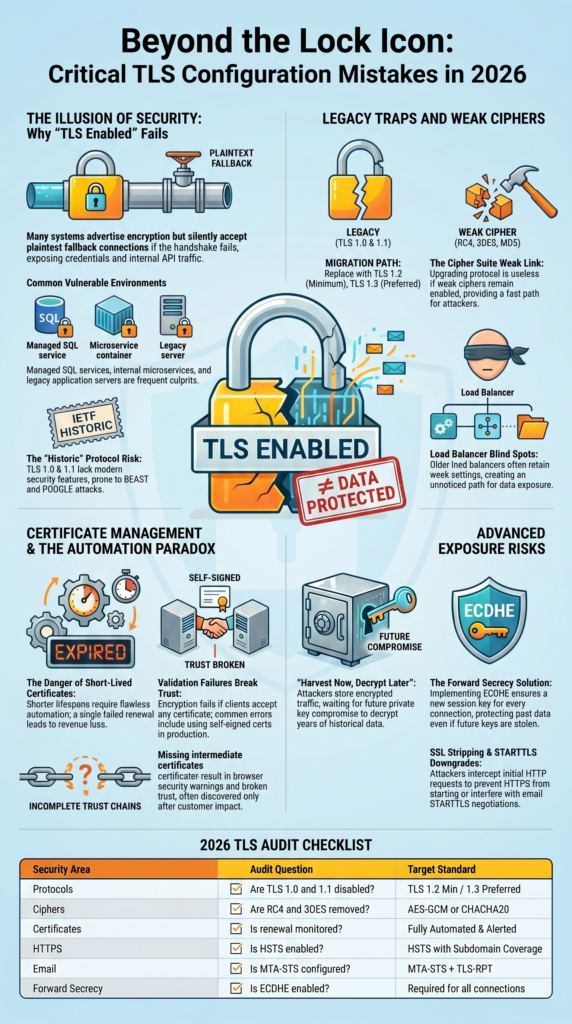
Because encryption only works when the connection can be trusted. If a client accepts any certificate, an attacker can present a fake one and intercept the traffic.
We regularly see validation mistakes that weaken otherwise secure systems. Teams may enable TLS correctly, yet certificate checks are incomplete or disabled.
Some of the most common issues include:
- Self-signed certificates left in production.
- Expired certificates that are never replaced.
- Missing intermediate certificates.
- Invalid certificate chains.
- Verification disabled during testing and never restored.
We have seen developers turn off certificate checks to solve temporary problems. Months later, those settings remain in production and create serious security gaps.
Applications should enforce strict hostname verification and validate the entire certificate chain. Automated renewal has reduced many manual errors, but shorter certificate lifetimes mean teams must monitor certificates more closely than before.
As certificate validity periods continue to shrink, automation becomes even more important. Our experience shows that strong validation, regular monitoring, and secure coding practices help prevent certificate mistakes from becoming data exposure incidents.
What Is the Automation Paradox Behind Short-Lived Certificates?
Short-lived certificates improve security, but they can also create new operational problems when automation stops working.
Shorter certificate lifetimes reduce the amount of time a stolen certificate can be abused. That is a clear security benefit. At the same time, organizations must renew certificates much more often. If an automated renewal process fails, outages can happen very quickly.
During our training sessions and security reviews, we have seen environments where certificate renewals stopped weeks earlier without anyone noticing. Teams often discover the problem only after a service goes offline or users begin reporting errors. Which highlights several overlooked risks of sensitive data exposure when certificate management fails.
Several issues appear repeatedly:
- Failed automated renewal jobs.
- Older appliances that cannot handle frequent renewals.
- Missing expiration alerts.
- Incomplete certificate inventories.
- Gaps in monitoring and reporting.
Our experience shows that automation needs regular attention. A renewal system that worked six months ago may no longer function after infrastructure changes.
As certificate lifetimes continue to shrink, organizations need stronger monitoring and backup plans. We encourage teams to combine automation with secure coding practices, renewal alerts, and regular reviews so certificate problems do not become unexpected outages.
How Does SSL Stripping Still Work Against Modern Websites?
Credits: Darien’s Tips
SSL stripping remains a problem because many users still begin their visit with an HTTP request. If that first connection is not protected, an attacker may intercept it before HTTPS takes over.
We often explain that a website can have valid certificates and strong encryption yet still expose users during the first request. A visitor types a web address, the attacker removes the redirect, and the connection stays in plain text.
This type of attack can lead to stolen session tokens, login credentials, and other sensitive information. We have seen organizations focus heavily on TLS settings while overlooking how users reach the website in the first place.
Several mistakes appear often:
- Missing HSTS headers.
- HSTS applied only to the main domain.
- Subdomains left unprotected.
- Short HSTS expiration periods.
HTTP Strict Transport Security helps solve this problem by telling browsers to use HTTPS automatically. Our experience shows that reviewing HSTS settings across all public domains is an important step. Combined with secure coding practices, it helps block downgrade attacks before they can expose sensitive data.
Why Is STARTTLS a Hidden Downgrade Risk for Email?
Email systems often prioritize message delivery, which can create security risks when encryption fails. If a mail server falls back to plain text, sensitive messages may travel without protection.
We often find that email security receives less attention than web applications or APIs. Many organizations assume that STARTTLS always protects email traffic, but that is not always the case.
An attacker can interfere with the STARTTLS negotiation and remove the request to use encryption. The mail servers may continue sending the message because delivery is considered more important than security. As a result, emails can travel across the network without encryption.
As noted by APNIC Blog
“STARTTLS for opportunistic encryption – meaning: Use it when it’s there, otherwise connect without it – is now considered insecure and dangerous, because it gives a false sense of security.” – APNIC Blog
We frequently recommend several protective measures:
- Enable MTA-STS policies.
- Configure TLS-RPT reporting.
- Monitor mail server encryption settings.
- Review email security during regular assessments.
Our experience shows that mail server settings are often overlooked during security reviews. When organizations apply the same attention to email security that they give to web traffic, they reduce the risk of hidden downgrade attacks and unprotected messages.
Does TLS 1.3 Hide Everything From Attackers?
No. TLS 1.3 protects the contents of a connection, but it does not hide every detail. Some information about the connection can still be seen by observers.
Many developers assume that upgrading to TLS 1.3 solves every privacy problem. The protocol provides strong encryption, but it is not a complete shield against traffic analysis.
Several pieces of information may still remain visible:
- Server Name Indication (SNI).
- Destination IP addresses.
- Traffic timing and connection patterns.
- Client fingerprints such as JA3 and JA4.
We often demonstrate this during training sessions. Even when the data itself is encrypted, network tools can still reveal how systems communicate. An attacker may learn which services are being accessed or identify devices based on their connection patterns.
The industry continues to improve privacy protections through technologies such as Encrypted Client Hello (ECH). However, these protections are still being adopted.
Our experience shows that organizations should include metadata exposure in their threat models. Especially when applying modern data minimization principles in software to reduce unnecessary information leakage. TLS 1.3 is an important step forward, but privacy requires more than encryption alone.
How Can Middleboxes Accidentally Cause TLS Misconfigurations?

Middleboxes such as firewalls, proxies, and inspection devices can sometimes create security problems while trying to improve compatibility. These systems often sit between users and applications, which means they can affect how TLS traffic is handled.
During our training, we often discuss a confusing behavior in TLS 1.3. For compatibility reasons, some parts of the protocol appear similar to TLS 1.2. An administrator reviewing packet captures may believe that a downgrade attack has occurred even when the connection is working correctly.
We have seen teams react to this misunderstanding by changing settings that did not need to be changed. In some cases, these changes introduced new security issues.
Common problems include:
- Blocking valid TLS 1.3 traffic.
- Creating unnecessary firewall rules.
- Breaking application upgrades.
- Generating false security alerts.
Technical discussions frequently show this type of confusion, especially when teams rely only on packet captures. Our experience shows that understanding how TLS 1.3 behaves helps prevent unnecessary changes. Proper training, secure coding practices, and careful testing reduce the risk of weakening security.
What Should a Modern TLS Exposure Audit Include?
A modern TLS audit should look beyond encryption alone. It needs to examine configuration, validation, monitoring, and the ability to respond when problems appear.
We often remind teams that TLS is not a one-time project. Systems change, certificates expire, and new services appear. Without regular reviews, small issues can become serious risks.
These areas deserve immediate attention:
| Area | Audit Question |
| Protocols | Are TLS 1.0 and TLS 1.1 disabled? |
| Ciphers | Are RC4 and 3DES removed? |
| Certificates | Is renewal automated and monitored? |
| Validation | Is certificate verification enforced? |
| Is MTA-STS configured? | |
| HTTPS | Is HSTS enabled? |
| Forward Secrecy | Is ECDHE enabled? |
| Cloud Services | Are plaintext fallbacks blocked? |
We regularly see organizations focus on only one or two of these areas while missing the rest. A strong TLS program requires continuous attention.
Teams often use packet captures, TLS scanners, and internal testing tools to verify their security posture. Our experience shows that regular reviews, monitoring, and secure coding practices help prevent configuration drift before it exposes sensitive data.
FAQ
How can I detect a TLS misconfiguration sensitive data leak early?
A TLS misconfiguration sensitive data leak often begins with warning signs such as failed connections, certificate errors, or unusual network traffic. Security teams should review system logs, monitor encryption settings, and perform regular TLS scans. These checks help identify problems before sensitive information is exposed. Early detection also reduces the risk of insecure TLS settings data breach incidents.
Why does missing HTTPS enforcement increase data exposure risks?
Missing HTTPS enforcement data exposure occurs when users access a website through HTTP before encryption starts. This situation can create an HTTP to HTTPS downgrade data leak if attackers intercept the connection. A no HSTS header data exposure issue can make the problem worse. Enforcing HTTPS and HSTS helps protect login sessions, personal data, and other sensitive information.
What happens when TLS certificates are expired or invalid?
Expired TLS certificate data exposure can occur when applications continue using certificates that are no longer trusted. An invalid TLS certificate data breach may also result from a missing intermediate certificate data leak or incomplete certificate chain data exposure. Regular certificate monitoring and timely renewals help prevent connection failures, browser warnings, and security issues.
Why are weak cipher suites still considered dangerous?
Weak cipher suite data exposure remains a serious concern because older encryption methods provide weaker protection. RC4 cipher vulnerability data leak and 3DES cipher weakness data exposure issues can make encrypted traffic easier to attack.
A deprecated cipher TLS data leak may also occur when outdated settings remain enabled. Strong cipher settings reduce the risk of insecure TLS cipher data breach incidents.
Which systems are most affected by TLS configuration mistakes?
Cloud and application environments often experience TLS configuration problems. Cloud TLS configuration data exposure can affect virtual machines, storage services, and hosted applications.
API TLS configuration data exposure and microservice TLS misconfiguration data breach issues may occur when systems use inconsistent settings. Database TLS connection data leak problems can also happen when encrypted connections are optional instead of required.
Make TLS Security Part of Everyday Development
TLS problems often appear long after deployment, when weak settings or missed validation create risks that are hard to detect. Small configuration mistakes can expose sensitive data and leave teams reacting to avoidable issues.
Building secure coding habits helps developers catch encryption problems earlier and maintain stronger security as systems grow. Practical training gives teams the skills to validate TLS settings, improve encryption practices, and reduce mistakes before they reach production. Strengthen your team’s security skills with Secure Coding Practices.
References
- https://emudhra.com/en/blog/ssl-certificate-misconfiguration-risks-to-website-security
- https://blog.apnic.net/2024/10/04/smtp-downgrade-attacks-and-mta-sts/